
Consumables Stock for the Shop Floor: The Minimum Without Cutting Tools
A consumables stock for the shop floor helps keep machines running. Here we break down the minimum for filters, belts, sensors, lubrication, and small components.
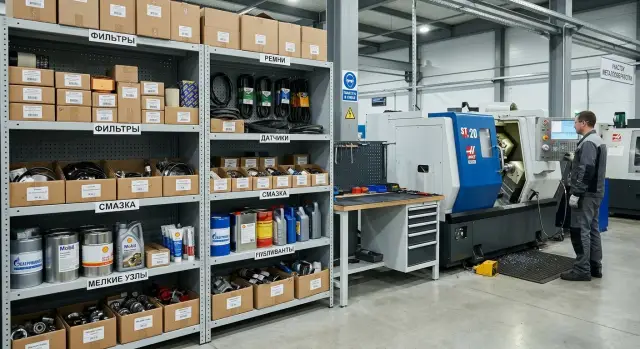
Why small parts stop the shop floor
A shop floor usually stops not because of a major breakdown, but because of a small part that is not at hand. A filter gets clogged, lubrication starts to fail, a sensor stops seeing the position of a unit, and the machine can no longer keep working. One hour of downtime in this situation almost always costs more than the part itself.
Tooling is usually handled better. It is counted, planned, and reordered in advance. But secondary consumables live by the leftover principle. As long as the filter, belt, or limit switch is in place, nobody thinks about it. People only remember it when the machine has stopped, the technician is looking for a replacement, and purchasing is rushed.
This problem is especially noticeable in small production shops. One machine stops, the next operation shifts, control is delayed later on, and shipment is held up after that. The chain is simple, but the losses are very real.
A minimum consumables stock does not solve every problem, but it removes the most frustrating part of downtime. It helps you work without panic, avoid paying extra for urgent delivery, and keep from using temporary fixes that later cause another failure.
A good запас does not have to be large. It has to be clear. If the team already knows which items are replaced most often and what cannot wait even one day, downtime drops noticeably.
What the minimum should include
If you build stock “by eye,” the simplest part is almost always missing when you need it most. That is why it is better to organize the warehouse by groups and immediately tie items to specific machine models.
Usually five groups are enough:
- filters: air, oil, hydraulic, and coolant filters
- belts: drive belts, timing belts, belts for feed systems and auxiliary units
- sensors: limit switches, inductive sensors, temperature sensors, pressure and level sensors
- lubricants: way oil, grease, hydraulic oil, coolant, and concentrates
- small components: nozzles, unions, fittings, seals, rollers, couplings, valves
This set covers not the tool itself, but the things that often make the machine stop unexpectedly. On a small shop floor, one clogged filter or a level sensor can stop a shift just as easily as a serious breakdown.
Items with a long delivery time should be marked separately. These may include sensors from rare series, non-standard belts, centralized lubrication components, and units made for a specific model. It is better to keep at least one replacement on hand.
Do not store consumables under the principle of “something here will probably fit.” It is much more convenient to keep stock by machine model. That means less confusion, fewer issuing mistakes, and a lower risk of installing the wrong part.
A short card is enough for each item: part number, size or type, where it is used, and how many pieces are in stock. That is already enough to keep purchasing calm, without duplicates or emergencies.
Filters that run out without warning
A shop floor often stops because of a clogged filter. It is inexpensive, but without it the machine cannot keep running: pressure drops, oil overheats, dust gets pulled into the cabinet, and coolant circulates worse.
For CNC machines, four filter groups are usually needed: coolant, hydraulics, pneumatics, and cabinet ventilation. Each group has its own replacement interval, and it rarely matches the purchasing schedule. Stock disappears especially quickly where there is a lot of abrasive dust, oil mist, or dirty emulsion.
If the shop works in harsh conditions, the “one extra just in case” approach does not help. For several identical machines, it makes sense to keep one to two sets of each type. If a filter is replaced often, it is better to increase stock now than to wait a couple of days for delivery later.
A common mistake is simple: someone orders a “nearly identical” filter. For this kind of part, it is not enough to know the machine model. You need to check the housing size or mounting seat, the thread if the filter screws in, and the filtration rating. Even a small mismatch creates problems: the filter does not fit, does not hold the required flow, or lets dirt pass deeper into the system.
It is better to store these items with clear labeling. On the box or bag, note the machine model, the unit, and the date of the last replacement. That removes guesswork and quickly shows what is being used up faster than usual.
Belts and sensors: fewer similar parts, more exact matches
A belt or a sensor often costs little, but it is exactly these parts that make the shop floor lose a shift. This is especially familiar where CNC lathes and chip conveyors are running: the part is small, but the downtime is big.
Belts should be kept not only for the main drive, if the specific model has one. Check belts for pumps, fans, and chip conveyors as well. They wear out differently, so a general “by eye” reserve almost always gives you the wrong result.
Sensors are similar. A minimum stock usually includes limit switches, inductive sensors, and pressure sensors. If there are several similar machines on the shop floor, do not assume the sensors are identical. The same housing may hide different power supply, connector, or cable length.
For each item, it helps to record the exact marking from the housing, cable length, connector type, power supply, output signal, and the unit where the part is installed. That kind of card saves time better than a photo on a phone. When a technician or warehouse keeper sees the full record, the chance of a mistake drops sharply.
Buying a similar part without checking is risky. A belt may differ by a few millimeters in length, and a sensor may differ in signal type. From the outside everything looks almost the same, but then the machine either does not start or works with false triggers.
After replacement, do not throw away the removed sample right away. Label it, put it in a bag, and keep it as a reference until the next purchase. For a small shop floor, this is a simple way to avoid mixing up belts and sensors and ordering unnecessary items.
Lubrication and the parts that supply it
Mistakes with lubrication are expensive. The material itself may cost a moderate amount, but dry operation quickly turns a small issue into a repair of the guides, pump, or metering units.
Right away, separate stock by area of use. Way oil, hydraulic oil, and grease are best stored separately and labeled clearly and in large print. If they are kept together without labels, confusion is almost inevitable, especially in a hurry.
Do not mix different types in the same container, even if “there is only a little left.” A mixture changes viscosity, worsens flow, and then causes strange failures. The operator only sees the symptom: the guide jerks, the pump is noisy, or the dispenser feeds unevenly.
Next to the lubricants, keep small parts for delivering them as well. In practice, the first things to run out are not the oils themselves, but the items needed to feed them properly into the unit:
- filters for lubrication units
- seals and gaskets
- hoses of the required diameter
- fittings and unions
- metering units and check valves
It is better to build this reserve for specific machines, not “roughly for everyone.” One machine has its own fitting threads, another has a different type of dispenser. If there are several CNC models on the shop floor, it is easier to label boxes for each one.
Another thing people often forget is cleanliness. A dirty funnel, an open canister, or dust on the filler neck quickly ruins the entire feed system. Then you end up replacing not only the oil, but also hoses, filters, and sometimes the lubrication pump.
Small units people often forget
The most frustrating downtime often starts not with an expensive module, but with a part worth only a few thousand tenge. A machine may wait for a coolant pump, a small check valve, or a burned-out panel lamp longer than for a major repair.
People usually forget the units that do not stand out in day-to-day work. The warehouse should keep at least one or two sets of what actually fails on your machine park. For lathes, this often includes coolant pumps and centralized lubrication pumps, nozzles, valves, seals, couplings, rollers, tensioners, fuses, relays, start buttons, and indicator lamps.
A good example: the lubrication pump is working, but oil is not reaching the guides because of a sticking valve or a clogged nozzle. The failure is small, but the risk for the machine is already serious. The same goes for a coolant pump: the machine itself is fine, but without fluid delivery the work stops.
With these units, you do not need to buy everything. Look at failure history. If one type of machine had a coupling replaced three times in a year, that is exactly the part worth keeping in stock. If relays and buttons almost never fail, there is no need to overstock them.
A simple rule works best here: keep in reserve what breaks often, takes a long time to arrive, and is quick to install. Everything else can be ordered as needed.
How to build stock step by step
It is better to start not with purchasing, but with records. Put together a simple table: machine model, serial number, and all consumable units installed on it. Include not only the obvious items, but also the small things that stop the equipment: filters, belts, sensors, lubrication delivery parts, seals, fuses, and limit switches.
Then review replacement history for at least the last six months. If you do not have exact records, gather data from repair requests, service reports, and maintenance notes. That is usually enough to see the real picture: what runs out regularly, what is changed after a breakdown, and what just sits on the shelf.
Then follow this order:
- gather a list of all machines and their consumable units
- mark the items without which the machine cannot operate
- count replacement frequency for at least six months
- set the minimum stock and reorder point for each item
- assign one responsible person to record keeping and replenishment
The minimum should not be the same for every part. If a belt or sensor takes two weeks to deliver, one piece is not enough. If one item fits several machines, the stock can be shared and you do not need to hold extra leftovers.
On a small shop floor, one coolant level sensor or a clogged filter often stops a shift faster than an expensive unit that is replaced only once every few years. That is why stock should be built around downtime risk, not part price.
Mistakes that make the warehouse useless
The most common mistake is buying consumables by the general name, not by part number and exact parameters. “Sensor,” “belt,” or “filter” on their own mean nothing. Without size, connector type, length, fit, and compatibility with a specific machine, those names are useless.
The second problem is simpler, but hits just as hard: oil, grease, sensors, and filters sit on the shelf without proper labels. A couple of months later, nobody remembers what fits one machine and what was bought for another unit. In a rush, the wrong item gets installed or time is wasted checking again.
Keeping only one piece for the whole shop is also a bad practice. If the only sensor or belt is already installed, you have no reserve. That is not a warehouse; that is hope.
Another typical mistake is calculating stock without considering delivery time. Then holidays, vacation season, or transport delays come along, and a normal purchase takes much longer. For companies in Kazakhstan and across the CIS, this is especially important if the item is not in stock and must be ordered.
And one more common failure: the part was installed, but it was never written off from stock. On paper the balance exists; in reality it does not. The next request looks fine right up until the day the machine stops.
To make the warehouse work, simple discipline is enough: record the part number and installation point, label the package right after receipt, keep reserves for fast-wearing items, watch delivery time, and write the part off on the day it is installed.
Example for a small shop floor
Imagine a shop floor with three CNC lathes and one chip conveyor. What is needed here is not a large stock, but an accurate one. A coolant filter can be changed in 15 minutes, while finding one from suppliers can take half a day. The same is true for a pump belt and a door limit switch.
If you look at actual replacements over the last few months, the picture is usually simple: coolant filters go first, then the pump belt, then the door limit switch. In that situation, there is no point filling the warehouse with dozens of items that just sit there.
It is enough to keep two pieces for the most common replacements and one reserve for a rare but unpleasant failure. That means two filters of each used type, two belts of the needed size, two limit switches if the machines use one model, and one rare sensor without which the machine will definitely stop.
This stock covers normal disruptions without extra spending. If one filter is used up in the morning, the second one lasts until purchasing. If a belt breaks on the night shift, it can be replaced immediately instead of waiting several days.
The most useful habit here is not even the number of boxes on the shelf. Once a month, the technician compares stock with the replacement log. It takes little time, but it quickly shows what is being used often and what is just dead weight.
Check before purchasing
Ten minutes of checking is enough before placing an order. Those ten minutes often save you from extra items, duplicate requests, and confusion in the warehouse.
For each part, keep two things nearby: the part number and a photo. Names like “small sensor” or “belt for the main drive” break the records, because a month later nobody remembers what exactly was meant. A photo helps you quickly check the design, connector, length, and housing shape.
Then check the machine assignment. For every item, it should be clear where it is installed: model, unit, and, if needed, the exact installation point. On a small shop floor, this may first seem unnecessary, but this is exactly how the warehouse stops living in the technician’s memory.
Before a new purchase, it is useful to quickly go through five points:
- each item has a part number, photo, and clear name
- it is clear which machine and unit the part belongs to
- the records show the minimum and the actual balance separately
- lubricants are stored cleanly, in sealed containers, and not mixed by type
- long-lead items are kept with a reserve, not right at the limit
Lubricants are best checked separately. If way oil, hydraulic oil, and grease are mixed together, a mistake is almost unavoidable. One wrong container sometimes creates more problems than the absence of a belt or filter.
What to do next
Do not try to cover the entire list with one large purchase. First review the causes of downtime over the last few months and mark what repeated most often: filter, belt, sensor, lubricant, or a small unit that kept the machine down for half a day.
Then compare the machine manual with what you actually replaced in practice. The manual gives you a starting point, but real workload often changes the picture. If the shop runs two shifts, filters and belts wear out noticeably faster than the standard schedule.
The easiest way is to put the minimum into one simple table: machine model and unit, exact part number, average replacement interval, minimum stock level, and the person responsible for replenishment. That is already enough to stop buying by guesswork. After a month, such a table usually shows both extra items and empty spots that nobody noticed before.
If you are updating your machine park, do not carry over the old stock automatically. A new model may use different filters, belts, sensors, fittings, and lubrication requirements. It is better to agree on the list in advance with the machine supplier and service team than to search for the needed small part on the day of startup.
If your park is built on Taizhou Eastern CNC machines, it is convenient to clarify such a list with EAST CNC, the official representative in Kazakhstan. The company handles selection, supply, commissioning, and service, so the minimum stock can be assembled right away for specific models and operating conditions.
If you start with the most common causes of downtime and keep replacement records for at least three months, the warehouse quickly stops being a collection of random boxes. It becomes a working tool that really reduces downtime.
FAQ
Where should I start when building a minimum consumables stock?
Start with a simple table for each machine: model, serial number, unit, and the exact consumable part number. Then review replacements for at least the last six months and note what most often stops the work. After that, set the minimum stock level instead of buying by guesswork.
What should be kept in stock besides tools?
Usually five groups are enough: filters, belts, sensors, lubricants, and small components for lubrication or coolant delivery. The point is not to keep a huge number of items, but to cover the small failures that bring the machine to a stop right away.
How many filters should be kept in reserve?
For several identical machines, it is common to keep one to two sets of each filter type. If the shop is dirty, there is a lot of abrasive dust, or the emulsion gets contaminated quickly, it is better to increase the запас. One filter “just in case” often runs out at the worst possible time.
Can I buy a nearly identical belt or sensor?
Because a visual match does not guarantee anything. A belt may differ in length, and a sensor may differ in power supply, connector, cable, or signal type. In the end, the machine either will not start or will begin to work with false triggers.
How do I keep records if I don’t have a separate warehouse system?
Yes, if you keep short cards for each item. It is enough to write down the part number, size or type, where the part is used, and how many pieces are left. This kind of record already helps you avoid losing items, buying duplicates, and ordering the wrong thing too late.
Which small parts are most often overlooked?
People often forget nozzles, fittings, unions, seals, check valves, dispensers, coolant pumps, fuses, relays, start buttons, and indicator lamps. These parts are inexpensive, but they are often the reason a shop loses a shift. Look not at the price, but at what has actually failed in your shop.
How should lubricants and lubrication-supply consumables be stored?
Store way oil, hydraulic oil, and grease separately, and label the containers clearly right away. Do not mix leftover materials, and do not keep open cans near dust. Dirt and confusion quickly lead to lubrication supply problems.
How do I decide the minimum for each item?
Look at two things: how often the part is replaced and how long delivery takes. If delivery takes two weeks, one piece is not enough. If one item fits several machines, you can treat it as a shared reserve and avoid excess stock.
What should I do with rare parts that take a long time to deliver?
Such items are best kept at least for one replacement, even if they fail rarely. This is especially important for rare sensors, non-standard belts, and parts made for a specific machine model. Otherwise, a small failure turns into several days of downtime.
What should I check before placing a new consumables order?
Before ordering, check the part number, photo, machine assignment, and the actual stock on the shelf. Recheck the connector type, dimensions, thread, and installation point. These few minutes usually save you from extra purchases and from the situation where the needed part does not fit.