
Machine servicing before purchase: what to check with the supplier
Check machine service before signing: confirm response times, spare parts availability, remote diagnostics, maintenance schedule and training.
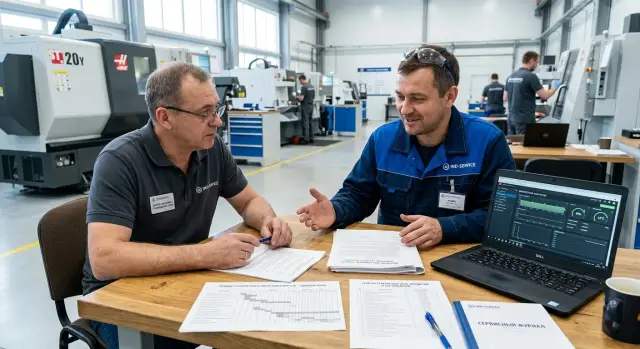
Why service is discussed before the contract
You don’t buy a machine for a neat spec sheet or for just one season. After startup, the important question is who will help if the line stops, a program fails, or a unit needs urgent replacement. At that moment a discount on the invoice doesn’t solve much.
Downtime after launch often costs more than the discount you got at purchase. The shop loses production, shipment dates shift and jobs become rushed. That’s why service terms are better discussed before payment, while they can still be changed.
After an advance payment, the supplier and buyer often end up with different expectations. The buyer expects an engineer right away, while the supplier considers a one- or two-day response normal. In negotiations such differences are easy to hide behind calm phrases like “we’ll respond promptly” or “we’ll provide support.” When the machine is down you need clear rules: who accepts requests, what the first-response time is, when an engineer is assigned, whether common spare parts are kept on hand and who trains staff.
A good contract reduces disputes by being specific. Usually it fixes the first-response time, conditions for remote diagnostics, engineer travel time, the list of parts in stock, the maintenance schedule and the training format for operators and technicians.
A simple example. A shop starts a new CNC lathe, and two weeks later a drive error appears. If response times aren’t specified, the buyer waits and calls while the supplier refers to a service queue. If times are on paper, there’s little to argue about.
If the supplier takes responsibility for selection, commissioning and ongoing service—like EAST CNC—these terms are convenient to discuss together with model selection. That way you see not just the machine price but the real cost of ownership.
What does response time mean
The phrase “we respond quickly” is worthless without numbers. Before signing, ask for times in hours: how long from request to first response, and how long until an engineer starts work. These are different things and are often mixed up.
A first response may come from a manager or dispatcher: “Request received.” For production this is not enough. It’s important to know when a service engineer will actually engage with the problem, not just when someone acknowledges an email or call.
It’s better to separate three stages from the outset. First — request reception. Second — remote connection by an engineer, if the issue can be checked without travel. Third — a site visit if the problem cannot be resolved remotely. Also specify different times for weekdays, weekends and night shifts.
Pay special attention to the service working hours. If your shop runs Saturdays and night shifts but support accepts requests only on weekdays until 6 pm, a weak spot is obvious. For a factory in Kazakhstan this is a common situation: the machine stops in the evening, and real help only begins the next day.
Another common gap is unclear responsibility. One person accepts the request, another promises to pass it to an engineer, and a third doesn’t know about the breakdown. Before the contract, clarify the full chain: who accepts the request, who sets the priority, who contacts you and who decides on dispatching.
Ask when the engineer will work remotely and when they will come on site. Remote diagnostics suit CNC errors, parameter checks, the fault log and step-by-step checks with the operator. But mechanical issues, spindle problems, hydraulics and geometry usually require an on-site inspection.
A simple test question: “If the machine stops on Saturday at 10:00 pm, who will accept the request, how long until an engineer connects, and when can a site visit occur?” The answer quickly shows whether the supplier has a functioning service or only comfort phrases.
How to check spare parts availability
When service is discussed before purchase, many hear “we usually have parts” and relax. Don’t. Until the supplier shows which items they keep, what’s at the factory warehouse and how long deliveries take, that phrase means nothing.
Request a list specific to your model. A general catalog is of little use, especially if the company sells a wide range of equipment. You need the items that truly affect downtime: sensors, belts, filters, pumps, boards, drives, chucks and other frequently replaced assemblies.
Frame the conversation around four things: what is currently in the local stock, which parts are most commonly replaced on this model, delivery times by group, and who holds the stock — the local supplier, the factory or both.
Break electronics, mechanical parts and consumables into separate discussions. Consumables are often measured in days. Mechanical parts — in weeks. Boards, servo drives and display modules can take even longer. If the supplier gives one single lead time “for everything,” they’re either oversimplifying or haven’t checked the supply chain.
Also clarify the urgent-order procedure. Who starts it, how availability is confirmed, until what time urgent requests are accepted and how parts are shipped. If, in an emergency, they promise to “solve it quickly” but cannot describe the step-by-step process, that’s a weak spot.
It helps to ask for one concrete example from practice. Suppose a spindle sensor or an I/O board failed. Where is the replacement kept, who reserves it, when does the engineer depart, and can the unit be checked remotely first? That scenario quickly shows how realistic the supplier’s answer is.
If the supplier supports many models, like EAST CNC, it’s especially important to request data not “for their machines in general” but specifically for the chosen machine. After such a conversation you should have not faith in reliability but a clear table of lead times and stock.
When remote diagnostics help
Remote diagnostics are useful but not omnipotent. They work well when an engineer can quickly view an error code, fault history, drive and sensor status and some CNC settings without visiting the site.
If the problem is mechanical, a remote session yields little. Backlash, spindle noise, oil leaks, vibration, guide wear or cable damage usually require a hands-on inspection.
Before purchase, ask directly what the service can see remotely. Don’t accept a general answer — ask for concrete examples: fault log, axis parameters, servo amplifier status, limit switch signals, spindle overload. The more specific the list, the better.
There’s a simple test. Ask for one task that the service typically resolves in a single remote session. A good answer looks like this: after startup the machine shows a recurring error on the X axis, the engineer connects, checks the log and sensor signals, finds a mis-set parameter or an incorrect datum and helps restore the machine to operation within 30–40 minutes. That example is more convincing than any vague promise.
Don’t forget access. Often this is only considered after launch and a day is lost to IT approvals. Clarify which communication channel the supplier uses, who configures remote access, whether an industrial router is required, who ensures connection security and whether sessions can be done outside regular hours.
Another important point is communication during troubleshooting. If the engineer only writes to the manager while the operator stands by, the work drags on. It’s much more efficient when the service engineer talks directly with the operator and asks them to perform actions at the control panel.
Also understand the limits of remote work. Remote diagnostics usually help with power cycles, parameter errors, recurring sensor faults and odd behavior after a tool change. They rarely replace a site visit when the machine has been hit, lost geometry or has a clear mechanical failure.
What a practical maintenance schedule looks like
A proper maintenance schedule starts from your operating mode, not from a pretty calendar. If the machine runs two shifts, a calendar-only plan quickly becomes meaningless. Request a regimen by operating hours: what the operator does every 8 hours, what is checked at 500 hours, and what’s included in a major inspection at 2000 hours.
What the plan should include
A good schedule divides tasks into levels. Daily care is done by shop staff: cleaning, lubrication checks, pressure checks, chip removal and simple panel checks. Planned maintenance occurs less frequently and needs a precise list of operations, time and consumables. A major inspection is reserved for assemblies where skipping small tasks leads to costly repairs.
If the supplier only offers the phrase “service per regulation,” that’s insufficient. You need a document showing intervals by run-hours, the list of tasks, responsible persons, required consumables and the form used to record completion.
It’s especially important to define boundaries of responsibility. Operators and technicians can perform basic care, but not all tasks should be left to the shop. If later the service claims that your employee should have adjusted a unit or replaced a part without an engineer, a dispute will start at the worst moment. Better to record up front what shop staff do and what the service team handles.
Ask for an example annual maintenance budget: filters, oils, lubricants, minor consumables, engineer visits and accommodation if the site is remote. Then you’ll see not only the commissioning price but typical first-year costs.
How completed maintenance is recorded
Maintenance only matters if it can be verified. Ask where the record is kept: in a service report, an act, an electronic log or a machine card. The record should include date, run-hours, list of tasks, remarks and the engineer’s name.
This is not a formality. Six months later accuracy complaints may arise, and no one will remember when a filter was changed or who checked the guides. One clear log is often more useful than a long contract section full of general phrases.
How to verify training
Training often looks good on a proposal but in practice is limited to a quick demo of the buttons. That’s not enough. Before purchase, understand who will be trained and what staff will be able to do after startup without continuous outside help.
Start by separating roles. Operators need one skill set: starting the machine, changing tools, basic checks and safe operation. Technicians need another: offsets, alignments and common fault resolution. Process engineers may need programming and working with cutting modes. If the supplier only says “we will train staff,” ask for specifics by role and the expected outcome for each.
Also clarify where training takes place. The best option is hands-on training on your machine after commissioning, not a generic session on a similar model. Then staff see their interface, fixtures, tooling and real shop operations. If there’s no practice on your equipment, the value quickly diminishes.
A good program includes not only normal startup but frequent faults. People should be shown what to do for an axis alarm, how to check part zero, how to determine whether a fault is tool-related or program-related, and when to stop work. Otherwise staff learn on actual downtime and scrap.
Before signing, ask four direct questions: who conducts training after commissioning, how many hours or shifts it takes, what’s included beyond basic startup and how new staff are trained after a month or six months.
The last question is often forgotten. Turnover exists in almost every shop. If training is only provided on the commissioning day, knowledge leaves with people who move to another area or quit. A reliable supplier explains whether you can order a repeat visit, run remote reviews of common operations or quickly train a new shift.
How to prepare before meeting the supplier
Before negotiations, gather a single file with service questions. It’s easier to keep the conversation factual and not forget about visits, training and first-year costs.
Make the checklist simple. First list questions about response time, commissioning, maintenance, spares and servicing. During the meeting note only specifics: hours, deadlines, names, quantities in stock. After the meeting open a draft contract and compare what the supplier is willing to commit to in writing. If remote diagnostics, a maintenance schedule and operator training were promised, these must be included in the contract, specification or service appendix.
Also request an estimate for maintenance. It should show planned tasks, engineer visits, consumables, training, commissioning and paid options. Then you can see where the machine price looks fine but service costs make the total much higher.
Compare not only purchase price but first-year support. Place two figures side by side: equipment cost and all service expenses. This often reveals that the cheaper offer actually carries greater downtime risk.
Where buyers often make mistakes
The most common mistake is to focus on the machine and postpone service “for later.” Problems start not on delivery day but a few weeks after, when production loads increase and any stoppage costs money.
Second mistake: relying on the warranty as a universal fix. A warranty may cover repairs or part replacement, but it does not return lost shifts, delayed shipments or hours spent waiting for an engineer or part.
Third mistake: accepting vague words instead of precise terms. Phrases like “quick dispatch” and “prompt support” sound reassuring until the first breakdown. The contract needs hours for first response, the remote diagnosis procedure, the travel time and parts delivery times.
A separate issue is spare parts. The buyer hears “parts are available” but doesn’t ask where. There’s a huge difference between a needed sensor being in Kazakhstan or at a nearby CIS warehouse and having to wait weeks for it from the factory.
Another frequent error is training only one shift. The most experienced staff attend commissioning, and then the evening or second shift gets people who saw the machine once. Scrap increases and disputes begin over whether the operator or the equipment is at fault.
Finally, many don’t clarify who will provide service after commissioning: a local engineer, the supplier’s service team or the factory via remote diagnostics. Without that, any request can bounce between departments.
Before signing, check five points: first response time in hours, who and where will travel on-site, which parts are available for your model, who will be trained after commissioning and who will handle service after a few months of operation. If those answers aren’t on paper, clarity rarely improves after purchase.
Example before signing the contract
A small shop buys a CNC lathe for a serial part. Orders arrive weekly and even one day of downtime shifts shipments and hurts margin. Two offers sit on the table with almost the same price.
The first supplier promises service verbally. The manager says engineers “usually respond quickly,” but the contract lacks response times, a list of common parts and a clear maintenance plan. Training is described vaguely: we’ll show the startup and deal with issues as they arise.
The second supplier is clearer. They provide a regimen: initial response within a few hours, site visits in an agreed window, a list of parts in stock and a maintenance plan for the first year. Training is also clear: who trains, how many shifts and what the operator must be able to do after startup.
What the shop owner noticed
The comparison quickly changes the purchase decision. The first supplier’s lower risk is only on paper. The second supplier’s terms are clearer and future costs are easier to estimate.
The difference is most visible with a common breakdown. Suppose the machine stops because of a sensor or feed drive. If there's no response time and no clarity on where to get the part, the shop loses more than hours. Shipments are postponed and sometimes paid rush work is required. If the supplier keeps common parts and can first connect remotely, many such failures are resolved the same day.
Therefore treat service at purchase with the same attention as the machine price. In this example the owner didn’t choose the cheapest offer. He chose the one where it’s clear who will come, what will be checked in maintenance, what the operator will learn and what costs to expect in the first year.
What to fix before signing
Before the contract, collect all supplier answers on one page. That immediately shows weak spots: one promises a quick visit but is silent on spare parts; another talks about training but doesn’t state who and how many hours will be spent.
This page should include response times for working hours and weekends, rules for remote diagnostics, spare parts availability, the maintenance schedule, a list of consumables, the training format and the procedure for follow-up after commissioning. Resolve disputed points before signing while terms can still be changed without conflict.
It helps to compare two or three companies in a simple table. In one column put the promises from emails and meetings. In the other column put what the supplier is willing to lock into the contract or an appendix. The difference quickly shows who is concrete and who just wants to close the deal.
If you need a full cycle—from machine selection to commissioning and ongoing service—compare not only equipment price but who takes responsibility for startup, operator training and post-launch maintenance. For such tasks companies like EAST CNC typically discuss the whole project, which helps agree terms upfront without gaps.
The final step is simple: send the supplier your list of questions and ask for written answers. After that it’s easier to decide without unnecessary risk and to understand which service really works and which is just talk.
FAQ
What should I ask the supplier first about service?
Ask for numbers, not vague phrases. Find out how many hours it takes to register a request, when an engineer will be assigned, and the expected time for a site visit. Also ask about evenings, nights and weekends. If the shop runs on Saturdays but support only accepts requests on weekdays, the risk of downtime is already clear.
Is the first response to a request a solution to the problem?
No. A message like “request received” does not get the machine back into service. You need a timeframe for when a service engineer will actually start working. Those two times (acknowledgement and engineer action) should be separated in the contract.
When does remote diagnostics really help?
Remote diagnostics help with CNC errors, checking parameters, reviewing the fault log and simple checks with the operator at the control panel. If there is spindle noise, oil leakage, play, vibration or lost geometry, the engineer usually needs to inspect the machine on site.
How to check that the supplier really has spare parts, not just words?
Ask for data specific to your model, not a general catalog. Check what is in the local stock, what the factory keeps and the lead time for each group of parts. A good sign is when the supplier immediately explains where to get a sensor, board or pump and who starts an urgent order.
Which spare parts should I clarify before purchase?
Start with parts that most often cause downtime: sensors, belts, filters, pumps, electronic boards, drives, chucks and other frequently replaced components. Ask not only whether they have them, but also the delivery time for each item. One blanket lead time usually hides gaps.
How to tell if a maintenance schedule is practical, not just formal?
A real maintenance schedule is based on operating hours, not just calendar dates. This is especially important for machines running two shifts. The document should show intervals, a list of tasks, required consumables and how completion is recorded. A vague “service per regulation” is insufficient.
What should the operator do and what should the service engineer handle?
Basic care is often done by shop staff: cleaning, lubrication checks, pressure checks, chip removal inspection and simple panel checks. But adjustments, complex diagnostics and critical tasks should be assigned to the service team. If you don’t record this division of responsibility in advance, you’ll likely get disputes later about who should have done what.
How to ensure post-commissioning training isn’t just a formality?
Don’t rely on a promotional line like “we will train your staff.” Look for roles and outcomes. Operators need skills for startup, tool changes and basic checks; technicians need alignment, offsets and troubleshooting; process engineers need programming and process setup. The best training happens on your machine after commissioning so staff learn your interface, tooling and real shop tasks.
Why is a warranty alone not enough?
No. A warranty may cover repair or part replacement, but it doesn’t return lost production time. It won’t recover a shifted shipment or the hours spent waiting for an engineer or a part. That’s why you should agree response times, on-site visits, spare parts availability and the diagnostic procedure before payment. These affect shop operation more than the warranty wording.
What must be recorded in the contract before paying for the machine?
Record response times in hours, rules for remote diagnostics, on-site visit windows, spare parts availability per your model, the maintenance plan and the training format. Add an estimate for the first year covering commissioning, site visits, consumables, repeat training and paid services. That shows not only the machine price but also the expected running costs.