
Second Set of Chucks: When You Really Need It
A second set of chucks reduces changeover downtime, keeps dimensions more stable and prevents wasting time on frequent tooling swaps.
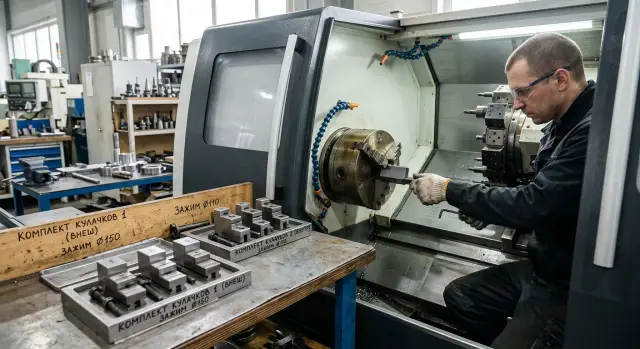
Where time is lost without a second set
On paper swapping chucks looks like a quick operation. On the shop floor it almost never fits into "five minutes." You need to remove the old set, clean the seating from chips, find the correct bolts, install the other set, check the numbers, clamp the first workpiece, eliminate runout and dial in the dimension. Then comes a trial part, measurement and small adjustment. In the end a single changeover often takes 20–40 minutes, and for a complex part or after a long pause it can be nearly an hour.
The problem isn’t the chucks themselves but the frequent switching between batches. When two or three different parts run in a shift, the machine spends more time idle and less time cutting. Each new batch takes a slice of spindle time, and you can see the effect on utilization immediately.
Individually those actions look minor. Together they eat a noticeable portion of the shift. If one change takes 25 minutes, three changes add up to 75 minutes of downtime. In an eight-hour shift that’s almost a sixth of available time. If the cycle time is about 6 minutes, the cell loses roughly 12 parts per day.
This is where a second set of chucks starts to pay off. While one set is installed, the second can be prepared in advance for the next batch. The operator spends less time searching, assembling and rechecking, and the changeover stops ballooning into a separate problem.
You notice this most on cells with a wide range of parts and short runs. Losses hide not in a single big downtime but in dozens of small actions around every tooling change. Add them up by day or week and it becomes clear why the machine is less utilized than the plan suggests.
Which batches usually hit the chucks limit
The issue appears less on long runs—where one part is processed for weeks—and more on mixed flows. The machine seems busy, orders are enough, but the operator is constantly returning to clamp, check runout and re-adjust. In such work a second set pays off much sooner than many expect.
A typical case is parts with similar geometry but different diameters that run consecutively. In the morning they machine a bushing with one clamping range, after lunch a shaft of another diameter, and in the evening they return to the first part. On paper the work is simple. In practice every chuck change takes time and increases the risk that the part will seat slightly differently than in the previous run.
A similar situation happens when a batch returns after a few days. A small run was completed, the tooling was removed, they switched to another order, and then the customer asks for another 20–30 pieces. If the original setup is already disassembled, the operator rebuilds what was recently tuned. With frequent returns this becomes a constant time loss.
Where this is most noticeable
It hits hardest on a single machine that handles several similar orders at once. This is common where one CNC lathe covers parts for automotive, construction equipment or repair batches. Orders are close in shape but not identical, and that breaks the rhythm.
Another clear sign is an operator switching clamping schemes during the shift: external jaws, then internal, then external again for a different diameter. Each swap seems small until you tally all the stops in a week.
At risk are usually small to medium runs with repeated restarts, similar parts with two or three common diameters, and orders that one machine processes in parallel. If consistent seating of the part between batches matters, a second set is often not just "nice to have" but necessary to avoid unnecessary stops.
Signs that a second set is already delivering value
You see it in the changeovers themselves. If retooling takes more than 10–15 minutes and starts eating a noticeable share of working time, it’s not just operator habits. The machine isn’t cutting while the operator removes chucks, cleans the seat, fits the other set and brings the clamp back to working condition.
Another clear signal is that the first part after a tooling change takes a long time to hit the dimension. The operator runs a trial cut, measures, tightens, checks again. If this repeats almost every time the tooling changes, you lose time twice: for the swap and for returning to stable processing.
Losses are hard to miss if several short batches run in a shift, an urgent order breaks the plan, the spindle often waits for a swap, and after each change the number of trial parts and extra checks increases. On paper the machine is busy all day, but actual cutting time drops because of pauses between batches.
There is a subtler sign: the operator starts postponing small batches or avoids urgent runs because they know the setup work they will cause. That is no longer a minor annoyance but a limitation for the whole cell.
At that point a second set usually brings real benefit. While one set runs in the machine, the other can be prepared for the next batch. For cells where fast changeovers matter this means a steadier rhythm, fewer nervous swaps and a more predictable first part.
How to decide, step by step
The purchase rarely needs a complex spreadsheet. It’s enough to honestly count how much time is spent not cutting but on changing tooling and dialing in dimensions. If losses repeat every week, a second set quickly stops feeling like an unnecessary expense.
Start with a normal chuck change on your machine. Time not only the swap itself but everything around it: removing the old set, installing the new one, tightening, checking runout, trial part and the first dimension check. On paper this is often 15–20 minutes, while in a real change it comes out 35–50.
Then do a simple calculation:
- Take the average time for a full chuck change.
- Count how many such changes happen per week.
- Add the time for the first acceptable part and measurements after the change.
- Convert that to hours of downtime per month.
- Compare the result with the cost of a second set and its preparation.
This quickly shows the real price of changeovers. If a machine loses 3–4 hours a month just returning to the same batch, that’s not trivial. It’s lost capacity and sometimes deadline shifts.
Next, split batches into two groups. Put frequent parts that use the same chucks and are sensitive to repeatability in the first group. Put rare orders that appear once in several months or vary a lot in clamping into the second. For the first group buying is usually justified. For the second, the spare set will often just sit on a shelf.
A small example: if the shop changes chucks 4 times a week and each change plus first part tuning takes 40 minutes, that’s over 10 hours a month. If some of those transitions are covered by a pre-assembled spare set, the benefit is immediate. The operator touches the clamp less, dimensions come into tolerance faster, and the spindle runs longer cutting parts rather than standing at setup.
What changes in repeatability
Repeatability suffers not only because of the machine or program. Often the scatter begins at the clamp. When the operator re-tools, repositions or readjusts the chucks every time, small differences in seating are almost inevitable. They show up as runout, dimensional deviation on the first part, and time spent tuning.
A second set removes that extra variable. A prepared set returns the familiar clamping scheme: the same protrusion, the same support, the same part position in the chuck. As a result the machine starts not just "almost the same" but closer to the previous successful run.
This is especially noticeable on parts where clamping affects final shape. Thin-walled bushings, flanges or long blanks quickly show the difference between "seems clamped" and "clamped the same as last time." In the first case dimensions drift from the start. In the second the cell reaches predictable results faster.
For repeat orders the effect is even clearer. When a set is labeled for a specific part or family of parts, the planner can schedule the work without hunting for old settings. The operator takes the known tooling, mounts it in the chuck and checks a few control points instead of rebuilding the entire scheme.
Put simply: a second set is not just shelf backup. It’s needed when the cell wants to return to the same setup repeatedly with less variation. On a CNC lathe this often gives more benefit than the price of the jaws themselves: fewer trial parts, fewer manual corrections and calmer series starts.
A simple shop example
In the morning the lathe machines a small-diameter shaft. The operator has the regime dialed in, checked runout and keeps dimensions without fuss. The chucks for this part are bored to the required grip, so the machine runs almost without pauses.
After lunch the plan changes. A bushing comes up next and it needs a different clamping method: different diameter, support length and sometimes a different locating scheme. If the shop has only one set of chucks the operator cannot just put the next blank in and continue. They must remove the current set, fit another, recheck the seating and make a trial part.
On paper such a change seems short. In a live shift it easily stretches out. Time is spent not only on the physical swap but on usual small tasks: remove and refit chucks without rush, check the part seating, correct the position if the first fit was off, run the first part and wait for inspection.
As a result the machine cuts less than it could. A half-hour pause between batches is common, and sometimes more if the bushing is sensitive to reclamping.
With two sets it’s calmer. While the machine runs the shaft in the morning, the second set can be prepared for the bushing. After the task change the operator installs a ready set, quickly verifies the clamp and starts the first part without long fiddling at the chuck.
The difference is often visible the same day. Instead of a long changeover the shop gets a short pause and a smoother start to the new run. If that swap repeats several times a week, the second set saves not minutes but hours per month.
Where mistakes happen most often
The problem is rarely the chucks. More often a cell loses time because it treats them like consumables. Then the second set is bought but work doesn’t speed up.
The first common mistake is the set has no clear link to a part. The foreman remembers these jaws are "sort of for the flange," the operator thinks they’ll also work for the bushing, and a week later no one is sure. The set is removed, rebored or checked in place. If a set is meant for a specific part or narrow diameter range, label it clearly.
The second mistake is not fixing the protrusion, mounting scheme and control dimension. Without that repeatability drops fast. One operator mounts the part deeper, another changes the stop, a third only checks after a trial part. Formally a spare set exists, but every start feels like starting from scratch.
Usually a simple card with the part number or family, blank protrusion, locating and clamping scheme and one control dimension before start is enough. This isn’t bureaucracy; it’s a way to avoid losing the same time repeatedly.
The third mistake seems small but eats many shifts. Jaws are stored mixed up, without labeled places, sometimes even with different bolts and shims. Searching takes 10–15 minutes and then another chunk of time to verify. If this happens several times a week, utilization falls even though a spare set exists.
Another error: buying a second set for a rare batch. This is a classic "just in case" purchase. If a part appears once every two months and doesn’t create a queue, the return is weak. A second set works much better where a batch repeats often and changeover downtime disrupts monthly output.
Quick check before buying
The purchase decision is more about the cost of each unnecessary changeover than the price of tooling. If the crew repeatedly removes chucks, refits them and then chases the dimension on the first part, the money is going into machine downtime, not into tooling.
Start with one month. Take shift logs, job sheets or the setup records and count how often chucks are changed for a specific part. Multiply that by the real time of the operation: removal, installation, tightening, runout check and tune-up. It usually turns out to be 25–40 minutes of real time, not the 10 minutes people mention in conversation.
Answer four useful questions:
- Does this part or family come back with the same clamping several times a month?
- Is the first good part needed quickly without long adjustment?
- Is the same set of chucks constantly moved between orders?
- Is there a person who will label the set, store it properly and check it before the next use?
If you answer "yes" to two or three of these, a second set already looks like a practical purchase rather than a luxury.
A simple rule of thumb: if you change chucks 6 times a month and each change plus tuning takes 30 minutes, that’s 3 hours lost. If the machine is tightly scheduled, those 3 hours are almost always worth more than an extra set.
Also check repeat batches. When the clamping stays the same, a prepared set gives a calmer start. The mechanic mounts known jaws, gets a stable first part faster and spends less time guessing corrections. For batches that come in waves this is especially noticeable.
But the buy will only work with basic discipline. Someone must label the set, store it separately and inspect it before mounting. Without order the second set quickly becomes just a second lost set.
What to do next
Make the decision based on your shifts and parts, not on a feeling. If a second set seems like a "useful small detail," but operators still spend an extra 20–40 minutes on each repeat setup, it’s time to measure time and look at the facts.
Start with the most frequent repeats. Pick 2–3 parts where chuck changes take the most time or most often break the rhythm. This is usually obvious: the batch is small, the order returns regularly, and the changeover eats a chunk of each shift.
Then apply simple discipline:
- Create a card for each set with dimension, protrusion, part position and short notes.
- Record how many minutes current installation and tuning take.
- Reserve one set for a repeat part and don’t touch it without reason.
- Check results on a batch that repeats over a month.
This test quickly shows whether there’s a real gain. If the operator mounts a ready set and gets the required dimension almost immediately, repeatability improves. If the machine spends less time waiting for changeovers, utilization rises. Then the question is not "need or not" but about concrete hours and losses.
There’s another underestimated sign: people stop trying to "catch" the dimension after every tooling change. When the same set is returned to the same conditions, work becomes calmer and more predictable. For serial parts this often matters more than the one-time saving on tooling cost.
If you see that frequent changeovers slow production over a month, look wider than just the chucks. Sometimes the problem is workflow, sometimes the machine, sometimes tooling selection. At EAST CNC we usually approach such questions holistically: we look not only at a spare set but also at choosing the right CNC lathe, commissioning and service if the cell is stuck in its current organization.
A good month-end result looks simple: fewer stops, fewer trial passes and a clear map of setups for repeat parts.