
Seal grooves: how to keep depth and a clean bottom
Seal grooves require precise depth and a clean bottom. We break down the machining route, inspection, tooling, and common mistakes.
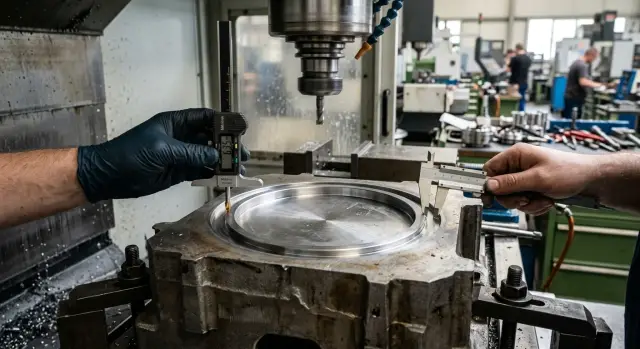
What is the problem with such a groove
A seal groove looks simple only on the drawing. In practice, even a small deviation quickly turns into a leak after assembly. An extra 0.02-0.05 mm in depth already changes the compression of the ring, and with it the sealing performance.
If the groove is deeper than specified, the seal is compressed less and holds pressure worse. If it is shallower, the ring is overcompressed, heats up more, ages faster, and may tear right at the start of operation. The difference seems small, but in the assembly it shows up immediately.
Problems are caused not only by depth. If there are scratches, buildup, or fine chips left on the bottom, the ring sits unevenly: tighter in one place, looser in another. Because of that, a leak often appears not right away, but after several starts. Then the cause is blamed on the seal material or the assembly, although the mistake is in the groove itself.
Another trap is a burr at the entrance. On a small part it is easy to miss. But during installation the ring catches on the edge, gets nicked, loses its shape, or tears. Such a defect is often taken for poor rubber, although the real cause is machining.
So it makes little sense to argue only about the depth dimension. The whole route affects the result: which tool removed the stock, how the tool was brought to the bottom, when the burr was removed, and what was used to check the size. If the operator changes the feed on one part, uses a different tool on another, and inspection happens only at the end, variation is almost inevitable. Sealing is usually lost not because of one gross error, but because of several small ones that no one stopped in time.
What to check before the first part
Before starting, it is better to spend 20 minutes on preparation than to later sort out a leak at assembly. With a seal groove, problems do not start with the shape, but with small things: where to measure depth, what corner radius is acceptable, and what counts as a clean bottom.
First, review the drawing in full. You need not only nominal values, but also the depth tolerance, groove width, and corner radii. If the depth is tightly specified and the radius is missing or too vague, the tool may simply not enter the way the designer intended. The error will appear even before setup.
Then look at the body material. Aluminum and mild steels often pull a burr along the edge, especially if the tool is dull or the feed is too aggressive. Cast iron is usually calmer in terms of burr, but it may chip the edge. In both cases the depth may be within tolerance, yet the seal sits unevenly.
Also set one base for machining and inspection. If the machine takes the dimension from one surface and the inspector measures from another, mismatch is almost guaranteed. On housing parts this happens often: the process engineer uses the support face as the base, while inspection locates the part by a neighboring shoulder. Then people argue about the numbers, although the reason is already clear.
Check the clamping as well. The housing must not spring in the vise or fixture. If the clamp pulls the wall, the depth will shift after the part is released. The same applies to tool overhang: a long overhang adds vibration, spoils the bottom, and moves the size, especially in a narrow groove.
It is better to plan the finishing pass separately. Do not try to remove the entire volume in one go, even if the machine allows it. A small allowance on the bottom and walls gives a more predictable depth and a cleaner surface. In practice, the calmer route is to remove the main volume with a roughing pass, then true the shape, and only after that do the finishing pass with the same setup.
If you boil it down to a simple list, before the first part you need to remove five sources of scrap: unclear drawing, unsuitable tool, different base, weak clamping, and no allowance for finishing. After that, startup goes much more smoothly.
Machining route step by step
For such a groove, trying to reach size in one pass is a bad idea. That is usually how you end up with wandering depth, marks on the bottom, and a burr on the edge. A calmer route works much better, where each pass has its own task.
First, leave a small allowance on the bottom and walls. The roughing pass removes the main volume, but does not bring the size to the final value. The tool runs easier, and the metal does not pull the edge at the last moment.
After that, a semi-finishing pass is useful. It evens out the load before the final pass and removes marks left by the roughing path. On a housing part, this is easy to see: if you skip this step, the finishing tool cuts in one place and starts rubbing the surface in another.
The bottom is better machined separately. If you combine the bottom and walls in one final pass, stability in depth usually drops. When the tool is guided only along the bottom, it is easier to keep one cutting regime and get the same surface along the whole groove.
The walls are finished after the bottom, without unnecessary re-entry cuts or turns in the corners. The calmer the path, the lower the risk of tearing, a step at the exit, and local overheating.
The route usually looks like this:
- rough removal with allowance on the bottom and walls
- semi-finishing pass to even out the shape
- separate finishing pass on the bottom
- finishing pass on the walls
- gentle burr removal and part washing
At the last step, people often try to save time. It is not worth it. If chips or a thin burr remain in the corner after machining, the measurement will give a false picture. The part may pass the machine, but the assembly will leak later.
The normal practice is simple: after finishing, carefully remove the burr without rolling over the edge, wash the part, and only then send it for inspection. This route is easy to repeat both for a single part and for a small batch.
How to keep depth consistent from part to part
If groove depth shifts by even a few hundredths, the assembly starts to behave differently. On one part the seal is overcompressed, on another it is undercompressed. For a sealed joint, that is already a direct leak risk.
Stability starts not with a program correction, but with the base. Depth should be tied to the housing surface that controls the size in assembly. If the operator uses a different base simply because it is easier to set the part up that way, variation is almost inevitable. This is especially noticeable after several operations, when height error has accumulated.
Another common cause of drift is tool touch-off on a cold machine. First the machine should reach working temperature. After warm-up, the operator does the touch-off and only then starts the first part to size. Otherwise, the first batch often differs from what comes an hour later.
It also works badly when the tool is changed only after scrap appears. Cutting edge wear happens gradually, and depth drifts gradually too. It is much calmer to schedule tool changes by part counter or cutting time. This approach is easier for both the supervisor and quality control.
The working scheme is usually this: after warm-up, touch off the tool, fully inspect the first part, set an inspection interval, and change the tool on schedule even if there is no obvious scrap yet. The interval depends on the material, groove width, and cutter life. On aluminum, it can be longer. On steel and stainless steel, it is better not to stretch it.
There is one more rule that is often broken in the middle of a batch: do not change the allowance for the finishing pass without a clear reason. If the first, second, and inspection parts are going well, there is no need to “slightly adjust” the feed or take off a few hundredths for your own peace of mind. It is exactly these small tweaks that often destroy repeatability.
A good process for this operation should be boring. One base, one touch-off order, one inspection interval, and planned tool changes work better than constant small adjustments.
How to keep the bottom clean
For such a groove, it is not enough to hit the depth. If the cutter smears metal, drags chips with it, or leaves marks on the bottom, the seal will sit unevenly. The assembly then leaks, even though the measurement looks fine.
Tool and cutting conditions
Start with choosing the cutter. Its diameter should match the groove width so that the tool actually cuts, instead of rubbing the bottom and walls. A cutter that is too large removes chips poorly from a narrow pocket. A cutter that is too small may chatter and leave waves.
The part material also changes the picture. On aluminum, built-up edge appears quickly if the cutting edge is already dull. On steel, heat and fine chips that get back under the edge are more of a problem. That is why, for a seal groove, it is better to use a sharp cutter with a short overhang and not run it until it is clearly worn out.
A common mistake is making the feed too small “for a cleaner finish.” In practice, the bottom often comes out worse. The edge no longer cuts, it rubs the surface, heats the metal, and builds up material. From the outside the bottom may look smooth, but a probe or optics will later show a smeared surface.
Usually a simple set of rules helps: bring the tool to depth in a working pass, do not rub the bottom for too long, keep the feed in the normal range for the cutter and material, direct air or coolant straight into the pocket, and regularly inspect the cutting edge if the material is sticky.
Chips and repeat passes
Chips damage the bottom faster than it seems. One small particle is enough for the final pass to leave a scratch along the full length of the groove. That is why air or coolant should not only cool, but also actually carry chips out of the pocket.
Do not run a repeat empty pass over an already finished bottom. Such a pass hardly cuts at all. It polishes the surface, heats the area, and drags fine chips across it. If you need to correct the wall, it is better to change the path so you are not rubbing the entire bottom again.
Right after cutting, clean the groove and the tool itself, remove any built-up material, and only then measure. On a housing part this saves time: the operator sees the real surface, not dirt that hides as a defect.
How to build inspection without unnecessary disputes
Disputes begin where the process engineer, operator, and inspector use different reference points. If the program calculates depth from base A, it should be checked from the same base A. Not from the top edge, not from some random surface after flipping the part, but from the surface the machine actually used for the dimension.
That alone is enough to remove half the disagreements. The same dimension taken from different bases can easily differ by several hundredths. For a sealed assembly, that is more than enough.
It is better to lock in the inspection order once and not change it from shift to shift. The first part is fully checked after machining. Depth is measured at several points, not just one. The bottom plane, corner radii, burr, and buildup are checked separately. The log records the part number, tool number, and actual size.
Measuring at several points is not just a formality. The bottom can taper if the tool is slightly off, if the feed is too high, or if chips remain in the pocket. The center may be correct, while near the wall there is already a deviation. The seal feels exactly that, not the average value in the report.
The bottom plane and corner radii are also better checked separately. If the radius is larger than required by the seal profile, the ring will not seat the way it was intended. If the bottom is wavy, the pressure will be uneven even with a normal average depth.
Burr and signs of buildup are often missed because the instrument shows the size within tolerance. But in fact the bottom is no longer clean. On housing parts this is a common story: after the finishing pass, a thin ridge remains at the wall, and that is what interferes with seal seating.
A short note after each size drift works well. For example: part 27, 6 mm cutter, depth drifted by 0.03 mm, a buildup mark appeared on the bottom. That kind of record quickly shows the cause. If the size drifts across a series with one tool, the argument ends right away.
Mistakes that make the assembly leak
A leak often appears not because of the seal itself, but because of several small machining mistakes. The error margin for such a groove is small: an extra 0.03-0.05 mm in depth or a tiny burr already changes ring seating.
The first common problem is measuring from the wrong base. The operator checks depth from the raw surface and gets a “normal” number, but in assembly the part rests on a different plane. On paper everything is right, but in the assembly the ring is either undercompressed or compressed more than needed.
The second mistake is using the same tool for roughing and finishing without accounting for its condition. After roughing, the edge is already hot and has started to wear. It is harder to get a flat bottom and a clean wall with the same tool. Marks remain on the bottom, and edge tearing appears in the corners.
Another bad approach is to leave a large allowance and remove it in the last pass. In a narrow groove, the tool can easily deflect, especially with a large overhang or built-up material. On one part the size may still fall within tolerance, but across the batch it will start to wander.
Many people underestimate warm-up. A cold spindle does not cut the same way it does after forty minutes of work. The part itself can also shift slightly after the first passes if a noticeable amount of metal has been removed. If the first part was accepted without warm-up, control quickly turns into an argument between the machine, the measurement, and the assembly.
There is also a very frustrating cause of leaks: everyone checks only the size and misses the burr at the entrance. This thin edge catches the seal during installation or simply keeps it from seating properly. From the outside everything looks neat, but after assembly the joint starts to weep.
If a leak appears in a batch, first check the inspection base, the condition of the finishing tool, the real allowance on the last pass, and the entrance edge of the groove. That is usually where the problem is, not in the rubber.
Example on a housing part
On an aluminum housing for a cover, a circular groove for an O-ring was machined. The depth tolerance was tight because that depth set the seal compression. The first parts came out fine, but then the size started drifting by about 0.03 mm. For such an assembly, that was already enough: one build closed tightly, another leaked.
First they checked the base, tool zero, and measurement. The reason was simpler: the cutter was mounted with too long an overhang, and chips were leaving the groove poorly. The tool deflected slightly, signs of recutting appeared on the bottom, and the depth stopped repeating from part to part. This happens often with aluminum: the material cuts easily, but buildup and chips quickly spoil the bottom.
The route was not redesigned from scratch. They shortened the cutter overhang to the minimum working value, left the roughing pass only for removing the main volume, added a separate finishing pass on the bottom, and adjusted the coolant feed so chips would not remain in the groove.
After that, the process became much calmer. The roughing pass removed the main allowance, and the finishing pass no longer fought chips or pulled the tool down in jerks. The bottom became flatter, buildup marks disappeared, and inspection stopped producing disputed results.
The effect was even clearer in assembly. Before the change, some units had to be reworked: in some places the ring was too tight, in others the compression was not enough. After the change, the parts assembled without extra fitting, and the assembly passed testing without leakage.
The conclusion is simple: if seal grooves suddenly start to wander in depth, do not rush to change the Z correction. First check the tool overhang, chip evacuation, and whether there is a separate pass on the bottom. Very often the reason is right there.
Quick check and next steps
Before starting a batch, it is useful to do a short check. It takes little time, but often saves you from mass scrap.
- Match the machining base and the inspection base.
- Make sure the program has a separate finishing pass for the bottom.
- Set a clear tool wear limit instead of the rule “it can still go a bit longer.”
- Check the first part and repeat the measurement after several parts in a row.
- After washing, inspect the bottom and edges for burr, buildup, and chip marks.
On a housing part, the mistake is rarely just one thing. More often, two small issues pile up at once: inspection measures from the wrong base, and the operator is already running the tool at the edge of its life. Separately these deviations are still manageable; together they create an assembly that leaks.
If groove depth is unstable, do not rush to rewrite the whole program. First check the setup, then the finishing pass on the bottom, and only after that the actual tool wear. In that order, the cause is usually found faster.
For a batch, it is useful to create a short check sheet right by the machine: which base to measure from, when to change the tool, and what to look for after washing. That is already enough to remove unnecessary disputes between the operator and quality control.
If the operation runs in batches and questions keep coming up, EAST CNC can discuss selecting a machining center for such parts, as well as commissioning and service. For tasks where the groove directly affects sealing, a stable machine and a clear route usually help more than constant manual corrections.
The practical next step is simple: lock in one base, one finishing pass, and one wear limit. Then check 5-10 parts in a row and see where the size starts to drift. That is more useful than spending a long time on one disputed part.
FAQ
Why does the assembly leak if the depth seems to be within tolerance?
Often the problem is not the average size, but the groove itself. Scratches on the bottom, a thin burr at the entrance, chip buildup, or measuring from the wrong base can all cause leaks. If the depth shifts by even a few hundredths, the seal is compressed differently than intended. So look not only at the number, but also at the bottom, the edge, and the inspection method.
Which base is best for setting groove depth?
Use the surface from which the assembly actually holds its size. If the machine calculates depth from one base and inspection measures from another, you will almost certainly get variation. It is better to lock in one base for both machining and inspection. Then the operator, process engineer, and quality control will see the same dimension.
Do I need a separate finishing pass for the bottom?
Yes, this is usually the most reliable option. A separate bottom finishing pass helps hold stable depth and gives a more even surface along the full groove length. When one finishing pass touches both the bottom and the walls at once, the tool works less steadily. That leads to waviness, marks, and depth variation.
Why does the first part often differ from the next ones?
Because a cold machine and a warmed-up machine cut differently. If the operator set the touch-off before warm-up, the first part often comes out different from the parts an hour later. First let the machine reach working temperature, then check the tool touch-off, and only after that accept the first part to size.
How do you remove the burr without damaging the groove?
Remove the burr right after machining, but without rolling over the edge. If the sharp edge remains, the ring catches on the entrance, gets nicked, and then leaks in service. This happens especially often with soft materials like aluminum. There, it is worth checking the edge after washing, not only the depth.
What usually ruins the cleanliness of the groove bottom?
Usually the bottom is ruined by chips, built-up material, and too long a tool overhang. Another common mistake is too little feed, when the tool no longer cuts but rubs the metal. A short overhang, a sharp edge, and proper chip removal with air or coolant directly from the pocket all help. After finishing, clean the groove and only then measure it.
When should the cutter be changed for this operation?
Do not wait for obvious scrap. It is much calmer to change the tool by part count or cutting time, especially on steel and stainless steel. Wear grows gradually, and the depth drifts gradually as well. Planned replacement gives a more stable size than working by the rule of “it can still go a bit longer.”
How should groove depth be checked correctly?
Measure depth from the same base every time and do not rely on just one point. In a groove, the bottom can taper: the center may be correct while the wall area already shows a deviation. Also remove chips and buildup before measuring. Otherwise, the gauge will show a nice number, but the seal will sit unevenly.
Can such a groove be made in one pass?
Better not. One pass more often gives wandering depth, marks on the bottom, and a burr on the edge, especially in a narrow groove. It is more reliable to leave a small allowance, remove the main volume with a roughing pass, then true the shape and separately finish the bottom and walls. This route is easier to repeat part after part.
What should be checked first if the depth starts drifting in a batch?
First check the setup, tool overhang, and chip evacuation from the groove. Very often the size drifts not because of Z correction, but because the tool deflects or the chips are recut. Then see whether there is still a separate finishing pass for the bottom and whether the cutter has been pushed too far in its life. Only after that does it make sense to touch the cutting modes and offsets.