
Roundness and Cylindricity: Why Diameter Won’t Save You
Roundness and cylindricity explain why a part passes the micrometer but jams during assembly. We look at common cases, mistakes, and checks.
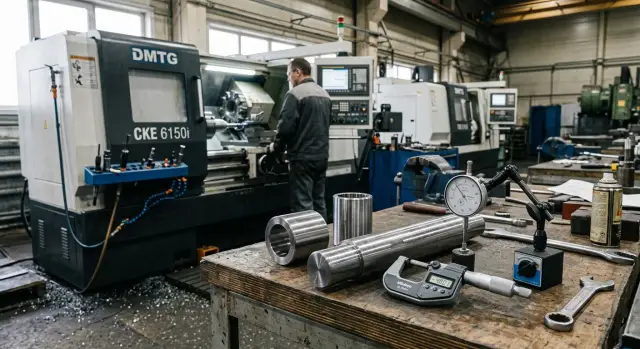
Why the diameter matches, but the part still won’t seat
The same diameter on paper does not mean the part will actually fit the mating surface. A micrometer shows the size only at the point where you place it. If that spot is within tolerance, the tool will honestly show a good result. But assembly checks the part differently: it “feels” the whole surface at once, from the entry edge to the working depth.
That is where the confusion often starts. The part passes on diameter, but it needs force to assemble, jams, or goes in crooked. The cause is usually not one number, but the shape of the surface. If you look only at size, it is easy to miss ovality, taper, or a lengthwise deviation.
Ovality is the clearest example. In one cross-section, the part may have a normal average diameter, but the shape itself is no longer round. In a mating pair, contact then happens not across the full circumference, but in separate zones. On the bench, the part looks ordinary. In the assembly, it starts to bind, especially if the fit is tight and the clearance is small.
Taper is different. At the entry, the part goes in easily, and that often makes the operator too calm too early. But farther along, the diameter changes little by little over the length, and the fit becomes tighter than it should be. The part goes in a few millimeters, then stops. If you keep forcing it, you get scoring, misalignment, and extra stress in the assembly.
This is especially common on long shafts, seating journals, and parts after turning, when the setup has drifted only a little. In the shop, this is a familiar story: the first micrometer check says “good,” but on assembly the pin will not go into the bushing without tapping. Formally, the size is there. In practice, the shape is already causing trouble.
Size answers the question “how many millimeters.” Shape answers the question “how this surface works in a pair.” If you control only diameter, some defective parts will almost inevitably reach assembly, where the mistake costs more and takes more time.
What a micrometer shows, and what it misses
A micrometer is almost always useful, but its limits are often overestimated. It shows a local size between two contact points. For a quick check, that is enough: you can tell whether the size has drifted after tool wear, whether the setup is holding, and whether there is a clear out-of-tolerance condition.
The problem starts when one number is used to judge the whole geometry of the part. A shaft may show 20.00 mm in one position, but after turning it by 90 degrees it gives a different value. If the operator made only one measurement, ovality is easy to miss. The same thing happens along the length: the start is within tolerance, the middle is slightly larger, and the end is normal again. One measurement will not show that. Sometimes even two will not.
On the assembly line, it looks familiar: the pin goes confidently into the bushing for a few millimeters, then stops and leaves a mark on one side. The micrometer may still show a good value. It does not tell you where the part starts to bind, at what length the clamping appears, or in which position extra contact begins.
So when you suspect a shape issue, one measurement is not enough. Check the part in several cross-sections along the length, repeat the measurement after turning it, and compare the values. It helps to look at the spread, not just one “nice” number. And it is better to measure the zone where the part actually binds during assembly, not just the convenient area near the end.
What is the difference between size, roundness, and cylindricity
Size is simply the numerical value of the diameter. If the micrometer shows 40.00 mm and that falls within tolerance, you know only one thing: the size is correct at that point. But you still do not know the shape of the part.
Roundness applies to one cross-section. If you imagine cutting a thin disc from a shaft and looking at its outline, it should be a circle. If there is even a small oval shape, the micrometer may still show an acceptable diameter in several points. Formally, the size is fine, but in the real fit there will be extra interference in one direction and clearance in another.
Cylindricity applies to the entire side surface along the length. A part may be almost round in every individual cross-section, but still have taper, barrel shape, or a bend. Then separate diameter measurements look normal, but the fit along the full length is ruined.
Put simply, size is a number, roundness is the shape of one cross-section, and cylindricity is the shape of the surface along the whole length. That is exactly why a part can pass the micrometer check and still refuse to assemble.
On CNC machines, this is especially visible on long parts. Incorrect clamping, tool wear, or a poor cutting setup can leave the diameter within tolerance while ruining the geometry. That is why roundness and cylindricity are form tolerances, not ordinary diameter checks.
A simple shop-floor example
In the shop, a shaft was being turned for a bushing with a nominal size of 30 mm. After machining, the operator took a micrometer, made a few quick measurements, and saw a normal picture: the diameter was close to the target, and the part looked good. On paper, everything was calm. On assembly, it was not.
The bushing accepted the shaft only at the entry. The first millimeters went in easily, especially with the chamfer. Then the shaft began to tighten, and deeper in it started to bind. If you pushed harder, it went in a little further, but a proper fit still did not happen.
Usually people first suspect burrs, dirt, or a bad bushing. That is logical. But in cases like this, the problem is often in the shaft shape. By size it passes, but by geometry it does not.
When the part was rechecked not at one point, but in several cross-sections and also after turning it, the picture changed. At one end, the result was almost a true 30 mm. In the middle, the difference between the two directions was already noticeable. At the far end, the shaft was a little larger in one position and a little smaller in another. That revealed two causes at once: ovality and a slight taper.
That is why arguing with the micrometer makes no sense. It is not wrong; it simply shows only part of the picture. If you measure a shaft in three sections and in at least two positions in each section, the cause usually appears quickly.
How to check a part without unnecessary fuss
One measurement in the middle of the part guarantees almost nothing. A shaft may match the drawing and still have ovality, taper, or a slight barrel shape that makes assembly tight or prevents it altogether. You need one consistent inspection routine. Then you can see not only the diameter, but also how the shape behaves along the length and around the circumference.
A practical sequence looks like this:
- Mark the inspection points right away. Three sections are usually enough: near one end, in the middle, and near the other end.
- Measure each section carefully and with the same pressure on the tool.
- Turn the part and repeat the measurement. In most cases, turning it by 90 degrees is enough.
- Compare the numbers. The difference within one section shows circumferential deviation. The difference between sections shows what is happening along the length.
- If possible, do a trial fit with the mating part or a gauge.
With this kind of inspection, you can already tell what is happening. If the size varies around the circumference, that points to ovality. If it changes from end to end, look for taper. If the middle is larger or smaller than the edges, barrel shape or a concave shape is likely. All of these affect assembly, even when the average diameter looks fine.
Here is a simple example. A shaft should fit into a bushing. In the middle, you got 30.00 mm, and it seems everything is fine. But near the end, after turning the part, you get 29.98 and 30.02. By size, the part looks acceptable, but in reality one axis is larger than the other, and the fit becomes uneven.
If the trial assembly goes in crooked, do not force the part. Measure it again at the same marks and write the values in a table. Five minutes of checking often saves hours of searching for the cause.
Where inspection most often goes wrong
Defects often hide in the habit of measuring quickly and only where it is convenient. The operator checks the size near the end, sees a good micrometer reading, and decides the part is fine. Meanwhile, the middle already has a barrel shape, taper, or local ovality.
A common mistake is checking only one spot. That kind of measurement does not show what is happening along the full length. If a shaft or bushing works in a fit, even a difference of a few hundredths between the ends and the middle can already lead to a tight assembly or misalignment.
The second typical mistake is measuring the part in only one position. A micrometer shows the distance between two points, not the full cross-sectional shape. Turn the part by 90 degrees, and the size may change. That is how ovality usually gets missed.
The third mistake is checking right after machining, while the part is still hot. After cutting, the metal does not always keep the same size it showed in the first minutes. This is especially noticeable on long, thin-walled, and not very rigid parts.
Another underestimated source of trouble is chuck marks. If the clamping force was high, the surface near the jaws may have been slightly deformed. While the part is still in the chuck, this is almost invisible. After unclamping, the shape changes, and one quick measurement no longer guarantees anything.
In practice, simple discipline helps: measure in several sections, turn the part during measurement, wait for cooling, and check the clamping zones separately. That is already enough to sharply reduce the number of cases where a part is “good” on the report but will not assemble in the machine.
How clamping and cutting settings damage shape
Very often the problem does not start with the drawing or the measurement, but with how the part was held in the machine. A thin-walled bushing under strong jaw pressure may temporarily become round for the tool, and then return to a deformed shape once the force is released. A micrometer may later show a normal diameter in several points, but in assembly such a part will still go in tightly.
A long blank is different. If it is turned without enough support, the end of the part deflects under cutting load. You can barely see it with the eye, but along the length a taper or slight barrel shape appears. One measurement near the chuck may be correct, the second may also be close to size, but the overall geometry is already damaged.
A worn tool also affects not just size, but shape. It cuts worse, drags the surface, heats the metal more, and can pull the cutting edge off line. As a result, the part develops waves, local ovality, and a rough surface, pushing roundness and cylindricity out of tolerance even though the average diameter is still holding.
Cutting parameters add their own problems. Too much feed or depth of cut creates deflection, especially on long and thin parts. Too high a speed with a dull tool overheats the cutting zone. The usual result is taper along the length: one end passes, the other already interferes with the fit.
There is another trap too: re-clamping. The part is removed, flipped, and clamped again, but the reference shifts by fractions of a millimeter. Individual dimensions may still stay within tolerance, but the axis of one surface no longer matches the other. On assembly, this shows up quickly as misalignment, a tight fit, and faster wear.
If there are strong chuck marks near the jaws, the cutting sound changes noticeably during the pass, the size varies from one measuring point to another, and the part passes the micrometer but jams in the real fit, the cause is worth looking for not in the controller, but in the machining process itself.
A quick check before starting a batch
Before a series run, it is risky to look at only one size. The first part may have the right diameter and still jam in the fit later. The reason is usually simple: the size is within tolerance, but the shape has drifted.
For a quick check, it is enough to take the first part and measure the same diameter in three sections: near the start, in the middle, and closer to the end. Then repeat the measurement in two positions, usually after turning the part by 90 degrees. That is already enough to notice taper, barrel shape, or ovality.
If one section shows 40.00 mm, and after turning it gives 39.97 mm, the size may still formally pass. But the assembly is already in question. With that kind of difference, the fit often goes in crooked, especially if the part later works in a bushing, bearing seat, or another precision pair.
It helps not just to record the numbers, but to write down the spread for each section right away. Then it is easier to see exactly where the shape is drifting. If the spread near the end is larger than in the middle, check the clamping, overhang, tool condition, and the finishing pass settings.
A trial assembly on the first part also shows a lot. If the part has to be pushed by hand, twisted, or “found” in position, it is too early to start the batch. Such a defect almost always moves farther down the process, and fixing it at the next operation will be harder and more expensive.
This check takes only a few minutes, but it stops defects from going further. For parts where roundness and cylindricity matter, this is not overcaution, but normal shop discipline.
What to do next
If a part passes by diameter but still will not fit into the assembly, you need to change not only inspection, but also the way the task is defined. On the drawing, it is worth specifying not just one size, but the parameters that actually control the fit. For a tight fit, a long guide, or a thin-walled bushing, that often means not only diameter, but also roundness, cylindricity, and sometimes runout and straightness.
The first step is simple: review the acceptance requirements. If assembly fails because of shape, then the working surfaces need form tolerances. Otherwise the operator will honestly meet the size requirement, and the problem will remain.
The second step is to agree in advance on the inspection method before the batch starts. It is important to decide what is used to measure size and shape, in which sections the checks are done, which surface is the datum, and who makes the final call on disputed parts. This conversation takes little time, but it often saves a shift and a batch of blanks.
The third step is to look at the process itself. If the drawing and inspection method are fine, the cause may be the machine, clamping, support, tool wear, or overheating. This is especially noticeable on long shafts, thin tubes, and parts where roughing and finishing are done in one setup.
Here is a simple test: machine several parts in a row and measure not only the diameter, but also the shape in several sections. If the spread grows from part to part, the problem is no longer measurement, but process stability.
When the issue comes down to equipment, it helps to look not at a single catalog parameter, but at how the machine holds geometry on your part in production. EAST CNC, the official representative of Taizhou Eastern CNC Technology Co., Ltd. in Kazakhstan, supplies CNC turning machines and handles the full cycle from selection to commissioning and service. This is especially relevant when the task is to hold roundness and cylindricity consistently, not just hit the diameter on the first part.
FAQ
Why won’t a part fit if the diameter is within tolerance?
Because assembly checks not just one number, but the whole surface. A micrometer may show a normal value at one point, while the part still has ovality, taper, or a slight barrel shape. That is why a shaft may enter a hole only partway, go in crooked, or jam at depth.
What is the difference between ovality and taper?
Ovality changes the shape of one cross-section. In one direction the size is one value, and after turning the part it is another. Taper changes the size along the length. At the entry the part may go in easily, but farther in the fit becomes much tighter.
How should you check a shaft if you suspect a shape problem?
Usually three sections are enough: near one end, in the middle, and near the other end. In each section, it is best to measure in at least two positions after turning the part by 90 degrees. That way you can quickly see what changes around the circumference and what changes along the length.
Why turn the part during measurement?
Turning the part helps catch ovality. Without it, you only see one distance between the micrometer faces and can easily miss differences around the circumference. If the size changes after turning, the problem is no longer just one diameter, but the shape of the section.
Why does a shaft go in only a few millimeters and then jam?
This often happens with a slight taper or a local thick spot. The chamfer helps the fit start, but farther in the surface begins to press harder than it should. If you keep forcing assembly, you will get scoring and extra stress in the joint.
Can one micrometer cover the entire inspection?
For quick size checks, yes. For shape evaluation, no. A micrometer is good at catching diameter drift, but it does not show the full picture along the length and around the circumference. If the assembly is sensitive to geometry, add measurements in several sections and do a test fit.
Why should you avoid measuring a part right after machining?
Do not rush to measure a hot part. After cutting, the metal may still change size, especially on long and thin-walled blanks. Let the part cool down first, then take the final measurements. Otherwise you may accept a questionable part as good.
How does chuck clamping spoil the part shape?
Strong clamping can temporarily deform the part. The tool machines the blank in one state, and after release the shape changes. This is most common on thin-walled bushings and near the jaws. That is why you should check not only the diameter, but also the shape after removing the part.
What should you do if the first part in a batch raises doubts?
Do not start a batch based on one number. Re-measure the first part in several sections, repeat the measurements after turning it, and do a test fit. If the part is already tight at the start, look for the cause in clamping, overhang, tooling, or cutting parameters, rather than hoping it will improve later.
What should be shown on the drawing besides the diameter?
If fit depends on shape, it is better to specify more than just the diameter on the drawing. Roundness, cylindricity, and sometimes runout or straightness are usually added as well. Also agree on the inspection method right away: where to measure, what to measure with, and which surface serves as the datum. Then production and inspection are working toward the same goal.