
Roughing and Finishing on Different Machines: When It Pays Off
Roughing and finishing on different machines helps a shop keep deadlines, reduce rework, and stabilize dimensions. We look at when it pays off.
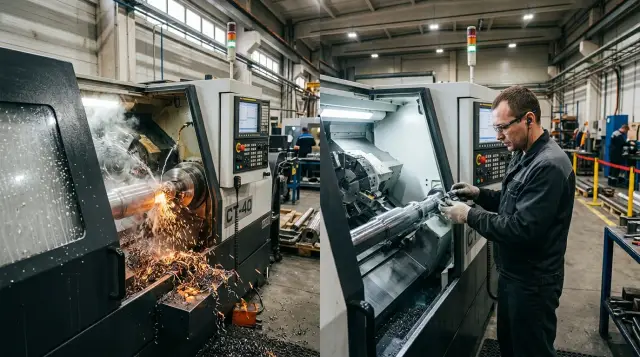
Why one machine is not always the best choice
The idea of machining a part from start to finish on one machine seems simple. Fewer moves, one operator, one route. But in a real shop, this approach often turns one machine into a bottleneck for the entire queue.
The problem starts with scheduling. A long roughing operation keeps the machine tied up for a long time, while a short finishing operation waits its turn, even though it only takes a few minutes. In the end, the shop loses not just machine time, but also predictability in part lead time.
A typical situation looks like this: rough turning of a housing takes 35 minutes, and finishing the bearing seat takes 7 minutes. If both operations are in one route on one machine, the short job always loses to the long one. The batch is almost done, but shipment still gets pushed back.
There is a second reason too. After heavy metal removal, the machine, the tool, and the blank itself take on a lot of load. The material may relax slightly, the part heats up, the chuck affects the shape more strongly, and the size drifts more often than after a calm finishing pass on a separate machine.
The operator sees it right away. He makes a test pass, checks the size, adjusts the offset again, and only then reaches the required tolerance. Formally, the part is made on one machine, but in practice the time goes into waiting for dimensional stability.
Urgent orders make this imbalance worse. When one rush job is suddenly inserted into the schedule, a long roughing batch has to be interrupted, priorities change, and the tool flow has to be rearranged. One urgent part can shift the whole shift plan.
When choosing CNC lathes for a shop, this point is often underestimated. People look at hourly utilization, but they should be looking at queue length, repeatability of size, and the risk of missing the deadline. One machine can be busy 85 percent of the time and still block production more than two machines with a calmer schedule.
That is why roughing and finishing on different machines often brings a gain where it does not show up in a simple cycle-time calculation. The shop gets a smoother flow, fewer size fluctuations, and fewer disruptions when urgent work appears.
When splitting speeds up output
Splitting gives the clearest effect where roughing is long, noisy, and heavily loads the spindle, while finishing takes less time and needs a calm, predictable mode. If both operations stay on one machine, the finished part appears only after the full cycle. Part lead time grows even when the total machine time seems acceptable.
When roughing and finishing are set up on different machines properly, the shop starts working in parallel. On the first machine, the main allowance is removed, while on the second, a finished part from the previous batch is already coming off. After a short ramp-up, the flow evens out, and shipments move without long pauses.
Where one route slows down output
The most common problem is that a long roughing cycle blocks the machine. While the machine removes excess metal for 20-30 minutes, it cannot finish a single part. For the customer, it looks simple: the deadline moves, even though the machine is busy the whole time.
With two machines, the picture is different. Roughing works at its own pace, and finishing does not wait for the full cycle on every blank. This is especially clear on repeat batches, where the route is already tuned and the allowance is stable.
A simple example: rough turning of a housing takes 18 minutes, finishing takes 6 minutes. On one machine, a finished part comes out every 24 minutes. With operations split across machines, the first finished part will not appear immediately, but after that the finishing machine can output results much more often if roughing keeps a steady supply of semi-finished parts.
How this helps shifts
The shift combination works well too. At night, the shop loads roughing, when it is less risky to keep long cycles running without frequent setup changes. During the day, the operator keeps the more precise machine for finishing, dimensional checks, and handing over finished parts.
This mode is also convenient for planning. Roughing builds a buffer, and finishing closes current orders without sharp swings. In shops with different CNC lathes for heavy stock removal and for more precise work, this often brings a benefit not only in hours, but in the actual delivery date too.
Another advantage shows up in serial orders. When a batch repeats every week or every month, it is easier to keep the flow even: one machine constantly prepares blanks, while the other constantly brings them to the final state. This route is usually easier to plan than a long universal cycle on one machine.
When result stability improves
Stability often drops not because of the program, but because of the conditions around the part. When one machine first removes a large allowance and then immediately brings the part to final size, it is working in two different modes at once. That is normal for roughing. For finishing, not always.
A dedicated finishing machine usually works in a calmer mode. It heats up less during heavy cutting, catches strong vibration less often, and does not fill the work area with as much hot chip. Because of that, it is easier for the machine to hold the same result from the first part to the tenth.
The part itself behaves more calmly too. After rough removal, the metal heats up, internal stresses partially redistribute, and the size can drift after the cut stops. If the part rests and cools before the final pass, finishing gives a more predictable size. This is especially noticeable on fits, thin walls, and long shafts.
Roughing and finishing on different machines often brings the gain right here: not in cycle minutes, but in repeatability. For example, a shaft after rough turning may look fine at first, but an hour later the bearing journal shifts by a few hundredths. If the finishing machine takes an already cooled part, that surprise happens less often.
Surface finish works the same way. When heavy passes are happening nearby, there is more chip, dust, and random impact load in the cutting zone. On a finishing pass, that quickly turns into marks on the surface, burred edges, and unstable Ra. On a separate machine, it is easier to keep the process clean: a different tool, calmer feed, fewer interruptions around it.
Where this matters most
This approach often pays off if the shop makes:
- bearing and seal seats
- parts with thin flanges and sharp edges
- long shafts that are sensitive to deflection
- batches where dimensions must repeat without constant adjustment
On CNC lathes, this is easy to see in serial work. If the operator has to chase the final size on almost every batch after roughing, the problem is often not the tool. The route simply mixed heavy cutting and precision work in one place.
How to tell that one route is holding the shop back
One route on one machine seems convenient until you look at the whole shift. The problem usually shows up not in machine time, but in queues, size drift, and extra changeovers. If a machine keeps switching from heavy stock removal to finishing, it often works in bursts rather than smoothly.
First, look at how the batch moves. If blanks wait between stages, the operator is rushing, and finished parts only come out near the end of the shift, one route is already slowing output. This is especially noticeable when roughing one batch takes, for example, 4 hours, while finishing takes only 1.5. In that case, the finishing step depends on a long and heavy stage, even though it could run separately and faster.
A good sign of trouble is when dimensions start drifting toward the end of the shift. After a long roughing cycle, the machine, tool, and fixture are heated differently. On the first parts, the finishing size holds fine; on the last ones, the operator has to adjust the offset more often. If this happens almost every day, the problem is not just the tool. Often the route itself is overloading one machine with different tasks.
Also count how many times per shift you change the tool, jaws, chuck fixture, or program just to move from roughing to finishing and back. On paper, each setup takes 10-15 minutes. In real life, with the first-part check and small stops included, it can easily add up to an hour or more.
It is useful to check five things:
- how many parts really wait after roughing
- how much time roughing and finishing take on the same batch
- which positions drift most often at the end of the shift
- how many setups one machine does per day
- how many minutes tool and fixture changes consume
If there is an imbalance in these areas, splitting operations across machines is worth serious consideration. For a shop, this often means not a prettier report on hours, but a smoother part lead time and less scrap. On CNC lathes, this is especially true in series where roughing heavily loads the spindle and finishing needs a calm, repeatable mode.
How to split the operations step by step
Start not with the whole flow, but with a couple of parts that slow production the most. Usually these are parts with long stock removal, repeating geometry, and clear demand. If you split the entire product range across different machines right away, the shop will quickly get confused by routes and setups.
For roughing and finishing on different machines, it is better to take 2-3 parts with the longest cycle. On them, it is easier to see whether splitting operations across machines brings a real gain in part lead time, and not just a nice picture in the utilization report.
- First, choose the parts where roughing is truly heavy: a large allowance, lots of chips, noticeable heat, and frequent tool changes.
- Then set the allowance for the finishing machine so it can remove it calmly, without fighting the shape left by roughing. It is often better to leave enough for one or two finishing passes than to save a few seconds.
- Keep one datum and the same sequence of transitions. If the part has to be found again from scratch after moving to another machine, dimensional stability will quickly suffer.
- Separate the tools into fixed sets. The roughing machine has its own set of cutters and modes, and the finishing machine has its own. Do not move the same setup back and forth between machines.
- Then run one test batch and record not only cycle time, but also size deviation, form drift, the number of corrections, and returns.
A good sign that the scheme is right is when the finishing machine works steadily and almost does not spend time “saving” the part after rough removal. If the operator has to change offsets every time, the allowance is set badly or the datum is lost between operations.
For a small batch, it looks simple. For example, the first machine removes the main amount of metal and leaves a stable allowance, while the second machine brings the fits and finishing surface to spec. If the spread gets smaller after 10-20 parts and the queue at the machine shrinks, the route can be locked in.
If the shop works with different classes of CNC lathes, do not mix roles. Let the stiffer and more "rugged" machine take the heavy roughing work, and keep the more precise one for finishing. That makes it easier to hold dimensional stability and avoid loading the finishing area with extra chips, heat, and frequent tool changes.
Example for a small batch
A small batch shows well when roughing and finishing on different machines bring a gain not only in minutes, but also in the rhythm of the shop. Let’s take a batch of 40 housings per week. Roughing takes 18 minutes per part, finishing takes another 6 minutes.
If the whole route runs on one machine, everything looks tolerable on paper: 24 minutes per housing, about 16 hours of pure machine time per week. But in a real shop, this calculation breaks down quickly. One urgent order is enough to shift the whole queue: some housings are already roughed, but they reach finishing later than the foreman planned.
Because of this, it is not only part lead time that suffers. The operator keeps returning to the semi-finished batch, then taking it off the machine again for urgent work. At times like this, size spread often grows: parts wait longer, setup changes repeat, and the risk of small mistakes rises.
After splitting, the route looks calmer. The first machine keeps doing roughing and maintains the flow of blanks. The second machine takes only finishing and works in a steadier mode, without frequent switches.
What this looks like over a week
At the beginning of the week, the first machine quickly builds a buffer, for example 8-12 housings after roughing. The second machine then starts closing dimensions steadily and is almost unaffected by urgent insertions into the overall schedule. Even if another job suddenly goes onto the roughing machine, the finishing area can keep working off the buffer for a while.
For a small batch, this is often more important than saving a couple of minutes per setup. The shop ships the batch more evenly: not 25 parts today and the rest whenever it happens, but a more predictable output by day. Planning also becomes simpler because the foreman sees a separate queue for stock removal and a separate queue for final size.
There is another plus too. A finishing machine holds dimensions more easily when it is not being used for heavy roughing with large metal removal. Less thermal load, easier tool setup, and a clearer reason if a dimension drifts.
In the end, the shop gets not a record in machine hours, but a more useful result: fewer reworks, fewer stressful rush moves, and a more even shipment of the full batch of 40 housings.
Where this solution will not work
Separating roughing and finishing across different machines does not always make sense. Sometimes the shop gets not a schedule gain, but extra moves, new datum risks, and an idle second machine.
This is most often visible with small batches. If you need to make 10-20 parts, each blank has to be taken off, moved, waited in line, and put back on again. On paper, the machines look busier, but in a real shift, people just spend time on carrying, waiting, and re-clamping.
The problem gets worse when the machines are far apart. If the operator carries parts across the whole shop area, the route eats minutes on every piece. For a long run, that can still be justified, but for short orders this path quickly becomes expensive.
Another risk comes from changing datums between operations. Roughing is done in one clamping, finishing in another datum, and the size starts to wander. This is especially unpleasant on parts where concentricity, runout, and fit repeatability matter. Then splitting operations across machines has the opposite effect: more time was spent, and dimensional stability got worse.
Sometimes it is even simpler: the second machine is just not loaded. It was assigned to finishing, but it waits for parts half the shift. In that setup, one machine works in bursts, the other sits idle, and the plan does not speed up. For CNC lathes, this is a common story in shops where the product mix changes every day and the flow is not even.
Another weak point is the check after reclamping. If the area does not inspect the part right after it moves to the second machine, the shift is noticed too late. By then, the batch has already moved on.
Usually the solution does not work if several signs appear at once:
- the batch is small, and setup time takes a noticeable part of the shift;
- the machines are far apart, and the operator spends a lot of time walking with blanks;
- finishing is done on a new datum without a reliable locating scheme;
- the second machine does not have a steady load;
- inspection measures only the final size and does not catch drift after reclamping.
A simple test helps. Time not only machine time, but the entire path of the part between operations. If transfer, waiting, re-clamping, and extra inspection consume more than you save in cycle time, it is too early to split the route.
Common mistakes when splitting operations
Splitting operations often looks logical on paper, but the shop loses time on small things nobody counted in advance. That is why roughing and finishing on different machines only works when the route is built carefully, not on the principle of "we’ll sort it out later."
The most common mistake is an incorrect allowance between stages. If the allowance after roughing is too small, the finishing machine will not correct drift, runout, or marks left by heavy stock removal. If the allowance is too large, finishing turns into semi-roughing: the load rises, dimensions drift, and the tool wears faster. On a shaft or flange, this is obvious right away: one machine removed the metal quickly, and the other spent a long time chasing the size and still left variation.
The opposite extreme is no better, when the technologist copies the roughing parameters to the finishing machine almost without checking. This happens often if the machines look similar on paper but differ in rigidity, chuck, spindle condition, and fixtures. As a result, a setting that worked calmly on the first machine causes vibration, surface marks, or diameter drift on the second.
Where lead time is most often lost
Problems usually build up in the between-operation stage, not in the cutting itself:
- parts are not marked after the first operation;
- batches with different remaining allowances are mixed at the finishing machine;
- the operator receives blanks without a clear inspection card;
- nobody is responsible for measuring after roughing;
- the time for delivery, transfer, and reclamping is not included in the lead-time calculation.
Because of this, splitting operations across machines may unload the equipment, but it does not shorten part lead time. Sometimes it even grows by a day, because the finishing machine waits, the inspector searches for the right batch, and the operator rechecks every part by hand.
Another mistake is not assigning one person to interoperation control. If the roughing area assumes that "it will be handled on finishing," and the finishing area is waiting for ready geometry, the argument starts right at the machine. A better approach is simple: one person or one role is responsible for measuring base dimensions, marking the batch, and releasing the part to the next operation.
If the shop works in series, it helps to separate batches visually too: a different tray, a tag, a route sheet number. It sounds simple, but these little details are what matter most for dimensional stability and repeatability. In metalworking, mistakes often start not with the cutting tool, but with two similar parts being placed in the same bin.
Quick check before launch
The decision about whether roughing and finishing should be done on different machines can often be made without long calculations. It is enough to look not only at machine time, but also at batch lead time, the queue at the machine, and how the size behaves after heavy cutting.
The first signal is simple: the roughing pass is long, and the finishing pass is short. If the machine spends 30-40 minutes removing the main allowance and then another 5-8 minutes holding the part for finishing, you are creating a queue yourself. The finishing step is short, but it waits for the heavy cycle to end, and the batch lead time stretches.
The second signal is even more obvious in real shop work. One machine is constantly busy, so urgent parts get pushed back, even though the route looks fine in total hours. In that situation, splitting operations across machines often reduces part lead time, not just cutting time in the report.
Check five things before a trial run:
- The part has a long roughing stage and a short finishing stage.
- Orders are missing deadlines because of a queue at one machine, not because of a general lack of shift time.
- After a heavy cycle, the size
What to do next
Do not move the whole flow to the new scheme at once. Start with one part that has already had problems: a queue at the machine, drifting size after roughing, or frequent rework on the finishing pass. One shift is enough for a check.
If roughing and finishing on different machines only sounds reasonable in theory, a test run will show it quickly. In the trial, do not look only at machine time. Often the shop gains in a different way: the batch comes out more evenly, operators wait less for a free machine, and there are fewer questionable parts.
Compare the old and new route using three simple indicators:
- the batch lead time from the first blank to the last part
- the size spread after finishing
- the number of reworks, trims, and parts sent to scrap
It is best to measure on the same batch and the same material. Otherwise, the conclusions will be blurred. If the part is complex, add one more indicator: how many times the operator had to adjust the offset or manually chase the size.
When the trial shows a clear benefit, lock the scheme in as a permanent route. Do not keep it only "in the foreman’s head" or with one setup operator. Write down which machine does roughing, which one handles finishing, in what state the part is passed on, which datums are used, and who is responsible for interoperation control. That way, the result will not fall apart on another shift.
It is useful to check the new scheme more than once, at least over two or three runs. Sometimes the first pass goes smoothly only because everyone is watching closely. If after several batches the lead time holds, the size does not drift, and there are fewer reworks, the route can be considered ready for use.
If at this stage you need to choose CNC lathes for such a setup, it is better to discuss the task in practical terms: material, batch size, tolerance, part type, and desired delivery time. EAST CNC, as the official representative of Taizhou Eastern CNC Technology in Kazakhstan, helps select equipment for the real shop route, not for an abstract specification. That kind of conversation is usually more useful than buying "with a margin" without tying it to the parts and the workload.