
Rough Machining of Housing Parts: How to Choose a Strategy
Rough machining of housing parts requires balancing cycle time, tool wear and spindle load. We compare two common approaches.
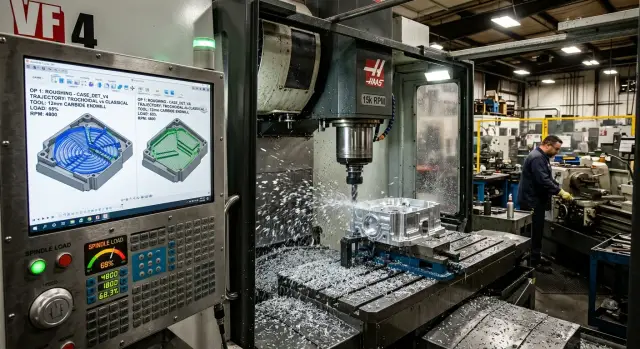
What affects the choice
The same pocket on a housing part can be machined with different toolpaths and the cycle time will differ. The part geometry doesn't change, the cutter is the same, but the toolpath changes almost everything: cutting length, number of entries, heating and how the spindle handles the load.
In roughing people most often compare two approaches. The classic strategy removes material with familiar straight passes and noticeable width of cut. Trochoidal moves the cutter in arcs and loops, keeps contact lighter and often allows higher feedrates.
On paper trochoidal machining almost always looks faster. Feed is higher, the cutting sound is steadier, and the spindle works easier. But cycle time is not calculated from the feed value in CAM alone. Time is spent not only on cutting but also on entries, retracts, lifts, island bypasses and rapid moves. On a simple open pocket one strategy may win. In a deep pocket with narrow zones and frequent turns the result can easily change.
High feed by itself guarantees nothing. If the trajectory becomes tens of percent longer and the tool makes many small arcs, the time gain can disappear. It also happens that the machine moves fast, but the part is finished later because the controller spends time on unnecessary non-cutting moves.
Looking only at time is risky. Two programs can differ by a couple of minutes, but one of them may noticeably wear the cutter faster. Then the saving is eaten by tool changes, pauses, readjustments and the risk of uneven dimensions after wear.
Usually it's enough to evaluate four things:
- net cutting time;
- share of rapid moves and entries;
- spindle load during the cycle;
- tool life measured on several identical parts.
When you look at everything together, the choice becomes practical. For a shallow pocket with good chip evacuation the classic path sometimes honestly wins. For heavy stock removal in a closed zone the trochoidal path often gives calmer operation and fewer wear problems.
How the two strategies work
Classic roughing usually uses straight passes. The cutter removes metal in strips, turns and re-enters the material. This path is easy to understand and quick to program, but in corners and on re-entries the tool often encounters almost full-width cuts.
Because of that the load changes abruptly. On one section the spindle runs calmly, and a second later it receives a noticeable torque spike. If the pocket is deep and the allowance large, these spikes are audible, visible by tool heating and by chip appearance.
Trochoidal machining works differently. The cutter moves in a series of arcs and smooth entries. The trajectory is longer, but the contact angle with the material stays small. The tool does not cut the full width at once but cuts more evenly and predictably.
In practice this means a simple fact: both strategies remove the same volume of metal but in different ways. Classic roughing often wins by simplicity and a shorter path. Trochoidal often gives steadier spindle behavior and less tool load, especially in gummy steels and closed pockets.
There is a nuance often underestimated. The result depends not only on the strategy but also on cut depth and radial engagement. If the radial engagement is left too large, a trochoidal path loses its point. If depth per pass is set too high on a weak tool, even a smooth path won't save you from chatter.
Material also changes the picture. In aluminum the classic roughing often runs very fast because the metal cuts easier. In steel, stainless and heat-resistant alloys a small contact angle already gives a noticeable advantage in stability. On housing parts with deep windows and internal corners the difference is usually felt immediately: in classic cuts the machine often strains on turns, while trochoidal cuts more evenly.
If you remove the theory, the choice comes down to the nature of the load. Classic strategy likes simple geometry and a power margin. Trochoidal suits cases where you need to keep cutting calm and avoid overloading the spindle at each entry.
Where cycle time changes most
Cycle time changes not across the entire part equally, but in specific zones. For housings this is usually wide shallow pockets, narrow slots, deep pockets with high walls and areas with frequent direction changes.
On shallow pockets classic roughing often runs faster. The reason is simple: the path is shorter, there are fewer entries and arcs, and the machine spends less time accelerating and braking. If the pocket is wide and the tool can take a good layer without big load jumps, the classic scheme often gives the shortest cycle.
In narrow slots and deep zones the picture changes. There the classic path quickly hits rising loads, and the operator usually reduces feed, decreases step-over or adds extra passes. Trochoidal keeps material removal more even, so feed remains closer to the calculated value. The toolpath is longer, but actual time can be less.
This is where many err: they look only at path length. A long path by itself solves nothing. If the tool hardly slows in turns and stays in cutting mode, a long path goes by quickly. A short path with frequent braking easily loses by minutes.
The biggest differences show on wide pockets about 1–1.5 cutter diameters deep, in slots where the cutter works near full width, in deep pockets with islands and corners, and on parts with many short transitions and small arcs.
There is also the opposite side. The expected gain from a trochoidal scheme can be eaten by machine accelerations and CNC limits. If the controller cannot hold feed on small arcs and the axes accelerate poorly, real speed falls far below programmed. Then everything looks good in CAM but in the shop the cycle is longer.
Therefore compare times not by the CAM model alone, but by the specific combination: material, depth, cutter diameter and how the machine behaves on the trajectory. On a modern machine the difference between strategies can be noticeable, while with weak accelerations the classic scheme for simple pockets often remains the most sensible option.
What happens to the tool and spindle
Classic roughing often loads the tool unevenly. On a straight section the cutter cuts calmly, but on entry and in corners the contact area rises sharply. At that moment the spindle draws more current, the cutting sound roughens and the edge receives a short, hard shock.
Because of such peaks the tool wears faster than the average cutting time suggests. The part surface may look fine, but the cutter edge already shows small chipping and the spindle and drives constantly catch extra jolts. This is especially noticeable with deep pocketing and when machining gummy steels.
Trochoidal behaves gentler. The cutter follows arcs, keeps a more constant engagement angle and does not heat the cutting edge so much. Spindle load is usually steadier and the shock on entry is smaller, so the tool often lives longer even at higher feedrates.
But trochoidal on its own doesn't solve everything. If chips don't evacuate well, the cutter begins rubbing the material instead of cutting. Temperature rises, the surface darkens and the spindle still receives extra load.
Weak workholding spoils results with any scheme. If the housing part moves even slightly in the fixture, vibration quickly eats any advantage of a given trajectory. So the strategy debate must always go together with the question of the rigidity of the whole system: machine, arbor, chuck, tool overhang and clamping.
Example on a housing part
Take a steel housing with a pocket 180 x 120 mm and 38 mm deep. Inside there are two narrow zones 20 mm wide and several internal corners where the cutter inevitably enters heavier. The situation is common: geometry looks simple but loads change sharply.
On the same machine two programs run with the same 16 mm cutter. The first uses a short path with conventional passes and looks advantageous by net time. The second builds a longer trajectory with smooth loops. There are more moves, but the cutter hardly receives sharp shocks in corners.
With the classic roughing the numbers on the first part are pleasing: the program removes the material in 13 minutes 40 seconds. But in narrow spots spindle load jumps from a usual 55–60% to 85–90%, cutting sound changes and the operator once reduces feed to stop vibration.
Trochoidal processing takes slightly more time — 14 minutes 50 seconds. But the machine picture is steadier: load stays around 60–68%, sound barely changes and chips come out calmer. On such regimes the machine runs without abrupt jolts, and this is noticeable even without sensors.
Summing up briefly: classic wins on one part by about 1 minute 10 seconds. But in tool life the result favors trochoidal: with the classic scheme the cutter reliably holds for four parts, while trochoidal gives eight or nine. Machine behavior also differs. Classic shows load peaks and noticeable vibration in corners, trochoidal runs calmer.
For a small batch of two or three housings the first program may be more convenient. It's simpler, shorter and yields a quick result if the machine is rigid and the pocket not too deep. But in a run of 20 parts the choice is not so obvious. Tool change, extra edge check and cautious feed easily eat the minute that classic saved at the start.
The takeaway from this example is simple: if a part has many narrow zones and deep pockets, a longer trajectory often behaves better than a shorter one. It does not always win on the first part by minutes, but often wins in tool life, steadier machine work and process predictability.
How to choose a strategy
Compare trochoidal and classic roughing not by feelings but by a short test on your part. The same pocket in aluminum, steel and cast iron behaves differently even if the program looks almost identical.
First look at the workpiece material and hardness. Soft aluminum gives one timing picture, while steel or cast iron quickly change spindle load and chip behavior. If the material is gummy or hard, trochoidal often runs calmer because the cutter doesn't bite into the allowance too sharply.
Then assess the machining zone. The most influential factors are pocket depth, width of cut, available cutter length, tool overhang and presence of narrow spots with sharp turns. A deep pocket with a long cutter almost always requires caution. If the tool overhang is long, classic roughing can cause extra vibration. On shallow, open areas it often wins on time.
Next check the rigidity of the whole system. Machine, arbor, chuck and workholding act as a chain. If the part is clamped weakly or sits on a tall spacer, even a good strategy won't prevent chatter. On a rigid center you can take bolder regimes. On a less rigid setup it's better to reduce radial load first rather than just lowering feed.
After that do a short test on the same area. You don't need the whole cycle. Usually one pocket or a segment with the same allowance is enough. During the test record spindle current, processing time, cutting sound and chip appearance. If current jumps and the sound is ragged, the regime is too heavy for that scheme.
Compare strategies only after the same removed volume. That's a common mistake. If one program removed 120 cm3 and the other 80 cm3 the conclusion will be false. After the test inspect the cutter edge, tool temperature and pocket wall condition.
A practical rule works: if the zone is deep, the tool long and the machine or fixture handles impact poorly, trochoidal often wins. If the area is open, rigid and without narrow spots, classic scheme frequently runs faster.
Common mistakes
The most frequent mistake is simple: trochoidal is set by default as if it were always better. For housing parts it's not. If the zone is open, allowance small and the cutter runs stably, classic roughing can give a shorter cycle and is easier to tune. Trochoidal shows its strength where cutting is heavy: deep pockets, narrow passes and large single-pass removal.
The second mistake follows immediately. People change the path but keep old cutting parameters. That's a bad habit. Trochoidal changes cutting character: the engagement angle, average chip thickness and tool behavior in turns differ. If you leave feed and RPM unchanged you may end up either overly conservative and slow or excessively loading the spindle.
Fixtures often create problems. A technologist may choose a longer cutter just in case, although overhang could be shortened by 10–20 mm. For housings this matters: a long tool vibrates more, holds size worse and dulls faster. On paper the program looks fine, but on the machine noise, wall marks and load jumps grow.
Another mistake is looking only at total program time. If the cycle is six minutes shorter it doesn't automatically mean it's the better option. Count how long the cutter holds, how often the operator changes it and how many parts run before regrinding. Sometimes a longer path gives calm cutting and ultimately lowers tooling cost.
Finally, CNC capability matters. Trochoidal creates many small segments. If the controller handles such frames poorly, the machine won't keep programmed feed on arcs and short transitions. Then time in CAM and real time differ a lot.
Before launch clarify: where the cutting zone is open or closed; whether feed and RPM are recalculated for the new path; whether a shorter overhang is possible; whether tool life is considered together with cycle time; and whether the CNC can handle such a trajectory by memory and accelerations. If answers are negative to two or more points, better run a short pocket test than lose a shift fixing the regime.
What to check before start
Spend a couple of minutes on checks before start — it's cheaper than an hour finding the cause of a chip, vibration or odd spindle load. A small mistake quickly turns into scrap or extra wear.
First check the cutter. Diameter must fit the pocket without unnecessary risk, overhang shouldn't be longer than needed and the tooth count should suit the material and feed method. In deep pockets a very dense-tooth cutter can hinder chip evacuation.
Then check the cutting zone. In closed pockets and narrow slots chips must leave freely and not spin under the cutter. If chips accumulate in a corner, even good trochoidal machining loses meaning: the tool starts cutting chips again, heats up and dulls quickly.
Quickly run through basics: does the cutter fit by diameter, overhang and tooth count; can chips exit the pocket without clogging; is the workpiece and fixture rigid; does the spindle keep RPM steady; does the operator know what to watch and listen for in the first minutes.
Workholding rigidity often decides more than the strategy debate. If the part is thin and the clamp weak, classic roughing can sharply increase forces on entry. Trochoidal cuts softer, but it won't help if the part starts to ring.
In the first minutes the operator should stay near the machine. Watch the load graph, listen to cutting sound and check chips. A steady sound, stable RPM and short hot chips usually mean the regime is correct. Howling, load pulsation, long blue chips or slight vibration in the fixture are signs to reduce feed, check overhang or recalculate the path.
If even one point raises doubt, don't run the program at full regime. A short trial pass is much cheaper than changing a cutter and repairing vibration marks on a finished housing.
What to do after the test
Collect test results in one table. When numbers are side by side there's little to argue about: you see where cycle is shorter, where the tool lasts longer and where the spindle gets extra load.
The table typically needs cycle time per strategy, actual metal removal rate per minute, tool wear after the same removed volume, average and peak spindle load, and overall machine behavior — vibration, sound and chip stability.
Then don't look for a single scheme for everything. A mixed approach often works best. Trochoidal wins in deep areas, narrow pockets and where the tool overhangs far. Classic roughing is simpler and faster on open areas where the machine holds feed.
If in doubt, split the part by zones. For example, a housing may have a deep pocket for a seating and several shallow features for fasteners. Use a softer trajectory for the deep pocket and classic passes for the simple pockets. That way you don't sacrifice cycle time where it's not needed.
Also check the machine reserve. If the load graph often hits the upper limit, the problem is not only strategy but the equipment capability. Constant work at the limit affects tool, spindle and process repeatability faster.
Practical conclusion: don't look for an absolute winner. Develop rules for your parts and fix them in the process sheet so the operator doesn't start each time from guesses.
If you are still selecting a machining center for such tasks, EAST CNC can help with consultation, selection, supply, commissioning and service. The company operates in Kazakhstan as the official representative of Taizhou Eastern CNC Technology Co., Ltd., and the EAST CNC blog publishes equipment reviews and practical metalworking materials.
FAQ
When is classic roughing faster than trochoidal?
Most often the classic roughing wins on open, shallow pockets. If the cutter can take material without sharp load jumps, a shorter path and fewer entries give the fastest cycle.
In which cases is a trochoidal trajectory preferable?
If the pocket is deep, has narrow areas, internal corners or a long tool overhang, trochoidal toolpaths usually behave more calmly. They reduce impact loads on the cutter and spindle, so the process is steadier and the tool often lasts longer.
Can I choose a strategy just by the feed set in CAM?
No — you shouldn’t decide by a single feed value in CAM. Look at the whole cycle: path length, entries, retracts, rapid moves and how the machine holds speed on arcs.
How do I know the regime is overloading the machine?
Listen to the cutting sound and monitor spindle load. If current jumps in corners, chips darken, vibration appears or the operator reduces feed, the regime is already too heavy for that strategy.
Which matters more: material or part geometry?
They work together. Material sets the general load level, while geometry shows where the cutter will suffer most. On aluminum classic roughing often runs fast, while in steel and stainless trochoidal usually gives a smoother cut.
Why doesn't a longer toolpath always increase cycle time?
Sometimes a longer path is faster because the machine brakes and accelerates less and the cutter stays in a steady cutting mode. If the cutter rarely slows in turns and stays cutting, extra path length doesn’t always increase cycle time.
How to correctly compare two strategies on my part?
Take the same area with identical stock allowance and remove the same volume with both programs. Then compare time, average and peak spindle load, chip shape and edge wear after a few identical parts.
What is more important: time per part or tool life?
For a single part the shorter cycle may look better. For a series, the option that preserves the cutter longer and avoids constant adjustments usually wins, even if its single-cycle time is slightly longer.
Should trochoidal roughing always be used?
Do not enable trochoidal by default. On a simple open pocket it can only lengthen the toolpath without real benefit in time or wear.
What should I check before the first program run?
Check tool overhang, clamp rigidity, chip evacuation and run a short trial pass. If any point raises doubts, do a test rather than running the full program at once.