
Rough and Finish Machining on Separate Machines: When It Pays Off
Separating roughing and finishing across machines helps reduce spindle overload, slow guide wear and make shift output estimates more accurate.
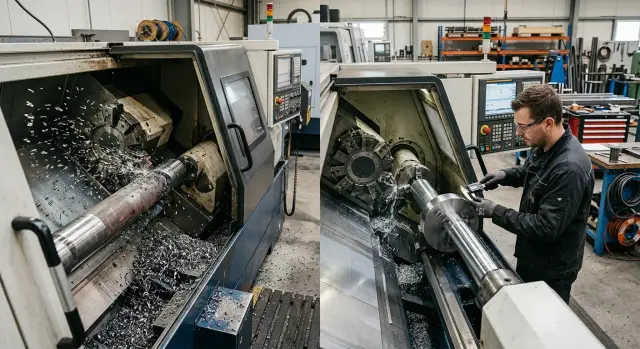
Why one machine starts to slow down
A single machine begins to lose pace when two operations of very different character are done sequentially on it: first heavy stock removal, then an attempt to hold a precise size. Roughing requires force, feed and resistance to shock loads. Finishing needs a calm mode, a clean cutting zone and predictable behavior of the components.
The problem is usually not the program but the rhythm of work. After a heavy roughing cut the spindle, guides and tool have already accumulated heat and load. Chips fly more actively, cooling works harder, and the operator stops more often to remove built-up material and inspect the cutting edge.
Then the same machine has to perform the finishing pass immediately. Finishing doesn’t tolerate haste. It needs a stable size, steady feed and minimal random vibration. If components have heated unevenly, size can drift by tenths of a millimeter. At first this is barely noticeable, but by the end of the shift the scatter often increases.
Usually one of several causes is to blame: rising temperature after roughing, chips and dirt interfering with finishing, time lost to tool change and corrections, and simply the machine needing time to return to a calm mode.
Because of this, the cycle on paper and the real takt almost always diverge. The operator spends minutes measuring, adjusting offsets, blowing out the work area and checking the surface. On a series this accumulates quickly. Over a shift you can lose not just a few minutes but a significant share of output.
This is clear on a simple shaft part. The roughing pass removes bulk quickly, but afterwards the machine is in a different thermal state. If you immediately machine a fit diameter and do the finish pass, the size starts to wander and the tool wears unevenly. In the end the same machine is fighting both for productivity and for accuracy—and most often it loses on both counts.
A machine becomes a bottleneck not because it’s weak, but because it’s asked to perform too different tasks in one cycle, and each task interferes with the other.
How separating operations changes load on components
When roughing and finishing are split across different machines, each one runs in its intended mode without unnecessary overload. This changes not only cycle time but also how the spindle, guides and tooling wear.
The roughing machine handles the main allowance. It cuts deeper, heavily loads the drive, often runs at high torque and receives shock loads at cut start. If the blank has a skin, runout or an uneven allowance, this machine takes the hardest part of the work. That’s fine if the machine was chosen for this mode.
The finishing machine works under completely different conditions. It removes little metal, keeps an even feed and doesn’t experience constant load jumps. The spindle rarely reaches its power limit, heats up less, and the geometry is easier to keep within tolerance. The part shows the result quickly: lower risk of waves, vibration marks or size drift by the end of the shift.
Guides also benefit. Roughing produces heavy chips and more abrasive debris in the work area. If the same machine then immediately performs finishing, that environment remains near the components that need accuracy. With separated operations the finishing machine runs cleaner. This matters: even ordinary cast-iron dust or coarse chips cause extra wear over time.
There’s another effect that’s not obvious at first. The operator doesn’t have to switch the machine constantly between work modes. Fewer mode changes mean fewer tool corrections and fewer attempts to force a universal route to work in every case. Setup becomes more stable and repeatability increases.
On CNC lathes this is especially noticeable in series production. One machine can be kept dedicated to heavy metal removal, the other to a precise, calm finish. This approach usually extends normal life of components and reduces the number of small problems which alone seem trivial but cost hours over a month.
Signs that it’s time to separate operations
If a part runs in series almost every day, losses become visible quickly. A one-off delay hardly matters. A repeated delay on every batch reduces output.
The first clear sign is that the roughing portion of the cycle is much longer than the finishing one. The machine spends a long time removing the main allowance, runs under high load, heats up, and then has to hold a finish size. The precision operation waits while heavy work finishes.
The second sign shows in the operator’s behavior. After roughing they take too long to hit size: they measure more often, tweak the offset, add extra passes. If this happens regularly, the machine is already warmed and guides and other components have taken extra load before finishing.
Another strong signal is tool life dropping quickly on rough passes. You replace the roughing insert more often than expected while the finishing insert lasts noticeably longer. That means heavy removal is costing not only time but predictability for the whole route.
Typically the pattern repeats shift after shift: early parts run well, then size begins to drift more often; by the end of the shift the operator spends more time on checks; after a long run the share of rework or scrap grows; the finishing pass sometimes removes too much and sometimes almost nothing.
On a production bushing for construction equipment this is obvious. Roughing may take, say, 8 minutes and finishing 2 minutes. But those 2 minutes stretch because of measurements and adjustments. Formally the cycle still fits the plan, but in reality the machine no longer maintains a steady rhythm.
If these signs repeat nearly every day, separating operations on CNC should be considered a working option rather than unnecessary complexity. At that point one CNC lathe is trying to do two different tasks at once and is performing both worse than it could.
When it’s better not to split the route
Splitting operations across two posts is not always worthwhile. Roughing and finishing on different machines pay off only where part flow is steady and uninterrupted.
If batches are small and arrive sporadically, the second machine often sits idle. Ten parts today, four tomorrow, then an urgent one-off—this pattern forces the operator to wait for blanks or constantly retool the machine, and the output gain doesn’t materialize.
On simple parts the split often doesn’t pay either. Suppose a bushing cycle on one machine takes 6–8 minutes. Removing the part, moving it to another post, re-fixturing and checking size can easily eat all the benefit of separating.
On CNC lathes this is especially true for short cycles. The cutting itself is fast, while transfers between machines add small losses: bringing fixtures, waiting for an available operator, reclamping, checking the program, and inspecting the first part after transfer. Each item is minutes; over a shift they become a noticeable delay.
Another common case is the second machine being needed only occasionally. The route is split, but there’s no steady load. The machine stands idle and space is occupied while parts wait for an opening in the schedule. If equipment doesn’t run for most of a shift, the scheme is usually more expensive and complicated than running the whole cycle on one machine.
Pay attention to inspection. After moving the part many shops add an intermediate check because the datum changes or the risk of size drift increases. If inspection takes longer than possible savings in cutting time, splitting the route makes no sense.
Usually keep the cycle on one machine when at least two of these conditions hold: small inconsistent batches, a simple part with a short cycle, the second machine won’t reach steady loading, transfers create queues, or post-roughing inspection consumes the time saved. A simple rule: if you can’t show minute-level savings per part on paper, in a real shop they are almost always eaten by waits and repeat actions.
How to decide step by step
Start not from theory but from the actual cycle for a part. Take the route, a stopwatch or CNC data and break the time down into two parts: how many minutes go to heavy metal removal and how many to sizing, surface finish and trimming.
For the "roughing and finishing on separate machines" scheme that’s usually enough to end arguments. When the numbers are on the table it’s easy to see where the machine cuts metal and where it just waits or performs secondary tasks.
- List operations in order and split them into roughing and finishing minutes. If roughing takes most of the cycle, the combined machine often slows output.
- Mark transitions with the largest metal removal. That’s where heat, vibration, insert wear and mechanical load grow.
- Check where the spindle spends the longest time under heavy load. Simple signs are enough: high load percentage, fast tool wear, frequent mode corrections, traces of overheating on chips.
- Compare retooling between the two options. On one machine you lose time changing inserts, jaws and offsets for both stages. With two machines you add part transfer, but each machine stays in a more predictable regime.
- After splitting, immediately look for the new bottleneck. It may no longer be a machine but inspection, washing, material feed or an operator who can’t service two positions.
A good reason to split appears when roughing is heavy and dirty while finishing needs a calm, repeatable mode. In this layout you reduce guide wear on the finishing machine and catch size scatter less often.
A simple example: a casting requires 8 minutes of rough turning and 3 minutes of finishing. On one machine the finishing pass constantly waits for the heavy cut to finish. If you put roughing on a separate machine the finisher runs smoother and shift output increases without large route changes.
If the difference is small, the benefit may not appear. Suppose roughing is 4 minutes and finishing 4, and transfer plus second checks take another 2 minutes. In that case splitting no longer looks attractive.
How to estimate shift output without a complex model
You don’t need a big table of assumptions to estimate shift output. You need actual takt per operation and an honest count of losses that usually don’t appear on the routing sheet.
If roughing and finishing are on different machines, calculate not the "ideal cycle" but how the section works during a normal shift. Measure time across 20–30 consecutive parts, without picking the best cycles.
First record the actual takt for roughing and for finishing separately. Take the full cycle: loading, machining, unloading, brief blowout and workpiece checks. Then separate pure machine time. That shows where the machine cuts and where the operator moves parts, changes inserts or makes brief stops. Add all shift-consuming items separately: blank supply, transfers between posts, first-part inspection, tool changes and small stops. Then compare two schemes: one machine doing everything in sequence, or two posts working together where output is set by the slower station.
A simple example shows the difference better than any complex model. A shift lasts 480 minutes, but 15 minutes go to start-up, first-part checks and warming, and 10 minutes to clean-up and handover. That leaves 455 minutes.
On one machine the part actually takes 10.5 minutes, and inserts/corrections take another 20 minutes per shift. Output is (455 - 20) / 10.5 = 41 parts.
Now split the route. Roughing gives a takt of 6.2 minutes, finishing 4.4 minutes. Transfer and inspection add 0.8 minutes per part, but that time doesn’t load the spindle. The bottleneck is the roughing machine, so its takt sets the pace. A crude estimate: 455 / 6.2 = 73 blanks per shift.
But that number is premature. At shift start the finisher waits for the first rough parts; at the end some blanks may be between operations and not turn into finished parts. If you lose 4–5 parts for ramp-up and tail-off, real output will be about 68–69 pieces.
For CNC lathes this calculation is especially useful because the gap between pure machine time and actual takt is often large. If one operator services both posts, add 0.3–0.5 minutes per part for walk time. Otherwise the calculation looks good only on paper.
This is enough to compare schemes without a complex model. If the split route yields more good parts even after accounting for start-up, transfers and tail-off, test it in a pilot series.
Example on a production part
Take a steel housing made in a run of 120 pieces per shift. Initially the shop runs the whole route on one CNC lathe: rough, semi-finish and finish on the same setup.
The problem appears quickly in the takt. Two heavy rough passes take most of the cycle because they remove the main allowance from a hard blank. The spindle spends most of the time under high load; guides and feed are constantly in force cutting. By mid-shift the operator monitors not only size but heat, chips and insert condition.
On one machine the typical picture is a 4 minute 20 second cycle, with roughing taking more than 3 minutes. An insert change immediately disrupts the rhythm and the finish pass sits at the end of the heaviest cycle.
After splitting, the first machine removes the main allowance and leaves a stable blank. The second machine receives a part without large load jumps, calmly brings it to size and finishes the surface. It no longer wastes resource on heavy cuts, so it holds size more consistently from start to finish.
In practice the first machine may run a 2 minute 30 second cycle and the second finish in 1 minute 20 seconds. With this route it’s easier for the shop to keep the plan. If the roughing machine changes inserts, the finisher still runs from a small buffer of semifinished blanks and output doesn’t drop sharply—the foreman doesn’t have to push rates in the last hour.
For this part splitting roughing and finishing not only evens takt but also reduces peak spindle load on the finishing machine, lowers the risk of size drift after heavy cuts and slows guide wear where precision matters. As a result the same 120 pieces are made calmer and more steadily, without constant racing to hit the plan.
Common mistakes
After splitting many expect an instant output jump but lose it on small issues. The idea doesn’t work automatically. If old habits remain, the new route just adds transfers and arguments between shifts.
The first mistake is leaving too large an allowance for the finisher. Then the finishing machine removes metal almost like the rougher: the spindle runs loaded, the tool heats up and the surface starts to drift. The finishing operation loses its point: it takes longer and wears the machine more than it should.
The second mistake is treating "time that seems missing" as negligible. On paper everything looks neat: rough separate, finish separate, takt shorter. But on the shop floor the part still needs unloading, transport, waiting for free space, reclamping and size checking. Sometimes saving 30–40 seconds on cutting is eaten by a couple of minutes of waiting.
Another problem is pushing the finishing machine into harsh regimes to gain speed. That can shorten the cycle slightly but increases vibration, surface marks, size drift and guide wear. The finisher should run in its normal mode—if it lives like a rougher, scrap usually appears before any production gain.
There are tool mistakes too. After splitting you must recalc the replacement schedule. Inserts on the roughing machine wear faster. Finishing inserts wear slower, but even a slightly blunt edge spoils size and finish. The old combined schedule almost always skews replacement timing: some inserts are changed too early, others too late.
Look at several numbers right away: the actual allowance that reaches the finisher, minutes spent on transfer and waiting, how tool life changed per operation, and levels of scrap and rework after splitting.
The most expensive mistake is looking only at shift output and ignoring scrap. If you gain 12 extra parts but then lose part of the batch to finishing defects, the advantage disappears. A good decision is visible not only in takt but in stable size, predictable wear and calm machine operation.
Quick checks before launch
You don’t need a long calculation before the first run. It’s enough to check a few things on the shop floor. If the scheme looks good on paper but fails on the first ten parts, the reason is usually obvious.
What to check on a trial batch
First check the allowance left after roughing. It must be even part to part, without jumps that the finisher then chases. If one blank leaves 0.6 mm and another 1.2 mm, the finishing operation will drift in both time and size.
Next check fixturing. The finisher must receive the part in a repeatable position. If the operator spends a long time re-fixturing each piece, splitting loses its purpose. A simple good sign: the part seats the same way and the first control part doesn’t need lengthy adjustment.
Measure inspection time separately. Inspection should not become its own bottleneck. If checks take 3 minutes with a 4-minute takt, you’ve already found the bottleneck. In that case either change the inspection scheme or revise the route.
Another useful test is to run both machines for a short series and watch where waits accumulate. The rougher shouldn’t deliver parts in bursts, the finisher shouldn’t stand idle waiting for a batch, inspection should fit the normal rhythm, operators shouldn’t make unnecessary transfers and it must be clear where each part goes after each step.
If one machine runs 12 minutes and the other 4, downtime is almost inevitable. Sometimes tolerable for a small series, but for continuous production such imbalance usually costs more than it seems.
Watch people as well as minutes. If the operator is confused about which part to take to the finisher, where to measure and where to put good parts, the route is still raw. A normal scheme is clear without many explanations from the first shift.
For CNC lathes this short test is often more useful than a long spreadsheet. If the allowance is stable, the datum repeats, inspection doesn’t break the takt and both machines run without long pauses, you can move to series production.
What to do next
If you feel splitting roughing and finishing will increase output, don’t rebuild the whole route at once. Take one part that runs in series every day. It’s easier to see real time, size and tool losses on a repeat part than on one-offs.
First record baseline data on the current scheme. Then run the new scheme for 3–5 similar shifts: same material, similar batch, same tolerance. Comparing different blanks and modes quickly leads numbers astray.
Track a few simple KPIs: takt per operation and total shift output, size after roughing and after finishing, actual tool life, scrap rate, reworks and downtime. This quickly shows where the effect hides. Sometimes the new route doesn’t speed cutting but the shift runs more evenly: the roughing machine takes heavy cuts, the finisher keeps size more steadily and the operator intervenes less. That steadiness often raises output more than expected.
Record data per shift in a simple form: cycle time, number of good parts, stop reasons and when an insert was changed earlier than planned. After a few days you’ll see if the scheme helps or only looked good at start-up.
If numbers confirm the effect, keep the variant the shop can hold calmly and predictably. In the shop floor that matters more than a pretty idea on paper. Even if the new scheme gives a slightly lower theoretical maximum but produces less scrap and fewer disruptions, it’s usually the better choice.
If special equipment selection is needed, EAST CNC can help in practice. The company operates as the official representative of Taizhou Eastern CNC Technology Co., Ltd. in Kazakhstan, selects CNC lathes, organizes delivery, commissioning and service. This is useful when you need to align roughing and finishing with actual load, machine stiffness and planned output.