
Roller burnishing instead of grinding: where it works
When does roller burnishing instead of grinding give the right size and surface roughness, and when does it only complicate the route and add an unnecessary step?
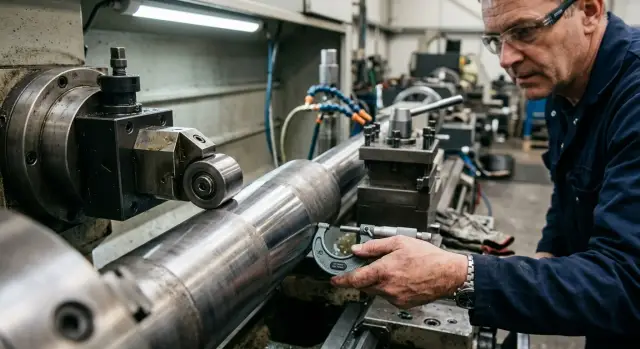
Why this choice is controversial
After turning, a part is often already very close to tolerance. The drawing usually requires only a little more: remove tool marks, slightly adjust size and improve surface finish. That’s when the question comes up — grind or try to finish with a roller.
Grinding gives a predictable result. The process engineer normally knows in advance how long the operation will take, what mark will remain on the surface and how to handle the part when tight tolerances are required. But that predictability costs machine time, an extra operation and another transfer of the part along the route.
That’s why roller burnishing looks attractive. The part is already clamped, the size is close, and the operation promises to improve roughness without a new setup. On paper everything seems logical: fewer steps, shorter cycle, lower cost.
The problem is that this technique does not perform the same on every batch. The same shaft can give different results if the allowance, material hardness or cutting mode changed before burnishing. Then the roller no longer finishes the surface but tries to fix what should have been removed by the cutting tool.
Debates usually come from different priorities on the shop floor. Production wants a short route. Quality control wants stable dimensions. The process engineer wants a method that won’t fail on the hundredth part when the tool has worn or the blank came from a different heat.
On CNC turning this is especially noticeable. If the program already brings the size close to nominal, operators want to remove the extra step. But a mistake in the route quickly makes the part more expensive: you add a cycle, increase scrap risk, and the minutes saved are lost to rework.
A simple example. After turning the shaft almost holds size, but the tool mark is still visible. If the surface is suitable for burnishing, the roller can smooth the micro-profile and slightly densify the top layer. If the shape is unstable or the allowance is chosen incorrectly, grinding will still return to the route. Then burnishing was an unnecessary operation.
Because of this, the choice generates many arguments. The decision seems quick, but the cost of a mistake is higher than it first appears. One extra setup on a series of hundreds of parts often costs more than a carefully chosen finishing process from the start.
What roller burnishing actually does
Roller burnishing does not remove metal. The roller presses down the peaks of micro-roughness and pushes them into the surface layer. Because of this, the post-cut mark becomes lower and the surface looks and measures noticeably smoother.
This effect appears only when the part has already been properly turned. If the tool leaves a consistent, repeatable mark, the roller will smooth it. If turning left torn grooves, vibration marks or local tearing, the roller will not remove them. It only presses down what is already there.
Therefore rollering instead of grinding is not always suitable. It reduces roughness well on cylinders, journals, fits and other areas where the geometry is already produced by the cutting tool and only the top layer needs finishing. Sometimes this is enough to avoid a separate abrasive step on a simple part.
Size also changes, but usually within small limits. Material is redistributed, not removed, so the diameter can grow slightly or shift depending on the processing strategy. That is normal behavior for the process. If the dimension is already near the tolerance limit, the influence of burnishing must be accounted for in the route in advance.
There is a strict limitation: the roller almost never fixes geometric errors. If turning left taper, runout, ovality or a lengthwise wave, burnishing will not turn such a surface into an accurate one. The roller repeats the part’s base geometry. Sometimes the surface even looks better to the eye, but measurements show the same issue.
The idea is simple. First the cutting tool creates the correct geometry, then the roller finishes the micro-profile. If you swap these tasks, the result almost always disappoints.
Where the method works
Roller burnishing performs best on simple continuous surfaces where the roller can run smoothly and not lose its trajectory. If after turning the part has only a small allowance for smoothing rather than significant size correction, this technique often achieves the required roughness without grinding.
The first and most obvious candidate is external cylinders of shafts and axles. On such features the roller can travel the full length, compress the peaks left by the cutter and make the surface smoother. This is especially noticeable on smooth bearing seats where you don’t need to correct strong ovality or taper, but you do need to remove marks from the finishing pass.
Bearing journals and seats for bushings also suit the method. For these zones both size and stable surface finish matter. If CNC turning has already produced the correct geometry, burnishing helps bring the journal to working condition faster than a separate finishing step. On a series this is immediately felt: each extra operation affects the whole cycle.
The best results come from long smooth areas without grooves, holes, sharp transitions or reliefs. The straighter and more continuous the contact path, the more predictable the roller’s work. On a long shaft with a simple cylindrical zone for a bushing, the effect is often visible on the first trial batch.
Which materials are better suited
The method prefers ductile materials. These include many structural steels with normal toughness, some stainless steels, and aluminum and copper alloys. On these materials the roller truly densifies and smooths the surface.
The process performs worse where the material is too hard or brittle. In such cases instead of a smooth surface you may get little effect, local damage or increased scatter in size. For these parts a conventional finishing pass is often more honest and predictable in outcome.
In short, burnishing works well where the part is already nearly correct after cutting. The roller does not fix large geometric errors. It refines what has been machined accurately, especially on simple cylindrical surfaces.
Where it only adds a step to the route
Problems begin when the part departs from a simple cylindrical shape. On some surfaces burnishing does not rescue the route but only lengthens it. Time is spent while size and finish remain unstable.
The first weak spots are areas near shoulders, steps and sharp transitions. The roller needs a steady run and space to enter and exit. If a shoulder sits immediately after the working surface, the roller does not have time to establish stable contact. As a result the edge turns out worse than the middle, and the transition easily gets a build-up or an extra mark.
The same applies to grooves, slots and any interrupted tool path. Burnishing prefers continuous surfaces. When the roller passes over interruptions, pressure becomes uneven. Afterwards parts often show stripes and roughness varies significantly from area to area.
Material is not always straightforward either. Brittle alloys and very hard zones do not tolerate plastic deformation well. Instead of smoothing you can get microcracking, edge chipping or almost no effect. For such parts a standard finishing pass is usually clearer and more reliable.
Burnishing does not correct part geometry. If turning left taper, ovality or waviness, the roller will not remove those errors. It will repeat the geometry and only smooth the peaks. Therefore when burnishing shafts you first check geometry, then Ra.
There is also a practical case: after turning the dimension still fluctuates noticeably. If diameter varies due to machine stiffness, tool wear, heat or poor clamping, burnishing will not stabilize the process. First you must calm the finishing pass itself.
In practice the decision to drop the operation is usually clear quickly. If the part after turning still “lives its own life,” the roller does not fix the problem. It only makes the route longer and more expensive.
How to decide
Look not at the roller, but at the surface after turning. If after the finishing pass the diameter is already close to tolerance and the geometry holds along the length, burnishing can close the question on roughness and slightly adjust size. If turning left taper, ovality or noticeable runout, the roller will not help.
A short checklist is most convenient:
- measure diameter at several sections and separately check geometry;
- compare actual size with tolerance and calculate the available allowance in hundredths;
- take material and hardness into account;
- make sure the roller can pass the area without obstacles;
- make a trial part and compare measurements before and after.
A trial only makes sense under normal conditions. Use a blank from the same heat, don’t change cutting modes between measurements without reason and don’t test on a tool that is nearly spent. Otherwise you are testing not the method but a random set of factors.
If everything aligns, roller burnishing instead of grinding is often justified. It removes a separate operation, shortens the route and helps achieve the needed roughness directly on CNC turning.
If at least one item fails, it’s better to stop earlier. For example, if the shaft holds size only in the middle but drifts by several hundredths at the ends, burnishing will make the surface smoother but won’t fix the main issue.
Look for a stable result, not the best-looking one. If only two or three out of ten parts reliably pass, the method is unsuitable for a series.
Mistakes that give false results
False conclusions usually arise not from the method itself but from how it’s placed in the route. A part can look shiny after burnishing and an instrument can show a low Ra, but that does not mean the operation replaced the finishing cut or grinding.
The first common mistake is trying to remove deep tool marks with a roller. Burnishing does not cut metal. It redistributes the top layer and smooths the peaks of micro-roughness. If turning left visible grooves, the roller will not remove them. It will only make the pattern less noticeable.
The second mistake is pressing harder than the material allows. It seems that more force will produce a smoother surface. In practice the dimension can shift and a thin wall may start to deform. On a bearing journal this is especially unpleasant: the seat may shine but the diameter can move by several hundredths and the part fails inspection.
The third mistake is not about burnishing but about the turning before it. If the cutting tool is unstable, leaves steps, vibration marks or a torn surface, the roller will not fix the cause. It only hides part of the traces. So first you must stabilize the finishing pass.
Time is often underestimated. On paper burnishing looks quick. But the real route includes tool approach, trial parts, measuring size after the pass and readjustment if the batch material differs. On a single part this is small; in a series extra 15–20 minutes for setup and control change the economics.
Another mistake is comparing with grinding only by Ra. Ra is convenient, but not the only metric. A part can show good Ra yet lose on roundness, waviness or dimensional stability over length.
If a result seems successful, check at least four things: size before and after burnishing, surface geometry, repeatability over 5–10 consecutive parts and total operation time including inspection. This stage usually reveals that the roller finishes a carefully turned surface well, but poorly rescues an unstable route.
Example on a simple part
Take a common shaft with two bearing journals. On the drawing everything looks simple: a long journal for a bearing, a shorter one nearby, a shoulder and a groove. On such parts it’s especially clear where burnishing instead of grinding helps and where it only complicates the process.
After finishing turning the long journal often already holds size stably. The cutter runs evenly, without sharp entries and exits, the machine does not pick up extra vibration, and the diameter is predictable. If low roughness is needed in this area, burnishing usually gives a good result: the roller smooths micro-irregularities and a separate grinding step becomes unnecessary.
Imagine an 80 mm long section without grooves, threads or diameter steps. After turning it is in tolerance but the surface is too rough for a bearing seat. Here burnishing works well. It does not correct geometry but on a smooth journal often brings the surface to the required condition faster than a separate finishing operation.
At the shoulder the situation changes and many make mistakes. The roller no longer presses evenly across the contact width. Near a groove the tool lacks a normal track, and edge results become worse than the middle. Instead of a uniform surface you may get an area with a different pattern, and sometimes the size shifts.
Therefore for such a part the route is often mixed. The long smooth journal is left for burnishing, while the shoulder and the area near the groove keep the conventional finishing pass without a roller. This is normal practice: don’t try to solve everything with one operation, use it only where it truly brings value.
Check before production launch
Roller burnishing is verified not by faith but by selective trials. If the area suits the method, you achieve size and lower roughness in a single pass. If not, the operation only lengthens the route and hides turning problems.
Before the first part it’s better to check the actual blank and the whole processing route rather than rely on catalogue settings. The roller does not cure geometry. It densifies the top layer and smooths cutter marks, so the base must be prepared.
A few quick questions answer the fit. Is the area continuous or does it have a groove, hole or step? Does the material deform well under pressure or is it too hard and brittle? After the finishing pass does the part already keep shape or remain tapered, oval or with runout? Does the tool have a free entry and exit? Is it clear where diameter will be measured and how roughness will be checked?
In practice this is easiest to test on a standard journal. If after turning it is even, without breaks and with a normal size allowance, burnishing often gives a good result without grinding. A short strip between a shoulder and a groove usually does not justify the step: the roller will pass but stability will be lacking.
If at least one point fails, don’t expect a miracle from roller pressure. In that case the finishing pass remains the main way to hold size, and burnishing should be applied only where the surface supports a stable operation.
What to do next
Test the method on a typical part you already produce in series. A shaft, bushing or step with a clear tolerance, stable material and repeatable tooling is suitable. On one-off parts conclusions are often random.
Prepare two routes for the same part. Route A — standard finishing pass. Route B — same roughing route but with burnishing on the selected surface. This makes it easier to see where roller burnishing instead of grinding really works and where it only lengthens the cycle.
Compare by measurements, not by how the part looks. You need sizes before and after burnishing, roughness at several identical spots, cycle time per part and per batch, scrap and rework rates, and the number of extra readjustments during the series.
Run the test on 10–20 consecutive parts rather than 2–3. The first part almost always looks better than the tenth. If size holds only at the start of the batch, the route cannot be considered successful.
Also watch the scatter, not only the final size. Sometimes burnishing improves roughness while the dimension shifts negative and the part must be rescued by an extra cut. In that case the operation does not remove grinding but adds another step.
The decision is usually straightforward. If the new route gives the required finish, holds size, shortens the cycle and reduces scrap, it can be adopted. If gains appear only sporadically or require frequent adjustments, it’s wiser to keep the conventional finishing pass.
If the choice depends on machine selection, rigidity of the setup or the processing route, discuss it with EAST CNC specialists. The company supplies CNC lathes and other metalworking equipment and assists with selection, commissioning and service, so the conversation can start from the part, tolerance and required result.