
Relocating a Machine Tool Within the Workshop Without Losing Geometry
Moving a machine tool inside the workshop takes a plan: we cover dismantling, transport, leveling, a test part, and the checks that catch misalignment.
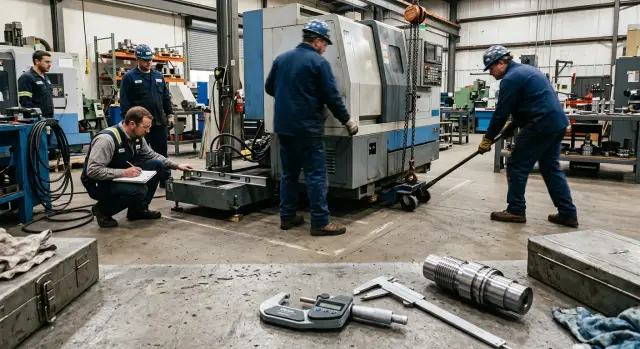
Why a machine loses accuracy after a move
After being shifted, a machine often starts to "lie" not because something inside is broken, but because it is resting on the floor differently. For metalworking, that is already enough. Even a small tilt in the base changes the position of the guides, spindle, and feed units. On the indicator, the difference may look almost invisible, but on the part, size drift appears quickly.
Relocating a machine tool inside the workshop looks simple: take it from its place, move it, and start it up again. In practice, several conditions change at once. The floor in the new spot may have a different slope. The supports may sit unevenly. If the frame shifts even a little during lifting or lowering, the machine starts working under internal stress instead of in its normal position.
Most often the problem is tied to three things: floor rigidity, the condition of the supports, and leveling accuracy. If one point has settled, the bed gets twisted. If one support is tightened more than the others, the geometry drifts even further. On a heavy machine, a fraction of a millimeter at the base can easily turn into a noticeable error over the length of the cut.
The worst part is that the defect is not always visible right away. At idle, everything may look normal. One test part may also come out within tolerance. The error often shows up in the first batch, when the machine warms up, the assemblies go under load, and repeatability starts to drift. Then the operator sees a strange picture: the size holds, then slips, and the reason is not obvious.
A common workshop situation looks like this: before the move, a shaft consistently came out within tolerance, but after relocation the first two parts are fine, on the fifth a taper appears, and by the tenth the size is off by several hundredths. The cause may not be the tool or the program, but the tilted base.
After the move, there is only one goal: bring the machine’s geometry back to working condition under real load. For that, it is not enough to place it in the new spot and power it up. You need careful dismantling, calm transport, precise leveling, and a test cut that shows the real picture on the part, not just on the instruments.
What to prepare before dismantling
Before moving the machine even one meter, record its current condition. Otherwise, after installation you will not know what changed: the machine itself, the floor, or the cutting mode.
First, save the result the machine is producing now. Take a test part or make a simple check part in the usual mode. Write down the dimensions, tolerances, runout, and surface finish if you normally monitor it. If the machine already holds size well, these data will quickly show what shifted after the move.
Then record everything that is usually forgotten after a couple of hours. Photograph the supports, shims, anchors, cables, hoses, chains, the position of the chuck, tailstock, and fixtures. Take both wide shots and close-ups. A good photo on the shop floor is often more useful than long explanations.
Also write down the level readings separately. Check the machine at the points where you normally level it, and mark the measuring location right away: longitudinal direction, cross direction, front and rear support zones. Later you will compare not impressions, but specific numbers.
Before dismantling, the machine must be fully cleared. Remove workpieces, tools, holders, removable fixtures, containers, and anything that could shift during movement. Clean the work area of chips and drain fluids if the manual requires it. Dirt and chips often make it hard to seat the supports properly in the new location.
The route should also be checked in advance, not when the crane is already in place. You need to know whether the floor can handle the machine’s weight and the equipment, whether there are thresholds, rails, grates, or pits on the way, whether the machine fits in height and width, and whether doors, columns, cable trays, or pipes will get in the way.
If the machine is heavy or precise, it helps to mark the old support positions on the floor in advance and record the distances between them. For CNC lathes, this makes it easier to return the machine to a state close to the previous one. The better the preparation before dismantling, the fewer surprises there will be after the first test part.
How to remove the machine from its place
Mistakes begin not on the transport cart, but at the moment of disconnecting. If the machine is removed in a hurry, it is easy to end up with a tilt, a drifting zero, or strange axis noise after installation. So the rule is simple: do not force anything, do not leave anything "for later," and record every step.
First, shut off power, air, and coolant supply completely. After that, label all connections: cables, hoses, sensor connectors, pendant controls, pumps, and the lubrication system. A simple tag and a few photos often save hours during reassembly. One unlabeled connector can cost a full extra day of downtime.
If the transport plan requires unloading the machine, drain the fluids. Most often this is coolant, and sometimes oil from separate units or the hydraulic system if the manufacturer clearly requires that order. Do not leave fluid as is if, during tilting or lifting, it can move where it should not.
Next, secure all moving parts according to the manufacturer’s instructions. Every model has its own points and sequence, but the idea is the same: axes, carriage, turret, table, tailstock, or gantry must not shift during a jolt. If there are no factory locks, do not replace them with random straps or supports against the cover.
Fragile parts are better removed in advance. These are usually external scales and sensors, protective covers that are easy to bend, remote panels, handles, and parts sticking out beyond the machine’s dimensions. These are often what get caught during transport and create extra problems.
The machine may be lifted only at the points specified by the manufacturer. Do not attach slings to the cover, spindle unit, guides, or places that only seem strong. That can ruin the geometry before the machine is even moved.
If the manual does not give a clear lifting scheme, it is better to stop and confirm it with the supplier or service department. For complex models, including CNC machines and machining centers, that pause costs much less than repairing damage after one wrong lift.
How to move the machine around the workshop
Problems during transport are more often caused not by distance, but by jolts, tilt, and the wrong equipment. While the machine is standing still, everything looks simple. As soon as it leaves the base, any hurry starts working against accuracy.
First, calculate the real weight. Use not only the factory weight, but also everything left on the machine: the chuck, turret, tank, part of the fixtures, and sometimes even chips in hidden cavities. After that, choose the moving method. A compact machine may work with reinforced carts or rollers, while a heavier one may require a crane or rigging system with enough lifting capacity.
If you are choosing between two options, it is usually better to pick the one with more reserve and better speed control. It is a boring decision, but almost always the right one.
Before the first move, check all moving units again. Pay special attention to cable carriers, coolant hoses, pneumatic lines, and sensors. Do not pull the machine by them even for half a meter. The load there is not designed for that, and the damage often shows up only after startup.
During transport, the movement must be slow and steady. No sudden starts, stops, or attempts to "just nudge it" with a forklift from the side. On uneven floors, reduce speed even more. If the route crosses a joint, ramp, or damaged section, it is better to lay steel sheets or sturdy plates in advance so the supports do not sink and the frame does not twist.
At the new location, do not place the machine right against the wall. Leave space for service, cabinet doors, access to the units, and ordinary cleaning around the supports. Right after installation, check how the floor is carrying the load at each point. If one leg is hanging or, on the contrary, taking too much weight, the leveling work will already start with an error.
A useful practice here is simple: walk the route in advance with empty equipment, check the passages and turns, mark the final machine position on the floor, prepare the shims for the supports, and assign one person to give commands along the entire route. Once the machine is in its new place, the job is not finished. Leveling will decide everything.
Leveling step by step
After the move, the machine first needs to be properly seated on its supports and the obvious tilt of the frame removed. If one point is hanging or carrying almost the entire load, precise adjustment will not be possible.
Place the level only on base surfaces. Cladding, covers, and decorative panels are not suitable because they can easily introduce an error. Usually you check guideways, machined mounting surfaces, or other surfaces connected to the machine’s geometry.
Leveling a machine after relocation takes patience. Do not tighten one support all the way while the others are still uneven. Work in a circle and adjust in small steps so the frame does not twist. Sometimes a quarter turn is enough to shift the level more than you expect.
A useful rule is simple: adjust one point, then check the others again. That makes it easier to see where the machine starts to drift. On a long bed, this is especially noticeable.
Once the initial level is set, do not rush to call the job finished. Let the machine sit for a few hours. During that time, the supports, anchors, shims, and the floor itself may settle a little, and the readings can change.
After the pause, repeat the measurement at the same points and in the same order. If the difference is small, adjust the supports again in a circle, without sudden moves. Then check the fasteners. Sometimes they loosen at this stage.
One more check is needed after the first warm-up. Let the machine run idle so the spindle, feed units, and bed warm up. Then take the level readings again and inspect the fasteners. This is often where things appear that were not visible on a cold machine.
If you are dealing with a heavy CNC lathe or a 5-axis center, it is better not to rely on guesswork. A few hundredths of an installation error later show up as taper, runout, or size drift on the part. It is easier to spend an extra hour on leveling than to search for the cause of defects across the whole process chain.
What the test machining will show
Test machining after installation gives a clear answer: is the machine cutting the same way as before, or has its geometry already shifted? Without it, it is hard to tell whether the problem is in the installation, the tool, or the cutting mode.
After relocation, do not start with a complex part right away. It is much more useful to make a simple test part from familiar material that the shop uses all the time. Then the result is easier to compare with what you had before the move.
A short check part with clear operations works well: facing the end, a pass along the outside diameter over a length, a repeated finishing pass with the same tool, and a runout check after locating. Sometimes repeating the same operation two or three times is enough to see the problem.
The point is not the part itself, but checking how the machine behaves through simple measurements. First look at the size along the length, then at the end face, then at runout and repeatability. If one pass gives a good result and the next one shifts the size, that is already a warning sign.
It is better to compare the result not with the catalog, but with the same machine’s data before the move. If it used to hold size steadily on the same blank, and now the size drifts by 0.03–0.05 mm, the cause is usually the new machine position, the supports, or the leveling.
It is best to separate machine error from tool error right away. A dull insert, weak clamping, or a problematic insert can also spoil the picture. That is why test machining should use a proven tool, a familiar mode, and a normal blank without surprises.
There is a simple sign. If the first parts come out fine, but the size starts drifting after warm-up, do not rush to change the offsets. First check the supports, the level, and whether the bed is resting evenly. Very often the problem is not in the program, but in the machine sitting crooked after transport.
Good test machining leaves numbers behind, not impressions. Record the dimensions, shop temperature, tool number, and the result of repeated passes. These notes save a lot of time later if the deviation returns a day or a week later.
Mistakes that ruin geometry
After relocation, the machine often does not start lying right away. At idle, everything looks normal, but the first batch gives taper, size drift, or vibration marks. At that moment many people blame the program or the tool, although the problem is in the setup.
One common mistake is placing the machine on a section of floor with a height difference and hoping the anchors will fix it. Anchors hold the machine in place, but they do not correct a crooked base. If the supports are at different heights, the bed is already twisted before the first startup.
There is another extreme: overtightening the supports. When every point is cranked down as hard as possible, it is easy to twist the bed. From the outside everything looks tight and secure, but in fact the machine is already working under internal stress. Then strange dimensions appear, and the operator wastes time adjusting offsets.
Hurrying after the move also costs a lot. The machine is connected, and production starts right away. That should not be done. It needs warm-up, a repeat level check, and a test part. Otherwise, thermal expansion will mix with the installation error, and the source of the defect will become hard to see.
Another mistake seems minor, but it hits accuracy hard. During dismantling and transport, sensors, covers, stops, and safety elements are removed. Then one sensor is reinstalled a little off, one cover is not put back, and one cable is pulled tighter than before. The machine is no longer the same as before the move, even if it looks normal from the outside.
The order of checks is better kept simple. First check the floor, the supports, and the fasteners. Then check the level and tightening according to the diagram. After that, reinstall all removed assemblies. Only then start the test part.
When dimensions drift, do not immediately look for an error in the program. If the same program used to work fine and the problem started after installation, the machine should be leveled again after the move first. Only then does it make sense to review the code, offsets, and cutting modes.
Short pre-start checklist
Before returning the machine to normal work, check a few things. This step takes little time, but it often saves the first batch.
- Compare the level readings with the notes made before dismantling. Measure the same points in the same order.
- Inspect the supports. Each leg should sit firmly and carry load.
- Check the cables, hoses, and coolant supply. They should not pull on the body or act like a spring.
- Make a test part on a cold machine, then repeat the same operation after warm-up.
- Agree in advance which dimensions the operator will check during the first shift.
The list looks simple, but this is exactly where mistakes happen most often. You can level a machine almost perfectly and still get size drift just because a tight bundle of cables, after relocation, pulls the cabinet and body slightly to one side.
If you work with a CNC lathe, do not judge the result by one good part. Take two identical blanks, machine them with a pause after warm-up, and compare the measurements. That makes it easier to see whether the machine’s geometry really holds up under load, not just during a formal check.
If even one item fails, do not start production. Spending another 20–30 minutes on corrections is always cheaper than dealing with defects in the whole first batch.
A simple workshop example
In one workshop, a CNC lathe was moved closer to a new workpiece supply line. The decision looked logical: it became easier for the operator to load material, and the cart no longer blocked the passage. The move itself took less than a day, and they decided not to stretch out the startup.
Dismantling and transport were done carefully. The machine was disconnected, removed from its mount, moved to the new place, and connected again. The program was not changed, the tool stayed the same, so everyone expected the usual result on the first part.
But after startup, a taper appeared on the long blank. On a short part, it might have gone unnoticed, but on a shaft about 300 mm long, the error showed up immediately. The operator first went down the usual path: checked the offsets, clamping, insert condition, and cutting mode. That took time, but the cause was not there.
When they returned to the machine base, the picture became clear. One support at the new location had settled slightly. The floor looked level, but under the machine’s weight it had given a small height difference. That was enough for the bed to twist and the machine geometry to shift enough that the size drifted along the length.
After that, they did a proper leveling job. They loosened the fastening, adjusted the support, leveled the machine again, and checked its position at the control points. Then they took a new blank from the same batch and repeated the test machining under the same conditions.
The second part showed a different result: the taper was gone, the size returned to tolerance, and the setup took only a few minutes. If the team had started with checking the supports and leveling, they would have saved several hours. One missed step after a move often feels minor only until the first long part.
Cases like this quickly teach people not to rush. When a machine is moved even a few meters, do not trust the apparent flatness of the floor and start production right away. First leveling, then test machining, and only after that normal work.
What to do after the first part
The job is not finished after the first part. This is exactly when you can see whether the machine geometry has come back and whether it holds size under load, not just according to the level and indicator.
Immediately save the final level readings after leveling. Write down where the level was placed, what values you got on each axis, which shims remained under the supports, and what result the test part produced. If the size drifts a week later, you will have something to compare against.
The test part should not be judged by eye either. It is better to keep a measurement record: diameter, length, taper, runout, and surface finish. If the part is a test piece, note the date, machine, tool, and cutting mode. After several shifts, this helps determine whether the problem is in the machine’s setup, the fixtures, or already in thermal stability.
After relocating a machine inside the workshop, it is useful to schedule a repeat check after several shifts of operation. The machine should sit under real load: with warm-up, stops, vibration from nearby equipment, and the operation of hydraulics and cooling. In practice, people check the level again, the basic dimensions of the test part, and the machine’s behavior on the same program.
If accuracy does not return to the needed value, do not start production with the attitude of "it’ll do for now." A small drift in level or axis position quickly turns into batch defects. In that situation, it is better to call service before production starts than to sort out the cause through dozens of bad parts.
For Taizhou Eastern CNC Technology machines in Kazakhstan, startup and service are handled by EAST CNC. If the size starts drifting after relocation, taper increases, or the machine behaves differently in the morning and by the end of the shift, this kind of check often saves both time and material. In the east-cnc.kz blog, the company also publishes equipment reviews and practical metalworking tips.
A good final habit is simple: save the measurements, schedule a repeat check, and do not argue with the facts. The move itself is not the problem. Trouble starts when checks are skipped and the first good part is taken as proof that everything is already fine.
FAQ
Why does a machine lose accuracy after being moved?
After relocation, the machine often changes the way it rests on the floor. Even a small base tilt shifts the guides and spindle, and the error quickly shows up on the part. The machine itself may be fine, but the geometry no longer behaves the way it did before the move.
What should be done before dismantling?
First, save the machine’s current state. Record the dimensions of a test part, take level readings at the usual points, and photograph the supports, shims, cables, and hoses. Then remove the tool, fixtures, workpieces, and anything that could shift during lifting.
Should the tool and part of the fixtures be removed before transport?
Yes, it is better to remove everything unnecessary. The chuck, tool holders, tools, removable guards, and protruding parts add weight and make the machine harder to move safely. That lowers the risk of impact, shifting, and extra load on the frame.
How do you know if the new spot in the workshop is suitable?
Check not only how flat the floor is, but also how rigid it is. If one support sinks under the machine’s weight, the bed will twist. Before installation, it helps to inspect the area, run the route with equipment, and prepare shims for the supports in advance.
How should a machine be lifted without ruining its geometry?
Lift the machine only at the points specified by the manufacturer. Do not attach slings to covers, guides, or assemblies that only look strong. If the lifting diagram is unclear, stop and confirm it with the supplier or service team.
Why wait after the initial leveling?
Because the supports, anchors, and floor may settle a little after installation. If you call the job done right away, the machine may move out of level within a few hours. Let it sit, then check the measuring points again and adjust the supports in small steps.
What test part is best after installation?
Use a simple part made from familiar material and run it in a familiar mode. Usually a faced end, a pass along the outside diameter, and a repeated finishing pass with the same tool are enough. That kind of check shows taper, runout, and size drift faster.
What should you do if the size starts drifting after warm-up?
Do not rush to change the correction values. First check the level, the supports, and how the bed sits under load. If everything is fine when cold, but the size starts drifting after warm-up, the cause is often a twisted base.
Can you start production if the first part is good?
No, one part is not enough. A machine may cut within tolerance at the start and then drift during production once the spindle and feeds warm up. Repeat the same operation after warm-up and compare at least two identical workpieces.
When should you call service?
Call service if the machine still shows taper, runout, or drifting dimensions after re-leveling. The same applies if the floor sinks, the lifting plan is unclear, or the machine behaves differently from shift to shift. For Taizhou Eastern CNC Technology machines in Kazakhstan, this check is carried out by EAST CNC.