
Reference Part on Repeat Orders: How to Remove Disputes
On the shop floor, a reference part for repeat orders helps quickly verify dimensions, start the batch without extra trial runs, and reduce disputes between OQC, the foreman, and the setup operator.
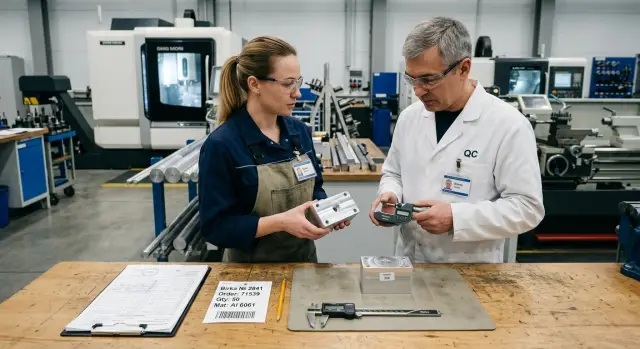
Where confusion starts on a repeat order
Most problems do not happen on the first batch, but a few months later. The part has already been made, the program is saved, the card is in the folder, but the restart still turns into an argument. One person remembers that the outside diameter was kept closer to the upper tolerance limit, another is sure it was the opposite, and a third points to an oral agreement from the last setup.
On the shop floor, this looks familiar, but it takes a lot of time. The setup operator opens the route card and sees one set of data. The OQC inspector pulls an old report and finds different numbers. The foreman remembers that last time the first part had to be “tweaked” after a trial pass. While everyone checks papers and memory, the machine sits idle.
Usually the argument is not about a complex geometry, but about small details that later cause scrap or extra setup. Most often, four things do not match:
- which size on the first good part was accepted as the working reference;
- whether there was room to the upper or lower tolerance limit;
- what was used to check the size last time;
- after which pass the part was considered stable.
If there is no saved sample, the first part of a new run almost always raises questions even before production starts. Formally, everyone relies on documents, but a document does not always show the real picture. It may not mention that the operator slightly changed the correction after the machine warmed up. And that is exactly what produced the right result.
Imagine a simple production bushing. The first batch came out fine, the order was closed, and six months later the customer repeats the same item. The program is saved, the tool is similar, the material is the same. But even on the first part, extra measurements begin: the foreman asks for the diameter to be checked again, OQC doubts the length, and the setup operator makes one more trial pass “just in case.” It is easy to lose 20–40 minutes this way, and sometimes more if the shift argues about which part should be considered correct.
Without a reference part, the argument does not happen because someone is doing a bad job. The reason is simpler: everyone has their own point of reference. When there is no single physical sample, the shop spends time not on production, but on agreeing what was already done correctly once.
What counts as a reference part
A reference should not be taken from just any good part. Only an acceptable part from the first batch works, when the process has already reached a normal mode. If the operator was still chasing corrections, changing tools, or arguing with inspection about size during startup, it is better not to keep that sample.
A good reference appears when the size is already staying steady from part to part. That is the key point. The sample should show not a lucky hit within tolerance, but a stable shop result. Otherwise, on the repeat order, it will only add confusion.
The inspection also needs to be complete, not just formal. Inspect not only the main size. Confirm the datums used to locate the blank later, the chamfers, lengths, diameters, and the fits that most often lead to arguments between the operator, setup operator, and OQC.
On simple parts, the mistake often hides in the details. For example, the outside diameter is within tolerance, but the chamfer is cut slightly deeper, and the assembly now behaves differently. Or the overall length is correct, but the datum is shifted, and the next operation drifts in size. That is exactly why the reference part is needed.
To make the sample truly useful for repeat runs, link it right away to the drawing number, revision, approval date, and the name or title of the person who accepted the part. Without that, even a good part quickly loses its meaning. Six months later, no one will remember exactly which drawing version it was made to or who approved the size.
It works best when the sample is accepted not by one person “from memory,” but by a specific responsible person: an inspector, foreman, or technologist. Then on the next run, the shop does not argue about whether it “looks right,” but compares against an approved part and a clear record. That saves time within the first few hours.
How the reference moves through the shop
The reference should not sit “somewhere by the machine.” If the shop wants to start repeat orders quickly and without size disputes, the part needs a clear path from acceptance to storage.
First, the OQC inspector selects a part from the first batch after a full inspection. This is not just a “good” blank, but a part with all important sizes, datums, and tolerances approved. After that, OQC marks the sample: the drawing or order number, revision, date, and, if needed, the machine or operation number. These details are entered in a log so that later no one has to guess where the sample came from or which drawing version it belongs to.
Then the shop foreman puts the reference into a fixed storage place. It is better if this is a separate slot, box, or cassette with a label. When samples are mixed in with setup parts, confusion starts almost immediately.
On a repeat order, the route goes in the opposite direction. The foreman takes out the reference and gives it to the setup operator before the machine starts, not after the first disputed part. The setup operator checks three things against the sample: how the part is located, what tool and offsets are needed, and what the first good part looks like after setup. That saves a lot of time. Instead of “last time it was something like this,” he has a physical point of reference in hand.
If there is doubt about size, OQC does not rely on memory either. The inspector takes the drawing, the current part, and the reference, then compares the disputed area using the same measuring logic. Often that is enough to settle a question in five minutes that would otherwise drag on until the end of the shift.
The rule itself can be very short: OQC accepts and labels the sample, the foreman records the storage location, the setup operator receives it before startup, and after the batch it goes back to storage. The reference does not replace the drawing or the inspection plan, but it removes unnecessary guesswork. For the shop, that means less time lost on changeovers, fewer disputes between shifts, and a smoother repeat start.
How to store the reference after the first batch
If the reference is thrown into a common bin after the first batch, it will do more harm than good within a month. Small nicks appear on the edges, the locating surfaces get dirty, and then during the next startup people argue about which size is correct. That is why the sample should be stored like a working document, not an ordinary part.
First, protect the part itself. Do not mix it with serial products, fixtures, or measuring tools. It is better to wrap the sample in a soft material and put it in separate packaging right away so the edges are not damaged and the datums are not harmed. For a bushing, flange, or housing, that may seem minor, but one accidental knock can easily trigger an extra inspection of the whole batch.
The tag only needs short, clear information: the part code, material, revision, and the date the sample was approved. If the part is similar to nearby items, add the drawing number or order number. Then the foreman, setup operator, and inspector will not have to guess whether this is the right reference.
It is better to keep the documents next to the sample, not in another folder and not with another employee. The route card and measurement report should stay with the part in the same envelope or cabinet pocket. Then, on a repeat run, you can immediately verify sizes, datums, transitions, and not have to reconstruct the history from memory.
Storage should also be fixed. Assign one place in a cabinet, on a rack, or in a locked drawer and do not change it from order to order. When the reference is with the foreman today, the inspector tomorrow, and the setup operator next week, it quickly drops out of normal workflow.
Before each issue, the sample should be quickly inspected. Check cleanliness, whether the datums are intact, and whether there are any burrs, rust, or accidental rework. If the condition raises doubts, do not use that part as the reference. It is better to remove the sample from storage on time and recheck it than to argue over tenths later and remake the batch.
How to start a repeat order
A repeat order does not fail on cutting; it fails on shop memory. If people pull up old settings “from habit,” the batch can drift into size disputes on the first ten parts.
The reference only works when it is clearly tied to the drawing, the operation, and the previous setup. Missing one step often costs more time than all the preparation.
First, pull up the drawing, the process sheet, and the record from the previous batch. Look not only at the part number, but also at the revision. If engineering changed the tolerance, chamfer, radius, or datum, the old setup no longer fits, even if the part looks the same.
Then find the reference and check its marking. The part number, revision, and date or batch should be readable on it. If the marking is unclear, it is better not to use that sample in production. Otherwise, the argument will start after the first OQC check.
Next, set the blank and adjust the machine using the same datums as in the first batch. This is where people often make mistakes: the operator chooses a convenient datum instead of the original one and gets a shift in length or runout on the fit. In the end, the sizes may look close, but they no longer match the previous batch.
After setup, take the first part and measure not everything, but the same points that were used to accept the reference before. Usually this is the fit diameter, overall length, groove width, and the end face from the datum. That kind of control on the shop floor is faster and more honest than a vague “the part passes.”
If you see a deviation, stop and write it down right away: what drifted, by how much, and which offset was changed. Do not start the whole batch thinking you will “fix it later.” On a serial turned part, that can easily turn 20 minutes of setup into half a day of sorting.
A good example is a simple bushing repeated after three months. If the setup operator checked the revision, took the right reference, set the same datums, and compared the first part using the same check points, the startup goes smoothly. If even one step is skipped, the shop starts arguing again about which size is correct.
Example with a simple serial part
Eight months later, the shop starts up a simple bushing for construction equipment again. The part is familiar, the drawing is in the archive, and the operation card is there too. But on the old copy of the route sheet, the setup operator left a note, and two employees read it differently: one takes the length from the end face after trimming, the other from the datum after clamping.
On paper, the difference seems small. On the machine, it quickly becomes a 0.3–0.5 mm argument, then an extra measurement, a stop, and a new adjustment. If the batch is small, these pauses are especially noticeable: almost as much time is spent on them as on the machining itself.
This is exactly where a saved reference part helps. It removes the ambiguity right away. It shows not only the final size, but also which datum was used for the length, where the chamfer starts, and what it looks like after the finishing pass.
Usually it is enough to check four things:
- the datum end face used for measurement;
- the overall length after all operations;
- the width and shape of the chamfer;
- the point where the inspector measured it last time.
After that, the setup operator does not argue with the inspector from memory or from someone else’s note. He loads the first blank, machines it, and compares it with the reference next to the machine. Then the inspector checks the first part not “by guess,” but against a clear sample and the drawing. The check goes faster because the question of the datum is already closed.
In practice, it is simple. Instead of three or four stops for clarification, the shop gets one short verification cycle at the start. If the size matches, the batch continues without extra pauses. If there is a deviation, it is caught on the first part, not the tenth.
For a serial bushing, this is especially useful. Its geometry is simple, and that is exactly why people often underestimate the details. But one old chamfer or a misunderstood datum can easily create scrap that then gets discussed for a long time. The reference removes unnecessary talk and returns the startup to a normal working rhythm.
Where mistakes happen most often
Most mistakes do not appear at the machine, but earlier — when the shop picks a “sample” from memory and thinks that is enough. If the part is chosen by eye, an argument is almost guaranteed. One operator says the part is good, the inspector remembers a different size, and the setup operator only looks at what is easiest to measure quickly.
A common mistake is simple: the reference is recorded as the straightest part in the box, not the one OQC accepted as the sample after the first batch. Visually, they may look almost identical. But the accepted part already has a clear status, while the “just good” part does not. On a repeat startup, this shows up immediately when the dimensions are near the tolerance limit and everyone refers to their own version of the standard.
Storage creates just as much confusion. If the sample is kept with serial parts, without a tag or order mark, no one will know where it came from after a month. Sometimes the part is even shipped to the customer with the batch or accidentally sent to rework. Then the shop has no reference, and the repeat run starts with guesswork.
The tag usually needs three things: the drawing number with revision, the date of first acceptance, and a note that the part was approved by OQC as the reference.
Another typical mistake is checking only one dimension. For example, the outside diameter matches, and everyone relaxes. But later it turns out that the wrong datum was used, the chamfer was cut at a different angle, or the length was measured from another surface. The part is supposedly “the same,” but in reality setup, inspection, and acceptance are using different reference points.
Revision control is also worth mentioning separately. A repeat order often seems like a copy of the old one, so people simply do not check it. But the drawing may have changed the tolerance, radius, datum, or material. If the reference part is from the old version, it no longer helps — it gets in the way. In that case, arguing is useless: the person who is right is not the loudest, but the one holding the current document.
Worst of all is leaving the issue to an oral agreement. “Last time we did it this way” sounds familiar, but it solves nothing. After a shift change or a week later, no one will remember the exact wording. It is much safer to write down right away which part is used for comparison, who approved it, and which dimensions are mandatory to check. That significantly lowers scrap risk in metalworking.
Quick pre-start check
The reference helps only if everyone involved in startup checks it quickly and in the same way before the run begins. It takes a few minutes, but later you do not have to stop the machine and argue about which size is right.
The most common situation is simple. A repeat order arrives, the operator takes the reference from storage, the setup operator installs the tool, and the inspector is already looking at a different drawing revision. As a result, the first part looks like the previous batch, but nobody is sure. It is better to catch that issue before startup, not after ten finished pieces.
Before starting, a short check is enough. Compare the drawing number on the job, on the route card, and on the reference tag. Then check the revision. Even a small change in chamfer, radius, or tolerance makes the old sample questionable. After that, inspect the tag: the number, revision, date, and, if that is the shop practice, the responsible person’s signature should be readable without guesswork.
Next, confirm the setup datums. The operator must know which surfaces to locate the part from in the chuck, prism, or fixture. If the datum is only “understood verbally,” that is already a weak point. Finally, mark the measurement points in advance. The inspector and operator should measure in the same places, in the same way, and in the same order.
This is especially noticeable on a CNC lathe. Suppose a simple bushing is being restarted. If one employee measures the diameter closer to the end face and another in the middle of the fit, they may get different results even on a good part. The argument starts not because of the machine, but because no one fixed the measurement point.
A good pre-start check does not require a long meeting. It is enough for the setup operator, the operator, and the inspector to look at the same reference and the same drawing once, and to agree on what counts as normal. Then the first good part appears faster.
What to do next
If you want to stop arguments on repeat orders, start not with new instructions, but with a simple order for working with the reference. When one person keeps the sample, another holds the route card, and the setup operator searches for sizes in old messages, confusion is almost inevitable.
The rule is better kept short and mandatory for all shifts. For example: the foreman or storekeeper issues the reference against signature before the batch starts, the route card includes the storage location of the sample, the setup operator and inspector compare the first part against that exact reference, and after inspection the sample goes back to the same place with the return date noted.
Usually that is already enough to make repeat startups faster. People do not waste half a shift looking for the right sample and do not argue about which size is correct.
If the part has been causing disputes for a long time, do not try to sort all the dimensions at once. Take one pilot part from the repeat batch and measure the disputed areas together: the operator, OQC, and the setup operator. Then keep the results next to the part number: actual sizes, tolerance, what was used to measure, who checked it, and when. Next time, that will remove half the unnecessary questions.
There is one more useful detail: in the route card, it is worth writing not only the cabinet or shelf, but the exact storage location. For example: “Rack 2, slot 4, box with the red mark.” The fewer guesses there are, the fewer mistakes happen.
If repeatability is still unstable, the cause is often no longer the paperwork, but the equipment itself, the fixture, the clamping, the tool, or the setup logic. In such cases, it makes sense to involve service and technical support. EAST CNC supplies CNC lathes and machining centers, and also handles commissioning and service support, so it is a logical place to turn when the shop reaches the limits of its current equipment.
A good result looks simple: the reference is found in a minute, the first sample is measured without arguments, and the batch starts without extra rework.
FAQ
What should count as a reference part?
It’s a good part from the first batch that the shop later uses to verify repeat runs. Take the sample only after a full inspection and only once the process is holding size without extra adjustments.
When should a part not be kept as the reference?
Don’t use the first acceptable part from the setup stage. If the operator was still adjusting offsets, changing tools, or arguing with QC about size, that sample will only confuse people on the next order.
Who should approve the reference part on the shop floor?
Usually the reference is approved by OQC, the shop foreman, or the process engineer. It’s better to name one responsible person in advance so that months later no one argues about who approved the sample.
What should be written on the reference tag?
The tag usually needs the drawing number, revision, approval date, and who accepted the part. If there are many similar parts, add the order or operation number so the samples do not get mixed up.
Where is the best place to store the reference after the first batch?
Store the reference separately from serial parts, tooling, and gauges. A dedicated slot, box, or cassette with a label works well, where the part won’t knock against metal or lose its datums.
How should the reference be used for a repeat order?
First pull up the drawing and revision, then take out the reference part, and only then start the setup. The setup operator should check the mounting datums, measurement points, and appearance of the first good part before the run starts.
Which dimensions should be checked first?
Look not at everything, but at the places where disputes usually start. That is usually the fit diameter, overall length, the end face from the datum, the chamfer, or the groove — the same points used when the reference was approved.
What if the reference is damaged or the marking is hard to read?
If the sample has nicks, rust, dirt, or unclear markings, take it out of service and recheck it. It is better to drop a questionable reference on time than to sort a batch later because of someone’s guesswork.
Can a reference part replace the drawing and inspection sheet?
No, it does not replace them. The reference part gives a real-world guide to the part, while the drawing and inspection sheet define the standard, datums, and checking method. They only work together.
What should we do if size disputes continue even with a reference part?
Then the cause is probably not in shop memory anymore, but in the process itself. Check the drawing revision, datums, clamping, tool, measurement logic, and machine condition. If the shop is limited by the equipment, bring in service and machine setup support.