
Reduce trial parts when starting a new series
Reducing trial parts at the start of a new series is easier when tooling and measurements are done off-machine and unnecessary stops are removed.
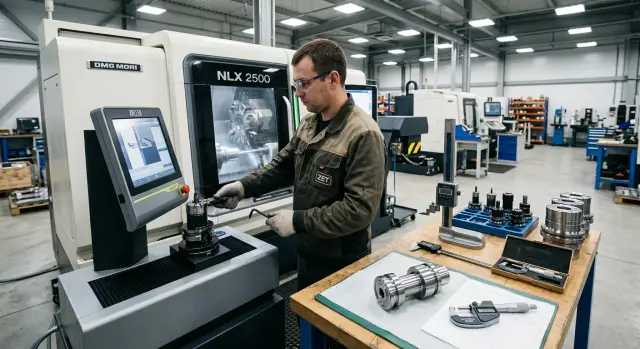
Why a new series start drags on
At the start of a new series the machine is often busy not cutting, but being prepared. The operator fits tools, checks reach, makes a trial pass, measures dimensions and applies adjustments. This is common on the shop floor, but it’s exactly where time is lost—time during which the machine could already be producing parts.
Usually the delay is caused not by one big failure, but by a chain of small stops. Tools are assembled at the machine, measurements are taken after each trial, corrections are made little by little, and the first blank is effectively used for setup. As a result, the first good part appears later than it should.
Losses add up quickly. While the spindle stands idle, the shift proceeds, the order is already started, but the part is not yet confirmed. In a busy area this shifts the whole plan: one delayed start interferes with the next job.
Most often the problem boils down to four causes:
- tools prepared directly at the machine;
- measurements taken after every trial pass;
- corrections applied by guesswork in small steps;
- treating the first part as a setup piece instead of trying to make it good from the start.
Even a small deviation quickly leads to more tweaks. One dimension shifts by a few hundredths, then another is adjusted, then the tool position changes, and the operator returns to checks again. If the goal is to reduce trial pieces, take out of the machine everything that can be done in advance.
A simple sign of a stretched-out start: the program is ready, material is loaded, the fixtures are nearby, but the first good part is still delayed. That means time is spent on preparation inside the machine, not on cutting.
What to prepare before the machine becomes available
While the machine is busy with the previous job, you can eliminate half of future problems. If tooling, fixtures and the setup sheet are ready in advance, the operator won't waste the first hour searching for small items and rechecking things.
Assemble a kit for the specific part, not just a similar one. Take the drawing, operation sequence and program, then pick holders, inserts, drills and other tools for each operation. For a lathe it's convenient to assign tools to turret positions in advance so the machine doesn't have to decide what goes where.
Then check the tools themselves: reach, overall length, insert condition and fasteners. Excessive reach often causes vibration. A chipped insert can ruin the first part. It's easier to replace it beforehand than to hunt the cause of scrap later.
The setup sheet should be readable at a glance. No complex forms needed. It's enough to show tool position, operation, reach, offset and notes on measurements. If the kit contains similar holders, mark them with a marker or a sticker. Such a small detail often saves 15–20 minutes during a start.
Keep a short kit next to the upcoming run:
- assembled holders in the order of installation;
- spare inserts and screws;
- wrenches and measuring tools;
- a printed setup sheet.
Arrange everything in the sequence of work, not just thrown together. When the kit is mixed up, the operator spends time on unnecessary movements instead of setup. In areas where series change one after another, the workstation often slows the start more than the machine itself.
How to prepare tooling off the machine
When tools are assembled one position at a time during the setup, the start almost always drags on. The operator looks for holders, fits inserts, checks screws, sets lengths and only then begins real work. At this stage it's easy to lose an hour.
Therefore it's better to assemble the whole kit in advance. Not a single arbor or a couple of cutters, but the full set for the specific operation. Then the machine's role is mounting and verification, not searching.
A typical kit includes all positions from the setup sheet, cutting tools with inserts or drills already installed, fasteners, wrenches, spare screws and a prepared replacement position for quick changeover.
Set length and reach outside the machine. Use an external measuring post, presetter or at least one fixed place with a clear datum and a consistent measuring method. If one holder is set from one datum and another from a different one, the offsets table quickly becomes a lottery.
On CNC lathes this approach gives a clear result: the operator installs prepped tools and transfers the offset values obtained beforehand. The first part still needs checking, but the long chain of small tweaks is usually no longer necessary.
Labels also save time. Write plainly: T0101 right roughing, T0303 drill 12 mm, T0505 grooving 3 mm. Abbreviations understood only by one setup person almost always cause confusion when the job moves to another shift or repeats a week later.
Store spare tooling separately, but prepare it as carefully as the primary set. It should have its own label, the same reach and the same length. Otherwise a quick swap mid-run turns into a full re-setup.
Good off-machine tooling preparation looks mundane—but it's exactly what helps reach the first good part faster and reduce the number of trial blanks.
How to move measurements out of the machine
A lot of time is lost not on cutting but on stops for checking dimensions. If the operator measures the part in the machining zone every time, the machine idles. Off-machine measurements let you spot deviations faster and more accurately determine what needs adjustment.
First, choose the dimensions that most affect the first good part. Usually these are outer diameter, length, depth, fit dimension, axial position and runout if relevant. Don't try to control everything at once. At the start it's enough to check the dimensions that most often cause scrap.
Prepare a dedicated inspection set for those dimensions in advance. A micrometer, gauge, go/no-go ring, bore gauge or indicator should be at hand before the launch. If measuring tools are searched across the shop after the first pass, the series immediately loses pace.
A separate inspection spot one or two steps from the machine works well. A small table, clean surface, good light and a log sheet remove unnecessary fuss. The operator takes the first part, measures it and immediately returns to adjust if needed.
A simple set is enough:
- one set of instruments for the series;
- a clean spot near the machine;
- a control sheet with required dimensions and tolerances;
- a pen or tablet for recording.
Record results immediately. Not five minutes later and not after the next part. In a rush memory fails, and unnecessary corrections appear that could have been avoided.
For example, when launching a flange the operator checks outer diameter, thickness and fit. If two dimensions are within tolerance but the fit is off by 0.03 mm, he adjusts a single tool rather than changing the whole program. That order noticeably speeds up reaching the first good part.
Sequence for starting a new series
Extra trial parts most often appear where setup is done on the fly. One person takes an old drawing, another fits the first cutter at hand, a third looks for the zero only after startup. The machine runs, but there's no clarity.
A clear working order is simpler and more reliable.
- Before mounting on the machine, verify the drawing, fixtures and program. The setup person checks drawing revision, datums, clamping, tool reaches and the program number. Any discrepancy is resolved before the cycle starts.
- Tools are mounted to positions only after preparation and off-machine measurement. The turret should receive a complete measured kit.
- After mounting the fixture and blank, run an idle pass at a safe feed. This step usually catches errors with zero point, datum and tool approaches.
- Machine the first part calmly and measure it right away. Adjust only what has actually shifted. If one position is out, correct that one.
- Once a good part is achieved, record final values: offsets, reaches, zero point, order of mounting and clamping notes.
In areas with frequent series changes this order frees the machine. Off-machine tooling prep and off-machine measurements remove fuss from the equipment and help reach a stable start faster.
Example: launching a batch of flanges
A shop launched a new batch of steel flanges on a CNC lathe. Previously the routine was almost always the same: the setup person installed tools, made the first part, measured dimensions, adjusted reach and offsets, then started the next blank. Several parts were used to dial in the process.
The issue wasn't the drawing complexity. The flange looks simple, but at the start you must quickly hit outer diameter, thickness, fit and chamfer. If tools are assembled at the machine and reach is checked there, the error is planted from the beginning.
On the next launch the shop changed the workflow. Tools were assembled in advance for the specific operation. Each cutter was measured off the machine at a separate station, and verified values were entered into the program and offsets.
Dimensional control was prepared in advance as well. A measuring spot was set up next to the machine with a control sheet and required instruments. The micrometer, caliper and gauge didn't have to be found at the last minute.
After that everything went more calmly. The operator installed the prepared kit, set offsets by known values and processed the first part. One diameter was out; he made a single wear correction and immediately started the series. The second and third blanks no longer had to be sacrificed for fitting.
This example shows a simple truth: the machine shouldn't be the place where you look for the right holder, check the cutter reach and decide how to measure the fit. When tooling and inspection are ready in advance, launching a new series runs more smoothly.
Where mistakes happen most often
A failed start is usually caused not by a difficult cutting mode but by the habit of doing things the same way as before. Because of that the first good part appears later and the shop loses hours to small reworks.
One common mistake is carrying over old corrections without checking them against the new batch. Even if the drawing hasn't changed, allowance, material hardness, blank batch and fixturing may differ. Yesterday's offset can easily shift a dimension by a few hundredths today.
Mixed tooling causes no less trouble. Similar holders, inserts and arbors sit in the kit but belong to different runs. The tag number looks familiar, but actual reach, edge geometry and wear are different. Then all prior prep becomes meaningless.
Another frequent error is postponing inspection until the first obvious scrap appears. That's expensive. Material is already wasted, time lost, and the cause is often simple: wrong reach, incorrect tool length or shifted datum.
There's a typical scenario where the process drifts off. First old offsets are copied from memory. Then the kit is assembled from whatever is at hand. The cycle starts without proper verification, and inspections are delayed until a visible deviation. That's how trial parts multiply.
One more common issue in many shops: a successful start isn't documented. The operator reaches the correct dimension, finds working offsets, understands the sequence, but doesn't record it on the setup sheet or in the log. A month later the series returns and the shop starts from scratch again.
If precise values, kit contents and the inspection order are not preserved after the first good part, the launch isn't complete. The problem is merely shifted to the next batch.
Short checklist before the first good part
You don't need a long walk-around before the first cut. A few minutes of quick checks often remove most random errors.
The team usually checks five things:
- all tools are laid out by position and labeled;
- measuring instruments are already next to the machine;
- zero point, datum, reach and offsets are confirmed before start;
- the setup sheet is filled with no empty lines;
- the measurement sequence after the first part is agreed in advance.
If even one item is skipped, the start can easily stretch by an extra hour. On CNC lathes this is especially noticeable: the first part begins to show not the result of setup but a list of accumulated small errors.
What to do next on the shop floor
Don't change the whole shop at once. Start with one part you run often and where time losses are already visible. It's easier to see what really hinders the start and what can be removed by a simple change in order of work on a repeating operation.
For example, pick one flange or one bushing and run at least three starts in the new sequence. First prepare tooling off-machine, then assemble the inspection kit, fix initial values and only then install the kit on the machine. This way you'll see a reliable result, not a one-off lucky start.
A simple plan to begin with:
- pick one repeat part and one machine;
- measure time from the beginning of setup to the first good part;
- count trial parts and number of adjustments;
- move tooling prep and measurements out of the machine where possible;
- repeat the start following the same order several times.
Watch not only the total time. It's useful to separately note how many minutes the machine stood waiting, how often the setup person returned to corrections, and whether the number of trial parts was reduced without rushing. Sometimes the time difference seems small, but one trial blank instead of three already changes the batch economics.
After that create a short one-page start standard. A thick regulation isn't needed. A single sheet that both new and experienced staff understand the same way is enough.
A typical standard includes:
- tool list and positions;
- dimensions to check off-machine;
- initial offsets and datum;
- the first control after launch;
- who and when confirms the first good part.
Keep this sheet at the workstation and update it after each normal start. A living standard helps more than a binder no one opens.
If the shop is preparing equipment upgrades, discuss not only the machine itself. EAST CNC, the official representative of Taizhou Eastern CNC Technology in Kazakhstan, supplies CNC lathes, helps with selection, commissioning and service. In such conversations it's useful to plan the sequence for starting new series so the new equipment doesn't idle on the first parts.