
Quick-Change Vise Base: When It Saves Hours
A quick-change base for vises helps with short runs and frequent part changes: fewer manual repositionings, easier setup, and a more stable cycle.
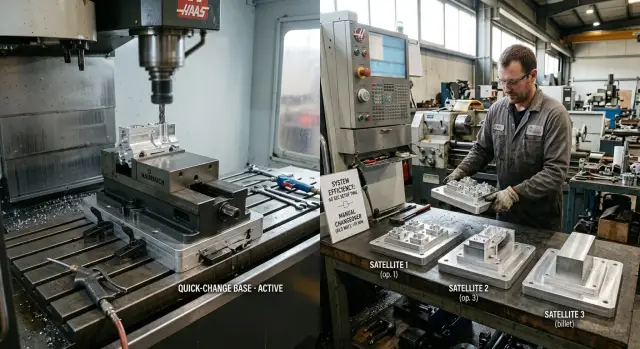
Where time is lost on short runs
On short runs, losses usually happen not during cutting, but between cycles. A machine may machine a part for 12 minutes, and the next setup takes another 6–10 minutes. If there are many such changes in a day, those small pauses quickly add up to noticeable downtime.
Usually it looks too ordinary, so the problem is often underestimated. The operator removes the finished part, clears the chips, wipes the support surfaces, loads the next blank, tightens the vise, and checks the setup again. Each action is short. Together, they can easily eat up dozens of minutes in a shift.
Most of the time is not spent on the physical movements, but on repeat checks. After every repositioning, you need to make sure no chips got under the part, the blank sits flat, the clamp holds properly, and zero has not shifted. If the batch is small and parts change often, this cycle repeats over and over.
Most often, time goes to four things: cleaning the vise and base, installing and clamping the new part, checking the position before start, and a more cautious first-part run after the change. The first part almost always takes longer. And that is normal. A mistake after setup changeover costs more than a few extra minutes of careful checking.
Because of this, the real output of a shift is almost always lower than the number calculated from pure cycle time. On paper, everything looks fine: programs are ready, batches are small, machining is known. On the shop floor, short stops build up between them, and each one is almost invisible on its own.
If one repositioning takes 8 minutes and there are ten of them in a shift, that is 80 minutes of spindle downtime. Add the slower start of the first part after each change, and it is easy to lose an hour and a half or two hours. That is exactly where a quick-change base starts saving not just minutes, but a noticeable part of the shift.
When pallets really bring a gain
Vise pallets usually pay off not on long runs, but on a shift where the operator keeps moving from one part to another. If 3–5 different jobs pass through one machine in a day, manual repositioning quickly becomes a bottleneck. While the operator changes jaws, sets the base, and checks the size again, the spindle stands still.
The clearest gain is where batches are small but repeat regularly. You assemble the setup for a part once, note the stop positions and projection, and then simply install the ready pallet. When the job comes back, there is no need to remember again how the blank was positioned last time. For short runs, that is often more important than a few extra percent of feed.
The effect is especially noticeable when each part needs its own jaws, stop, or shim. With a manual setup, the operator rebuilds the vise almost every time. A quick-change base changes the whole work pattern: remove one assembled setup, install another, check seating, and continue. The difference on one change may seem modest, but over a week it becomes very visible.
Pallets usually give the best result when several similar but different parts are processed on one machine, setup takes 15–30 minutes, and machining itself lasts 8–20 minutes. Another good sign is that the parts return every week or every day, and hand setting sometimes shifts the size or changes the base position.
If the machine waits for setup longer than it cuts metal, the problem is often not the program or cutting parameters. More often, the bottleneck is fixture work that takes too long to rebuild by hand. In that situation, pallets save not minutes but hours per week.
There is also a simpler benefit: the operator gets less tired from repetitive assembly, mixes up stops less often, and spends less time on small rechecks. On mixed production, that is felt very quickly.
When manual repositioning is still justified
Manual repositioning does not always lose. If one part takes almost the whole shift, a quick-change base may only bring a very small gain. The machine cuts for a long time, and the operator changes blanks rarely. In that case, most of the time goes to machining, not fixture change.
This happens when a shop spends the whole day turning or milling the same job from the same batch. The vise is set once, the stop is checked, the clamp is tightened, and the work continues in a loop. If setup changes happen once every few days, a pallet system pays back slowly.
There is another practical point. Pallets work best when the next setup is prepared outside the machine. If nobody does that, part of the benefit is lost. The operator will still be removing, installing, checking, and tightening the fixture at the machine. The gain remains, but it is often smaller than expected.
Manual setup is usually justified when one part runs almost all day, new setups are rare, the setter does not prepare the next setup in advance, and the top priority is a very rigid and easy-to-understand clamp.
Rigidity often decides the outcome. On a heavy part or in roughing, the shop often chooses a simple scheme: massive vises, minimal intermediate elements, and a careful one-time setup. With frequent changes in product mix, this approach is slower, but predictable. If the part is expensive and the tolerance is tight, many shops gladly give up ten minutes rather than risk having to recheck the base.
A good example is a large steel blank that takes almost six hours to machine. In a shift, the operator loads one or two parts. Even if pallets cut the changeover by 8–10 minutes, the overall picture barely changes. In that case, a reliable clamp and a calm setup bring more value.
If short runs are rare, manual repositioning often remains a normal working option. This is especially true where the shop values a simple setup, rigidity, and familiar working order more than faster fixture changes.
How to compare the two approaches step by step
The argument here is usually not about the price of the fixture, but about machine downtime. That is why manual repositioning and pallets should be compared not by impression, but by actual time.
- Measure one full part change during normal manual work. Start the stopwatch when machining ends and stop it only when the new part is fully ready to start.
- Break that time down into steps: cleaning the vise, removing and installing the part, alignment, offset setting, and a test run or first-pass check. Then it becomes clear where the biggest losses are.
- Count how many times that changeover really happens in a week. Use not the ideal schedule, but the actual shop load.
- Then assess pallet-based work in the same honest way. Some operations move off the machine: the part can be clamped in advance, the seating can be checked, and the next setup can be prepared while the current batch is being machined.
Do not compare the whole preparation in general, but specifically the machine time that can be freed up. It helps to write down two numbers: how many minutes are spent on a part change with the manual method, and how many minutes the machine stands still when using pallets. The difference between those numbers, multiplied by the number of changeovers per week, shows the real saving.
If the calculation shows that the machine gets an extra hour of cutting per shift, or at least 4–5 hours per week, the quick-change base starts to look less like a convenient accessory and more like a practical way to relieve a production bottleneck.
Example: three parts per shift
Imagine a normal shift in a short-run department. In the morning they machine a housing, after lunch a flange, and by evening a bushing. The parts differ in shape, stops, and clamping method, so the setup has to change every time.
If you work manually, the machine waits for each new setup. The setter removes the previous setup, cleans the seating, moves the vise or stops, sets the size, makes the first part, and only then brings the machine back into a normal rhythm. Even without failures, one such change often takes 25–35 minutes.
If pallets are used, the next setup can be built nearby while the machine is cutting the current batch. On the machine, only a short operation remains: remove one pallet, install the next, check the base, and start the first part. The first check is also faster because the repeatable seating already holds the position without a long search.
In practice, the difference is felt not by the stopwatch, but by shift loading. With a manual setup, the operator keeps looking at a motionless spindle and waiting for the setup to finish. With pallets, downtime often shrinks to 5–10 minutes per change, because the long part of the job moves away from the machine.
A simple calculation shows it well. Two manual changeovers at 30 minutes each equal one hour of downtime per shift. Two pallet swaps at 8 minutes each equal 16 minutes. The difference is about 44 minutes per day. Over a five-day week, that is 3 hours 40 minutes. If parts change more often, losses easily exceed 5–6 hours.
That is why a quick-change base does not only pay off on large series. In a shop where different parts run in the morning, afternoon, and evening, it is often most useful.
What affects the result besides the base itself
Time savings are easy to lose on small details. A quick-change base only works fast when the base and pallet seat the same way every time, without play and without trying to "pull" the position by hand. If the seating shifts, the operator spends time checking again and finding zero again.
Another silent enemy is dirty support surfaces. One chip between the plate and the pallet can create a tilt, and the part may shift by a few hundredths. Then the setup has to be removed, cleaned, reinstalled, and checked again. On short runs, these repeats consume a lot of time.
Marking matters more than it seems too. When each setup is clearly labeled, the operator does not have to remember which jaws were on part A and which stop is needed for part B. They simply take the right pallet and install it without guessing. If there is no marking, or only one person understands it, time is lost to extra questions and mistakes.
A single setup logic helps a lot. If one pallet is based from the left stop and another suddenly from the right, mistakes are almost inevitable. The operator mixes up the side, changes the order of actions, and loses the rhythm. It is much easier when all setups follow one rule: where the base is, how the part lies, and in what order the clamping happens.
On two-shift operations, the work order should also be the same for everyone. If one operator blows out the surface, installs the pallet, and immediately measures the first part, while another skips one of those steps, the result in time and size will differ. A quick-change base needs repeatability just as much as precision.
It is better to treat the first-part check after a change as a normal step, not unnecessary caution. One quick measurement of a critical dimension costs far less than an hour of scrap or rework.
If, after a fixture change, the operator is again searching for zero, the first part almost always needs adjustment, the same pallet is set differently by different shifts, and jaws and stops are moved almost as often as the pallet itself, then the problem is no longer the idea itself, but the way the work is organized.
Common mistakes when choosing and using it
The first mistake is simple: the base is bought without calculating the real number of changeovers per shift, week, and month. If fixture changes happen rarely, the benefit will be modest. If the operator changes parts 6–10 times a day, the picture is completely different.
The second common mistake is about pallets. Too few are bought, usually just "to test," and then the clamping setup is still prepared at the machine. At that point, the idea breaks down: the spindle waits while the person sets the part, checks the stop, and tightens the clamp.
Another problem appears where different stops are used without proper marking. The base may be precise, but if one pallet is built for one part and another for a different one, and there are no labels, the operator wastes time guessing. Worse, they may install the wrong setup and get a shift already on the first part.
People also often forget about the machine mechanics itself. Before buying and before putting the system into use, it is worth checking a few things: whether the axes have enough travel in the new part position, whether the tool will hit the vise body or stop, whether there is enough room for tool changes and safe approach, and whether the pallet can be removed and installed without extra movements.
This check is often skipped, and then zero is moved, tool lengths are changed, or part of the fixture is removed just to reach the part. That is where the savings end.
There is also a very ordinary mistake: people rush and clean the base, seating surfaces, and the pallet itself poorly. One chip or a dried coolant film is enough for the part to shift in height or repeatability. The loss is double: first they save a minute on cleaning, then they spend half an hour finding the cause of the defect.
The normal practice here is simple. Count the number of changeovers, keep enough pallets for the real pace, label the stops, and do not skip cleaning. Then the base really works faster instead of just looking convenient.
What to check before buying
It is better to start such a purchase not with a catalog, but with numbers from your own shift. A quick-change base gives good results where you change parts often and lose time on repetitive actions. If those losses are almost absent, payback will be slow.
To start, it is enough to collect simple data over 3–5 working days. Do not rely on rough estimates. Time it and write down how often the operator really stops work for a repositioning.
Before buying, it helps to check a few things:
- how many different parts are changed per shift;
- how many minutes one full repositioning takes;
- whether the next pallet can be assembled outside the machine;
- whether there is enough space in the work area for the base, clamp, and tool;
- who will clean the base and inspect the seating surfaces every day.
One point is often underestimated. Even an excellent base will not help if chips build up in the pockets and on the support surfaces. On paper, a changeover takes two minutes, but on the shop floor the operator spends seven because they first clean the dirt and search for the cause of the tilt.
It is useful to do a small test before buying. Take three typical parts and go through the full cycle on the current setup: installation, machining, removal, next installation. Then calculate how much time you would save if you assembled pallets in advance. That gives you your own number, not a sales claim.
If you discuss this kind of task with a supplier, come with those measurements already in hand. Then the conversation will be practical: you can choose not a "convenient system in general," but a solution for your part size, work area, and setup frequency.
What to do next
You should not buy a quick-change base based on general promises. First, calculate your own month. On short runs, money is often lost not on cutting, but on machine stops, searching for the right fixture, and rechecking after every part change.
You can start with a simple shift table. Write down how many times a day the operator changes the part or vise, how many minutes each repositioning takes, how many times the size has to be checked again, how long the machine waits during setup, and which parts repeat most often. These numbers quickly show the real picture.
If you are reaching five or six changeovers a day at 12–15 minutes each, you are already losing not a small amount, but a noticeable part of the shift. In that case, pallets and a repeatable base may pay off much sooner than it seems at first glance.
It is better to test a new setup not across the whole production at once, but on one group of parts. Choose similar jobs where blanks change often and repeatability requirements are already clear. That way, you will see the difference between manual repositioning and working with several pallets without unnecessary guessing.
A direct comparison works best: the price of the base, the pallet set, the implementation time, and the hours lost per month. If the base costs as much as 30–40 hours of downtime and you lose that much in a few weeks, the decision is usually obvious. If parts run rarely and setup takes 3–4 minutes, manual work may still be fine for now.
If the question is no longer only about the vise, but about choosing the machine itself and the layout of the shop floor, it helps to look at the task more broadly. EAST CNC, the official representative of Taizhou Eastern CNC Technology Co., Ltd. in Kazakhstan, supplies CNC lathes and machining centers, and also helps with selection, commissioning, and service. The company blog on east-cnc.kz includes equipment reviews and practical materials on metalworking, which makes it easy to compare your calculations with real production tasks.
A good next step is simple: take one repeating group of parts, calculate the time losses, and test the setup in practice. After that, the decision is usually made from the numbers, not from feelings.
FAQ
Which jobs benefit most from a quick-change base?
Most often, it gives a clear advantage when several different parts go through the shift and setup happens many times. If machining takes 8–20 minutes and changing the fixture takes 15–30 minutes, a base with pallets quickly frees up the machine. It works especially well for repeating short runs, when the next setup can be assembled in advance right next to the machine.
When is manual repositioning still the better choice?
Yes, if one part takes almost the whole shift or changeovers happen rarely. In that case, the machine spends more time cutting metal than waiting for setup, so the base only brings a small gain. The same applies to heavy-duty work, where the shop puts rigidity and a clear clamping setup first.
How do you know the base will pay for itself and not just seem convenient?
Look at spindle idle time, not just the price of the base. If you lose at least an hour of machine time per shift or 4–5 hours per week to fixture changes, the purchase already makes sense. The easiest way is to compare the actual time for one manual changeover with the time needed to swap a pallet, then multiply the difference by the number of changeovers per week.
How many pallets does a shop need?
Usually you do not buy one or two - you buy enough so the next setup can wait outside the machine. If there are too few pallets, the operator ends up building the clamping setup again at the machine and part of the benefit disappears. A simple rule: frequent parts should have their own ready-to-go setup, otherwise the spindle is waiting again.
Why is time sometimes still lost after installing a pallet system?
Because the base itself does not solve everything on its own. If the support surfaces are dirty, the seating shifts, or people set up the pallet differently each time, the operator will keep searching for zero and spend time checking again. Fast change only works when seating repeats the same way every time and everyone follows the same setup method.
Do you need to check the first part after every change?
Yes, and it is better to treat it as a normal step rather than extra caution. One quick check of a critical dimension after a fixture change costs far less than scrap or rework on a whole batch. If the base and pallet hold position consistently, this check takes very little time and does not undermine the system’s purpose.
What most often prevents real time savings?
Chip and dirt on the base, poor marking, different setup habits between operators, and trying to save time by skipping cleaning. Another common issue is that nobody prepares the next setup in advance. Because of these little things, the machine waits longer than it should and repeatability suffers.
Is this system suitable for mixed production?
Yes, if you often alternate similar parts with different jaws, stops, or shims. In that case, pallets move the long setup work off the machine and reduce the number of repeated checks. But if every new part means almost completely changing the clamping scheme, first check how practical it is to prepare the setup away from the machine.
How can you test the benefit before buying without complex calculations?
Make a simple test with your own parts. Measure the full manual changeover time from the end of machining to readiness for the next start, then break it down into steps and count how often it happens in a week. After that, estimate what would move off the machine when you work with pallets. That gives you your own number instead of someone else’s promise.
Does a quick-change base make sense for heavy, large parts?
Not always. For a large part with long roughing time, the shop often chooses rigidity and a calm setup rather than faster fixture changes. If one part runs for several hours and only one or two blanks are loaded per shift, the saving from changeovers will be small. In that case, a reliable clamp and machining margin matter more first.