
Production Bottlenecks: What to Remove Before Automation
Production bottlenecks often hide not in loading, but in inspection, tooling, and the part route. Let’s look at what to check before automation.
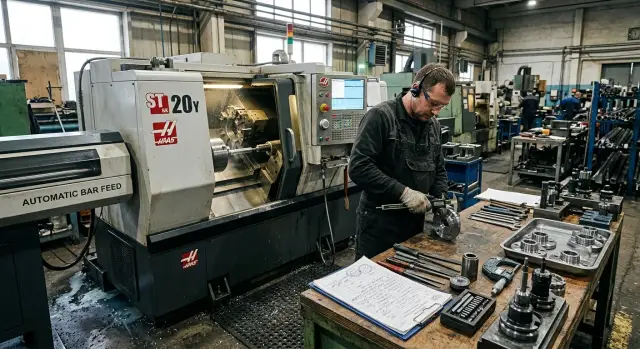
Why output doesn’t grow after automating part feeding
Automatic feeding removes manual loading, but it does not add parts where the line loses time between operations. If feeding became 15 seconds faster, but the part then waits for measurement, changeover, or transfer to another machine, output hardly changes.
The difference is simple: feed speed affects only one part of the cycle, while real output is counted by finished parts per shift. That is why automating part feeding often looks great at the machine, but does not change the result for the whole line.
This is especially clear on CNC lathes. The machine may cut for 6 minutes, then sit for another 4: the operator carries the part to inspection, changes jaws, waits for a new blank, or waits for free space at the next operation. In the report, the cycle looks short, but there are still few parts by the end of the shift.
Most often, production bottlenecks are not in loading, but in three places:
- inspection takes longer than the machining itself;
- tooling requires frequent adjustment or long changeovers;
- the part route sends the batch back and forth between machines, stations, and people for no good reason.
If inspection is set up poorly, the operator is constantly pulled out of rhythm. They make a couple of parts, then go measure, wait for approval, or call the setter. Automatic feeding doesn’t help at that point, because the machine is no longer limited by the operator’s hands.
If the problem is tooling, the line loses time on clamping, runout, tool changes, and trial parts. This is especially noticeable in small batches, where changeovers eat up a large share of the shift.
The route can also easily break output. A part may be turned first, then taken for drilling, then brought back for a second clamping. Each such loop adds waiting, the risk of error, and extra handling.
So before buying automation, look not only at loading seconds. First, find out where the machine waits outside of cutting. If you remove these pauses, even without new feeding equipment, the line often produces more finished parts in the same shift.
Where delays usually hide
Production bottlenecks are rarely found in just one machine. More often, the delay hides between operations, where the part is not being cut, measured, or moved forward. On paper the line looks busy, but in reality the batch is just standing and waiting.
It helps to follow the full path of the part: from the blank and first setup to inspection, washing, marking, packaging, and shipping. This walkthrough quickly shows a simple truth: machining may take 8 minutes, while the waiting between steps takes 30 or 40.
You need to look at the whole route
If you only look at one machine, it is easy to draw the wrong conclusion. The machine may run without stops, but output still does not grow because the operator is waiting for the setter, the inspector is busy with another batch, or the cart has been moved to a neighboring line.
The delay is usually visible in four places:
- at the machine, when finished parts sit in a bin waiting for the next operation
- at the inspection station, where batches build up in a queue
- at the tooling area, when the needed jaws, mandrel, or tool are tied up on another job
- during transfer, when parts are waiting for a person, crane, or cart
It is also worth looking at batches and work in progress. If five boxes of semi-finished parts are sitting between turning and inspection, there is already a problem, even if nobody is complaining. A large pile of parts usually means one thing: the next step is slower than the previous one.
On a turning line, this shows up very quickly. Say automating part feeding saved 15 seconds at loading. But then the operator puts the batch into a crate, waits for the inspector, and after that the parts sit for another 20 minutes by the aisle before being taken to the next operation. There is savings at loading, but the shift output barely changes.
A good rule of thumb is simple: don’t look for the fastest machine, look for the longest wait. If a part often waits for a person, tooling, or transport, that is where the delay lives. Then the solution should not be found in one machine, but in the way the whole line works.
How to check the line in one shift
Take one typical part that runs every day and often delays output. Don’t choose the rarest or most complex job. You need a part that shows how the line normally works.
Then follow its full path, from the blank to the end of the operation or the finished batch. Watch the clock and record not only machine time, but every pause. Production bottlenecks often sit not in cutting, but in waiting.
What to record
Write down, in order:
- when the part arrived at the operation
- how long setup and tooling change took
- how many minutes the machining itself took
- how long the part waited for inspection, a cart, a crane, or the operator
- how much time was spent moving it to the next operation
That is enough to see the real picture in one shift. If the operator is doing other tasks at the same time, note that too. Otherwise, it is easy to blame the machine when the person is actually leaving every 20 minutes for measurement, adjustment, or tool searching.
Inspection is best put in a separate line. That is often where output is lost: the part is already finished, but sits for 15–30 minutes before it is checked. The same happens with tooling. If jaws, cutting tools, or a mandrel take longer to change than it seems from the outside, automating part feeding will add almost nothing.
After recording, compare the pure cutting time with the total time it takes for a part to flow through the line. If cutting takes 6 minutes, but the full path takes 24 minutes, the problem is not blank feeding. First, remove the biggest gap.
Usually one simple question helps: where does the part lose the most minutes? It may be first-piece inspection, waiting for the setter, looking for tooling, or an unnecessary move between machines. Choose the single most expensive loss and try to remove it without new automation. Often that is enough for the line to produce more on the very next shift.
What to look at in inspection
Inspection often takes more time than machining itself. The operator finishes a part in 4 minutes, then waits 10 minutes for it to be checked. In the end, automating part feeding does not change output, because the queue simply moves to measurement.
First, look at where the part is measured. If the operator carries the first part to an inspector in another room, minutes are lost to walking, waiting, and repeated questions. On a CNC turning line, this is easy to see: the machine is free, but the next batch does not start until the size is approved.
It helps to spend one shift with a simple log sheet and record not only defects, but also pauses. Usually four lines are enough:
- where the dimension is measured - at the machine, at the inspection station, or in the lab
- how many minutes are spent waiting for the inspector
- which dimensions are checked every time
- which measurements are repeated without a clear reason
After that, split the checks into two groups. The first group is the dimensions that really affect fit, assembly, or defect risk. These often need to be checked on every part or at the start of every batch. The second group is the dimensions that hardly drift once the process is stable. For those, sampling at a clear interval is often enough.
If the operator measures the part at the machine every time, and then the inspector repeats the same actions with the same tool, the benefit may be zero. Double-checking only makes sense where it matters: a new setup, a borderline dimension, or a high cost of error. In other cases, it only builds a queue.
Part of inspection should be moved closer to the operation. You do not need to move all inspection onto the machine, but the first part, intermediate checks, and the most common dimensions are best checked where the part was just removed. That way, the operator sees faster whether the size has drifted, and does not build up a batch with the same error.
One of the most common production bottlenecks is inspection that lives separately from the process. If the measurement route is longer than the part’s route between operations, the line will stop even with good equipment and a normal supply of blanks.
A good sign is simple: the operator knows what to measure themselves, the inspector steps in where a second opinion is needed, and waiting time is tracked as strictly as cutting time. Then inspection helps output instead of slowing it down.
What to look at in tooling
Tooling often eats output more quietly than a breakdown or machine stop. Production bottlenecks are often found here: the operator waits for a chuck, looks for a fixture plate, tightens the clamp, then has to bring the size back into spec after a tool change.
First, measure not the planned time, but the real setup and fine-tuning time. Time how long it takes from the last part of the previous batch to the first good part of the new one. If the paperwork says 15 minutes but the shifts show 35–40, the reason is usually not the people, but the way the tooling is organized.
Also look at what people search for or assemble before starting. If jaws, spacers, mandrels, or wrenches are kept in different places, the line loses several minutes every time. Over a shift, that turns into a noticeable pause. Sometimes a simple step is enough: keep the kit for a specific part in one place and label it.
It is useful to compare actual tool-change times across shifts. If one shift changes a cutting tool in 6 minutes and another takes 14, do not look for a “human factor” first—look for a difference in the approach. Often one shift prepares tools in advance and checks projection, while the other does it only after the machine has already stopped.
Another common source of loss is unstable clamping. The part shifts slightly, the size drifts, the operator stops the process, restarts it, and checks the first piece again. That kind of defect looks small, but it breaks the rhythm much more than it seems.
Check four things:
- how long a full changeover takes before the first good part;
- which tooling employees spend the most time looking for;
- how tool changes differ between shifts;
- where clamping causes size drift or a restart.
After that, look for quick fixes, not expensive ones. A firmer stop, clear labeling, a ready jaw set, a tool projection template, or a dedicated place to assemble a mandrel often bring more than automating part feeding. On a turning line, that can remove 20–30 minutes of losses per shift without buying new automation.
If the line uses CNC machines and output is held back by changeovers, tooling should be reviewed before discussing a new feeder. In EAST CNC practice, small details like these often matter more than they seem from the outside: the machine stays the same, but there are fewer stops.
What to look at in the part route
If a part makes a long loop through the shop during a shift, automating part feeding helps very little. The machine may take blanks faster, but output is still limited by transfers, waiting, and returns to earlier operations.
First, draw the real route of the part, not the one shown on the routing card. Take one item and trace its path from the first operation to packaging. Mark every stop: machine, waiting table, inspection station, cart, intermediate storage, rework area.
It helps to record four things right away:
- how many times the batch is moved by hand
- where it waits the longest
- where it is sent back
- where semi-finished parts build up between operations
- who decides when it can move on
Then compare the paper route with how people actually work. On paper, a part may go straight from turning to milling, but on the shop floor it first sits by the machine, then goes to a shared table, then waits for inspection, and only after that moves on. That is how production bottlenecks are found when they are not visible in reports.
Also check returns to earlier operations. If a part is sent back after the next step for trimming, finishing, or re-measurement, the route is poorly arranged. Each such return adds not only transfer time. It also creates a new queue and confuses priorities for supervisors and operators.
Often the delay appears where the batch is held until enough pieces accumulate. For example, 15 parts are already finished, but they are not passed on because a full basket of 50 is being waited for. At that moment the next machine may be idle, while the previous line is already backed up. Small transfer batches in such places usually bring more benefit than another feeder.
You should also look at intermediate storage. If there is a separate storage zone between two neighboring operations, that is already a reason to ask: why does the part even go there? Sometimes moving the bin, the cart, or the order of operations is enough to remove one unnecessary transfer.
A good route looks boring and short. The part moves forward, does not go back, does not sit for hours between steps, and does not wait until a convenient batch is built up. If that is not the case yet, it is better to start not with automation, but with the part’s own path through the shop.
A simple example from a turning line
Let’s take a simple medium-run part: a steel bushing, batch of 200 pieces. It is turned on a CNC lathe, then taken to a neighboring line for drilling a cross hole. The part is not complicated, so the shift supervisor decides to install automatic part feeding and expects a noticeable increase in output.
Before automation, the operator spent about 30 seconds loading each blank. After installing the feeder, that step dropped to 8 seconds. On paper, the difference looks good: almost 22 seconds on every part.
But then comes what usually does not show up in the cycle report. The first part after changeover cannot go straight into series production. The operator waits about 20 minutes for first-piece inspection because the inspector is busy at another machine. The machine sits idle during that time.
Then tooling becomes an issue. One cutting tool is needed for finishing, another for the groove, and one holder is not by the machine but in the shared cabinet. The operator spends another 10–15 minutes searching, installing, and making a trial run. The feeder does not help at all here.
Even if the turning line itself runs faster, the batch slows down again after machining. The finished bushings are put in a bin and taken to the neighboring line. About 12 minutes are lost to transport and waiting for the cart, and then the batch waits another 25 minutes for a free spot at the next machine.
If you look at the whole picture, the conclusion is simple. The feeder saved about 73 minutes on a batch of 200 pieces. That sounds good. But first-piece inspection, tooling search, and the extra move between lines took almost the same amount of time, and sometimes more.
In the end, output was not limited by blank loading. It was limited by inspection, tooling organization, and the part route. That is what production bottlenecks look like: the machine was sped up, but the number of finished parts per shift barely changed.
Common mistakes before buying automation
The most expensive mistake is simple: buy automation before the line has been measured in practice. On paper the machine is loaded, but output barely grows. The reason is often not blank feeding, but the fact that the operator is waiting for inspection, looking for a mandrel, changing jaws, or carrying the batch to the next operation. If you do not collect data for at least one shift, the new system will only speed up one short part of the process.
People also often count only cycle time. It is a convenient number because it is already in the machine program. But the line loses output not only during cutting. A part may be machined in 2 minutes, then wait 5 minutes for measurement, first-piece approval, or a free spot at the next station. That is how production bottlenecks stay in place while the investment goes in the wrong direction.
Another mistake is keeping the old part route after loading becomes denser. When feeding was manual, the slow transfer between operations was less noticeable. After automation, the same route quickly creates a queue: the batch builds up at inspection, washing, marking, or heat treatment. The machine runs more steadily, but the whole line does not.
Tooling problems can look simpler than they really are. The day shift gets used to the old method and handles it faster. The night shift loses an extra 10–15 minutes on setup, alignment, and checking, because the fixture is inconvenient and the procedure lives only in one setter’s head. If tooling does not give the same result across shifts, automation will only increase the cost of that instability.
Defects are also worth separate attention. They are often mistaken for low productivity. If a part goes out of spec because of tool wear, weak clamping, or late inspection, part feeding will not solve the problem. It will simply deliver the next blank faster and increase rework.
Before buying, it helps to check just a few numbers:
- how many minutes per shift the machine is actually cutting metal
- how much time is spent waiting for inspection
- how long tooling and tools take to change
- where work in progress builds up
- how many parts are lost to defects and rework
If you do not have clear answers to these questions, it is better not to rush into automation. First remove waiting, get tooling in order, and fix the part route. After that, it becomes clear where part feeding will really improve output and where it will only add another expensive unit.
Quick checklist before deciding
Before buying automation, it is worth spending one shift on a simple review of the line. Production bottlenecks are often not where blanks are fed, but where the part waits for measurement, jaw changes, or a free operator.
Start with paper or a simple spreadsheet. Follow one part from the first operation to batch handoff and record not only machining, but every pause between steps. By this point, it is usually already clear where output is being lost.
- Draw the part route through the line. Include every point: machine, washing, inspection, storage between operations, waiting area for the setter. If the path zigzags through the whole shop, the problem is already visible.
- Mark the longest wait separately. Don’t guess. Time 10–15 parts and compare: where does the part sit the longest - at the machine, at inspection, or before the next operation?
- Measure two things that are often underestimated: inspection and changeover. If checking one part takes 6 minutes and machining takes 4, automating part feeding will not bring a noticeable gain.
- See which tooling breaks the rhythm. It may be unstable clamping, fast wear of soft jaws, awkward part setup, or frequent tool touch-off. Here it is better to count real stops per shift than to rely on a general impression.
- Build the first plan without new investment. Sometimes it is enough to move the inspection station closer to the machines, combine two checks into one, prepare tooling for the next batch in advance, or change the order of operations.
On a turning line, this looks very down-to-earth. The machine runs steadily, the feeder is not idle, but the batch still does not come out on time because the operator carries parts across the whole shop for inspection, and the setter changes a problematic jaw set every two hours. In that situation, a new automation system does not solve the cause.
If the picture becomes clear after this checklist, the decision usually comes faster. First remove the unnecessary waiting and disruptions, then decide whether automation is needed at all and where it will truly improve output.
What to do next
If several problems show up on the line at once, do not fix everything at the same time. First remove one expensive wait - the one that most often stops the machine or creates a queue between operations. That might be a long first-piece inspection, looking for the right mandrel, or an unnecessary move to a neighboring machine. After the change, measure shift output again: how many parts came out, how many minutes the machine actually ran, and where the pause remains.
A repeat measurement is needed for a simple reason. Production bottlenecks often hide where you do not expect them. On paper, it seems that automating part feeding will solve the problem, but on the shop floor the line is still waiting for the setter, inspector, or a tooling change. If output increases after one precise fix, you can already see whether it is worth going further or whether the next limitation should be removed first.
A good approach is to move in a short sequence:
- choose one delay with the biggest time loss;
- remove it in the simplest possible way;
- measure output again under the same conditions;
- only then decide whether automation is needed on this line.
If, after these steps, the machine is still idle because of manual loading, then automating part feeding can have a noticeable effect. But if the main pause is in inspection, tooling, or the part route, automatic feeding will only move the queue somewhere else.
For complex turning operations, it is better to discuss not only the machine itself, but the whole line startup. In such a case, EAST CNC can work through the task with you: which machine fits, what tooling is needed, how to build the part route, and in what order to launch the work. The company handles selection, supply, commissioning, and service, so the conversation can focus right away on the real startup plan, not just machine specs.
Before purchase and implementation, assign responsibility for four things: who handles commissioning, who trains the operators, who is responsible for service, and who accepts the line based on actual output. If these roles are not defined in advance, problems usually show up only after delivery, when the equipment is standing still and the plan still is not being met.