
Preparing workpieces before CNC and loading the machine for a shift
Preparing blanks before CNC often determines how many parts a machine produces per shift. This article explains the role of cutting, washing and marking.
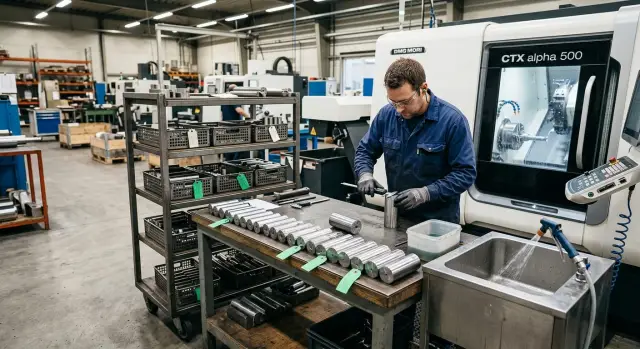
Where delays occur before the machine
Delays usually start not at the CNC stand but earlier in the chain. A blank leaves the warehouse, goes to cutting, then to cleaning, size check and marking. Only after that does it reach the machine. If there is a pause at any step, the spindle waits later, even when the program is ready and the tool is set.
In practice the operator often waits not because of the program or setup. The chuck is free, tools are in place, but the required part is not nearby. Or the part exists but has no clear tag, no confirmed size, or still has oil and swarf from cutting. Then the operator doesn’t cut metal but looks for, moves, wipes and remeasures the blank.
On paper the path to the chuck looks simple. In the shop time is spent on small but constant actions: finding the right bundle among similar blanks, transporting material between areas, checking length and diameter again, figuring out which batch is ready and which is waiting.
Each stop is short, but over a shift they add up to noticeable downtime. Five minutes to find material, seven minutes to move it, a few minutes to remeasure — and the machine is idle for fifteen minutes. For a CNC lathe that’s a lot. The shift progresses, the operator is present, equipment is occupied, but output doesn’t grow.
Worse is when the delay repeats with every new bundle. Then you lose not just one start but the whole rhythm of the shift. Instead of steady loading, the area gets surges: sometimes the machine runs non-stop, then it waits for the next blank.
Preparation of blanks before CNC affects output more than it appears. If a part arrives at the machine already cut, clean, tagged and checked, the operator simply takes it and puts it in the chuck. If not, the machine becomes a waiting place.
What a separate prep station gives you
A separate prep station is often more useful than trying to shave a few seconds from the program. If the machine waits for cutting, washing or a tag, the issue isn’t the cycle time. The machine is doing someone else’s work.
A prep station is a dedicated area where small delays are removed before a batch is sent to the CNC. There they cut material to length, remove obvious stock and miscuts, wash blanks of oil, swarf and dust, mark the batch and arrange parts so the operator can pick the right blank without searching.
On a small area one person can do two operations, but responsibilities must be clear: who is in charge of cutting and length, who washes, who marks, who arranges parts. If everyone does a bit of everything, in the end no one does it properly.
This is usually where minutes are lost. The operator grabs calipers, wipes a reference, rereads the job, returns the wrong blank, checks the batch number again. One delay is almost invisible. Over a shift it becomes a measurable loss.
Simple, clear data should travel with the batch. Usually the part number, material, blank size, quantity, operation number and a note that cutting and washing are done are enough. If there’s a special requirement, for example orientation during stacking or different allowances for first and second setups, record it on the batch card rather than passing it verbally.
A good prep station removes everything unrelated to cutting from the machine. The operator gets a clean, labeled and ordered batch, locates the part and works on the cycle. In practice this evens out the machine loading over a shift more than attempts to speed up processing by a few seconds.
How cutting affects shift pace
Cutting seems simple, but it often sets the pace for the whole shift. If blanks arrive at the machine in the same length, the operator sets the stop faster, clamps more confidently and makes fewer extra measurements.
Consistent length removes pauses nobody counts: checking the end face, adding a spacer, re-clamping, measuring again. On one blank this is almost invisible. On a batch these small actions easily become downtime.
Extra millimeters eat time more than they appear. If one blank is 2–3 mm longer, the operator can compensate. When the spread runs through the whole bundle, you need to change stroke, find the reference and monitor the first pass more often.
The problem is not only length. Poor cutting causes several issues at once: a burr prevents a firm stop, a skewed end face spoils referencing, mixed lengths confuse operator and setup person, and some blanks go to extra facing.
A burr can make a part look clamped correctly, but in machining it seats differently. A skew increases the risk of runout and the operator spends more time getting the size right. If a tray contains 118, 120 and 123 mm blanks mixed up, the shift pace drops almost immediately: people start sorting metal at the machine.
The difference is obvious on a simple shaft batch. In one case the bundle is cut to size with clear tolerances, ends clean, lengths labeled. The operator takes part after part and keeps a steady cycle. In the other case the machine constantly waits: one blank needs facing, another has to be deburred, a third is set aside because its length is doubtful. No big failure occurs, but dozens of short stops accumulate.
If the area works with serial parts, a separate prep station usually pays back quickly. For such tasks the machine is important, but so is the whole chain around it. EAST CNC also treats this chain as part of normal production organization, not as a secondary detail.
Why wash and mark blanks before sending to the CNC
A dirty blank rarely looks like a serious problem. In reality it regularly eats shift time. The operator places the part in the chuck or vise, and a thin film of oil, cutting dust or fine swarf prevents the clamp from seating evenly.
Because of this the blank can sit skewed or shift slightly during clamping. Sometimes the shift is small, but enough to throw the first workpiece off and leave the machine idle with the door open. All this can be eliminated in advance with a simple wash.
Cleanliness is also important for referencing. If swarf remains on the end face or support surface, measurement lies. A probe, caliper or indicator rests on debris, not metal. The operator corrects the size even though the cause isn’t the program or the tool.
This shows up especially on short batches. When there are few parts, people try to hurry and skip washing. They end up losing more: one blank doesn’t seat properly, the second is confused with a neighbor, the third is taken for recheck.
Simple marking without extra paperwork
Marking shouldn’t be complicated. A short tag with batch number, material, blank size or operation code, quantity and a note that cutting and washing are done is usually enough. Attach the tag to the tray, pallet or bundle. If the batch is split, put a tag on each part, not only on the first pallet.
This removes a common confusion. Two almost identical bushings of different material can sit next to each other. They look alike but cutting regimes and tolerances differ. Without a tag the operator spends 10–15 minutes checking, calling and remeasuring. With a tag they simply pick the right bundle and start.
Marking also helps after the first operation. When a part returns from another area, you immediately see which batch it belongs to, what’s already done and what must not be mixed with a neighboring series. Washing and marking therefore directly affect machine loading: fewer doubts, fewer extra checks, less idle time.
How to structure the work step by step
If a batch reaches the machine unordered, the first 20–30 minutes of the shift are spent not on machining but on finding material, checking sizes and deciphering tray labels. This loss is easy to accept as normal, though it comes from poor preparation.
It’s simplest to keep the same sequence of actions for any batch. Then there’s less confusion between shifts and fewer defects from haste.
First, accept the job and check the route: material, cut length, allowance, quantity and the machine for processing. If any dimension is missing from the card, clarify it immediately.
Then prepare the surroundings: material, an empty tray for semi-finished blanks, a separate area for ready blanks, a tag or marker. Doing this in advance prevents the new batch from mixing with leftovers.
Next comes the prep without interruptions: cut to size, remove burrs and then wash. After that arrange the batch in the order the operator will feed it to the machine. A simple layout by feed order saves several minutes each time someone reaches into the tray.
At the end leave a short note for the next shift: batch number, material, actual blank size, how many pieces are ready and how much material remains. If there were deviations in cutting or questionable parts, note them immediately.
On a small batch of 40 bushings this routine often saves not seconds but a meaningful portion of the shift. The operator doesn’t recount blanks, doesn’t wash them again and doesn’t guess which is the first part for setup. Work runs smoothly.
Example of one shift on a simple batch
Take a batch of 120 short bushings. The material is ordinary, the blank short, the operation straightforward. On paper this looks like easy work. But such batches show best how small delays eat machine loading.
If there’s no dedicated prep station, the operator does everything near the machine. They not only watch size and remove finished parts, but also cut the next portion, clear swarf, wipe blanks from oil and tag where each batch sits.
Each distraction is short: two minutes for cutting, one minute for washing, a little time for tagging. One pause is almost invisible. Over a shift the operator repeats this many times because the supply at the machine runs out quickly.
Typically the machine runs for a few pieces, supply at the chuck ends, the operator goes to the saw or table, cuts a new portion, returns, quickly wipes blanks, gets confused between two trays, checks which is finished and which is raw, and only then restarts the cycle.
Even 10–12 such stops per shift costs almost an hour. And that’s without small tasks like moving a tray, signing a bin, looking for a marker or recounting remainder.
Now take the same batch but with a separate prep station. Before the shift another employee, or the same operator in advance, cuts the entire volume, sorts bushings into trays, does a quick wash and tags them. Labeled containers are already at the machine: "in work", "after first op", "done".
The picture changes immediately. The operator doesn’t run to the saw. They pick a clean blank, set it, check the size and keep the pace. Instead of 10–12 stops there are 2–3 short pauses for checks and changing trays.
You don’t need complex calculations. If the machine doesn’t wait for cutting and doesn’t idle because of dirty or unmarked blanks, it makes more parts in the same shift. On a simple batch this is very visible: minutes don’t vanish — they are either lost at the machine or returned there beforehand.
Where time is most often lost
The worst losses happen not at the CNC but a few meters before it. The machine is ready, the operator waits, and the batch is still "almost ready": some blanks are wet, some lack readable markings, some need re-measurement because cutting left extra stock.
A common mistake is placing different materials or similar sizes in one tray. From the outside the box looks fine, but at the machine manual sorting begins. Minutes are lost on every feed. Worse, mixed-up material can get machined and the issue surfaces after the first part.
The same applies to marking. Writing with an ordinary marker on an oily surface smudges quickly. Then people revisit the route card, check sizes and argue which item it is. One rubbed-out mark can cost more time than the entire setup.
Wet blanks also slow the shift. After washing they are rushed forward even though moisture and residue remain. The batch is sent back for rewash or at least wiping, while the machine stands idle.
Cutting "with extra for safety" also hurts. When no clear allowance is fixed, blanks come too long. The operator must recheck size, change stroke and sometimes send parts back. This kills the rhythm.
Another quiet source of loss is feeding by single baskets. While the first basket is processed, the second is being carried, the third is still at the saw. People constantly walk back and forth and the machine gets short pauses between cycles. Individually these seem small, but over 8–12 hours they add up.
If your area often complains about lack of machine time, look first at preparation rather than the program or tooling. Losses usually hide there and nobody measures them minute by minute.
A quick check before starting a batch
Before feeding a batch it helps to run a short check. It takes a few minutes but immediately shows whether the part will enter the cycle without delays.
Check material and size against the job. A similar blank of another steel may lie nearby and the mistake will appear only after the first part. Then check post-cut length: even 2–3 mm can change clamping, stroke or facing allowance.
Inspect the surface. There should be no dirt, swarf, oil with abrasive or drops of water. Then check marking. It must be readable immediately without guessing or checking notes. Finally, place the batch next to the machine in feed order so the first blank is actually first, not buried at the bottom.
The most common failure looks ordinary: blanks are delivered but one bundle from washing is still damp, two pieces have smudged markings, and some cuts are at the upper tolerance. The operator calls the setup person, measures sizes, wipes metal and searches for the right bundle. The machine is quiet in the meantime.
This check doesn’t need a special meeting. One person should be responsible for releasing a batch to the machine and set a simple status: ready or return for rework. In areas where shift loading is tracked, this routine often gives an extra 15–20 minutes of clean work without rushing.
What to do first on your shop floor
Start not with a big overhaul but with one typical batch you make often. Measure time losses before the first cut. Usually three notes are enough: how long they wait for cutting, time spent searching for the right bundle and minutes lost to dirt, swarf or unclear marking.
Ask operators and setup staff to record the three most frequent delays before start for several shifts. A long report isn’t needed. A simple sheet with notes like "no tag", "blank wet after washing", "waiting for cut" will show where the area loses tens of minutes within a couple of days.
Next step — separate preparation physically from the machine. Even a small area needs a separate table, clear trays and one person responsible for batch readiness. Then the operator stops searching, wiping and checking parts instead of doing the main job.
Then fix the same routine for every shift: accept the batch after cutting, check size and quantity, wash if needed, tag the tray and the batch, and hand over only a fully ready set to the machine. The routine seems simple, but it makes preparation predictable.
If you already see that the old flow can’t handle new volume, the problem may be not only discipline but the area layout or equipment choice. In such cases discuss not only buying a machine but the whole process around it. EAST CNC supplies CNC lathes and machining centers and helps with selection, commissioning and service. If you link equipment choice to preparation organization in advance, the new machine won’t run into the same input disorder that limited the old one.
FAQ
When does a batch need a separate preparation station?
A separate prep station is needed when the operator regularly waits for cutting, washing, marking or searching for the right blank. If the machine is ready but the part isn’t, move preparation out of the CNC area.
Where is time usually lost before the machine?
Most time is lost before the cycle starts: searching for a bundle, moving material between areas, re-measuring and cleaning the blank. The machine is ready, but the operator is doing other tasks.
What must be done to a blank before sending it to the CNC?
At minimum: cut to a clear length, remove burrs, a quick wash, readable marking and arranging the pieces in feed order. Then the operator picks a part and puts it in the chuck instead of finishing prep at the machine.
Why do extra millimeters after cutting cause such problems?
Even 2–3 mm extra can slow work. The operator may need to change stroke, face the end, find the reference and check the first pass more often; on a series these small delays quickly eat the shift’s rhythm.
Why wash blanks if they are going to be machined anyway?
Dirt, oil and fine swarf prevent proper clamping and referencing. The part can seat with a tilt or shift during clamping, the first piece goes out of tolerance, and the operator spends time wiping and rechecking instead of machining.
What should be written on the batch tag?
Usually a short tag with batch number, material, blank size, quantity and a note that cutting and washing are done is enough. If there are special allowances or a specific stacking orientation, note that too instead of telling it verbally.
Who should be responsible for preparing blanks?
Better to assign one person responsible for making the batch ready for feed. When everybody does a bit of prep, tasks are often missed and the operator gets extra checking work.
Is a prep station worth it for small batches?
Even for small series it helps if delays repeat for each new bundle. On 40–120 parts you can still recover noticeable shift time by cutting, washing and tagging the whole volume in advance.
How do you quickly check a batch before starting?
Check material and length after cutting, surface cleanliness and readability of marking. Place the batch next to the machine in the loading order so the first blank is actually first, not buried at the bottom.
Where to start if the shop constantly lacks machine time?
Start by measuring losses before the first cut on a typical batch. When you see how many minutes are spent waiting for cutting, searching or re-cleaning, you’ll know what to change first.