
Preparing the shop floor for a customer audit without showy cleanliness
Preparing your shop floor for a customer audit without unnecessary shine: how to get documents, labeling, tools, and the work process in order.
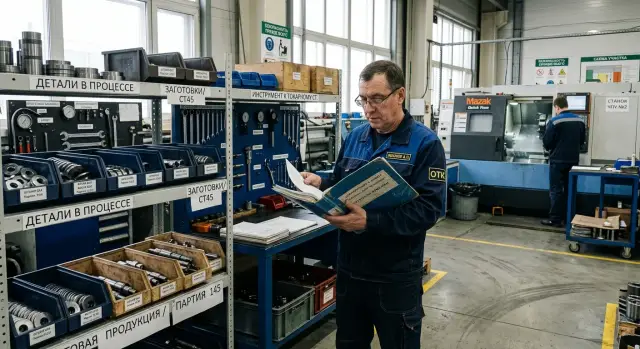
Why a clean floor does not save the shop floor
A clean floor looks nice, but a customer audit in manufacturing rarely comes down to housekeeping. The customer wants to understand how the shop floor really works on an ordinary day: which documents the shift follows, where the tools are kept, how the operator finds the fixtures, and whether what is written on paper matches what is standing by the machine.
If the aisles were polished before the visit, but the route sheets are scattered across different folders, that shows right away. The same happens when one label is on the rack, another in the logbook, and the supervisor explains a third rule out loud. At that point, cleanliness stops helping.
The problem with showy preparation is that it breaks the normal rhythm of work. The shift has to put familiar tools away “for now,” carts are moved just for the sake of appearance, and documents are taken into an office so they are not visible. Outwardly, the area looks neat, but people start searching for things longer, making small mistakes, and getting nervous when asked simple questions.
When preparing the shop floor for a customer audit, it is better to look at clear order rather than shine. An auditor usually notices a few simple things:
- does the operator find the right tool quickly, or waste extra minutes on it;
- do the labels on containers, shelves, and blanks match or not;
- are the documents near the workstation current, or are old versions lying around;
- are scrap, good parts, and semi-finished parts clearly separated, or mixed together;
- do employees answer based on how they really work, instead of trying to guess the “right” answer.
On a shop floor with CNC lathes, this is especially easy to see. If the fixture next to the machine is labeled, the setup operator can show the current card in a minute, and the cutting tools are stored by compartments, the area looks convincing without any extra polish. If the floor shines but tool holders are mixed together, trust drops fast.
Paperwork, labeling, and the real working order always matter more than cleaning the night before. A well-run shop floor does not act a role before a visit. It shows its everyday discipline, and that is visible within the first few minutes.
What the customer checks in the first minutes
Good preparation of the shop floor for a customer audit starts not with a rag, but with a clear path for the part. The customer usually looks to see whether they can understand the route of the blank in a minute: from receiving, through the current operation, to the next place it should go.
If the route lives only in the supervisor’s head, that is noticed immediately. The parts are on a pallet, the batch card is nearby, the container has a number, and the employee can explain without hesitation where the batch came from and where it is going next. That kind of order reassures better than any showy cleanliness.
Then attention moves to the small details that must match. The tag on the bin, the label on the container, the notation on the route sheet, and the name in the log should all say the same thing. If the label shows one operation and the paperwork shows another, trust drops within minutes.
On a metalworking area, this becomes obvious very quickly. For example, if a basket with finished parts is standing next to a CNC lathe, but it has no batch number and the card shows a different code, the machine may be running smoothly, but the customer already has a question: how do you prevent batches from getting mixed up?
Another quick marker is the tool handling. The customer does not conduct a full inventory, but almost always looks at where measuring tools are kept, where cutting tools are kept, and how you keep them from being mixed together. A caliper under a stack of rags and a cutter with no storage place say more about order than a freshly washed floor.
Simple questions for the people on site come up almost immediately too. Who is responsible for the shift? Who issues tools? Who keeps the log when an issue is found? Who can show the remaining quantity in a batch or the status of a part? If the answers are vague, or everyone points to one absent employee, that is a bad sign.
Usually the customer does not need a perfect shop floor. They need a shop floor where every item and every record has an owner, a place, and a purpose. If that is visible from the first steps, the customer audit in manufacturing goes much more calmly.
Gather the documents into one working folder
For preparing the shop floor for a customer audit, it is better to gather paperwork not “just in case,” but according to the way the work really happens. When the route card is with the supervisor, the instruction is with the setup operator, and the inspection log is in another cabinet, people start rushing. The auditor sees that right away.
Leave one clear set on the shop floor. It usually includes route cards, work instructions, inspection logs, maintenance records if they are needed for the operation, and the forms that employees fill out during the shift. Do not put everything there. If a document is not needed at the machine or at the inspection station, keep it in the archive, not on the supervisor’s desk.
Old versions create more problems than clutter in a drawer. If two instructions with different dates are lying on the table, the employee may honestly take the wrong one. The auditor will not see a “small detail,” but a risk of process error. That is why drafts, personal printouts, and copies with no status should be removed before the visit.
A simple rule works well: the names of folders and sections should match how your zones, machines, and operations are labeled on the shop floor. If the sign says “Turning Area 1,” do not call the folder “Machining Line.” People waste extra minutes even on something that small.
On a shop floor with CNC lathes, it is convenient to keep the folder in this order:
- layout of the shop floor or list of workstations
- documents for each operation in order
- logs with current entries
- active inspection forms
- a separate pocket for replaced versions before they are archived
After putting it together, do not rely on memory. Take the folder in your hands and check every paper: is the date visible, is there a signature, is the copy readable, does the version number match? Often the problem is not the missing document, but a poor print where the revision line is blurred.
If the operator can find the right card in 10 seconds and the supervisor can show the log for the current shift without searching, the area looks calm and honest. That kind of order is more convincing than a freshly washed floor.
Bring the labeling under one rule
The customer notices confusion faster than dirt. If one shelf says “cutters,” another says “turning tools,” and the list shows code TI-14, the area looks uncontrolled even when the floor is clean. When preparing the shop floor for a customer audit, it is better to remove inconsistencies than to stick on new bright labels the last evening.
Start with a simple naming template. It should be the same for zones, containers, and shelves. For example: “Area 2 - Rack 1 - Shelf 3” or “Line A - Container 05 - Good parts.” One format helps anyone understand where they are and what they are looking at, without the supervisor’s help.
The rule “one place - one name - one label” works well. If the zone is called “Tool storage,” that same name should appear on the sign, in the area map, and in the internal list. Do not mix casual names with accounting names. “Big chuck,” “small arbor,” and “Sergey’s box” may work inside the shift, but for an audit they are weak points.
Check the fixture numbers separately. On a CNC shop floor, this is obvious right away: the chuck number, arbor number, tool holder number, or fixture number must match the setup card and the inventory list. If the card says O-117 but the box is labeled “new arbor,” you can no longer track the fixture movement. It is better to spend an hour checking than to explain mismatches from memory later.
Colors help too, but without improvisation. Three clear states are enough:
- green - good parts or equipment approved for use
- yellow - quarantine, inspection, waiting for a decision
- red - scrap, no use allowed, isolated
The color should support the label, not replace it. If the sticker fades or the container gets moved, the text still has to remain clear.
Handwritten labels are better removed. Marks like “urgent,” “later,” “do not take,” or “after second shift” make sense only to insiders and lose meaning quickly. Replace them with short standard statuses with a date and the responsible person’s name. Then the labeling on the production floor helps every day, not just during the customer visit.
Put tools and fixtures in their places
The customer quickly sees how tools are handled on the shop floor. If the operator spends two minutes looking for an arbor or takes a micrometer from a shared drawer, the order only looks normal. For an audit, what matters is not a nice cabinet, but a system that works on an ordinary shift.
First, divide everything into three groups: cutting tools, measuring tools, and auxiliary items. Do not mix cutters and inserts with gauges, probes, keys, and small fixtures. When the groups are stored separately, it is easier to notice shortages, wear, and random items that no one should keep near the machine.
Each cassette, arbor, and key needs its own place. The simplest rule works best: one item, one slot, one label. If a cassette is returned to the wrong place, that is immediately visible. If the slot is empty, the supervisor understands that the tool is in use right now, not lost.
On a shop floor with CNC machines, this is especially noticeable. One missing arbor delays a changeover. One extra key in a drawer turns an ordinary search into chaos. For that reason, it is not a good idea to keep spare items “just in case” mixed together with the ones used every day.
Make the labels large and simple. It is better to write “keys,” “arbors,” “micrometers,” “cutters” than long and vague names. If the drawer has inserts inside, repeat the label on the front of the drawer and on the inside as well. A person should understand the order in two steps, without extra questions.
Remove broken, dull, or questionable tools from the work area immediately. Do not leave them next to good tools, even for half a shift. Such tools need a separate shelf or container with a clear tag: “to inspect,” “for repair,” “to scrap.” During a customer audit in manufacturing, those small details stand out faster than many documents.
When preparing the shop floor for a customer audit, it helps to run a simple test. Open any drawer and ask yourself: will a new employee understand in 10 seconds what is where and what is missing? If not, the order is still held together by people’s memory, not by a clear system. That is exactly what auditors notice almost immediately.
Walk through the audit route step by step
The best approach is not a one-day cleanup, but an ordinary inspection route. Walk it the way the customer will: from the entrance to the shop floor, to a specific machine, part, and operator. This kind of preparation for a customer audit quickly reveals weak spots that are not visible from the office.
Start with the entry point. What does a person see in the first 30 seconds: signs, walkways, PPE storage, the shift task board, the document folder, or clutter on the nearest table? If there is confusion already here, trust will be lower all the way through.
Then follow the visitor’s real path. Do not choose the “pretty” route. Go where blanks are normally moved, where tools are taken, where the operation is recorded, and where the part is handed to the next stage. On a floor with CNC machines, that walk often takes 10 to 15 minutes, but it gives more value than an hour of rushed cleaning.
Stop at the places where questions are usually asked. Most often, these are:
- the warehouse or blank storage area
- the tool and fixture station
- the workstation by the machine
- the place where route sheets, operation cards, or logs are kept
At each point, check three things at once: what is actually there, what the paper says, and what the label shows. If one tool is listed on the shelf but the operator takes another, the question is already there. If the card has one revision but the old version is hanging by the machine, that will be noticed too. If the container is labeled but the batches inside are mixed, that will be hard to explain.
It helps to walk in pairs. One person asks simple questions like the customer, the other writes down the comments without arguing or making excuses. That way you will see faster whether the problem is in the order, the documents, or the fact that people are used to working “from memory.”
Split the notes into two groups right away. The first group is what can be fixed today: replace a tag, remove extra tools, print the current sheet, put the fixture back. The second group is what needs time after the visit: redesign the storage layout, update the labeling rule, remove duplicates from the documents.
After that walk, the customer audit in manufacturing no longer feels like a surprise. You are left with a short list of actions tied to real points on the shop floor, not general words about order.
An example of calm preparation without a last-minute rush
A small area with two CNC machines can be prepared calmly in a week if you do not try to create a showpiece on the last evening. Normal preparation for a customer audit looks routine: people simply remove the extra items, check the documents, and put the order back where it already should have been.
On Monday, the supervisor does not start with the floor and rags. He gathers the papers for the two machines into one working folder: route sheets, current instructions, setup records, inspection marks, and the maintenance log. At the same time, he removes old sheets that were left near the control panel “just in case.” Those small details are often what throw off the impression: the operator works from one version, but two older ones are still on the shelf.
On Tuesday, the supervisor walks the area as if he were a new person. At the first machine, he checks where the fixtures are stored, how the containers are labeled, and whether good parts are mixed with WIP and scrap. The second machine usually looks similar, but something simple almost always appears: a faded label, an extra key in a drawer, a template with no signature.
On Wednesday, the storekeeper joins in. Labels are changed where the text is no longer readable, and the labeling is brought to one format. Chucks, jaws, tool holders, drills, measuring tools, spare inserts — everything gets its place and a clear name. If a box is labeled but contains something else, the label does not help. That is why the storekeeper does not just replace stickers, but checks the contents too.
The day before the visit, the shift walks through the audit route without rushing. People go the way the customer will go: entrance, area board, machine, tool cabinet, part storage, inspection zone. That walk quickly shows where an answer might “drift.” For example, the operator knows where to get the current setup sheet, while the next shift is already reaching for an old folder.
Such an area does not look like a museum, and that is normal. There may be a working oil mark on the machine, a pallet with blanks may be standing by the door, but everything still makes sense: the documents are current, the labeling is readable, the tools are in place, and people answer the same way. That is usually what reassures the customer.
Mistakes that stand out immediately
The customer usually notices not dust on the floor, but the gap between paperwork, labeling, and the way the shop floor really works. If one order is on the wall board, another in the cabinet, and the operator works by a third one, that is visible within minutes.
A common mistake is to hide everything unnecessary before the visit. It looks tidier at first, but then the supervisor or setup operator cannot quickly find the arbor, gauge, or the right card. On a CNC turning area, this is especially obvious: the auditor asks a simple question about the current fixture, and people start opening every drawer one after another. That kind of order does not reassure anyone; it only shows the rush.
Another weak point is heavy cleaning without updating records. The floors are clean, the benches are empty, but the tool replacement log was not updated for a week. Or the inspection sheet has an old date even though the batch was launched long ago. For a customer audit in manufacturing, that is a bad sign: the shop floor can make itself look good, but it does not keep discipline on ordinary days.
New labels that do not match the route card, the containers, and the part status look even worse. The shelf is relabeled, the containers are too, but the old designations are still in the paperwork. Then the labeling on the production floor starts getting in the way instead of helping. The auditor sees not a system, but a quick fix before the inspection.
Sometimes the team spends too much energy rehearsing answers. People memorize phrases about who is responsible for what and how to name the inspection step. But if there is a tool with no storage place on the next table and two different versions of the instruction in the folder, any correct phrases sound empty. It is much better to remove the inconsistencies than to memorize a script.
The same small things usually fail every time:
- the needed document takes longer than a minute to find;
- the tool is not where it is used every day;
- the part status on the container does not match the card;
- two employees explain the same procedure in different ways.
A normal preparation of the shop floor for a customer audit looks calmer. People do not hide anything; they place things in clear locations. Logs are updated according to what was actually done. Labels are changed only together with the documents. If the shop floor can calmly show where the tools are, which batch is in process, and who made the last entry, that is usually enough.
A short checklist before the visit and next steps
The day before the visit, there is no need to create a showy order. It is better to check whether the shop floor reflects the real working system. The customer quickly notices when the folders were gathered in the morning, the labeling was done in a rush, and the tools were simply hidden from view.
Before the auditor enters, check a few things:
- The documents are in one working folder: route cards, instructions, inspection records, shift logs, and the versions people actually use.
- The labeling is understandable without extra explanation: the blank, finished part, scrap, fixture, and container are marked by one rule.
- Tools and fixtures have fixed storage places, not random spots on a bench or cart.
- One person has been assigned on the shop floor to answer questions and show the process without arguments or guesses.
- If the audit includes CNC machines, check the maintenance log, planned work records, and the list of open service questions in advance. If there are EAST CNC machines on the floor, pull the maintenance records and prepare the questions ahead of time.
The assigned employee should not decorate the picture. Their task is simpler: show the documents, explain the part route, and calmly answer where everything is kept. When the supervisor, setup operator, and operator all answer the same question at once, even a normal process looks confusing.
After the audit, do not delay the review. On the same day, collect the findings into a short list and set a deadline for each item. Otherwise, the same small issue will show up at every next visit.
It is useful to record three things for each finding:
- what exactly was found;
- who will fix it;
- by what date the shop floor will close the item.
If the finding is related to CNC, do not stop at a promise to check it later. Decide right away whether it needs internal repair, adjustment, replacement of consumables, or a conversation with service. That kind of follow-up after the audit is usually more useful than any emergency cleaning: it shows that the shop floor knows how to close problems on time instead of hiding them.