
Pre-commissioning Checklist for a Machine: 7 Common Mistakes
A pre-commissioning checklist helps verify foundation, power, compressed air, coolant, tooling and operator readiness in advance so commissioning goes smoothly.
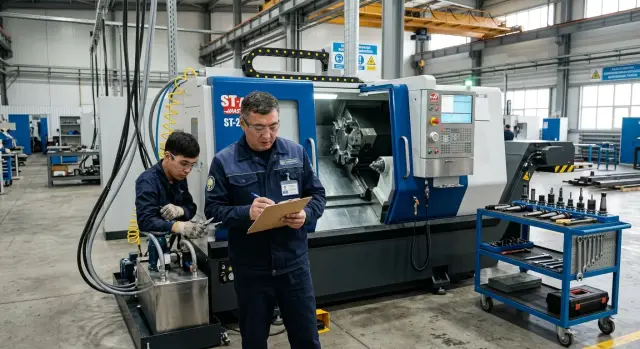
Why starts get delayed
Startup failures rarely begin on the commissioning day. Usually things go wrong earlier, while the machine is already on its way and the shop leaves preparation to the last days. Before the first cut it doesn’t look like a problem. Then, on site, there’s suddenly not enough air, the power sags, the right fixtures are missing or the location turns out to be unready.
Most often it’s not one big mistake but a set of small things. Uneven floor, old power line, wrong coolant, one missing holder, a thoughtless installation spot — each item alone seems manageable. Together these small issues easily cost several days, sometimes an entire first working week.
The usual picture is simple: the machine has arrived, but the site isn’t ready; service waits for power and grounding; the compressor is connected but the pressure fluctuates; consumables weren’t purchased; operators are asked to figure things out after installation. Formally the equipment is on site, but it’s still not ready to run.
For CNC machines this is especially unpleasant. The first days are needed not only for checks, but also to get into production properly: program run-in, tuning modes, training people and checking first parts. If the start fails on basic items, the whole subsequent chain shifts too.
So a pre-commissioning check is not a formality. It removes typical pauses before the equipment arrives and helps avoid spending the first weeks on things that could have been resolved in advance.
How to prepare without rushing
Preparation fails not because of a complicated breakdown, but because nobody compared the machine’s requirements with the shop’s actual conditions. First, get the documentation and compare it with what’s on site: foundation, power, compressed air, installation area, unloading access, storage for consumables and tooling.
It’s better to follow a simple sequence rather than tackling everything at once. One shared document works better than verbal agreements. It should include not only tasks but concrete people and deadlines. A note like "the electricians will handle it" almost always leads to a delay. Much more useful is to specify who supplies power, who checks grounding, who starts the compressor, who prepares the coolant and who receives the tooling.
A practical workflow looks like this. First, compare the machine passport requirements with the shop conditions. Then assign responsible people for the foundation, electricals and air. After that gather everything needed for the first days: coolant, oil, tooling, holders, chucks, measuring tools and spare small parts. Three to five days before commissioning go through everything again at the installation site and leave time for fixes: replace a cable, deliver fittings, buy adapters, tighten the power connection.
If the supplier’s engineer comes for machine setup, their first day should go to tuning and checks, not looking for hoses and sockets. This is especially evident with EAST CNC: when the shop closes basic questions in advance, commissioning goes calmer and faster.
Foundation and installation site
One of the most frequent failures starts not with electronics but with the floor. The machine arrives on time, but there’s nowhere to place it: the area is occupied, anchors don’t match, there’s no room for maintenance, or a cabinet door can’t open fully.
The mistake is often made at the very beginning. They put the machine where there’s a free corner, not where it can work properly every day. For a CNC lathe this quickly leads to skew, extra vibration and awkward part loading.
Check not only the length and width of the area. Look at anchoring points, door swings, axis travel, access to the rear, and the ability to open the electrical cabinet and reach the pump, filter and drain. If a technician cannot access these units normally, the shop will lose hours even on simple maintenance.
The floor is often underestimated. The slab must bear the weight of the machine, fixtures, blanks and nearby containers. If there’s a slope, old cracks, voids or weak spots, fix them before delivery. Otherwise the machine will be leveled hastily and geometry will drift after a few weeks.
There are five things to check before equipment arrives:
- is there enough space for installation and anchoring;
- is the floor level across the support area;
- are there passages for the operator and service technician;
- where will chips, pallets and empty containers be removed;
- is there constant dust, heat or vibration nearby.
The area around the machine affects the first weeks more than it seems. If a press works nearby, a forklift passes, or abrasive dust flies around, both accuracy and component life suffer. If cold drafts come from the gate in winter and temperatures swing in summer, the machine takes longer to reach a stable regime.
Power and grounding
Electrical issues interrupt startups more often than assembly problems. This block is often left to the last minute and commissioning gets postponed for several days.
Before connection check three things: supply voltage, total available power and the conductor cross-section to the connection point. “The line here is standard, it should be enough” won’t do. You need exact data from the machine’s passport. Otherwise the cable overheats, the breaker trips, and the CNC receives unstable power.
Protection must also be chosen not based on what’s in the storeroom. A too-weak breaker will cause false stops. A too-large one won’t protect the equipment when a real fault occurs. Such economy rarely pays off: you might save a day on purchases but easily lose a week chasing faults.
Grounding should be checked before connection. The earth loop must be ready and measured, and its parameters clear to both the electrician and the service engineer. If grounding is remembered on the day of commissioning, work almost always stops.
For a CNC lathe and a machining center it’s better to run a separate line from the start. Don’t put the machine on the same feed with welding, compressors or heavy motors. When nearby equipment takes peak loads, voltage drops. The machine then shows drive errors, sensor faults and random stops.
Before the engineer arrives close four questions: the supply matches the machine passport, the cable length and cross-section are correct, protection is calculated properly, and the machine is on a dedicated line without heavy consumers. A typical shop story: the new machine passes some tests and then errors without an obvious reason. The culprit is not the machine but the welding post on the same line. After moving to separate power the commissioning goes fine.
Air, coolant and consumables
Many delays start with ordinary items. Air pressure doesn’t hold, the emulsion was mixed wrong, hoses were assembled from whatever was on hand. The machine powers up, but on day one it already runs with errors.
Don’t guess with compressed air. Take requirements from the documentation and check not only pressure but flow. A common mistake is that the compressor shows normal pressure at idle, but under clamps, blow-off and automation the pressure drops. Then the machine becomes finicky and finding the cause takes hours.
Air must be dry and clean. Fit a filter and dryer in advance and use new hoses without dirt or oil inside. If there’s water or rust in the line, it quickly reaches pneumatic components and causes failures where they’re least expected.
Prepare coolant before the engineer arrives. Use the right type for the material and cutting modes and have a reserve for the first weeks. When the tank is low, people start topping up with whatever is at hand. Concentration drifts, foam and odor appear, and tool wear accelerates.
Also check the delivery circuit: the tank must be clean, the pump working, drain free. If fluid doesn’t return to the tank, overflows or stagnates in the tray, the operator will spend time searching in the machine settings for a problem that is actually mechanical.
A short pre-start check is enough: verify required air pressure and real flow, install a filter and dryer, prepare the correct coolant at proper concentration, clean the tank and ensure the pump and drain work. On paper it looks minor. In practice these things often consume the first days.
Tooling, fixtures and inspection
After installation problems usually arise not from the machine itself but from what’s around it. Power is on, air is available, equipment is ready, but they can’t run the first part because a collet, chuck or a simple micrometer is missing.
Gather tooling for the first 2–3 operations you will do immediately after commissioning. Don’t buy everything for the future, but don’t rely on urgent deliveries either. For a lathe this typically includes holders, chucks, collets, keys, inserts, drills and a basic set of inserts. For a machining center the set differs, but the principle is the same: everything for the initial trial batch should be on site before the service engineer arrives.
Check compatibility separately. Do holders and chucks fit your spindle and turret, are there enough collets and wrenches, is there a probe, micrometers, calipers and required gauges. A tooling table makes commissioning much easier. If the operator in the first shift is looking up what belongs in position T05 or re-measuring every drill length, time is wasted.
It’s better to start a simple form: position number, tool type, size, overhang, spare inserts and initial offset. This is not bureaucracy but a way to avoid stalling for no reason.
Order in storage also matters more than it seems. Label cabinets, shelves and bins. When gauges, wrenches and consumables are in different places, each tool change drags an extra 15–20 minutes. In sum this is more expensive than one neatly prepared startup kit.
Operator training before the first run
The first shifts often stall not because of equipment, but because the operator sees the control panel for the first time on commissioning day. If the supplier’s engineer spends time on the basics, the shop loses hours and sometimes days.
Theory is not enough for an operator. They need hands-on practice: power on, zeroing axes, warm-up, dry run, normal stop and shift shutdown. Then during commissioning people ask precise questions instead of hunting for a button in a hurry.
Each shift operator must confidently do four things: daily inspection, checking coolant and level, changing tools with entering offsets, and clear actions on alarm or fault. Offsets usually take the most time. The tool is loaded, the program is ready, but one wrong length or radius value can ruin the first run.
So give the shift a practice blank in advance and repeat the same scenario several times: tool setup, measuring, inputting the value, dry run and checking the first cut. Emergency procedures are even simpler. The operator should have a clear routine: stop the cycle, note the error code, don’t change parameters randomly and inform the technician or engineer. Such a routine reduces panic and helps get the first good part faster.
Seven mistakes that most often break the start
- Installation site not ready. Machine arrives on time but the area is occupied, passages are narrow, and there’s no access to the cabinet or service points.
- Power left for later. Cable, breaker, dedicated line and grounding are remembered on the commissioning day.
- Air checked only "by eye". At idle everything looks fine, but pressure drops in cycle.
- Coolant chosen hastily. Wrong fluid or concentration quickly creates foam, contamination and unstable cutting.
- Tooling not assembled for the first part. Missing holders, inserts, collets or measuring tools.
- Operators trained after installation. Basic actions are learned on real parts, making scrap almost inevitable.
- No one owns the deadline. Everyone knows it must be done, but there’s no owner and no specific date.
Almost all these mistakes seem small until the machine is in the shop. After that each one slows the entire commissioning.
A shop example
One shop in Kazakhstan expected a CNC lathe on Monday. The schedule looked fine: foundation poured, area cleared, engineer’s arrival agreed in advance.
Problems began on installation day. The area was ready but the power line to the installation point hadn’t been brought. The electrician arrived later, pulled the cable, and then it turned out grounding hadn’t been checked. That took several days because people were put in a queue instead of being gathered on site the same day.
The delay grew. The compressor guy connected air but pressure fluctuated and the air preparation was incomplete. The technician couldn’t move to a trial run. When that was fixed, it turned out coolant hadn’t been mixed, part of the tooling hadn’t arrived, and operators only knew the machine from the catalogue.
In the end the first run shifted by almost two weeks. The machine itself was fine. Time was eaten by ordinary mismatches between people and departments.
This scenario is common. The foundation is ready but not the power. Air exists but no one checked parameters. The technician came but tooling and coolant weren’t ready. Operators are called after commissioning though they should be trained before. One joint check a few days before installation usually removes most of these risks.
The check the day before commissioning
A day before the engineer arrives you don’t need to do anything complicated. You need a clean area, free access to the machine and gathered small items that usually cost half a day.
First, check the installation spot. Remove pallets, packaging, cables and extra tools from passageways. There should be enough room to level the machine, open cabinets and safely approach units.
Then check with instruments, not by eye. Measure voltage, compressed air pressure and coolant level in the prepared system. “Seems fine” almost always leads to a delay.
Lay out everything needed for the first hours beside the machine: tooling, collets, chucks, wrenches, measuring tools and consumables. And check people: who will meet the engineer, who’s responsible for electricals, and who will run the machine in the first shift. If one shift accepts the equipment but another will operate it, knowledge is lost immediately.
An ordinary paper checklist is still more convenient than chat messages. Walk through it with a pen and mark disputed points separately: power, air, coolant, missing tooling. In the morning this saves not five minutes but an entire shift.
What to do after the first day
Don’t file the list away after first commissioning. Small issues surface now that later consume shifts: air pressure drops, missing collets, wrong offsets, inconvenient access to the loading area. If you don’t record this immediately, some problems will be forgotten after two days and others will be “fixed from memory”.
It’s better the same day to gather the foreman, technician, operator and procurement person. A short 20–30 minute meeting is enough. Stick to facts: what failed, how many times it repeated, who will fix it and by what time.
Organize remarks by blocks: mechanical, electrical, air, coolant, tooling and program. Each item must have a precise deadline, not a phrase like “soon”. After the fix, the item is checked on the machine again and only then closed.
If a new equipment commissioning is ahead, it’s useful to discuss the site, power and tooling set with the supplier in advance. For EAST CNC clients this is especially practical: the company handles not only supply of CNC lathes and machining centers but also commissioning, consulting and service. The earlier such a conversation happens, the fewer chances you’ll lose the first week to small issues.
FAQ
What should be checked first before commissioning?
First, compare the machine passport (specifications) with the actual shop conditions. Check the installation spot, power, grounding, compressed air, coolant and the tooling kit for the first part. If at least one of these items isn’t ready, the commissioning will almost always be delayed.
When should the site for the machine be prepared?
Prepare the site before delivery, not on the day of installation. The shop should free the area, check the floor, clear passageways, ensure access to the electrical cabinet and service zones so the engineer doesn’t have to wait.
Does the machine need a separate power line?
Yes. For CNC machines a separate power line is usually the best option. A dedicated supply without welding, compressors or other heavy consumers reduces voltage drops and prevents random drive and sensor errors.
How do I know compressed air is suitable for commissioning?
Don’t rely only on the gauge reading. Check the actual airflow under load, not at idle, and make sure the air is dry and clean. If pressure drops during cycles, clamps and pneumatics will behave inconsistently.
When should coolant and consumables be purchased?
Don’t postpone supplies. Buy coolant, oils, filters and small consumables before the engineer arrives so you don’t have to top up with anything random or hunt for adapters during the first days.
What tooling should be prepared for the first part?
Prepare a kit for the first 2–3 operations you will definitely run right after commissioning. Typically you need holders, chucks, collets, cutting tools, drills, inserts, wrenches and measuring tools. This is enough to avoid stalling on the first part.
Should operators be trained before the engineer arrives?
Yes — and preferably before installation. The operator should go through the basic actions: power on, zeroing axes, warm-up, tool change with setting offsets, and the correct procedure for alarms. That way, on commissioning the team works instead of learning from scratch.
What mistakes most often delay the start?
Most delays are caused by everyday issues: an unprepared site, power left to the last minute, unchecked grounding, air pressure drops, wrong coolant or missing tooling. Another common cause is nobody owning the deadlines for each task.
What should be checked the day before commissioning?
Walk through a short paper checklist and verify everything with instruments. Measure voltage and air pressure, prepare coolant, lay out tooling next to the machine, and assign people who will meet the engineer and handle electrical and shop questions.
What to do after the machine’s first day of work?
Don’t drop the topic after day one. Same day, gather the operator, the service technician, the foreman and procurement, log all failures and inconveniences, assign deadlines for fixes and then verify the fixes on the machine again.