
Post‑weld Parts: How to Build a Machining Route
Welded parts need a careful machining route: relieve stresses, choose stable bases, add intermediate inspections and avoid losing size during finishing.
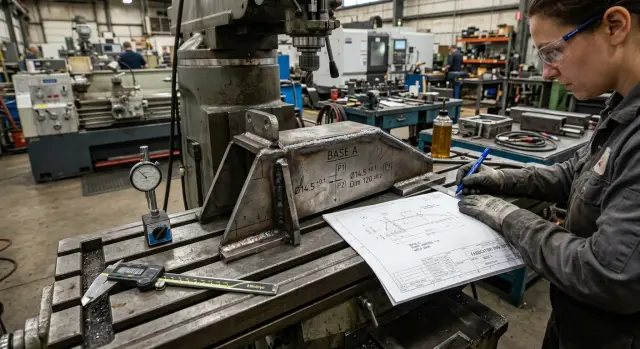
Why dimensions move after welding
Welding almost always changes the blank's shape. A weld strongly heats a small area, the nearby metal expands, then cools and contracts. In that moment it pulls adjacent zones, and the geometry no longer matches the pre‑assembly state.
Because of this a straight feature can become an arc, a surface can twist, and the distance between holes can shift. It’s not always visible to the eye. But on the machine the difference quickly becomes a dimensional issue, especially with tight tolerances.
Thin walls, long flanges and low‑stiffness zones move the most. A thick mass of metal holds shape better, while thin material reacts to heat faster. So one welded part can have a flat base that sits true while a welded pad already tilts slightly up or to the side.
The problem doesn’t end after cooling. Residual stresses remain in the metal. While the part rests on the table these stresses may be barely noticeable. But as soon as you remove the allowance during the roughing operation the force balance changes and the part releases some of those stresses.
That is why size often moves a second time after roughing. The blank looked stable while the extra metal was present, but after removing the layer it behaves differently. Hence the typical case: everything seems fine on the first setup, and on the next one an unpleasant surprise appears.
Doing the finish pass too early is risky. Finish machining often locks in a temporary geometry, not the final shape the part will have after all transitions. For example, on a welded frame you can almost bring the top surface to size, then remove metal from the underside. After that the frame redistributes stresses and the finished surface moves.
A welded part requires a more cautious route than a solid blank. First you need to understand where the metal pulls, which zones are weak and after which steps the shape may change again. Then machining proceeds calmer and the dimensions won’t wander at the end of the process.
What to check before the first setup
If the blank is welded, don’t start by finding a convenient clamp. First compare the part drawing, the welding scheme and the tolerances. A common mistake is the process engineer looking only at final dimensions while the welder assembled the unit with different tack welds and seams.
Pay special attention to which surfaces will become the bases. On the drawing they may look flat, but after welding there are often distortions, local overheating or excess weld metal. If you miss this at the start, the first setup will lock in the error and it will propagate through the route.
Before starting check four things: whether there is distortion along length, diagonals and planes; whether weld spatter, bead buildup or reinforcement interfere with proper referencing; whether there is enough allowance for roughing, straightening and future finish bases; and whether the part needs a hold time after welding, mechanical straightening or stress relief.
Look for distortion not by eye but at simple, clear points. For a frame these can be diagonals, deviation of a support plane, the distance between uprights and several control dimensions around welds. Even a 1–2 mm difference before the first setup already changes the clamping scheme.
Then assess the weld areas. Buildup and spatter seem minor but they often give a false support on the table or in V‑blocks. The heat‑affected zone is also dangerous: metal near the weld may behave differently on the first pass, especially if allowance is removed asymmetrically.
Be stricter with allowance than for a regular blank. If too little metal remains on a future base, you won’t be able to both level the surface and remove the deformation trace. Then referencing must be changed during the job, which almost always creates new errors.
Sometimes the best step before the machine is simply to wait. If the part was just welded, it may still be shifting. For heavy assemblies or critical fits decide in advance whether holding, straightening or heat treatment is required.
A good readiness sign is this: you clearly know which surfaces you will use to locate the part, where you will remove the first metal and which dimension you will check immediately after roughing. If any of these questions lack a clear answer, postpone the first setup.
How to choose machining bases
You can’t pick a base on a welded part simply by convenience. After welding a surface may look flat but change shape slightly under clamp. That’s why it often happens that the size is correct on the first setup and then shifts on the next.
Start by finding surfaces that hold shape and repeat from part to part. Typically these are thick pads, stiff areas and zones away from the weld and heat‑affected areas. Avoid using a thin wall or an edge next to a weld as a datum without a strong reason. The clamp will press the metal, and after unclamping the part will spring back.
A good base doesn’t spring under clamp, it’s easy to reach with the tool and measurement, and it can be reproduced on each setup. If any of these conditions is missing, the base raises doubts.
Separate roughing and finishing bases. On early operations use surfaces that allow a confident placement of the blank and removal of the main allowance. After that create new, machined bases and run the finish machining from them. This is more accurate and safer than trying to do everything from one random plane.
Also assign bases for intermediate checks. The inspector and operator must measure the part from the same surfaces that will be used for the next setup. Otherwise confusion arises: measured from one base the dimension is in tolerance, from another it is not, though the part itself hasn’t changed.
In practice the scheme is usually simple. For a welded frame take two rigid support pads and a side face away from the main weld for the first setup. On that operation generate a base plane and, for example, two reference holes. Later that plane and the holes are used both for finishing and for intermediate control.
If the part lacks convenient surfaces for reliable locating, sometimes allowance is left intentionally on special base pads. This avoids extra re‑setups and disputes at inspection.
How to build the route step by step
Build the route for a welded part based on how the blank behaves, not on machine convenience. After welding the metal has already changed shape and some internal stresses remain. If you go straight to the finish size the part can move after the next pass or even after unloading from the table.
A calm scheme with pauses and checks usually works. First remove excess metal, spatter and obvious bead buildup, and at the same time open roughing bases so the part can be placed consistently and without skew. Then let the blank stabilize. Sometimes natural cooling is enough, sometimes a hold is needed, and for critical parts stress relief is applied.
After that machine the main seating surfaces and the bases from which other dimensions will be referenced. Leave finish allowance rather than trying to close everything in one setup. Before finishing recheck the geometry: flatness, pull‑out, hole offsets, and distances between bases. If the part has moved, you’ll see it at this stage, not at the end of the batch.
In the final stage bring only stable zones to size. If an area still moves after machining, don’t finish it too early.
A good sequence for a welded part almost always includes a pause between roughing and finishing. At first the pause seems unnecessary, but in practice it saves time. It’s easier to wait a few hours and re‑verify the base than to chase deviations on finished parts.
If you’re unsure which operation to run earlier, the rule is simple: first create a stable support, then check the geometry, and only after that make the accurate surfaces.
Where to leave allowance before finishing
On welded parts leave allowance not uniformly but where the metal typically moves after roughing. Primarily these are zones near welds, corners with heavy heating and places that pull during cooling. If you remove metal in these points too early, you may lose the finishing dimension on the next setup.
Most often extra stock is left on planes close to welds. Even if a plane looks flat after the first roughing pass, internal stresses may not have fully released. It’s sensible to leave a bit more material near the weld than on a calm area of the same surface.
Long thin edges are also better treated cautiously. They are often almost brought to size early and then the part relaxes and the edge shifts by tenths of a millimeter. For such features it’s safer to do a rough pass, let the part rest and then perform finishing.
Bores for reaming or boring also require stock. After welding an axis can shift slightly — enough to keep a finished hole out of tolerance. Therefore machine the hole first with allowance for expected movement, and obtain the exact size later when the main deformations have manifested.
Keep a simple operation log. Record not only the measured size after a pass, but how much allowance actually disappeared after the first roughing of a plane, after re‑setting, before final boring of holes and after the check pass on edges. Such records quickly show which surfaces behave stably and which need extra stock. In a batch it becomes clear by the second or third part which surfaces you can safely reduce allowance on and where you shouldn’t risk it.
For a welded frame a reasonable order is: first remove the main excess from base planes but don’t finish them near welds; then rough machine long edges and holes; and only after an intermediate check remove the remaining stock to reach final size.
When to do intermediate inspections
Intermediate inspection isn’t a paperwork exercise, it’s how you catch movement in time. Welded blanks often change geometry not immediately. You removed metal during roughing, relaxed internal stresses, and the part can drift on the next setup.
Make the first check immediately after roughing. At that moment focus on base planes and the surfaces from which the next setup will be referenced. If a base has already moved, finishing will only lock the error.
Before flipping the part measure distances between supports, uprights or other stiff points. This simple step often saves the whole batch. If that distance changes after re‑clamping, the problem is in the part or the referencing scheme, not in the CNC program.
Keep a short set of control points: flatness of the base plane after roughing, distance between supports before flipping, coaxiality of holes after re‑setting, flatness and straightness after the hold, and remaining allowance before finishing at critical locations.
Another important point is the pause between operations. If the part is large, don’t rush to finish. Let it sit for several hours or until the next shift, then recheck flatness and coaxiality. On big parts shifts of a few tenths often appear after a pause when the metal redistributes stresses.
Before finishing do one more short check. Its purpose is simple: confirm that movement has stopped and that the allowance remains reasonably even. If one side is almost to size while the other still has a large reserve, stop and recalculate the route instead of trying to salvage the part by extra cuts.
Example route for a welded frame
Take a frame made from profile tube and sheet gussets where you need two base planes, four fastening holes and accurate diagonal dimensions. For such a part it’s better to build the route with time margin rather than only machine minutes.
First the fitter removes spatter and cleans welds at future support locations. Full cleaning of the entire frame isn’t necessary — remove buildup where the part will rest on supports and where referencing will occur.
On the first setup the operator places the frame on rough supports in a three‑point scheme so the part doesn’t rock or gain extra bending from the clamp. Then they bring the first plane to rough condition, removing the minimum metal needed to obtain an even base but not a final surface.
Immediately after roughing it’s best to unload the frame, let it cool to shop temperature and check the geometry. Typically diagonals, flatness and corner pull‑out are checked. If one diagonal shifted after the first metal removal, you’ll see it here rather than after an expensive finishing operation.
Once the first base is understood, the frame is re‑mounted from that base and holes are machined, then the second base plane is processed. This order is convenient because the holes and the second plane are tied to the actual geometry of the part, not to the as‑welded shape.
At this stage a short control is enough: check the distance between bases, verify hole coordinates from the first plane, measure diagonals again and watch for pull‑out near welds.
If sizes hold, the operator leaves a small finish allowance and performs the final setup. Finish machining should be done only after a repeat check when the frame has passed roughing and the second setup. The risk is lower: the size won’t shift after finishing and you won’t have to rescue the surface by removing extra metal.
This route takes a bit more time but noticeably reduces rework. For welded parts this is usually more economical than a fast single‑pass approach that looks good only on paper.
Mistakes that make parts move
Welded parts rarely behave calmly. The metal has already seen heating, cooling and local deformation, so haste almost always backfires. The most common mistake is doing the finish pass immediately after welding while the part hasn’t settled.
If you finish too early the residual stresses don’t go away. After the next pass, a flip or even after unloading, the geometry can shift by a few tenths or more. For a welded frame this is familiar: everything looks fine on the machine, but after unloading the plane is no longer correct.
A second mistake is choosing a datum where the part itself is weak. A thin wall, a flange next to a weld or an area with local thinning poorly holds repeatability. The operator sets up and the part rests on a zone that itself moves due to stress. As a result the following machining shifts.
The same applies to clamping. If you pull the part too hard the machine will straighten it under force, and after unclamping it returns to its state. Then the problem looks strange: the dimension exists in the setup but not off the machine. This happens constantly on long welded blanks.
Another common error is leaving too little allowance for a repeat pass. After the first roughing the part may pull a bit. If allowance is nearly zero there’s nothing left to correct. You either accept the shifted size or end up in rework dimension.
Checking only at the end of the batch is also costly. When dimensions are verified after all operations you see the final problem, not where it started. It’s much more useful to detect movement earlier: after roughing, after re‑clamping, and after removing stock near welds.
Safer practice is: let the part stabilize if material and schedule allow; remove roughing stock and observe geometry; reference on stiff zones away from welds and thin walls; leave stock for a second pass; and check dimensions before finishing, not after.
If a part regularly moves, don’t look for a single cause. Usually there are two factors together: weak referencing and excessive clamp force, or early finishing plus too little allowance. When the route is planned with these in mind, size stops drifting already on the first trial part.
Checklist before starting a batch
Before a run spend 15 minutes to verify the route — it’s better than sorting out dimensional scatter across the batch. For welded parts this is especially important: the metal still changes after welding and straightening, so a small mistake in base or allowance quickly shows up at finish.
Check several items. For each setup define bases in advance: separate for roughing and for finishing. After welding and any necessary straightening there must be real allowance — not just by drawing but on the first part. Place control measurements before finishing. The operator must know where to measure after each operation, with which instrument and in which base. Finally, the first part should go through a pause and re‑measurement after roughing.
If any of these points is not closed, don’t start the batch. On a welded frame, housing or bracket an error rarely stays in one place. Move the base on the first setup and you’ll get displacement across holes, planes and fits.
A good habit is simple: let the process engineer or setter run the first part, not only the operator. That initial pass almost always saves more time than any hurry.
What to do next
Do not launch the whole batch at once. For a welded part it’s wiser to make one trial blank and run it through the whole route. That run quickly shows where dimension drifts, which referencing works and at which transition the blank starts to move.
After the trial part don’t rely on memory. Fix the route in a process card so operator and engineer see the same logic instead of improvising during work. The card should list setup order and transitions, bases for each setup, where allowance is left before finishing, intermediate control points and actions if a plane or dimension moved after roughing.
This seems like needless paperwork only until the first disputed part. Later such a card saves time and material.
If the blank moves heavily after the first operations, don’t try to rescue the result only by tweaking the program. Usually the issue is deeper: large residual stresses, an unsuitable clamping scheme or unstable geometry after welding. In that case review the welding sequence, tack locations, supports and clamps, then retest the route. Otherwise finishing will simply lock the error.
If the trial run shows that the issue is equipment selection or the processing scheme, it makes sense to discuss it with the machine supplier. EAST CNC, the official representative of Taizhou Eastern CNC Technology Co., Ltd. in Kazakhstan, supplies machining centers, helps with selection, commissioning and service. Such a conversation is useful when the blank, clamping, route and a specific machine need to be matched into a working system.
The practical approach is simple: one part first, then adjustments, and only after that the series. Slower at the start, but you avoid ten identical spoiled frames or housings.
Good results do not rely on a single lucky operation but on a proven sequence. When the route is recorded, allowances are clear and control points are set in the right places, dimensions stop drifting from part to part.
FAQ
Why can't I do the finish pass immediately after welding?
Because after welding the metal still retains internal stresses. If you do the finishing pass right away, then remove metal elsewhere or re‑clamp the part, the geometry can move. First do a roughing pass, let the part stabilize, and only then finish the critical surfaces.
When should I pause after welding before machining?
A pause is needed when the part is large, has many welds, or when precise dimensions are close to welds. Even a few hours often helps reveal whether the part continues to shift. For critical assemblies decide in advance whether waiting, mechanical straightening or stress relief is required.
Which surfaces are best for the first base?
For the first setup choose rigid areas that do not change shape much under clamping. Usually these are thick pads and zones farther from the weld. Thin walls and edges next to welds are best avoided as primary supports unless there is a clear reason.
Where is it better to leave allowance before finishing?
Leave more allowance near welds, in corners with heavy heating and along long thin edges. These areas tend to move after roughing or re‑clamping. If you remove too much there too early, you may have nothing left to correct later.
When should the first intermediate inspection be done?
Do the first check right after the roughing pass. Don’t measure everything, focus on the bases, flatness and the distances between stiff points that will be used for the next setup. This way you catch movement before it reaches the finish stage.
Why do dimensions move after roughing?
During roughing you remove some metal and change the internal balance of stresses. That can make the part change shape on the next setup. The part might have looked stable on the table but after removing a layer the dimensions can shift — this is common with welded blanks.
How to tell if the part moves because of clamping?
If the dimension is correct under the clamp but after unclamping the part springs back and moves a plane or holes, the clamping is too aggressive. This is often seen on long frames and thin walls. Reduce holding force, change support scheme and check the part outside the machine, not only in the clamped state.
What to check before the first setup?
Verify the drawing, the welding scheme and the actual tolerances, then inspect for distortion, weld spatter and the real machining allowance. Before starting you must know which surfaces you'll use to locate the part, where you'll remove the first metal and which dimension you'll check after roughing. If these are unclear, don’t start the setup.
Is a trial part needed before starting the batch?
Yes — for welded parts a trial blank almost always pays off. One full pass reveals where bases shift, how the allowance behaves and at which operation the part begins to move. After that it’s much easier to correct the route than to rework a whole batch.
What to do if holes and a plane shift after re‑clamping?
Don’t try to fix the issue with a single program change. First check the referencing, clamping force, remaining allowance and the geometry after a pause. If movement repeats, revise the operation order: first create a stable support, then re‑reference the holes and only after that go to finish.
What should be checked before starting a batch?
Before launching the series, spend 15 minutes to verify the route — it saves more time than investigating size drift across the whole batch. For welded parts make sure the bases for roughing and for finishing are defined, that real allowance remains after any repair, that control points are set before finishing, and that the first part undergoes a pause and re‑measurement after roughing.
What to do next after planning the route?
Do not run the whole batch immediately. Machine one trial blank through the entire route. That run shows where the size moves, which bases work, and at which stage the blank begins to shift. Then record the route in a process card so operator and technologist share the same procedure.