
Positive rake angle for light cuts in heat-resistant steel
We explain when a positive rake angle reduces heat during light cuts in heat-resistant steel, and how to choose the geometry without overloading the machine.
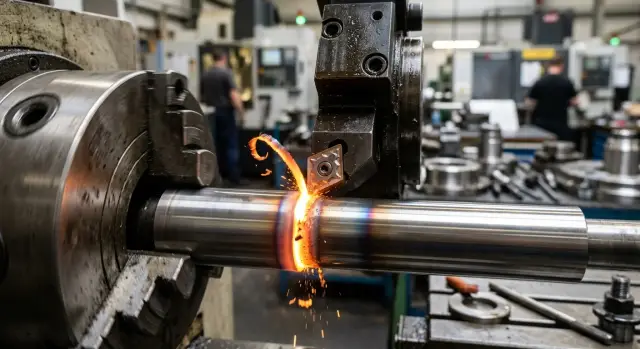
Why heat rises so quickly with a light cut
Heat-resistant steel does a poor job of carrying heat away into the chip or the workpiece. That leaves extra degrees right at the cutting edge. As the material heats up, it work-hardens quickly, and the edge almost immediately meets a harder surface layer.
When the machine is already working close to its limit, there is almost no room left to maneuver. You cannot raise the feed much because of surface finish. You cannot noticeably increase the speed because of vibration, power, or lack of rigidity. In the end, the operator often reduces the depth of cut so the pass will run smoothly. That can sometimes keep the size, but the process often gets hotter.
The reason is that with a light stock removal, the chip thickness becomes too small for stable cutting. The insert no longer shears the metal cleanly. Instead, it partly pushes the material ahead of it and rubs along the surface. Energy goes into friction instead of chip formation. And friction on heat-resistant steel quickly heats the tip.
What makes this especially annoying is that the machine does not let the process move into a more stable range. If you could shift the feed or depth of cut a little, the chip would become thicker, the contact would be shorter, and part of the heat would leave with the chip. But when the limit is already near, the process gets stuck in an awkward zone: the cut is small, the contact is long, and the temperature rises.
This shows up first on finishing passes. The allowance there is small, the feed is often small too, and the nose radius of the insert takes part in the work more than the straight cutting edge. The tool is not so much cutting as it is smoothing the surface under load. For ordinary steel, that kind of process may still be acceptable. For heat-resistant steel, rarely.
A familiar shop-floor picture looks like this: the roughing pass runs without obvious problems, but on the final pass with 0.1–0.2 mm per side, the edge heats up much faster. The size still holds, but tool life drops, the surface starts to wander, and the insert dulls sooner than expected. That is exactly when people start thinking about a positive rake angle.
What a positive rake angle changes
With a light stock removal, the tool often does not cut freely and instead partly rubs the metal. That is why heat rises faster than the settings suggest. A positive rake angle changes the very first moment of contact: the chip lifts more easily along the rake face, and the metal ahead of the edge is squeezed less.
You can see this in chip behavior. With a more positive geometry, the chip hits the tool less and starts flowing upward sooner. The contact zone is usually shorter, and pressure on the rake face goes down. For heat-resistant steel, that helps: the material resists deformation and heats the edge quickly.
The edge bites in more easily with this angle. For the machine, that means a softer entry into the material and lower cutting force. If the process is already close to the limit in power, rigidity, or feed stability, the difference can be noticeable even without a big speed change. The spindle runs more calmly, the part sings less, and less heat builds up at the tip of the insert.
Usually several things change at once: the chip separates earlier, friction on the rake face drops, built-up edge appears less often, and part of the heat leaves with the chip instead of staying in the cutting edge.
But there is a price. The more positive the rake angle, the thinner the wedge at the cutting edge. The tool cuts more easily, but the edge itself becomes weaker. If the cut is interrupted, there is scale, poor clamping, or vibration, the insert can chip quickly.
In practice it is simple: when the problem is extra friction and overheating during a light cut on a turning pass, a positive rake angle often helps. When the problem is impact and lack of rigidity, it can easily make things worse. That is why the angle is chosen not at the maximum, but according to how the process behaves in the first few minutes.
When this approach really helps
This approach is not for when you want to cut more aggressively. It is for when the machine and the process are already almost at their ceiling. With light stock removal, heat-resistant steel often does not cut calmly. It starts rubbing the edge, heating the part, and wearing out the insert quickly. In that situation, a positive rake angle can reduce cutting force and remove some of the extra heat.
It is most noticeable on machines where any attempt to raise the feed immediately brings vibration. Rigidity is lacking, the tool starts working roughly, and the operator has to back off the settings. Then a lighter geometry helps not by magic, but by reducing pressure in the cutting zone.
Another common case is when the spindle is already close to its load limit. If the power reserve is small, any increase in feed or depth of cut quickly leads to overload. In those conditions, a positive angle often gives a calmer run: the spindle holds speed more easily, and cutting becomes smoother.
On long passes, the benefit can be different. The part gradually heats up, and the size starts drifting before the cycle is even finished. That is especially unpleasant on thin or long parts. If the geometry cuts more gently and generates less heat, size drift is reduced and the pass becomes more predictable.
You can tell this approach may fit by a few signs. The edge darkens or chips too early. The chip comes off very hot even though the allowance is small. A small increase in feed and the machine immediately loses its calm sound. After a long pass, the size drifts more than expected.
Another common situation is when the tool burns out before the full allowance is removed. On heat-resistant steel, that happens often: the insert does not break right away, but it quickly loses sharpness, and after that cutting turns into rubbing. A positive rake angle often delays that moment and gives the edge time to do its job before critical overheating.
But it does not always help. If the problem is weak workholding, runout, wrong tool height, or a worn chuck, geometry alone will not fix it. This approach works best when the limit is set by cutting force, heat, and machine load rather than by a clear mechanical fault.
Most often it is chosen for finishing or semi-finishing, when you need to remove a small amount of metal without putting extra pressure on the machine or the part. The gain is not always huge in numbers, but in real work it is obvious right away: less heat, calmer cutting, and a better chance of hitting size on the first try.
How to choose the geometry step by step
It is easy to make a mistake with a positive rake angle: choose a sharper insert and expect the heat to disappear right away. That does not always happen. If the part is clamped weakly and the tool sticks out too far, a thin edge will first lose stability and then heat up even more.
It is better to change one parameter at a time. Then you can quickly see what actually helped: the geometry itself, the feed, or the machine’s behavior at that setting.
Setup sequence
First, check the rigidity of the whole setup. Look at the workholding, the tool overhang, and the condition of the holder. If there is chatter on an empty pass or on entry into the material, it is too early to move to a more positive insert.
Next, compare the current insert with one that has a more positive rake angle, but do not change everything at once. Keep the same holder type and a similar nose radius. Otherwise it will be hard to tell what actually reduced cutting force and temperature.
Keep the depth of cut in a safe range for the machine and the part. With light stock removal, it is often tempting to go extremely shallow, but too little depth can push the process back into rubbing. On heat-resistant steel, that quickly raises the temperature at the edge.
Change the feed in small steps and watch the chip each time. If it comes off evenly, without heavy bluing, and the sound stays calm, you are moving in the right direction. If the chip breaks into dust or, on the contrary, comes off as a sticky ribbon, the setting is still not right.
And most importantly, stop right away if the edge starts to chip, a whistling sound appears, or the surface starts to ripple. This is not the kind of case where you should “run one more pass and see.” On heat-resistant steel, that test often ends with a lost insert.
In real work, the process is usually simple: the operator chooses a more positive geometry, leaves the depth of cut unchanged, and carefully adjusts the feed. Within the first few minutes you can already tell whether it cuts easier. If the machine runs more smoothly and the edge lasts longer, the setup is moving in the right direction.
What to watch in the first few minutes of cutting
The first few minutes show not the catalog setting, but how the setup cuts this specific heat-resistant steel with a light stock removal. If a positive rake angle helps, you can see it almost immediately in the chip, the sound, and the edge behavior.
Start by watching the chip. Its color and shape tell you about heat better than the feeling that “it seems to cut fine.” If the chip comes off more evenly, breaks more easily, and does not darken too quickly, heat is leaving the cutting zone better. If it turns blue almost immediately, breaks into short hard pieces, or, on the other hand, comes off as a sticky ribbon, cutting is already sliding into rubbing.
Also check whether built-up edge is growing on the cutting edge. On heat-resistant steel it appears quickly, especially when the allowance is small and the insert is rubbing more than cutting. A short stop and a look under a magnifier are often more useful than one more guesswork pass. A small shiny buildup changes the actual geometry, ruins size, and then breaks off together with part of the edge.
What you hear and what changes on the part
After each adjustment, listen to the cut on the same section. A good sign is when the sound becomes smoother and softer, without squealing or periodic knocks. If the noise becomes sharper after a small feed increase or a change of insert, do not dismiss it as normal. Sound often changes before visible wear appears.
Check the part size not only on the first piece, but also after warm-up. Make several passes, let the spindle and holder work for a bit, then measure the same diameter again. If the size is within tolerance at a cold start but begins to drift after 10–15 minutes, the heat in the cutting zone is still too high.
Direct comparison is also useful: old and new inserts on the same section and with the same cutting length. Not from memory, but in fact. If the new geometry gives more even wear on the flank face and the edge stays clean longer, the approach worked. If wear becomes uneven and the tip starts chipping sooner, the temperature gain was too expensive.
In shops, people often make the same mistake: they feel the cut has become easier and immediately raise the speed. It is better to first make sure the chip is calmer, built-up edge is not growing, the sound is even, and the size does not drift after warm-up. Only then should you move the settings further.
When a positive angle gets in the way
A positive rake angle is not always useful. On heat-resistant steel, it reduces cutting load, but that advantage often comes at the cost of edge strength.
The first problem appears with interrupted cutting. If the tool passes over a groove, a hole, a lump, or a hard crust, the thin insert takes an impact on every entry. A sharp edge cuts more gently, but breaks sooner. In that situation, a stronger geometry usually lasts longer, even if it heats a little more.
The second problem is rigidity. If the whole system — machine, chuck, part, and holder — is already near its limit, a very sharp angle can easily trigger vibration. That is often seen on long shafts, with a large tool overhang, or with weak clamping. The surface becomes wavy, the sound changes, and the edge loses life in just a few minutes.
Another common failure comes from chip control. A positive geometry by itself does not solve chip handling. If the insert is designed for a different feed or depth of cut, the chip stops breaking and comes off as a long ribbon. It hits the part, catches on the jaws, and heats the cutting zone again. On heat-resistant steel, that quickly turns into chaos.
There is also a quieter mistake: the feed is reduced too much. Then the chip thickness drops below the level where the edge still cuts stably. Cutting slides back into friction and metal smearing. Temperature rises, the surface shines, but that is a false sign. The tool is no longer cutting properly.
Usually a positive angle causes problems in four cases: when the cut is interrupted or the surface is broken, when the part or tool lacks rigidity, when chip control does not work at the selected feed, and when the feed is dropped below the insert’s working range.
Even on a good CNC lathe, this line exists. On less rigid equipment, it comes sooner. If in the first few minutes you hear ringing, see long chips, and notice ripples on the cutting track, making the angle even sharper is not a good idea. It is usually more useful to restore edge strength, adjust the feed, or choose an insert with a different chipbreaker.
A simple shop example
A shaft made of heat-resistant steel was being turned in a production area. After roughing, only 0.3 mm of stock remained on the part. With that little left, you just want to remove the layer and hit size, but that is exactly where extra heat and poor repeatability often begin.
At first, the operator used the usual insert with a heavier geometry. The settings were left unchanged: the machine was already working near its comfortable limit, and the power reserve was small. After a short time, a blue mark appeared on the surface, and the edge started wearing much faster than expected. The size also drifted: the first parts still held, then a slow shift began.
The reason was not the machine itself or the metal batch. With such a light cut, the old insert was rubbing more than cutting. Heat was going into the part and the edge instead of into the chip. For heat-resistant steel, that is a bad scenario: the metal holds its strength, the chip comes off hard, and the tool gets tired very quickly.
After that, the operator switched to an insert with a more positive geometry. He kept the speed the same so as not to add vibration risk. He increased the feed only a little, without any sudden jumps. That was enough to make the cut cleaner.
The positive rake angle helped here for a simple reason: the edge entered the metal more easily, friction dropped, and the chip came off more evenly. The blue mark almost disappeared, the cutting sound became calmer, and the insert stopped dulling so quickly on the first parts.
The most noticeable change was not only in tool life. Size also became more stable. When the part heats up less during the pass, it moves less in diameter, and the operator does not have to keep chasing a correction after every couple of parts.
The lesson from this kind of case is simple. If only a small stock allowance remains on heat-resistant steel and the settings cannot be moved much without risk, a positive rake angle often brings more benefit than yet another attempt to tweak the speed back and forth.
Common mistakes
The most common mistake is simple: people treat a positive rake angle as a ready-made solution and forget about the rigidity of the whole system. If the holder is long, the overhang is large, and the workholding is weak, a sharp geometry may cut more gently, but it will fall into vibration faster. In the end, the edge lasts less, and the surface gets worse before the temperature even drops.
The second mistake appears almost immediately after the insert change. The operator sees an easier cut and reduces the feed even more. With light stock removal, that is dangerous: the tool no longer cuts, it rubs the metal. For heat-resistant steel, that is a direct path to extra heating of the edge and the part.
That is why you cannot look only at spindle load. Yes, the current may go down. But that does not mean the process got better. If the chip darkens, a squeal appears, the size starts drifting, and flank wear grows quickly, the lower load does not save you.
Another typical mistake is changing too many parameters at once. You install a different insert, reduce the speed, change the feed, and increase coolant flow. After that, it is already hard to tell what actually worked. On the shop floor, that approach only wastes time.
The working method is simpler: first change only the insert geometry and keep the same speed and feed for the first test. Then look at the chip, the sound, and the wear after a few minutes. Only after that should you fine-tune the feed in small steps.
Another special case is a rough or impact cut. A sharp positive geometry is often used where the blank has scale, a step, a hole, or interrupted contact. In those conditions, the thin edge just gets hit. On paper the cutting force is lower, but in real work the insert chips before it can show the benefit.
A good sign of correct setup looks boring, and that is normal: the chip comes off steadily, the sound is even, the load does not jump, and the edge wears predictably. If even one of those signs is missing, the problem is usually not the angle itself, but the combination of geometry, feed, and rigidity.
Quick check before starting
On heat-resistant steel, small things quickly become big problems. If you are removing only a light allowance, heat rises even because of extra overhang, weak clamping, or a feed that is too cautious. Before the first pass, it is better to spend two minutes checking than to chase size drift and built-up edge later.
First, assess the part overhang. If the part sticks out more than needed for the pass, rigidity drops and the tool starts rubbing instead of cutting. Then look at the insert and the holder. The geometry should suit heat-resistant steel and a finishing or semi-finishing pass, not just match in size.
Then check the feed. A very small value looks safe, but in practice it often pushes the cut into rubbing. For light stock removal, that is one of the most common mistakes. After that, make sure the chip leaves the cutting zone. If it comes off as a ribbon and catches on the part, the surface quickly suffers and the temperature rises within the first seconds.
After a couple of test passes, do not check the size immediately, but after a short warm-up of the part and the setup. If the size drifts, it is better to find the reason before production starts.
A positive rake angle is often chosen exactly when the machine no longer allows the process to be raised without risk. But it does not save a bad base setup. If the chuck holds unevenly, the tool hangs out too far, and the feed is too low, a sharper geometry will only expose the weak point faster.
The rule is simple: the sound is even, the chip does not stick, the surface does not darken, and the size repeats after warm-up. If even one point does not match, do not rush to change speed first. It is often more useful to reduce overhang, adjust the feed, or choose an insert that cuts better with a small allowance.
In shops that work with CNC lathes on heat-resistant alloys, this short check saves a lot of time. It is simple, but it is often what separates a calm start from a long setup.
What to do next
If you find a setting where a positive rake angle lowers heat and does not destroy the edge in the first few minutes, record the result in the operation sheet or in a simple work note. Shop memory is unreliable. After a couple of weeks, it is usually hard to remember which insert was installed, what the overhang was, and at what feed the cut suddenly became calmer.
Write down not only speed and feed. When machining heat-resistant steel, small details often matter more than they seem: the actual allowance, depth of cut, material grade, coolant condition, rigidity of the part clamping, holder model, and the exact insert geometry.
It is useful to keep short notes for each successful and unsuccessful attempt: where the angle gave an easier cut and less heat, at what allowance the edge lasted longer than usual, where chipping or micro-chipping appeared, how the tool behavior changed with a small feed increase, and whether there was a difference between continuous and interrupted cutting.
These notes quickly show the boundary where a positive rake angle helps and where it starts to get in the way. That is especially handy for repeat parts. Instead of a new trial, you take a proven working combination and go straight into cutting with less risk.
If the result only holds in a very narrow operating window, it is worth checking the tooling. Sometimes the problem is not the geometry itself, but a weak holder, too much overhang, or an insert that is sharpened too finely for your cut. In such cases, changing the holder or switching to another insert brings more benefit than trying to change speed by a few percent again.
When the task goes beyond choosing one insert, it helps to look at the whole process. In those cases, the equipment supplier’s experience also helps. For example, EAST CNC works with CNC lathes for metalworking and helps with equipment selection, commissioning, and service. For difficult jobs with heat-resistant materials, that is often more important than endlessly adjusting one setting.
A good next step is simple: build 3–5 working combinations for your typical parts and keep them as a base. That saves hours of trial passes and noticeably reduces the number of overheated edges and random chips.
FAQ
Why does the insert heat up faster with a 0.1–0.2 mm cut than on roughing?
Because the cutting edge often no longer cuts cleanly and starts to press and rub the metal instead. On heat-resistant steel, that quickly raises the temperature at the tip, and part of the heat stays in the tool instead of leaving with the chip.
What does a positive rake angle do in this situation?
It makes the cutting edge enter the metal more easily and helps the chip flow up the rake face sooner. Cutting force and friction usually drop, so the spindle runs more smoothly and the edge lasts longer.
On which passes is it used most often?
It is most often used for finishing and semi-finishing passes, when the allowance is small and the machine is already close to its limit. On roughing cuts, it does not always help, because the edge needs more strength there.
When does a positive rake angle make things worse?
On interrupted cuts, with weak clamping, a long tool overhang, and vibration. In those conditions, a thin edge chips quickly, and the gain from lower heat disappears.
How quickly can you tell that the new geometry works?
Look at the chip, listen to the sound, and inspect the edge after the first minutes of cutting. If the chip comes off more evenly, the sound stays calm, and built-up edge does not grow, you are moving in the right direction.
Do you need to change speed and feed together with the insert?
No, start by changing only the geometry. That way you can see what really made the difference, and then adjust the feed in small steps if needed.
Why is too little feed dangerous?
Because the chip thickness falls below the insert’s stable working range. The tool starts rubbing the metal instead of cutting it, and heat rises faster than the spindle load suggests.
What should be checked before changing the insert?
First check the workholding, the part overhang, the tool overhang, and the condition of the holder. If the whole setup is already shaking, a sharper geometry rarely saves it.
Can this angle help hold size?
Often yes, if the size drift comes from heating of the part and the tool. When the edge cuts more easily and heats the cutting zone less, the diameter changes less after warm-up.
What should be recorded after a successful setup?
Save the material grade, actual allowance, depth of cut, feed, speed, insert geometry, holder, and overhang. Then it is much easier to repeat the working setup without new trials and extra wear.