
Poor drawing legibility: when to stop estimating
Poor drawing legibility often hides missing dimensions, tolerances and datums. We explain when to stop estimating and request revisions without argument.
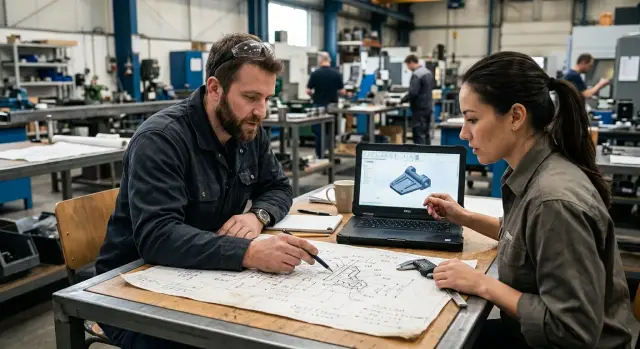
What makes a drawing unreadable
Price and lead time depend not on the part's general appearance but on precise data. The process engineer needs dimensions, tolerances, material, datums, surface finish and clear geometry. If any of this has to be guessed, the estimate immediately loses accuracy.
The problem isn't just a bad scan. A drawing can be formally filled out and still unreadable. Dimensions overlap, extension lines cover numbers, the same feature looks different on different views, and notes contradict the title block. In that situation the maker doesn't calculate — they invent. Later the dispute is no longer about the paper but about lead time and machining quality.
Not every slip-up ruins the job. If a general note has a typo that doesn't change geometry or tooling selection, it’s usually resolved quickly. A critical ambiguity looks different: no tolerance on a fit diameter, missing material, no visible datum surface, a section that doesn't match the view, a size covered by a stamp, or numbers blurred after printing.
Five signs typically raise alarm: a dimension is not fully readable, a feature has different values on different views, mating surfaces lack tolerances, material or heat treatment are not specified, or the file is so poor that lines and numbers merge.
Even a single such error can completely change the processing route. Diameter 20 and diameter 20 H7 are different requirements. The latter requires different inspection, higher accuracy and often more time on the operation.
In practice disputes usually start simply: the customer expects a standard part, but after launch the shop sees the requirement is stricter than it appeared on the drawing. They must rewrite the program, change tooling and repeat inspection. Sometimes the part is rejected entirely.
Therefore poor drawing legibility is not a convenience issue. It directly affects price, lead time and the risk of rework. If a document can't be read confidently at first glance, estimating from it without clarification is risky.
Ambiguities that most often cause disputes
A dispute starts when the process engineer and the customer read the same sheet differently. If a drawing contains even one ambiguous spot, the estimate quickly becomes guesswork.
Most problems come from the dimensioning block. One size is missing, another is shown differently in two places, a third doesn't match the overall dimension. For a customer this may seem minor, but for production the difference between 24.8 and 25 mm can mean another tool, another cutting mode or even another inspection method.
Equally common is uncertainty about which datum to measure from. A part can be checked from the end face, from the axis or from a mating surface. The result will differ even if all numbers are formally present. Then one side says the part was made to the drawing, while the other points to an offset and calls it a defect.
Tolerances, surface finish and fits are another risk area. If tolerances aren't specified for all dimensions, the technologist decides where to hold tighter accuracy and where it's acceptable to be rougher. That affects quality and price immediately. The same goes for surface finish: Ra 0.8 and Ra 3.2 are not just visual differences but different machining time and inspection. If a fit is unclear or the marking is smeared, a dispute is almost inevitable.
Another frequent source of problems is document versions. One sheet shows a new date while the assembly still contains an old fragment. Dimensions may have been changed, while a section or callout remains from the previous revision. The shop receives one set of data, inspection another. Each side refers to its own sheet and the discussion quickly becomes heated.
Even ordinary text can spoil the job. If callouts overlap, sections are hard to read and the font is too small, people start reconstructing meaning from memory. In metalworking this is a bad habit. When in doubt, it's better to request drawing revisions immediately than to later sort out who made the drawing mistakes and who pays for rework.
Worst of all, these ambiguities rarely appear alone. They usually come in packs. The later they’re found, the more expensive the fix.
When you must stop estimating right away
You shouldn't continue an estimate if the drawing has a gap that changes how the part is manufactured. In such cases price, lead time and even the blank selection become guessing. Then the customer expects one thing, production makes another, and the person who started work without clarification is blamed.
Stop immediately if a size needed to choose the blank is missing, if material or heat treatment is not specified, if tolerances contradict each other, if the drawing doesn't match the 3D model or the specification, or if it's unclear which surfaces are functional.
If one basic dimension is missing, the estimate can't be considered honest. A difference of 3–5 mm can change the bar diameter, blank length, stock allowance and machining time. On paper the lead time may seem reasonable, but in the shop it may turn out the required blank is unavailable or the part becomes too expensive.
The same goes for material. Steel 45, stainless and aluminum bring different cost, tool wear and cycle time. If material is not stated and heat treatment is only partly mentioned or missing, pause the estimate. Otherwise a dispute over lead time will start after launching production.
Brake the work when accuracy requirements contradict. For example, a general tolerance is given in one place and a fit that doesn't match it in another. Production will follow one variant and inspection another, turning an acceptance issue into a long exchange instead of a normal handover.
Errors also surface at document interfaces. A flange in the 3D model may have six holes while the drawing shows four. The specification lists one material and the main view another. Accepting any option without confirmation embeds a dispute into the estimate.
Another warning sign is unclear functional surfaces. If it's unclear which planes, diameters or holes are involved in assembly and inspection, the technologist can't prioritize correctly. Externally the part will look right, but in reality it may not assemble or pass acceptance.
How to request drawing revisions
If the delay reason is poor drawing legibility, don't try to guess the designer's intent. Such guesses almost always end in dispute: production budgets one scope of work while the customer expects another.
First, make a copy of the drawing and mark all questionable spots on it. Short notes on the sheet work better than a long email without reference to a view or dimension. Circle the unclear tolerance, arrow the dimension and note what confuses you: datum, surface finish, material, fit, radius or diameter.
Then gather the questions into one list. A generic phrase like "clarifications needed" doesn't help. Be specific: "no tolerance on the hole," "dimension reads as 18 or 13," "material in the spec doesn't match the drawing text." One consolidated list reduces the risk that some remarks get lost.
Next split the questions into two groups. First — critical items without which you can't honestly estimate price, processing route and lead time. Second — clarifications that don't prevent a very rough estimate but must be answered before launch. This order shows what blocks the estimate now and what can be resolved later.
In practice it's simple. For example, on a turned part the main diameters are legible but it's unclear from which datum the groove dimension is taken and what tolerance the fit needs. In that case don't calculate a final price or promise a ship date. First get answers to the two critical points.
Ask for a new drawing version with date and revision number rather than just comments in an email. Otherwise the old file can remain in use and the dispute will begin after fabrication. If corrections exist only in an email, no one will remember which revision was agreed a week later.
Recalculate price and lead time only after critical questions are answered and a new version is received. If an earlier guideline is needed, state it honestly: the estimate is preliminary and production cannot start until the corrected drawing is supplied. One marked sheet and one clear question list usually save a day of correspondence and several days of rework.
Quick check before starting work
Before launch, spend 3–5 minutes on a brief drawing check. It's cheaper than later rewriting a program, changing the blank or arguing over who caused a defect. If poor drawing legibility is already visible at this stage, don't continue by memory and guesswork.
Treat the document as a working tool, not a formality. The foreman, process engineer and operator should be able to read it without constant zooming, sending screenshots or calling to ask "what's written here?" If a dimension, callout or surface-finish symbol is blurred, the risk of error is already high.
The pre-start check typically covers a few questions. Are all dimensions readable without guesswork? Are tolerances present on working surfaces when they affect fit or assembly? Is the material specified clearly, and is hardness unambiguous? Are datums, holes, threads and chamfers clear? Do all parties have the same file and version?
Lead times are often ruined by small things that seem harmless. For example, a hole may be shown but it's unclear if it's through or blind. Or a thread is indicated but its depth isn't. For turning and milling these are not minor clarifications but differences in tooling, cycle time and even blank choice.
Check material separately. Steel 45, stainless and a hardened blank need different cutting speeds, tooling and costs. If the drawing lists only a general name and hardness is specified in correspondence rather than on the drawing, a dispute is almost guaranteed.
Most problems come not from complex geometry but from mismatched versions. The designer may already have changed a chamfer and tolerance, but an old PDF went to the shop. The estimate is done on one revision while production expects another.
If even one item fails the check, stop and return the document for clarification. A short pause at the start almost always costs less than last-minute rework.
A practical example
A customer sent a shaft drawing with two bearing fits. Diameters and fits are present, chamfers and radii marked. At first glance everything seems fine. But axial dimensions lack a clear datum: it's unclear from which surface to measure the length between steps and where the dimension chain starts.
Because of this the technologist and inspection lead interpret it differently. The technologist takes the left end face as the reference and builds a machining route for one setup order. The inspection lead reads the same sheet and thinks it's more logical to measure from the right end because the second bearing sits on that side and assembly depends on it.
On paper it looks minor. In the shop it becomes two different solutions. In one case the operator turns both fits first, then brings lengths between shoulders. In the other, priority is given to the overall length from the right and emphasis shifts to a different datum for inspection. The part may be "to the drawing" for one specialist and disputable for another.
In such a case stop the estimate if sizes exist but it's unclear from where they are taken, if the tolerance on a length affects assembly and the datum isn't specified, or if production and inspection already read the document differently.
After requesting revisions the customer clarifies the datum: axial dimensions must be taken from the left end face and the distance to the second fit must be checked against a specific stop. The estimate changes immediately. An extra inspection step appears, sometimes an additional setup is needed, and lead time shifts by several days.
It's unpleasant but honest. If you remain silent and start work by guess, a dispute is almost inevitable. Production will say they followed their logic. Inspection will point out deviations. The customer will see the bearing assembled with interference in a different place than expected, and the conversation becomes about defects, new lead times and rework costs rather than drawing legibility.
Such errors rarely seem serious before launch but later hit lead time and quality simultaneously. A pause for clarification is usually cheaper than reworking a batch.
Mistakes from both sides
Disputes usually start before the machine. One side thinks "it's obvious," the other proceeds by assumption rather than data. If sizes, tolerances or notes are hard to read, mistakes are likely.
Customers often assume small ambiguities can be resolved during the process. Suppliers also rush: they want to name price and lead time quickly to avoid blocking approval. Both sides create fertile ground for conflict over timing and quality.
Customer mistakes
A common problem is that questions and revisions live in different places. One dimension is discussed by email, a tolerance in messenger, material by phone. A day later no one sees the full picture and a mix of old and new conditions enters production.
Worse is when the customer agrees to verbal corrections without issuing a new drawing. "Yes, change only this radius" sounds simple but doesn't replace a document. If the part later doesn't fit, it's hard to prove the original agreement.
Another mistake is confusing an editorial remark with a substantive one. Blurry font or a poorly placed callout is annoying but doesn't always change the process. A different tolerance, new surface finish, heat treatment or datum immediately changes the estimate.
Supplier mistakes
Suppliers often worsen the problem. Instead of stopping the estimate, a manager or technologist fills missing data by habit: "likely a standard tolerance here," "probably the same material as before." That's how drawing errors appear in the estimate and schedule.
Another typical mistake is failing to gather all questions in one list. When answers arrive piecemeal, the team may apply one change and miss another. In production that costs: retooling, extra tool purchases, schedule shifts.
A further error is not recording that the lead time has changed after clarifications. If the supplier silently accepts the new version but leaves the old date, a dispute is likely. The client sees a delay even though the scope actually increased.
A practical approach is simple: one current drawing version, one list of questions and answers, written confirmation of each change and a new lead time if the scope changed. With poor drawing legibility, care matters more than speed. Fifteen minutes to record revisions usually costs less than a week of disputes after the order starts.
How to record revisions and new lead times
After revisions, disputes often arise not from the part but because parties keep different versions of the drawing. If this isn't closed in a document or message, the shop estimates one variant while the customer waits for another.
When legibility has already caused questions, it's not enough to write "fixed and proceeding." Specify what changed, when it was agreed and how it affects price and lead time — preferably in one short document or confirmation email.
It's convenient to list the part or project number, the old and new drawing revision, the specific changed item — dimension, tolerance, material, surface finish, datum or thread — and the new lead time and price if they changed. Add a line stating which drawing version production will follow.
Keep the old version for comparison. That helps quickly show where a change appeared and often settles a dispute in minutes. If the customer changed a tolerance on a fit diameter, the shop can honestly demonstrate: previously the part was machined on a standard operation, now different tooling and more inspection time are needed.
Price and lead time should be stated separately even if only one parameter changed. Otherwise someone can say: "We agreed the revision but not the postponement." One line for lead time and one for cost solves this better than a long phone call.
Assign one person for all revision questions. If the technologist messages the manager, the manager contacts the designer and the designer replies a day later, mistakes multiply. A single contact reduces the risk that someone verbally approves the wrong version.
Before launching, get a short confirmation: "Production proceeds by revision 3 dated 14.04." For CNC metalworking that's enough so customer and supplier work from the same document and don't argue after the first part is ready.
What to do next
If a drawing has even one critical ambiguity, pause the estimate. Otherwise price, lead time and processing method quickly become guesses. The customer waits for one part, production makes another, and the blame falls on the one who answered too quickly.
Consider any ambiguity critical if it changes technology or inspection: material, tolerance, datum, surface finish, heat treatment, coating, thread, fit and even units. One missing dimension can shift lead time by days if a blank was already ordered or a programmer started writing the program.
Keep a short template of questions for questionable drawings. Four points usually suffice: which size or parameter causes doubt, what exactly is unreadable or contradicts another spot, without which answer you can't estimate price and lead time, and which option the customer considers correct.
When poor drawing legibility prevents understanding even one important area, don't fill meaning by habit. Different technologists' guesses often diverge. On paper it looks minor, but in the shop it becomes rejection, rework or refusal to accept.
Before replying to the client do a short internal check. The manager assesses procurement and lead-time risk. The process engineer evaluates whether the requirement can be met without extra setups and unstable results. For complex parts involve the service team to check for hidden equipment, tooling or setup limits.
This is especially important for complex geometry, thin walls, tight tolerances and serial production. In such tasks the question is often not only about estimating but about which equipment can produce the part reliably.
If you need a second opinion before project launch, you can discuss the task with EAST CNC specialists. The company supplies CNC lathes and machining centers, helps with selection, commissioning and service, and publishes practical metalworking materials on the east-cnc.kz blog. One precise clarification at the start is almost always cheaper than reworking a batch later.
FAQ
When should you stop estimating from a drawing?
If a dimension, tolerance, material, datum or working surface is read with doubt, it's better to pause the estimate. Otherwise you'll name price and lead time by guesswork and the dispute will start after production begins.
Which drawing errors most often cause disputes?
Most disputes come from missing or contradictory dimensions, unclear datums, smeared fits, incomplete tolerances and different versions of the same document. Even one such gap changes processing, inspection and lead time.
Can you give at least an approximate price if the drawing isn't fully legible?
Yes, if the ambiguity doesn't change geometry, tooling or inspection. But don't promise a final price or date until all critical questions are closed in writing.
Why does the datum on a drawing affect the result so much?
If the datum isn't specified, different specialists will measure from different references and get different results from the same geometry. Later production may pass inspection for one person and be rejected by another.
What if the drawing doesn't state material or heat treatment?
Without the material you can't honestly estimate machining time, tool wear or cost. Steel, stainless and aluminum require different cutting regimes, and heat treatment changes the route even more.
How to correctly request revisions to a drawing?
Make a copy of the drawing, mark every unclear spot and collect the questions in one short list. Ask for a new drawing version with a date and revision number rather than just comments in an email.
What to do if the 3D model doesn't match the drawing or specification?
First check whether hole counts, sizes and materials match across all files. If 3D model, PDF and specification differ, don't pick one by eye — request confirmation first.
Why is it dangerous to work with different drawing versions?
An old revision can easily end up in the shop while the customer views a newer one. That leads to costing by one file and acceptance by another, and the dispute becomes almost unavoidable.
How to quickly check a drawing before starting work?
A quick check is enough: are all dimensions readable, are tolerances on working surfaces present, is the material specified, are datums, threads and holes clear, and does everyone have the same file version? This takes a few minutes and can save days of rework.
Who usually makes mistakes — the customer or the supplier?
Both do. Customers often scatter corrections across email, messenger and calls, while suppliers fill gaps by assumption and fail to record new lead times after clarifications.
How to document revisions and new lead times?
If the drawing's poor legibility has already led to questions, don't write just "fixed and proceeding." Record what changed, when it was agreed and how it affects price and lead time — ideally in one short document or confirmation email.