
Plunge Milling Deep Pockets on an Old CNC Center
Plunge milling deep pockets helps an old machining center reduce spindle load, cut vibration, and reach depth more calmly.
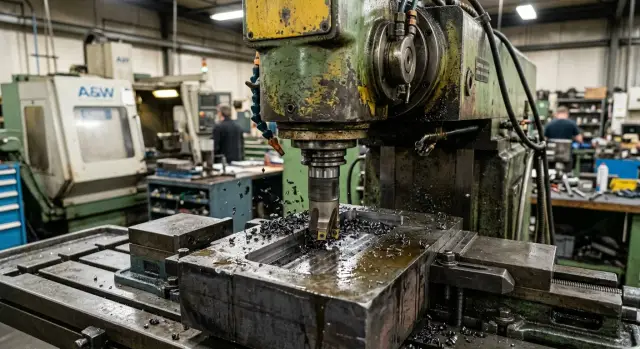
What makes a deep pocket a problem on an old center
A deep pocket only looks simple on the drawing. On an old center, it quickly becomes a test of the rigidity of the whole system. The deeper the tool goes into the metal, the more reach it needs. And a long reach almost always reduces stability. The cutter starts to flex, the cut no longer follows a clean line, and the machine responds with the familiar chatter.
Side cutting causes the biggest problems. When the cutter removes metal with its side, the cutting force pulls it sideways. A newer spindle and a stiffer machine body can handle that more calmly. An older spindle, especially one with play, tired bearings, or just a small rigidity reserve, performs worse. The load rises in jerks. A wave appears on the wall, and the smooth cutting sound turns into a sharp squeal.
At greater depth, one more problem appears: chips. They have to escape upward from a narrow space, but there is not much room. If coolant flow is weak or air does not blow the chips out of the pocket, they start spinning near the cutter and get cut again. Temperature rises, the edge dulls faster, and vibration increases even at a calm setting. The operator can see the machine cutting harder and harder, even though the program has not changed.
The first signs usually appear quickly:
- the cutting sound becomes uneven or high-pitched
- ripples appear on the pocket walls
- chips turn darker, get finer, or clump together
- the spindle heats up more than usual
- the size starts to drift even during roughing
A deep pocket loads every weak point of an old center at once. If you keep using ordinary side milling, the spindle gets extra radial load, the tool moves off track, and chips interfere with cutting. That is why it is better to notice the early signals right away instead of waiting until the cutter ruins the wall or the bottom of the pocket.
When plunge entry works better than a normal pass
A normal side pass works well as long as the cutter is not hanging out too far. But in a deep pocket, everything changes: the overhang grows, the wall starts to sing, and the spindle catches side load almost without a break. On an old center, you often hear that before you can really see it in the cut.
Plunge entry changes the cutting scheme. The cutter pushes more along the spindle axis instead of bending sideways. For an older machine, that is often calmer. It may sound rough on a side pass, but it can handle axial load quite evenly if the setting is not too aggressive and the chips can escape properly.
This method is especially useful when the pocket is already deep enough, the side pass starts to chatter, and the cutter has to stick out too far. It also works well when you first need to remove the core and leave the final walls and bottom for later.
The idea is simple: do not try to shape the whole pocket from the side at once. First remove most of the material with a series of vertical plunges or short steps with a small shift. After that, the tool has an easier path for the rest, because there is already room inside for chips and less constant side pressure.
In practice, this approach often saves the job where the normal path only looks faster on the screen. On the shop floor, an old center may lose on rigidity, but win by carrying the load more calmly. If a 16 mm cutter has a long overhang in a pocket 60–80 mm deep, a side pass can easily cause vibration. A plunge roughing pass in the same area usually runs more smoothly, even if it is not as fast.
There is one important limit: plunge entry does not replace finishing. Its job is to rough out the core. It is better to leave stock on the walls and bottom, then return with a separate pass once the tool is no longer fighting a solid block of metal. That way the surface comes out cleaner and the spindle works more calmly.
This method is worth trying not when you need the shortest cycle at any cost, but when ordinary milling already shakes the machine, ruins the cutting sound, and still cannot get through a deep pocket reliably.
What changes in spindle load
In a standard deep-pocket cut, the cutter mostly works sideways. For an old center, that is a heavy mode: the spindle pulls the tool to the side, the holder flexes a little, and the long overhang starts to chatter quickly. So a deep pocket often runs into transverse rigidity limits before it runs into the machine’s rated power.
Plunge machining changes the nature of the force itself. The tool works more along the axis, almost like a downward axial feed, instead of a long side cut. For the spindle, that is usually easier: bearings and the spindle mount handle axial load better than constant side pressure at the end of a long cutter.
Because of that, the spindle pushes the tool into the wall less. The machine stops trying to drift along the path, and the structure holds the cut more evenly. On an old center, the difference is easy to hear: instead of a sharp squeal, the work often sounds duller and more predictable.
There is another advantage. When the bulk of the metal is removed with axial plunges, less and more even stock remains on the side walls. Then the finishing or semi-finishing pass runs more calmly, because the cutter removes a consistent layer instead of meeting empty space and excess metal in turn. Those sudden load changes are often what bring vibration back near the end of the operation.
In practice, this usually gives four effects:
- the spindle sees less side load
- the long tool overhang behaves more steadily
- the table and machine body are less likely to resonate
- the wall of the pocket gets a more even stock allowance after roughing
That does not mean plunge entry is always better. It is slower on easy materials and will not save you if the cutter is already too long or the runout is too high. But when an old center starts to hum during side cutting, moving the load closer to the axis often helps you get through the depth without losing control of the cut.
How to prepare the tool and the setting
On an old center, preparation solves almost everything. If the cutter does not cut well at the center and the overhang is too long, vibration will come back within the first millimeters of depth.
The cutter must cut confidently along the axis. A regular end mill without center-cutting ability often starts rubbing, heating the metal, and jerking the spindle. That is a poor start for a deep pocket. If you have a choice, use a tool whose geometry is designed for plunging, not just for side cutting.
Do not leave extra overhang. Use only the length that is really needed for the pocket depth and a small safety margin. Even a difference of 10–15 mm often changes tool behavior more than trying to solve vibration with feed alone. The shorter the setup, the quieter the cut.
It is also better to decide on stock allowance before the program starts. Do not try to reach the final size during plunges. Leave a small allowance on the walls and bottom, then remove it with a separate pass. In practice, that is often 0.2–0.5 mm on the walls and a little more on the bottom if the material tends to heat up or the pocket is deep.
What to check before running the program
A short check is enough before the first run:
- does the cutter cut at the center, not only on the side
- is the tool overhang and holder length kept to a minimum
- is stock allowance set for the walls and bottom
- does coolant or air reach the bottom of the pocket
The last point is often underestimated. If chips stay at the bottom, the cutter quickly starts cutting already cut metal again. That brings heat, vibration, and wall marks. Air or coolant must do more than just arrive — it must actually flush chips out of the depth.
It is better to start a little conservatively and then increase. For the first entry, it makes sense to lower the plunge feed compared with familiar side milling and watch the sound, chips, and spindle load. If the cut stays even, without squealing or knocks, the setting can be raised gradually. On the shop floor, that is almost always faster than replacing a broken cutter or chasing size after vibration.
How to machine the pocket step by step
If the center starts ringing during a long side cut, it is worth changing the removal order itself. First, divide the pocket area into a grid of plunge points. That lets you remove the volume without extra chatter.
Set the grid so that narrow bridges remain between neighboring plunges. Usually, the step is kept smaller than the cutter diameter. If the points are too far apart, you will later have to remove thick leftovers with a heavy side cut, and the spindle will take a hard hit again.
It is better to do the first plunges at a moderate feed. There is no need to jump straight to the setting the machine can hold on shallow cuts. On an old center, it is wiser to pass the first row calmly, listen to the sound, and only then speed up little by little.
Move row by row, not randomly across the whole area. That way the load changes predictably, and you can spot the moment when the machine begins to work at its limit. After each row, look at three things:
- the cutting sound
- the shape and color of the chips
- signs of vibration on the bottom and walls
If the pitch gets higher, a rough knock appears, or lines start showing on the wall, do not keep pushing in the same mode. It is better to slow down, reduce the depth of the next plunge, or give the chips more time to clear out.
Once the plunge grid has removed most of the metal, connect the gaps with short side passes. A long contour pass at that point usually just brings the problem back. A short move between neighboring points loads the tool more gently and does not shake the spindle as much.
The finishing pass is better left as a separate operation. First unload the pocket, then bring it to size. A small allowance on the bottom and walls often gives a cleaner surface than trying to do everything in one cycle.
A simple shop-floor example
A small shop was machining a structural steel part. It needed a 120 x 80 mm pocket cut to a depth of 38 mm. The machine was not new, and that became obvious as soon as the cutter went below the middle of the depth.
At first, the operator used the normal method: a side pass with an end mill and gradual depth increases. Everything ran smoothly for the first few millimeters. But after about 18–20 mm, the familiar squeal appeared. A little deeper, and the machine began to work nervously: the sound turned sharp, ripples appeared on the wall, and the spindle load became more erratic than usual.
The problem was not only speed. The long tool overhang and constant side pressure started to shake the whole assembly: the cutter, the spindle, and the part itself. For an old center, that is a common picture. It may still have enough power to cut, but it handles that kind of side pressure poorly at depth.
So the strategy was changed. Instead of standard roughing, a plunge grid was made across the whole pocket area. The cutter went down in short vertical plunges with spacing between the points, and the middle of the pocket gradually broke into separate columns of metal. There was no hard pull to the side anymore. The machine ran much more calmly, and the sound became dull and even.
The first stage did not look especially fast in terms of time. But the vibration almost disappeared, and the operator no longer had to fight the machine on every pass. After that roughing grid, the remaining material was cleaned with light side passes. A small stock allowance had been left on the walls, so the cutter no longer tried to remove everything at once. The bottom was finished calmly too, without squealing or impact marks.
In the end, the shop got not a record time, but a much more predictable process. Spindle load became smoother, the risk of tool chipping went down, and the pocket came out cleaner. For an older machine, that trade-off is often worth it: a little more patience in roughing, and much less vibration, less scrap, and fewer attempts to force the cut.
Mistakes that quickly bring vibration back
Vibration often comes back not because the machine is old, but because of a couple of wrong setup choices. Even an older center can run calmly if you do not make the tool rub where it should be cutting.
A common mistake is choosing a cutter that does not cut well at the center. During plunging, that shows right away: the sound gets rough, the spindle gets extra load, and vibration marks remain on the pocket bottom. This kind of move needs a cutter that cuts confidently at the center, not only on the side.
A step between plunges that is too large causes just as many problems. On the screen it looks fast, but in the metal, rigid bridges remain between the entry points. The next plunge catches them with its side area, the load rises sharply, and the machine starts to ring. For a deep pocket, it is better to reduce the step and move a little more calmly.
Another typical cause of vibration is too much tool overhang. The cutter is often extended farther than needed, even though the actual depth does not require it. Every extra millimeter makes the spindle-holder-tool assembly softer. On an old center, you can hear and see it: more noise, a wavy wall, and a shorter tool life.
It is also a bad idea to expect a clean wall from the same roughing pass. Plunge roughing is excellent for removing volume and unloading the spindle, but it usually does not leave a beautiful surface. If you immediately try to side-finish the wall with the same tool and the same setting, side force rises again. Vibration comes back very quickly.
Chips at the bottom of the pocket
Chips at the bottom of the pocket are often underestimated. They build up fast, especially once the depth is noticeable. If you do not blow them out with air, flush them with coolant, or at least pause briefly to clear them, the cutter starts cutting chips a second time. After that, even a normal setting will not save the job.
The rule of thumb is simple: if the sound becomes broken and fine crushed chips are sitting at the bottom, the process is going in the wrong direction. At that point, it is more useful to slow down, reduce the step, and improve chip removal than to keep forcing the cut.
A short check before starting
On an old center, a small mistake quickly turns into vibration, squeal, and a poor pocket. That is why it is better to spend five minutes checking before the first run than an hour later trying to find the source of the chatter.
First, look at the cutter itself. Not every end mill likes axial plunging. The tool needs a geometry that cuts at the center, not only with the side edge. If the cutter does not go down well, the spindle gets hit hard on the first entry.
Then check runout. Even a small deviation on an old center is immediately heard in the sound and seen in the cut pattern. One tooth starts taking more than the others, the load rises in jerks, and the pocket starts to sing. If the indicator shows too much, it is better to reset the tool or check the collet right away.
Before starting, it helps to run through this list:
- the cutter can truly cut on the axis
- the tool sits straight and runout is within working tolerance
- chips escape upward or to the side instead of packing into the bottom
- a steady stock allowance remains for finishing after rough plunges
- the first entries sound dull and calm, without a sharp squeal
Even experienced operators get chips wrong. If the pocket is deep, chips do not have time to escape and get hit by the cutter again. Then temperature rises, the edge dulls faster, and the bottom surface becomes rough. It is better to give air, a clearing pause, or a slightly different point spacing in advance than to try to force the setting.
Also look at the stock allowance. If the pocket wall already starts to ripple after the first plunges, finishing will not fix it — it will only repeat the shape. A even allowance on the wall and bottom shows that the tool is cutting steadily and the center is holding its path.
The simplest sign of a good start is that the first two or three plunges go in without a sharp metal squeal. If the sound hurts your ears right away, do not assume it will improve later. Stop the cycle, check the overhang, runout, feed, and chip evacuation.
What to do next
If the new method gave you a calm cut, do not treat the job as finished after just one part. The real test starts on the repeat: on the second and third blank, you can see whether the machine keeps the same sound, the same load, and the same size.
Compare the new route with the old one not by feeling, but by three simple signs. Listen to the spindle, watch the load percentage, and time the cycle. Sometimes the cycle gets a little longer, but the machine cuts without vibration, does not burn the edge, and does not drift off size at depth. For an old center, that is often a sensible trade-off.
After a successful run, write the setting down as if another operator will need it a month from now. A short card is enough:
- step between plunges
- depth of one entry
- stock allowance for side and finishing passes
- spindle speed, feed, and actual load
- note on sound and chip shape
That record saves hours on the next batch. You will not have to search for the working combination again by trial and error.
If vibration remains, do not try to fix it with feed alone. First check the mechanics: is there play in the axes, how does the spindle behave, is the holder drooping, and is the part moving in the vise or on the fixture plate? On a deep pocket, even a small amount of play quickly turns into wall ripple and an unpleasant howl.
Sometimes you have already done everything right, but the machine simply has no rigidity reserve left. Side load is reduced, the setting is careful, and yet the pocket is still running at the limit. In that case, it is worth looking at the economics honestly. If you make a lot of parts like this, the material is demanding, and vibration keeps coming back, it may be time to think about more suitable equipment.
For situations like that, EAST CNC can help with machine selection, delivery, commissioning, and service support. The company works with Kazakhstan and other CIS markets, and the EAST CNC blog publishes equipment reviews and practical metalworking content.
A good outcome looks simple: the machine sounds even, the load is predictable, the tool lasts longer, and the deep pocket is machined without a fight at every start.
FAQ
When is plunge entry better than a regular side cut?
Use plunge milling when a deep pocket already causes chatter, wall waviness, and rising spindle load. This approach moves the force closer to the axis, so an older center often cuts more steadily. It is especially useful for roughing out the core. Leave stock for the size and final surface, then come back with a separate finishing pass.
Why does an old center vibrate more on a deep pocket?
An older center vibrates more at depth because the tool needs a long reach, and a long assembly bends sideways more easily. If the spindle already has play or the bearings are worn, side load quickly turns into chatter. Chip buildup at the bottom of the pocket makes it worse. It gets in the way of cutting, heats the edge, and adds noise even at a calm setting.
How can you tell the setting is already bad?
The usual signs appear quickly: the sound becomes uneven or high-pitched, the wall starts to ripple, and the size starts drifting even during roughing. The spindle often runs hotter than normal, and the chips darken or stick together. If you see that, do not keep forcing the same setup. It is better to change the machining strategy than wait for a chipped tool or a bad pocket.
Do you need a special tool for plunge machining?
Yes, the tool should cut confidently at the center. If it rubs the metal instead of cutting into it, the spindle gets hit hard on the first entry. For a deep pocket, it is better to use an end mill designed for axial plunging. A regular end mill without center cutting often creates noise and heat in this kind of move.
What tool overhang is best?
Leave only the length you really need for the pocket depth and a small safety margin. An extra 10–15 mm often hurts rigidity more than a bad feed setting. If in doubt, start with the shortest safe overhang. On an old center, that almost always gives a quieter cut and less wall waviness.
What should you do if chips stay at the bottom of the pocket?
First, make sure the chips can get out of the depth properly. Air or coolant should actually push them out of the pocket, not just hit the top. If chips stay at the bottom, the tool starts cutting them a second time. Then heat, noise, and edge wear go up, and the bottom surface turns rough.
Where should you start with the setting on the first run?
For the first run, it is better to use a gentler plunge feed than you would for normal side milling. Run the first few points, listen to the sound, and watch the chips. If the cut sounds dull and even, you can increase the feed little by little. If you hear chatter or a rough knock right away, stop and check the overhang, runout, and chip evacuation.
How should a deep pocket be machined step by step?
Break the area into a grid of plunge points and move row by row. Keep the spacing between plunges smaller than the tool diameter so you do not have to remove thick bridges with a heavy side cut. After the roughing grid, connect the empty areas with short passes and leave stock on the walls and bottom. That makes the tool work more smoothly and the finishing pass calmer.
Can plunge milling produce the final size right away?
No, plunge milling does not replace finishing. Its job is to remove the main volume quickly and calmly, not to leave a finished wall. Leave a small stock allowance and come back with a separate pass. Then the tool removes a steady layer without extra side force, and the surface comes out cleaner.
When is the problem no longer the setting, but the machine itself?
If you have already reduced the overhang, fixed the runout, improved chip evacuation, and lowered side load, but the pocket still runs at the limit, the machine has simply run out of rigidity reserve. In that case, the setting no longer solves everything. When this kind of work comes up often, it is worth looking at time, scrap, and tool cost. For help choosing a better machine and service support, you can contact EAST CNC.