
Piece-rate Pay on a CNC Shop Floor: Where Quality Suffers
Piece-rate pay on a CNC cell can boost output but often harms inspection, tool life and increases rework. We explain when the scheme works and when it doesn’t.
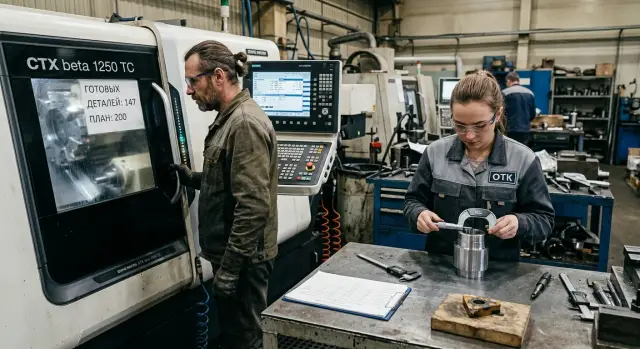
Where the problem starts
The problem doesn’t begin in the scrap report but in the shift assignment. When a CNC cell is paid only by piece count, output almost immediately looks better. The foreman sees a good pace. Losses come later and in a different form.
All day the operator must make the same choice: stop to measure a part again or immediately load the next blank. On paper the difference seems trivial. In a real shift those 40–60 seconds repeat dozens of times, and the hand reaches not for the micrometer but for the start button.
The issue becomes sharper where setup time is treated as downtime. Changing an insert, adjusting for size, checking the first part after a tweak — all of that starts to look like lost money. A person sees not the risk of scrap but a cut to their pay. With that logic, inspection slides to the background, even if nobody voices it.
Small deviations then accumulate. First the size shifts by a few hundredths, then surface finish worsens, then the edge degrades as the tool wears. Each part still looks acceptable on its own, so alarms don’t ring immediately. By the end of the shift there may be a whole batch of questionable parts and it’s hard to tell when the process went off track.
Often the foreman notices too late. Early in the shift they see higher throughput, not higher risk. Scrap appears after intermediate inspections, at finished goods, or during assembly — when corrections are more costly.
There’s another hidden problem. Under piece-rate pay tools are often pushed to the limit. It’s not profitable for an operator to change an insert right at its resource boundary if the machine is still cutting and a few more parts can be produced. Those extra parts often eat up any benefit from the faster pace.
In practice the picture is simple: the cell seems faster, but dimensional stability falls. In turning this is especially visible during long shifts, when speed combines with fatigue. Piece-rate doesn’t punish immediately. First it delivers attractive numbers, then quietly takes away quality, tooling life and time spent diagnosing causes.
When the scheme actually works
Piece-rate gives acceptable results where the process is already steady and doesn’t rely on constant operator guesses. If a part runs in a long series, the program barely changes and setups repeat without surprises, pace can be counted fairly. In such conditions the operator affects output without having to choose between speed and quality every hour.
The ideal case is a long series of simple or well-mastered parts. The operator doesn’t spend half a shift searching for the right mode, correcting transitions or taking extra measurements. They follow a clear routine and know how many parts can be made safely.
The scheme usually holds when several conditions align: cycle time hardly varies between shifts, the first part is fully checked before a batch start, tool wear is predictable, and the foreman sets a tool-life limit instead of waiting for the tool to ruin size.
This is where mistakes often happen. If the first part is accepted only formally, piece-rate pushes toward haste. The operator starts counting pieces, not parts within tolerance. But when the first part is properly checked, the batch runs calmly: size is confirmed, corrections are applied, and the measurement log is clear.
It also works when the cycle is nearly identical morning, afternoon and night. If the same bushing on the same machine consistently runs, say, 3 minutes 40 seconds, you can set a norm without guessing. If today the cycle is 3:40 and tomorrow 4:25 because of unstable blanks, poor clamping or frequent corrections, the piece-rate scheme loses meaning.
In a turning shop this becomes obvious quickly. Suppose a plant runs one bushing series for a month. The program doesn’t change, material is the same, the foreman and quality check the first part, and inserts are changed by count rather than by feeling. In that situation piece-rate doesn’t break quality — it simply pays for the steady output the cell can already maintain.
When the process is predictable, pay encourages discipline: timely tool changes, not missing the first check, and keeping a consistent cycle throughout the shift.
Where quality drops first
With piece-rate pay quality often falls not at shift end and not after a big scrap event. It starts in those minutes when the operator decides they can "get a little more" without stopping. Each such saving of 2–3 minutes later causes dimensional drift, surface risks or extra tool wear.
The first weak point is the intermediate check after a setup. An operator changes an insert, adjusts compensation, makes the first part and, instead of measuring, continues the run. The incentive is clear: the part counter keeps going up, while a stop costs visible pay. If size shifts by a few hundredths, it’s often noticed only at final inspection when the batch is already packed.
The second risk point is the tool. Under normal practice it’s changed slightly before the limit. Under piece-rate operators often push tools longer to avoid losing pace. On paper output holds, but in reality the cutter cuts worse, loads increase, vibration appears, and the machine struggles to hold size. Everything looks normal until tolerances drift.
Surface finish often deteriorates before size does. The part counter may run smoothly while roughness worsens: streaks, burns, torn edges, poorer fits. This is especially problematic where appearance seems secondary. If a bushing or shaft doesn’t assemble with the intended interference, the issue shows up at assembly.
Early signals usually look like:
- after a setup the operator skips the control part;
- size starts to "creep" toward the tolerance limits;
- surface degrades before output falls;
- tools are replaced reactively after scrap rather than by schedule.
The worst is that final inspection sees consequences, not causes. The root appeared earlier: a missed measurement, 20 extra parts on a tired tool, and a habit of not stopping the machine for checks. That’s where quality loses margin even when the piece count looks good.
Hidden losses the scheme hides
Piece-rate often seems simple and fair: make more parts, earn more. On paper output jumps. But the shop often loses more than it gains from the extra pieces.
The first hidden loss is rework. If an operator rushes and misses a small size drift, the batch won’t be shipped as is. Parts come back to the machine, taking time and requiring new checks. The gain from twenty extra parts vanishes when ten of them need rework.
Rework drags in other people’s time. The foreman rearranges the queue, an inspector remeasures, a setup person hunts the root cause, and the warehouse waits for a correct batch. The report already showed the output, but the shop effectively paid twice for the same work.
The second loss is more painful — tool breakage. Under piece-rate it’s tempting to raise feed, postpone insert change, or reduce intermediate checks. Sometimes that goes unnoticed. But if an insert crumbles or a drill breaks, the machine stops at the worst moment, when the schedule is tight.
Stopping rarely takes just five minutes. You must halt the cycle, remove tool fragments, inspect the part, install new tooling, run a test and recapture size. If this happens on a busy cell, multiple operations fall behind.
There’s a third loss: disputes over scrap. When pay is tied only to piece count, people argue about where the size shifted and who should accept a part. The operator says the machine held size in the morning, the inspector sees a deviation in the evening, the foreman tries to close the shift without extra scrap on the report. Time is spent not on production but on blaming and sorting.
The warehouse feels the effects too. It accepts a batch as finished, moves it along, then receives returns for rework. This breaks inventory and delays shipments. The customer sees only the delay, not the reason.
So under piece-rate quality usually doesn’t fail in one big collapse but in a series of small losses that no one counts. While the shop watches only piece numbers, money leaks through rework, downtime and scrap disputes.
How to set up pay step by step
Piece-rate works only where the process already holds size without constant surprises. If cycles vary, tools wear out too quickly and operators chase tolerances hourly, this pay turns into a race for pieces.
Where to start
Don’t convert the whole cell at once. First pick one group of operations where cycle time is stable and tolerances are consistent. A good first candidate is a simple serial turning operation with a long, well-established routing.
Next, split the pay into parts. You can pay piece-rate for acceptable parts, but pay setup, first-part inspection and scheduled tool changes separately. Otherwise the operator will economize on what actually keeps quality.
Fix rules in a short procedure. Piece-rate should apply only to operations with a stable cycle and clear tolerances. Batch start, the first part and scheduled tooling changes require separate compensation. If size drifts, vibration appears, roughness worsens or an insert crumbles, the operator must call the foreman immediately, not push to the end of the shift. Track not only finished parts but also scrap, rework, downtime and tooling usage. Pilot the scheme on one cell before rolling it out.
What to count daily
If you look only at piece count, the picture will be misleading. A cell can show high output and a week later you find part of the batch went to rework, a machine stopped for an extra tool change, or a tool was consumed earlier than expected.
So the foreman should check at least four numbers daily: good parts, scrap, downtime and tooling consumption. That’s enough to spot an imbalance. If output rises while rework and inspection costs rise too, the rate needs adjustment.
A small pilot usually reveals everything quickly. On a batch of identical bushings you’ll see within a month who holds size, who pushes the cycle, and how costly an extra minute of first-part inspection really is. After that you can tweak rates without disputes.
Mistakes that break the outcome
The pay system breaks not at payroll but earlier — when the shop sets crude rules. Piece-rate can seem fair on paper, but if everyone is measured the same way, people quickly see what they’re paid for in practice: not accuracy but speed at any cost.
A common mistake is one rate for simple and complex parts. On a short, stable operation the operator risks little. On a thin-walled part with frequent checks and delicate tooling they spend more time and attention. If the pay is the same, people will avoid hard tasks or cut corners on them.
Unpaid setup hurts quality even faster. If the first 30–60 minutes are unpaid, the operator rushes to start the run. That’s when extra checks are skipped, tooling is used "with a margin," and the first-part inspection is minimized.
Another error is basing the norm on the best day instead of the usual average. If rates are set by a one-off great shift rather than a stable mean cycle, operators will chase the plan at the expense of inspection. It looks like enthusiasm, but it’s pressure on quality.
A poor scheme also blurs the right to stop. If the foreman argues every time over whether to halt the machine for size drift or a worn insert, people learn to push to the limit. The machine runs while scrap risk grows.
Finally, combining scrap, rework and finished output into one neat number is a mistake. Such reporting calms management but doesn’t help production. If losses aren’t visible separately, they’re hard to fix.
Example: a batch of bushings on two machines
On a cell two lathes turn a batch of bushings. The order is urgent, three hours remain in the shift, and the foreman asks to "push" output to meet the piece target.
The operator runs both machines. The cycle is short and the parts look simple, so piece-rate pressure is direct: more parts before the bell means higher pay.
On the first machine the insert begins to drag on size. The operator changes it quickly without pausing because they don’t want to lose tempo. Normally they should make a measurement immediately after the change and another control after a few parts. They make the first measurement but skip the second.
This is a typical mistake. After an insert change size can drift gradually. The chip shape looks okay, the machine gives no alarms. It seems safe to keep running.
Forty minutes later the inspector samples a tray and finds a diameter shift. The deviation is small but enough for the bushing: some parts won’t assemble correctly. Ten pieces go to rework.
On paper at first the picture looks good. The counter shows high output, the foreman notes a gain and the shift seems productive. But then the hidden cost appears.
People spend time sorting the whole batch. The operator repositions blanks on the machine, removes an extra cut, rechecks sizes and finishes the remainder. Meanwhile the second machine waits longer than it should and loses rhythm.
In the end the cell doesn’t save time — it wastes it twice. The 2–3 minutes the operator "gained" by skipping a check turns into almost an hour of extra work: sorting, reworking, restarting and extra tool wear.
This example shows where piece-rate logic breaks. Piece count grows fast while quality declines quietly. The supervisor sees the output but the real picture becomes clear only after sorting and reprocessing the batch.
A short checklist before launching
Before introducing piece-rate pay, check the rules, not just the production plan. If rules are immature, the cell will quickly grow output on paper and just as quickly accumulate scrap, rework and extra tooling consumption.
The weak point is usually the same: the rate pays only for finished pieces. Then the operator has no incentive to spend time on setup, the first-part check or extra stops. People begin to rush where they mustn’t.
The rate should cover not only parts but also preparation for production. Setup, trial part, measuring the first sizes and logging results take time. If that time isn’t paid, it will be "eaten." On bushings, shafts and housings this shows fast: size drifts and the problem is noticed too late.
Before launch check a few things:
- does the rate include separate time for setup and the first-part control?;
- can the foreman stop production immediately if size drifts or a tool hits its limit?;
- can the operator see the tool-life limit — by parts, cutting minutes or clear wear indicators?;
- does the report separate scrap, rework and downtime?;
- is the pilot running on one group of parts, not the whole cell at once?
The foreman item is often underestimated. If the foreman argues with the operator every time about stopping the machine, the scheme already works against quality. The right to stop should be set in advance: at what deviation, at what wear level, and for which repeated defect.
Reporting matters too. When scrap and rework are hidden inside overall output, management sees a neat production number and misses its cost. Separate accounting quickly shows which parts really bring money and which only clog the machine.
Start with a pilot on one group of similar parts. It’s easier to see where time is honestly spent and where the scheme encourages skipping checks. After that test you’ll know whether to expand the pay scheme or first adjust the rules.
What to do next
Arguments about motivation mean little without numbers. First pull last month’s data and look at the cell without guesses. That’s more useful than any theory.
Put together at least four items in one table: how many parts were produced, how many went to scrap, how many returned for rework, and how much tooling was consumed. If possible add two more columns: downtime due to setup and stops for inspection. Then the picture will be more honest.
Don’t convert the whole cell at once. Choose one operation for a pilot where volume is clear, tolerances aren’t extreme and measurements follow a simple rule. You’ll see faster whether the scheme helps or just pushes people to chase pieces.
Set stop rules before starting. These are not for reports but to protect quality in practice. Who stops a batch after two consecutive size deviations, who confirms the first good part after a setup, and after what wear level an operator changes an insert without debate — decide these in advance.
Discuss the scheme with the foreman, the setup technician and the inspector before launch. Each has a different perspective: the foreman watches output, the setup person sees machine behavior, the inspector catches early deviations. When rules are agreed beforehand, there are fewer conflicts later.
A good pilot is short. Two to four weeks often suffice to spot differences in scrap and tooling use. If output rose 8% while rework and tooling write-offs rose even more, the answer is clear: the scheme eats profit despite attractive piece numbers.
Sometimes the issue isn’t pay at all. If size drifts because of the machine, clamping, unstable blanks or inconsistent setup, a new pay scheme won’t fix the process. In that case it’s better to stabilize production first. EAST CNC, the official representative of Taizhou Eastern CNC Technology Co., Ltd. in Kazakhstan, helps select CNC turning machines, performs commissioning and provides service. When the bottleneck is equipment rather than people, that conversation is more useful than another rate revision.
FAQ
Does piece-rate pay always ruin quality on CNC?
No — not always. Piece-rate pay works well when the cycle is stable, the part is well-mastered, and the first part receives a full check. If the process often needs adjustments, people start to skimp on measurements and tool changes.
What usually degrades first under piece-rate pay?
Intermediate checks usually suffer first. It’s easier for an operator to run the next blank than to stop for an extra measurement after a tweak or insert change. As a result, dimensions can drift unnoticed and the issue is discovered later.
Should setup and the first part be paid separately?
Yes, if you only pay for pieces. When setup is unpaid, operators rush to start a series and shorten the first-part inspection. It’s better to pay setup and inspection separately from piece production.
Which metrics should be tracked daily?
Don’t look only at output. Every day compare good parts, scrap, rework, downtime and tooling consumption. If output rises but rework and tooling costs rise too, the scheme is failing.
How should piece-rate pay be introduced on the shop floor?
Start with one stable operation or a group of similar parts. Two to four weeks is usually enough to see how scrap, downtime and tooling consumption change. That will show whether the scheme helps or pushes operators to race for pieces.
Why does the report look fine but the shop loses money?
Because losses appear later and elsewhere. Initially the shop shows a good tempo, but then rework, sorting, disputes over reject responsibility and extra downtime surface. The report of pieces looks good while real costs rise.
When should an operator change the insert under piece-rate work?
Change the tool by the schedule, not after scrap appears. Pulling an insert to the last minute makes size and surface drift before the part counter drops. A couple of extra pieces rarely pay for the rework and downtime caused by a broken insert.
When should the operator stop the machine?
Set this in advance. If size shifts twice in a row, surface roughness increases, vibration appears, or the tool reaches its limit, the operator should stop production immediately. It’s better to lose a few minutes than spend an hour on rework.
On which operations does piece-rate pay work well?
Piece-rate fits long series with predictable cycle time and tool wear. If the program hardly changes, material is consistent and the first part is checked properly, piece-rate can work. Avoid it on complex or unstable operations.
What if the problem is the equipment, not the people?
Often the issue isn’t people but equipment. If size drifts because of the machine, clamping, unstable blanks or inconsistent setup, changing the pay scheme won’t fix the process. Stabilize production first, then revisit pay.