
Part size drifting toward the end of the shift: temperature and wear
If part size drifts toward the end of the shift, the cause is often heating, tool wear, or operator actions. We provide a simple checklist.
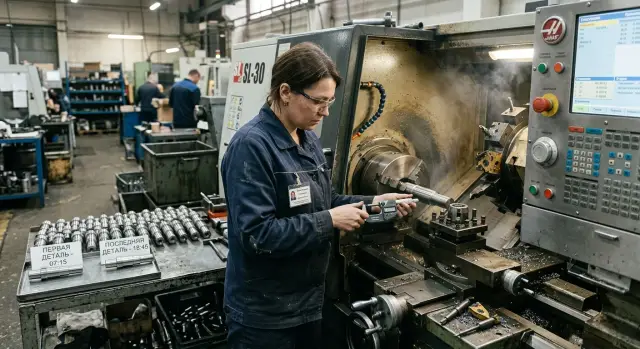
What happens to size by the end of the shift
If the size slowly drifts in one direction, it usually isn’t a random defect. A random error produces a one-off jump: one part is out, the next is normal. A gradual drift looks different. In the morning the size holds, after lunch it shifts by a few hundredths, and by evening the tolerance margin is almost gone.
This pattern means the process itself changes during operation. The machine heats up, the tool wears, and the operator makes adjustments, changes the measurement routine or takes pauses. Each shift alone may be small, but together they easily move the part size.
The first parts of a shift often differ from the evening ones for a simple reason: in the morning the machine, chuck, tool and shop air are at one temperature, and after a few hours they’re another. Metal expands, machine components sit in slightly different positions, and lubricant behaves differently than on a cold start. At the same time the cutting edge changes. It dulls, cutting forces grow, and machining no longer behaves like at the start of the run.
Typically the causes come down to three things: thermal shift, tool wear and operator habits. A simple example: in the morning a shaft consistently measures 24.98 mm with an upper limit of 25.00 mm. After a few hours it becomes 24.99 mm, then 25.00 mm, and near the end some parts read 25.01 mm. This is not chaos but a repeatable shift.
If size jumps up and down without a clear pattern, check for runout, clamping, chips under the datum, unstable stock or measurement error. But if drift is gradual and repeats shift after shift, first look at warm-up, tool life and operator actions.
On a CNC machine such drift can seem minor for a long time. Then it eats the whole tolerance. So it helps to notice not only scrap but the trend itself: which way size moves, when it starts and how long until the shift becomes noticeable.
How to tell the problem repeats
One bad part proves almost nothing. You need a pattern across the shift, not a single fact. The simplest way is to compare parts from the start, middle and end of the batch under the same operating conditions.
You don’t have to measure everything. A few points are enough. For example, take three parts in the first hour, three in the middle, and three near the end. This shows whether there’s a steady drift or just random noise.
The weakest link is comparing different measurements. If in the morning you checked a part with calipers and in the evening with another micrometer, the conclusion is already unreliable. Even a good instrument introduces its own small offset. Two different tools can easily paint a false picture.
A short record at each control point helps: time, tool or insert number, current correction, actual size and who measured the part. That’s usually enough to reveal a repeatable pattern.
Look not only at the number but at the direction. Morning 20.000 mm, mid-shift 20.006 mm, end 20.011 mm — that looks like a repeatable drift. Another sequence — 20.003 mm, then 19.997 mm, then 20.010 mm — doesn’t indicate a steady thermal shift. Then check clamping, play, measurement method and human factors.
Another common mistake is different people measuring differently. One will wait for the part to cool, another measures immediately. One places the micrometer at one spot, another at a neighboring point. After that it looks like the process is unstable, while part of the scatter comes from the control itself.
If you have records for two or three shifts, the problem stops being “random.” Then you can investigate the cause by facts, not memory.
Where temperature shifts size
Temperature often causes the quietest drift. The machine doesn’t fail, the program doesn’t change, but the size slowly creeps by hundredths.
In the morning the spindle, chuck, holder, carriage and bed are colder than after an hour of work. As the machine reaches operating state, metal expands and component positions shift slightly. For turning, that is often enough for diameter, length or fit to change under the same corrections.
The first parts after start-up and the first parts after a long pause often behave similarly. After lunch or a setup break the spindle comes back up to speed, and size can move again. If the deviation appears at roughly the same time, check thermal conditions first.
The part itself confuses things. Right after cutting it’s hotter than after 15–20 minutes. If the operator measures immediately, he gets one result; after cooling the size changes. This is especially noticeable on long shafts, thin-walled parts and tight fits.
Coolant temperature also matters more than it seems. In the morning emulsion is colder; by the end of the shift it’s warmer, and the cutting zone cools differently. Workshop air contributes too: open doors, switching heating or a draft can worsen stability.
To separate thermal drift from other causes, compare several situations: measurement right after machining and after full cooling, morning versus evening results, size after continuous work and after a 20–30 minute pause, coolant temperature at start and a few hours later. If the difference ties to time rather than piece count, temperature is almost certainly involved.
That’s why many misdiagnose. Thermal drift is often taken for tool wear, and corrections are adjusted all day. The size returns for a while, but the root cause remains.
How tool wear moves size
A cutting edge doesn’t change instantly. At first wear is nearly invisible, then cutting force increases, the tool pushes the part differently, and size begins to drift in one direction.
Typically first parts run fine, then the operator notices he must adjust correction more often even though speeds, material and program haven’t changed. On finishing passes this scenario is especially clear: even slight dulling affects both size and surface.
On gummy materials a built-up edge makes things worse. Metal sticks to the edge, then a piece breaks off, then the build-up forms again. Cutting depth becomes uneven. One part might be near the center of tolerance, the next at the edge, then size changes again.
There are three common situations. With normal wear size drifts gradually. With built-up edge it bounces. With a chipped edge you get a sudden jump, often visible on the next part. After a chip the cutting sound and surface finish usually change.
Small corrections only mask the problem. The operator brings size back into tolerance, but the tool already cuts differently. After a few parts the correction must be moved again. This continues until the tool causes a clear size loss.
That’s the danger: dispersion between parts grows and you lose the moment to change the insert by schedule. Instead of a calm change by resource, you end up with a run of scrap.
If correction must be moved increasingly in one direction, the tool typically needs replacement, not another tweak. For CNC lathes this is a common story.
Operator actions that add scatter
Even a healthy machine can give a questionable picture because of daily habits. Usually the problem isn’t one big mistake but several small actions layered across the shift.
The most frequent reaction to size drift is to immediately change the correction. That’s understandable but often harmful. If you change it without recording the reason and time, an hour later it’s hard to tell what caused the shift: heating, wear or the adjustment itself.
A hot part almost always confuses. One operator will wait for cooling, another measures right away and adjusts. After that scatter appears even on identical parts from one batch.
Different hand force on a micrometer causes many problems. One part compressed softly, the next a little harder — at tight tolerances that’s enough to confuse the pattern. Measure in the same way: the same tool, same spot and the same force.
After a start the machine also doesn’t immediately behave like mid-shift. A long pause, morning start or lunch break changes component behavior. If the operator runs into a series without warm-up, first parts often give a false signal and unnecessary corrections follow.
Worst is when mistakes coincide. The part is measured hot, the micrometer squeezed harder than usual, a correction applied without recording, and half an hour later the machine finishes heating. It looks like a complex cause while part of the scatter was made by the people.
So first align measurement discipline and recording. Only after that does it make sense to look for a machine fault or cutting-mode problem.
Step-by-step checklist
When size drifts toward the end of the shift, don’t rush to change correction or blame the machine. First collect simple facts in the same order.
Start with measurement. Who measures the parts, with which tool, at what point and how long after machining? If measurement conditions change, you’ll see differences in habits rather than the process.
Then compare the first and last parts under identical conditions. Both should be measured with the same instrument, at the same spot and after the same cooling pause. Otherwise the comparison is unfair.
Next look at temperature. What state was the machine in at startup? How did coolant and shop-air temperature change? Were there pauses after which the process returned to running state? If the first part came after a cold start and the last after many hours, the process itself is already different.
After that check the tool. A quick glance at the edge rarely helps. Assess whether there is dulling, built-up edge, chips, and when the insert was last changed.
Then open the correction log. If corrections were made repeatedly in one direction during the shift, that’s a strong hint. This often indicates thermal growth or gradual wear.
Finally make several control parts with one scheme: same program, same material, same tool, identical cooling pause and one person with one instrument. Usually three to five parts are enough to reduce noise and clarify the picture.
If size drifts again with the same pattern, the cause has shown itself. If scatter disappears, look not at the machine but at the measurement routine and shift practices.
Example from a shift
In the morning an operator turns a shaft on a CNC lathe and gets 40.00 mm. The first parts run steadily: the micrometer shows 39.99–40.00 mm and the run raises no questions.
A few hours later the size starts creeping up: first 40.01 mm, then 40.02 mm, and near evening 40.03 mm. This is not a sudden collapse but a slow shift, which is why it’s often noticed late.
The operator adjusts tool correction twice. After the first adjustment size briefly returns near the center of tolerance, but then the drift repeats. After the second adjustment the same happens. So it’s not a random part or a one-off entry error.
When the supervisor reviews the shift, they check not only the correction but also working conditions. In this example two causes were found: the machine was loaded almost without warm-up and the insert was near end of life.
Warm-up was simple: in the morning the spindle, carriage and coolant were in one state; after a couple of hours they were different. Geometry shifted and size moved. At the same time a tired edge changed cutting forces. For an outer diameter this typical scenario often results in increased measured diameter due to tool wear.
In the end the operator chased the process manually all day. If the shift had started with proper warm-up and the insert changed by schedule, size probably wouldn’t have drifted by evening. This case shows a simple truth: two small causes together give a noticeable drift, and one correction doesn’t solve the problem.
Common mistakes when searching for the cause
When size starts to drift near the end of the shift people usually hurry. That prevents finding the source.
The first typical error is changing the tool immediately. The operator sees drift, fits a new insert or moves correction while the part is still hot. Fifteen minutes later it cools and the size is different. Then it looks like the machine is unpredictable, while the real first step should have been to check part temperature and measurement routine.
The second error is blaming the machine when the fault is in measurement. Dirty micrometer anvils, varying hand force, haste at the end of the shift, measuring with gloves or using different instruments easily add extra hundredths.
The third mistake is making several changes at once. Replace the insert, move correction, reduce feed, move the part to another station — after that it’s hard to know what acted.
Another slip is drawing conclusions from one part. It’s much more useful to take several parts from the end of the shift, let them cool equally and measure with one instrument by one operator. Then the cause usually reveals itself faster.
Finally, people often confuse symptom with source. A size drift doesn’t automatically prove tool wear. Sometimes heating is guilty, sometimes the measurement routine, sometimes clamp torque, and sometimes a bit of everything.
What to check before the next shift
Before the next shift it helps to remove variability. It takes little time but greatly simplifies finding the cause.
Warm the machine in the same way it will run. Give parts the same cooling time before measurement. Use one measuring tool and one control routine during the shift. Record every correction with time and tool number. One more simple measure: schedule insert replacement proactively rather than waiting for wear to show in size or surface.
A simple control sheet near the machine works well. Note warm-up, cooling time, last insert change, corrections made — and you already have a base for proper analysis. In serial turning these small habits most often solve stability problems.
What to do next
If the drift repeats two or three times, don’t hunt for causes by memory. Start a simple table: time, actual size, which tool was running, what correction was set, and what happened with machine, coolant or at least shop air temperature. No complicated form is needed. A plain sheet at the machine is often more useful than a long weekly report.
Then fix a single control routine: who measures, when and with what. A good rhythm is: first part after warm-up, part after insert change, check after one–two hours of work, measurement after a noticeable shop-temperature change and a final control near the end of shift.
When the table shows a repeatable drift in one direction, endlessly chasing size with corrections is pointless. Check the machine, tooling and working conditions by facts.
If you have EAST CNC equipment, it makes sense to start with a consultation and a service check. EAST CNC supplies CNC lathes, helps with selection, commissioning and service, so a measurement log and shift history usually let you narrow the cause faster.
After a few disciplined shifts the picture becomes clear. Then you can decide what to change first: cutting mode, tool, measurement routine or the machine condition itself.
FAQ
Why does part size drift toward the end of the shift?
Most often the process changes gradually during the shift. The machine and fixtures warm up, the tool slowly dulls, and the operator makes small adjustments. Individually these shifts are minor, but by the end of the shift they add up to a noticeable size drift.
How to distinguish thermal drift from random scrap?
Look at the pattern of measurements. If size slowly moves in one direction from morning to mid-shift and evening, that's a repeatable shift. If values jump up and down without pattern, first check clamping, runout, chips under the datum, and the measurement method.
Can you measure a part immediately after machining?
No — measuring immediately can be misleading. A hot part often shows one size and a different size after cooling. To compare fairly, give parts the same cooling time and measure in the same place with the same instrument.
How to tell if the cause is tool wear?
A tool usually reveals itself when you have to adjust correction more and more in one direction. On finishing passes this is most visible: size drifts gradually and surface finish degrades. A chipped edge causes a sudden jump, often visible on the next part, and cutting sound changes too.
When should you not change the correction immediately?
If you haven’t checked part temperature and measurement routine, don’t change correction right away. You can mask the real cause and make the situation harder to analyze. First compare several parts under the same conditions, then decide if adjustment is needed.
What should be recorded during the shift to find the cause?
A simple shift log is enough. Record time, actual size, tool or insert number, current correction, and who measured the part. Such notes quickly show whether the drift repeats and when it starts.
Do coolant and workshop temperature affect part size?
Yes — quite often. In the morning coolant, the machine and the workshop air share one temperature and after a few hours another. Even a lunch break, open doors or a draft can move the size by hundredths when tolerances are tight.
How many parts are needed to see the problem?
For a quick check, a few points per shift are enough. Take three parts at the start, three in the middle and three near the end, give them the same cooling time and measure with one instrument. That’s usually sufficient to spot a trend or confirm that the process is just noisy.
Which operator mistakes most often create a false picture?
Most often people introduce variation through measurement. One operator measures immediately after cutting, another waits for cooling; one squeezes the micrometer harder; measurements are taken at different spots. Another frequent mistake is adjusting correction without recording the time and reason.
What to do before the next shift so size doesn’t drift?
Start the shift with a proper warm-up and set a consistent cooling time before measurement. Use the same measuring instrument and the same control routine. If an insert is near the end of life, replace it proactively rather than spending the day chasing size with manual corrections.