
Routing a Part Between Turning and Milling Sections
Routing a part between turning and milling sections: a straightforward guide to choosing datums, arranging operations and checking the route without unnecessary re-setups.
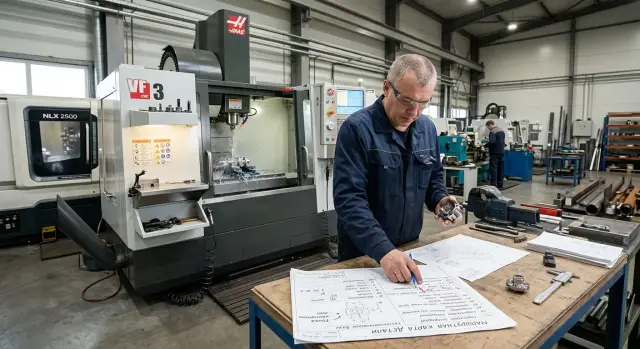
Where the route starts to fail
Routes between turning and milling often break not on a complex operation but on the first unnecessary re-setup. It may seem more convenient to grab the part again, but every new clamp slightly changes its position. If the next dimension is then measured from a different datum, those hundredths quickly turn into scrap.
A typical case looks harmless. On the lathe they machine the outer diameter and one face, then flip the part and clamp it by the finished diameter. On the milling side they then drill holes from the second face. Formally everything is correct. In practice the distance between holes and the groove drifts because the part acquired a new seat twice. For the machine this is minor, for assembly it becomes a problem.
Changing the datum between sections is even more problematic. The turner may reference sizes to the axis and one face, while the miller uses another face or a surface after a roughing pass. Both do their work neatly, but the sizes don’t match. People argue for a long time, while the root cause is the route itself.
The failure often starts already at roughing. Roughing is frequently seen as just removing excess material where order seems unimportant. But roughing determines which surfaces stay rigid for subsequent setups. If you remove allowance from the datum too early, open a thin wall, or make a slot before heavy turning, the part loses stiffness. Finishing then cannot recover the shape.
What’s convenient for the machine and what’s right for the part are not the same. The machine prefers the blank orientation that’s easy to clamp right now. The part usually needs a different path: first create a clear, repeatable datum, then keep referencing it as long as possible. If you choose only for current clamping convenience, the route looks short on paper but costly on the shop floor.
Problems usually start in one of two ways. Either an extra setup is added for the convenience of a single operation, or different sections work from different datums. Both cases can be seen in advance: the dimension chain becomes longer and the number of re-setups grows without a good reason.
What to gather before planning the route
A workable route doesn’t begin with arranging operations but with the input data. Skip even one item and the plan will look neat on paper while the shop gets extra re-setups, disputed datums and in-process scrap.
First you need the working drawing. Look not only at dimensions but also at tolerances, fits, surface finish, runout, concentricity and perpendicularity. Problems often lie not in the size itself but in what it’s referenced to. Making a diameter is usually easy; holding it from the correct datum is harder.
Next mark which dimensions must be referenced from the same datum. It’s convenient to do this on a copy of the drawing. If a face, hole and slot are related, don’t scatter them across different setups or sections without reason. Otherwise errors will accumulate from step to step.
Check material, blank type and the real allowance. Bar stock, forgings and castings behave differently. If heat treatment can distort the part, account for it up front rather than after the first batch. Often it’s smarter to leave allowance for finishing after hardening than to try to hold the final size earlier.
Also fix a few practical items before routing: batch size, queues at both sections, in-process inspection points, available measuring tools and any simple tooling like a V-block, mandrel or template. Batch size matters more than it seems. For ten pieces an extra setup is tolerable; for two hundred it eats hours and yields different results across shifts.
The workload on sections matters too. Process-wise it may be convenient to send the part to milling early, but if milling has a two-day queue the blanks will hang between operations and confusion will grow.
Plan inspection after each critical stage. Not a single final inspection but specific checks after roughing and after finishing. If the turner can’t quickly check the basic diameter, face and runout with tools actually available next to the machine, the route is already weak. A good process is designed together with its inspection, not separately.
How to choose the first datum
The first datum must hold the blank steadily and repeatably. If the part shifts already in the first setup, you’re chasing randomness instead of sizes. This is where most in-process scrap starts.
Don’t pick the visually "prettiest" surface but the one you can clamp confidently without bending or rotation. For a shaft that’s often the outer diameter or the face after an initial cut. For a housing it’s the face that gives a stable support and doesn’t rock in the fixture.
Link that datum to the most demanding drawing requirements. If the customer tightly controls concentricity, runout or hole positions relative to a mounting diameter, build the process so those dimensions come from a single reference. Otherwise extra error is introduced into the route from the start.
Also decide where to remove the main allowance. Roughing creates loads, heating and sometimes significant metal movement. That’s why the first datum is often chosen for a secure clamp and heavy removal, while the finish datum is established later when the part is calmer. This isn’t complication for its own sake — it reduces the risk of ruining geometry.
If the choice is debatable, ask four questions:
- Which surface holds the blank most rigidly?
- From which surface is it most practical to run the most precise dimensions?
- Where is it best to remove the major allowance without causing deformation?
- Will this choice force the part to shuttle back and forth between sections?
The last question often settles the issue. One extra setup doesn’t look bad on the map, but on the shop floor it almost always costs time and increases size scatter.
For a simple part the logic is usually: pick a rough datum for a secure clamp, remove the main allowance, then create the finish datum and run the accurate turning and milling from it. This is simpler than trying to do everything from the first convenient surface.
How to lay out operations step by step
Order operations by datum and allowance rather than by which machine is free. If you sequence transitions incorrectly, extra re-setups will appear quickly and dimensions will begin to drift after the second re-clamp.
Start by removing the bulk of the allowance and creating simple support surfaces. For a shaft this may be a face and rough outer diameter. For a housing it’s a reference face and rough sides. Then machine the surfaces that will serve as the main datum for later steps — this isn’t mere roughing but preparing the primary reference.
Next bring out sizes tied to concentricity, runout and mutual positions. Do these when the datum is single and stable. Milling faces, slots and holes are often scheduled later in the route. If made too early, another metal removal can easily spoil the reference. Finishes are left to the end when heavy work is done and the risk of shift is smaller.
In practice it’s straightforward. Suppose a shaft has a mounting diameter, a keyway and flange holes. First the lathe faces the end, removes large allowance and roughs diameters. Then it finishes the reference diameter and face that will be used for clamping. After that it brings out runout-critical surfaces. Only then does the part go to milling for the keyway and holes.
A common mistake is doing "convenient" operations too early. For example, milling a slot because the part is already in the vise and then returning it to the lathe for heavy removal. After that the slot drifts, holes shift and runout grows — scrap appears fast.
Use a simple test: after each operation ask yourself, did the datum become more stable or less stable? If less stable, that transition probably belongs later in the route.
When to transfer the part to another section
Send the part on not when everything possible is finished on the first machine, but when a stable datum exists for the next setup. Without that, the second section will adapt to rough surfaces and size scatter will appear quickly.
On the lathe they usually first create surfaces that will later be used for clamping: the outer diameter, a hole, a face, or a locating shoulder. With these ready it’s easier and more accurate to set up the part for milling without searching for a new datum.
The allowance for the next section should be specified explicitly — not "leave a bit" but a concrete value that will be removed without dispute. Too little allowance forces chasing size at the limit; too much increases the risk of distortion during machining.
A transfer is generally justified when four conditions are met: the datum after the previous operation is repeatable, it’s clear on the next machine what surface will be clamped, the routing card specifies the allowance for the next step, and there is in-process inspection after a risky operation.
Place inspection where the part most often shifts: after deep boring, machining a thin wall, large material removal or a long cut with an overhang. If an error occurs there, it will only consolidate further down the route.
Returning a part to the lathe without a clear reason is almost always bad. That adds another setup, a new datum and another chance for scrap. If the process requires constant returns, the operation sequence is wrong or the routing card lacks clear fixturing logic.
Example: for a bushing with a flange you might first bore the hole, machine the outer diameter and finish the reference face. Then check runout and hole size. Only after that transfer to milling to machine flange faces and bolt holes. Sending it earlier risks clamping on rough surfaces and drifting sizes.
Before production, verify the route against real tooling — not how the part looks on paper but how it will actually be held in a chuck, collet, soft jaws, vise or V-block. If the milling shop cannot clamp the part as the process assumes, move the transfer or revise the operation sequence.
Example for a simple part
Take a flange made from bar stock: outer diameter, functional face, central bore and bolt-circle holes. This part clearly shows how operation order affects accuracy.
Build the route around the datum, not around a list of machines. If holes and a face must be accurate relative to the center, it’s logical to make the finish datum from the central bore. If the main reference is the outer diameter, that may serve as the support. The usual mistake is making holes too early and then reclamping to finish diameters — concentricity is lost.
A working scheme looks like this. On the lathe start with a rough clamp, turn the outer diameter with allowance and face the end. Don’t chase finish sizes yet; the goal is to straighten geometry and remove excess metal.
Then bring the central bore or outer diameter to the state of a finish datum. In this example it’s often logical to prepare the bore because the milling shop measures the bolt circle from it.
After that the part goes to milling. There it’s fixtured by the finished bore and face, the milling face is machined if required by the drawing, and the bolt-circle holes are drilled.
If the outer diameter requires a tight tolerance or must be strictly concentric with the bore, the part can return to the lathe — but only for a clear reason and with a defined datum. In that case the outer diameter is finished from the same fixturing logic used for the holes.
Finally check concentricity, thickness, diameter, hole positions and face runout. This finish is easier than trying to catch every size after each setup.
If you do the opposite — machine holes first, then take long lathe passes to finish the outer diameter and face — the bolt circle will likely shift and thickness scatter will increase. For a simple flange the order often works best as: rough turning, create finish datum, milling, final sizing and inspection.
Where mistakes happen most often
Mistakes usually start not with the machine but with operation order. The process engineer looks at setup convenience rather than the future dimension chain. As a result each operation seems correct, but after the next re-setup sizes no longer match.
Often holes and milled features are made before there is a finish datum. On the first setup this is convenient — the part is easy to clamp and the tool has room. But later finish turning changes the surface that should serve as the reference, and holes drift relative to the axis or face.
Another typical error is removing all allowance before heat treatment. After heating the part may distort and there’s nothing left to correct. If final surfaces are to be produced after heat treatment, leave a clear finishing allowance.
Also avoid unnecessary transfers between sections. Turn, send to mill, return to turn, and then mill again — each transfer adds a clamp, waiting time and a chance of error. For single parts this is annoying; for series it becomes a repeatable defect.
Sometimes the datum is changed simply because it’s easier to clamp the blank that way. That’s faster for the setup person but almost always worse for sizes. If one dimension is referenced to the outer diameter, another to the face, and a third is checked after a new setup from yet another surface, the process becomes fragile.
Before launch quickly check four things: is there a finish datum before critical holes and slots; is allowance left on surfaces that will be heat treated; can you eliminate at least one transfer between sections; and does the inspector know how to measure the size after the next setup? If any answer is unclear, fix the route now.
Quick check before launch
Before issuing the routing card walk the route with one question: after each operation is it clear what the next datum will be? If a dimension has no clear datum it will start to drift at the first re-setup.
The check is usually five points. Each dimension that affects assembly, fit or concentricity must have one clear datum. Each re-setup must be justified: it should expose a new surface, not cover a mistake from the previous step. Allowance must remain after turning and after milling sufficient for the next operation. Inspection should be placed not only at the end but after operations that commonly shift the datum or deform the part. And finally the route must match the real shop: available tooling, the chosen machine, and a clear inspection place.
A simple human sign helps. If the shop foreman can quickly explain the operation order without long caveats, the process is usually well put together. First get a stable datum, then remove the bulk, then machine surfaces and sizes that are referenced to that datum. If the order needs long justification, it already has a weak point.
A small example: a shaft with a flange is first turned on external datums, allowance is left for finish passes, then transferred to milling for holes using the prepared register. After milling runout is checked and then final diameter is finished. This keeps concentricity and avoids hunting for scrap at the end.
Even with modern CNC machines and machining centers the route shouldn’t rely on "we’ll sort it out later." A ten-minute check before launch often removes one extra transfer between sections — and that already saves noticeable time and nerves.
What to fix in the routing card and next steps
When the operation order is clear, record it so the shop can work from the card without guessing. Otherwise one operator may remove too much allowance, another may clamp from a different datum, and inspection will spot the problem too late.
In the routing card record not only the sequence but the logic of transitions: which datum the turning operations reference and which datum the milling operations reference, the allowance left after key steps, where size, runout, concentricity or flatness are inspected, when the part is transferred to another section and what tooling is needed for each clamp.
Mark the transfer point between sections explicitly. The card should state in what condition the part leaves turning: after roughing, after finishing external surfaces or after a control measurement. Then the milling section receives a clear blank, not a "nearly finished" part with an uncertain allowance.
Review the route not only with the process engineer. The foreman quickly spots where the flow is inconvenient. The setup technician sees whether the part can be held stably, whether tool travel is sufficient, and whether an extra setup will appear. Five minutes of such discussion often save a whole shift at launch.
If the turning operation produces a datum by outer diameter but milling needs to reference a face and slot, agree that in advance. Otherwise the first batch easily goes to scrap due to different fixturing logic.
When the route depends on machine choice, tooling or the transfer scheme, check not only the card but the equipment capabilities. EAST CNC, the exclusive representative of Taizhou Eastern CNC Technology Co., Ltd. in Kazakhstan, has equipment reviews and practical machining materials in the blog at east-cnc.kz. This helps verify the route against how the part will actually pass through turning and milling operations. If the question concerns machine selection, commissioning and service, the company covers that full cycle.
A good routing card doesn’t try to look clever. It simply leaves no disputable points for the shop.
FAQ
Where to start calculating a part route?
Start with the working drawing and immediately mark the dimensions that must come from the same datum. Then check material, blank type, allowance, batch size and how you will measure the part after risky steps.
Why do dimensions disagree even though both sections work carefully?
Most often the turning and milling sections are referencing different datums. Until linked to a single reference, each section can do its work accurately but the assembled dimensions will still be off.
How to choose the first datum?
Choose the surface that holds the blank most rigidly, without bending or rotation. Then check whether it’s practical to run the most precise dimensions from that surface, not just to make the first cut.
When to form the finish datum?
Usually the finish datum is created after roughing removes the main allowance and the part becomes flatter and more stable. If you form it too early, the next heavy pass can distort the shape.
Which should come first: turning or milling?
First obtain stable surfaces you will reference for later sizes. Slots, faces and holes are better scheduled later, when the datum is set and further metal removal won’t break the reference.
When to transfer the part to another section?
Transfer the part when the next section can clamp it reliably by a finished datum. If they have to use a rough surface as reference, size variation will appear immediately.
Where to place in-process inspection?
Inspect the part right after the steps where it most often shifts: after large material removal, deep boring, machining a thin wall, or long passes with a long overhang. That way you find the error before the next setup, not at the end of the batch.
Should allowance be left after heat treatment?
Yes. Leave allowance if heat treatment can distort the part and precise surfaces are required afterwards. It’s usually easier to remove that allowance after heat treatment than to keep final geometry beforehand.
When is returning to the turning section justified?
Return the part to the lathe only for a clear reason — for example, to finish the diameter to final size from a datum that was already created. Returning by habit adds another clamp and another chance for scrap.
What must be recorded in the routing card?
Record operations, datums, allowances after important steps, the transfer point between sections, inspection points, and the tooling for each clamp. Then the operator won’t guess which surface to reference or when to move the part on.