
Part Inspection After Washing: Why Measurements Differ
Part inspection after washing often gives a different result than inspection before washing. Here’s how oil, temperature, and burrs change QC conclusions.
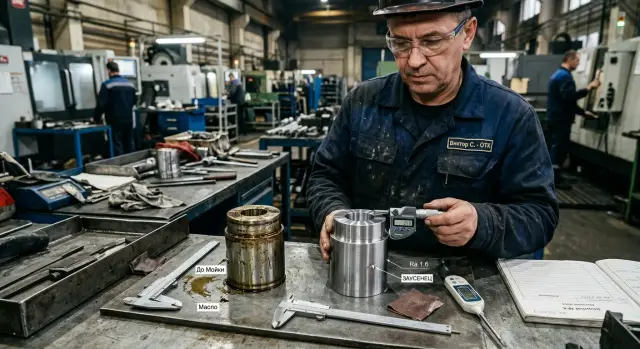
Why the same part gives two different results
This happens in the shop all the time. The part comes off the machine, the operator sends it for inspection, and QC records one dimension. Then the part is washed, left to sit, checked again — and the number is different. A familiar argument starts right away: did the machine shift the size, or was the first check wrong?
Often the problem is not the part itself, but the measuring conditions. Before washing, it may still be warm, covered with oil, and have a thin burr on the edge. After washing, it is dry, cleaner, and often cooler. Formally, it is the same part, but for measurement it is already in a different state.
That is why the two results often conflict not because of a defect, but because different things are being compared. The first measurement was taken right after machining, the second after washing and cooling. That difference proves nothing by itself.
Usually three things cause the confusion: an oil film and fine dirt on the surface, a different part temperature, and a burr on the edge. If even one of these factors changes between checks, the numbers can no longer be compared directly.
This is especially noticeable on CNC lathes. People want to check the part right after the cycle to close inspection faster, and that rush makes sense. But this is exactly when false discrepancies appear most often: one employee measures the part while it is still oily, another after washing. Both are sure they are right, even though their conditions are different.
First, the simple things need to be aligned: surface condition, temperature, contact point, and inspection order. After that, it usually becomes clear where the actual size drift is and where it is only the difference between a measurement before washing and after it.
What changes between inspection before washing and after it
Between the two measurements, the drawing and the machining program do not change. What changes is the measuring situation itself: the surface, the part temperature, and even the way the operator positions the tool. That alone is enough for the same part to produce different numbers.
Before washing, a thin oil film often remains on the metal. Fine chips and abrasive dust stick to it. When the inspector uses a micrometer, caliper, or gauge, they may be touching not clean metal, but that layer. The difference is small, but with a tight tolerance it is enough to start an argument.
Temperature also changes the result. After machining, the metal is often still warm. By the time the part reaches washing, drying, and a repeat inspection, its temperature has already changed. Sometimes just a few degrees are enough to shift the size on a microscopic level.
There is also a simpler point: after washing, the part is easier to read. On a clean surface it is easier to see a scratch, chamfer, transition, or end face. Because of that, the tool may be positioned slightly differently than the first time. The shift is tiny, but for accurate dimensions it is enough.
That is why inspection before washing and after washing should not be treated as two identical events. If the shop wants a fair conclusion, the first step is to make the conditions consistent: let the part reach the same temperature, remove contamination, and fix the contact point. Then the measurement reflects the part, not what happened to it on the way to QC.
How oil and dirt distort the measurement
If a part leaves machining covered in oil, the inspector is often not working with the metal surface itself, but with the thin film on top of it. That film smooths out tiny marks, hides a micro-burr, and changes the feel of contact. The surface looks flatter than it really is.
The problem is not just the appearance. The jaws of a caliper, the face of a micrometer, or a probe touch the oil layer instead of a clean reference surface. The film is very thin, but with a tight tolerance it already adds extra microns.
Dirt makes things even worse. Metal dust, coolant residue, and fine chips build up at edges, in grooves, and around holes. Where clean contact is needed, an accidental layer appears. It can add size, hide a burr, cause misalignment during setup, or leave a mark on the measuring tool itself.
Because of that, QC sometimes sees a false discrepancy. Before washing, the size seems fine; after washing, it shifts, and it looks as if the part has warped. In reality, the shape did not change. The tool simply started touching the metal instead of a mix of oil and fine dirt.
This is especially noticeable on turned surfaces, fits, and end faces after finishing. In such places, even a weak burr first sticks to the oil and is almost invisible. After washing, it becomes much more obvious, and the conclusion about the part becomes more reliable.
That is why inspection after washing often shows the more realistic picture. If both results are being compared, it is important to record the surface condition at the time of checking. Otherwise, the argument is not about the part size, but about what was left on its surface.
How temperature shifts the size
Even a clean, accurately machined part can show a different size if it has not yet reached the temperature of the inspection area. The geometry has not changed, but the numbers already have.
After machining, the part is usually warmer than the room air. Then washing, air blow-off, and drying change its temperature again. If the first measurement was taken right by the machine and the second after a pause, you are comparing not only size, but two different thermal states.
On a turning line, it looks simple. One part is sent for a quick check immediately after removal, another after washing and 15 minutes later. On paper, that becomes a discrepancy. In reality, one part was warmer or cooler than the other at the moment of measurement.
With small tolerances, just a few microns are enough to start an argument: did the part go over, go under, or did the gauge simply pick up temperature instead of the real size?
That is why the waiting time must be the same. You cannot compare a part that sat for 3 minutes with one that sat for 20 minutes. It is better to keep both in the same inspection area and, for disputed dimensions, repeat the measurement after additional settling time.
A small part equalizes temperature quickly. A heavy one can keep drifting much longer. There is no universal pause for every case, but the rule is the same: only identical conditions can be compared.
The practical takeaway is simple. If the shop often argues over repeat measurements, set one fixed waiting time before inspection after washing and the same waiting time for checks before washing. That removes part of the false discrepancies even before the discussion with QC begins.
Where a burr breaks QC conclusions
A burr often creates the most frustrating disputed measurement. The part may leave machining within tolerance, but a thin raised edge catches the jaw of a caliper, the face of a micrometer, or a probe. The tool rests not on the clean surface, but on that edge, and the inspector gets extra hundredths.
Before washing, this is easy to miss. Oil, fine chips, and a dark film hide the edge, especially on end faces, holes, and after drilling or turning. After washing, the film is gone, the edge is more visible, and it seems as if the size changed because of the washing. In reality, washing simply removed the masking.
The problem gets worse when the burr is not around the full perimeter, but only in spots. Then one measurement goes fine, while another gives an over-limit result. That is where the dispute between the shop and QC starts: the part is the same, but the numbers do not match.
Sometimes removing only the raised edge is enough for the size to move back closer to the real geometry. If the tolerance is tight, even a small burr can create a difference large enough to turn into scrap on paper.
Before repeating the measurement, it helps to do a simple check: look at the edge under side light, run a fingernail along the end face or hole edge, and compare the reading right at the edge with the reading a little deeper in. If there is still doubt, remove the burr carefully and in the same way, then measure again.
This order saves time. First inspect the edge, then argue about the number. Otherwise, you can spend a long time looking for a problem in the machine, the temperature, or the washing process, while the real cause is sitting right on the edge of the part.
How to compare results without confusion
To make a comparison meaningful, it is not enough to see two different numbers in the log. You need the same conditions: when the part was checked, where it was stored, whether there was coolant, chips, oil, and how much time passed after machining.
The working sequence is very simple. First record the inspection time and the part condition. Then let it equalize in temperature. After that, inspect the surface and edges, and only then repeat the measurement with the same tool and at the same point.
It sounds minor, but this is exactly where the error is usually hiding. If the shaft was measured closer to the chamfer before washing and in the middle of the journal after washing, a difference of a few hundredths looks like a defect, even though it is the same part. The same happens when the oil film disappears after washing and the tool sits tighter.
On a turning line, this is especially clear. The part leaves the machine warm, QC takes the first measurement, then the part goes to washing, cools down, and returns for a repeat check already clean. If nobody recorded the conditions or checked the edges, a false discrepancy is almost guaranteed.
A good rule is simple: first equalize temperature, cleanliness, tool, and measuring point. Only then decide whether there is a tolerance deviation.
A simple example from the shop floor
After turning, the operator removes a bushing from the machine and immediately takes it for the first inspection. They check the length between two end faces. The size is close to the upper tolerance limit, so even a few microns already raise questions.
The first measurement shows almost the maximum. QC makes a reasonable conclusion: the machine seems to be shifting the size upward. The shop reacts the way it usually does: it stops the batch, checks the compensation, inspects the tool, and looks for an error in setup.
Then the part goes through washing and a short drying cycle. It is measured again with the same instrument. Now the size is no longer sitting on the edge; it is calmly in the middle of the tolerance.
The reason turns out to be simple: before washing, a thin oil film remained on one end face. It was almost invisible to the eye, but the tool was touching not only the metal, but also that layer. If the size is already close to the limit, that small difference is enough to push the result upward.
This is frustrating because people start looking in the wrong place. The setter changes compensation, the operator doubts the cutting mode, and QC suspects process instability. Meanwhile, the source of the discrepancy has been sitting on the surface of the part the whole time.
That is why a measurement before washing is better treated as preliminary when the size is close to the tolerance limit. First, remove the oil from the end face, let the part sit briefly, and only then make the decision about the batch.
Common checking mistakes
The most common mistake is comparing parts in different temperature states. The part comes off the machine warm, and after washing and sitting it becomes cooler. For an accurate size, that alone is enough to matter.
The second mistake is using different tools. For the first check, a micrometer is taken by the machine; for the second, another tool is used in QC. Even if both are accurate, their setup, force, and the operator’s habits may differ. Direct comparison is then much weaker.
The third mistake is changing the measuring point. The operator measured the diameter closer to the end face, while the inspector measured a couple of millimeters farther away. If there is a transition nearby, a tool mark, or local wear, the numbers will differ.
Another common problem is blaming the machine too quickly. It is a convenient explanation, but far from the first one to check. First, remove the simple causes: temperature, oil, a different tool, a different point, and different measuring force. In CNC production, these small things more often create false discrepancies than a real change in geometry.
And finally, many people do not inspect the edge under magnification at all. A small burr after machining or transport is almost invisible to the eye, but it already lifts the probe or jaws. As a result, the size looks larger, and the investigation goes off track.
If the difference remains after the conditions are equalized, only then does it make sense to check the cutting mode, tool wear, and machine setup. This order saves time and reduces unnecessary complaints between the operator and QC.
What to check before calling it scrap
Before deciding on scrap or rework, it is worth spending a few minutes on a quick recheck. Very often the problem is not the part, but the fact that two measurements were taken in different states.
Check in this order:
- is the part temperature the same, and was the waiting time before measurement the same;
- is the measuring point clean, with no oil, emulsion, or dirt;
- is there any burr, dent, or fresh tool mark on the edge;
- were both measurements taken with the same tool;
- were they taken at the same point and in the same way.
If even one item does not match, it is better not to sign off on the conclusion right away. First repeat the measurement under the same conditions. This usually takes 10–15 minutes, and that is often enough to end the dispute without unnecessary rework.
It helps to set one simple route for disputed parts: temperature settling, washing or no washing according to the instruction, then inspection at one point with one tool. When the sequence is fixed, the number of discrepancies drops noticeably.
If the difference remains after that check, do not argue from memory. Record the measurement time, the part temperature, the measuring location, and the tool. With that data, the technologist or supervisor can much faster understand where the shift appeared.
When a company changes its process route, this issue is best discussed in advance: where the washing station is, where inspection takes place, and in what condition the part reaches QC. At that stage, productivity and line layout are important, but so is the measurement logic itself. If the task involves choosing a machine or redesigning a metalworking area, these things should be discussed early with the equipment and service supplier. For example, EAST CNC works on exactly these projects and supplies CNC lathes and production lines for metalworking.
The same dimension must be compared under the same conditions. If the conditions are different, the argument is not about the part, but about the inspection method.
FAQ
Why can the size of a part change after washing?
Usually it is not the part itself that changes, but the inspection conditions. Before washing, the surface still has oil, fine chips, and heat from machining, while after washing the part is cleaner and often cooler, so the tool shows a different number.
Which measurement should count as the main one: before washing or after?
If you need the final judgment against the tolerance, it is better to rely on a measurement taken under the same conditions: clean surface, same temperature, same tool, and same contact point. A measurement right after machining is useful as a quick check, but it more often leads to disputed readings.
How long should you wait before measuring again?
There is no single pause for every case, because a small part cools quickly while a heavy one takes longer. For a shop, it is better to set one standard waiting time for disputed dimensions and always measure after the same interval.
Does oil really affect the result, or is it a minor detail?
Yes, it can, especially when the tolerance is tight. The tool may touch not clean metal but a thin film on the end face, journal, or seating surface, and that is enough to add a few extra microns.
How do you know the problem is the machine and not the measurement conditions?
First remove the simple causes: equalize the temperature, clean the measuring point, check the edge, and repeat the measurement with the same tool. If the difference remains under the same conditions, then look at compensation, the cutting tool, and the machine setup.
Do I need to use the same tool for both measurements?
It is better not to change tools between checks. Even accurate micrometers and calipers can give different readings because of setup, measuring force, and the operator’s habits.
Where do people most often make mistakes during a repeat check?
The most common mistake is choosing the wrong contact point. One person measures closer to a chamfer or end face, another moves a few millimeters away, and on a precise part that is already enough to create a dispute.
What should I do if the size is right at the tolerance limit?
Do not rush to adjust compensation or stop the batch. First, wash the part, let it sit for a while, inspect the edges, and measure again — often the size will then fall comfortably within tolerance.
Can a burr really ruin the entire QC conclusion?
Yes, and quite often. A thin raised edge catches the jaw or probe, the tool is no longer touching the right spot, and the size ends up larger than the part’s real geometry.
How can we reduce disputes between the shop and QC because of different measurements?
Set one standard: the same waiting time, the same surface condition, one tool, and one measuring point. When the shop floor and QC work from the same method, false discrepancies drop significantly.