
Part catcher on a turning center: when you need one
We explain how a part catcher on a turning center affects scratches, cycle time and part reception — and when it’s better to run without it.
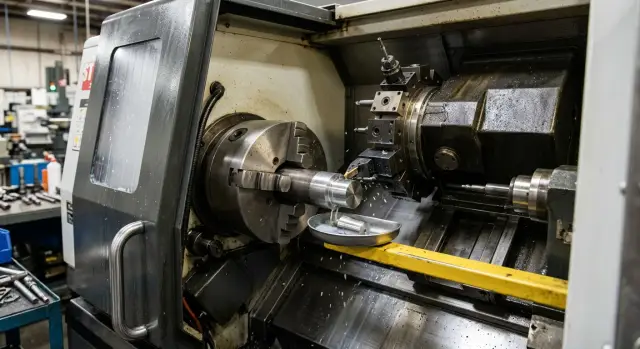
Where the risk appears after cut-off
The worst moment often starts not during cutting but immediately after it. In a fraction of a second the part loses support while the cutting tool has not yet completely left the cut. At that moment the blank is no longer held rigidly and behaves unpredictably: it falls down, rotates, catches on chips, or bounces off the nearest surface.
Because of this, a clean surface can be ruined after machining. The part touches the tray, the bed, the guard or accumulated chips, leaving scratches, dents and impact marks. On soft materials this is visible right away. On harder materials the defect may only be found during inspection.
A solid tray alone is not always the problem. But if there are curled chips, coolant residue and fine abrasive in it, even a carefully cut part lands on a contaminated surface. The result is simple: the tool produced a good surface, but the reception ruined it.
With small parts the risk is often higher than it seems. They not only fall but can bounce. After cut-off such a part may hit the chuck, the door of the work area or the internal guard. Sometimes it returns and gets under the tool again within the next second. Then you don’t get a single random mark but a series of identical defects until the machine stops.
On short cycles this is especially unpleasant. The operator doesn’t always notice the problem immediately, and in a few minutes you can accumulate a batch where some parts have faint marks while others become clearly defective. Then sorting begins and arguments about where the defect appeared.
A typical shop scene looks like this: a small bushing is cut cleanly, falls onto a metal tray, touches chips, bounces and gets a second mark on the guard. By size the part is within tolerance, but its surface is hard to accept without questions.
So the question of whether a catcher is needed is decided not by the tooling catalogue but by what happens in those half-seconds after cut-off. This is exactly where surface damage is most likely to occur.
When a catcher really protects the surface
A catcher is useful where not just receiving the part matters but a soft, predictable removal after cut-off. If a part falls into the tray by itself, it often hits an edge, rolls across chips or touches adjacent elements. That is acceptable for a rough blank but not for a finished surface.
Most often a catcher is justified in clear situations. A thin-walled bushing dents easily even from a small fall. A part with a polished band is quickly scratched by metal. A short small part without guided removal flies into the chips and gets lost. And a batch of expensive blanks tolerates even an occasional hit poorly because a single defect immediately affects cost of goods sold.
This is especially visible on bushings, rings and short cups. Their wall acts like a spring: an impact seems minor, but a mark remains on the surface and the geometry can shift slightly. If the part later goes for fitting, grinding or external inspection, the problem shows up immediately.
With finish areas the situation is even stricter. A part can leave the machine without tool marks but receive a long scratch after cut-off when it touches the tray or collector. Visually the machining is fine, yet the part is rejected.
On small parts a catcher is also useful because it defines the trajectory. Without it a part falls wherever, hides in the chips or jams in an awkward place. Searching for lost parts sometimes takes longer than the cycle itself.
In series made from expensive alloys or for critical assemblies even rare hits are too costly. Here a catcher pays off not by speed but by consistent batch quality.
When a catcher only slows the cycle
Sometimes a catcher causes more trouble than benefit. If the part is short, rigid and calmly falls into a soft collection box, the extra mechanism only adds movement.
On a simple production operation this is obvious. The machine cuts the part, the carriage retracts, the part falls into the receptacle and the cycle continues. If at that moment the catcher still has to move in, take position, accept the part and return, you get pure idle motion.
A couple of extra seconds seems minor until you count a shift. If a unit adds 2–3 seconds, on a batch of 800 parts this becomes tens of minutes. On a short cycle that increase is immediately noticeable.
Often the problem is not the device itself but its trajectory. The catcher comes out too early or too deep and the tool has to wait for a safe position. Sometimes a programmer retracts the tool on a longer path just to avoid the mechanism. Cycle time grows even though the part could be received in a simpler way.
Another common cause is chips. Fine granular chips, sticky stainless shavings or long spirals quickly pack into moving parts. The catcher begins to run worse, doesn’t always reach the target point, and the operator spends time cleaning it.
Typically it interferes in four cases: when the part doesn’t mind a soft fall, the collection box is already in the right place, the cycle is very short, and the cutting zone is full of chips.
A simple sign that the unit isn’t needed: without it the surface remains clean, the geometry isn’t harmed, and the operator doesn’t have to catch parts by hand. In a series that is often more profitable than keeping a catcher just for insurance.
What to look at for the part and the machine
Look not at the catcher itself but at how the part behaves in the final seconds of the cycle. A catcher is needed when after cut-off the part can really hit something, turn over or fall into chips.
First assess the part geometry. A short thick bushing falls quite predictably. A long thin shaft, a cup with a thin wall or a part with an offset centre of gravity behave worse: they are easier to rock, drop on their side or be caught at an angle.
Mass also changes the picture. A light aluminium part can bounce off the tray or the applied surface. A heavy steel blank strikes the receiving surface harder. If the catcher is weak or placed incorrectly, it won’t save the part and may add another hit.
Then look at the finish zones. If the outer diameter is already finished, any contact with a hard plate, chips or a neighbouring part will leave a mark. If there is still stock for the next operation, the risk is lower. It’s useful to mark on the drawing which zones must not be touched and which can tolerate light contact.
Material often matters more than dimensions. Aluminium dents easily on an edge and quickly shows indentations. Stainless steel doesn’t always deform but often receives visible scratches, especially near fine chips. Brass and soft alloys also dislike hard reception.
On the machine check not only the catcher stroke but the whole area around it: is there enough clearance between the catcher, turret and chuck, does it obstruct the tool during position changes, does it conflict with the bar feeder or guide tube, where will the part go if the catcher doesn’t accept it immediately, and where will it end up after being received.
That last point is often underestimated. If the part softly lands in the catcher and then rolls into a box full of sharp chips, the benefit is small. A good scheme is simple: the part separates, the catcher accepts it without impact, then it goes to a clean area without secondary contact.
How to decide step by step
Long debates aren’t needed. A short test in real conditions is enough to make it clear whether a catcher is necessary for your part.
Watch specifically the cut-off moment. It reveals almost everything: where the part falls, where it first strikes and what happens to the surface after contact.
- Take a part from a normal batch and record the cut moment on video. Slowed footage is best. Even a phone clip often shows what the operator can’t see with the naked eye.
- Run the cycle without the catcher. Note not only the fall but the place of the first impact: tray, guard, chuck or an already finished area in the removal zone.
- Then install the catcher and run at least 20–30 parts, not just two or three. That shows not a random event but the real picture of cycle time and repeatability of reception.
- Inspect the surface not by “it looks fine” but by actual contact marks. Look for dents, scratches and impact marks on finish zones and compare them to tolerances.
- Keep the option that produces less scrap with an understandable time loss. If the catcher adds 0.7 seconds but removes a stable post-cut defect, it is justified. If it doesn’t change quality but hinders the cycle and collects chips, it’s better removed.
It helps to keep a simple comparison sheet: cycle time, number of contact marks, number of good parts and causes of scrap for each scheme.
For short rigid parts without demanding external surfaces a catcher is often unnecessary. For thin-walled bushings, soft alloys and parts with a finished external zone after cut-off it often pays off on the first batch.
The decision should be simple: less scrap, a predictable removal and an acceptable time. If one test is inconclusive, the test was too short.
Example from a typical shop
In a small shop they turned a stainless bushing for a pump assembly. The part was small, had a neat external surface and the dimensions were fine. Scrap appeared after cut-off: the bushing fell on a steel tray and received a circumferential scratch on the outer diameter.
At first it seemed minor. The geometry stayed within tolerance, but the mark on the metal was visible, and for that part such a flaw was enough to rethink the process. When the surface must remain pristine, free fall after cut-off quickly becomes a source of losses.
They first installed a rigid catcher. It protected the surface better than an empty tray, but another problem appeared immediately. The machine had to wait longer in the reception zone, cycle time increased, and some bushings sometimes caught on the cut-off tool during separation.
The cause was simple: the part entered the catcher too early and too hard. At the moment of cut-off it hadn’t yet moved away from the plate, and any extra contact left a mark or made the part’s behaviour nervous in the final millimetres.
The operator didn’t abandon the scheme but redesigned the reception. He changed the angle so the bushing didn’t hit the edge but slid gently aside. He added a plastic insert to avoid metal-to-metal contact. He also slightly shifted the catch timing so the part entered the catcher only after normal separation.
After that the circumferential marks disappeared. The cycle increase remained but became acceptable: better to lose a fraction of a second than to sort a batch and polish surfaces manually. For a simple rough part this approach would not pay off. For a stainless bushing where both size and appearance matter, the decision was sensible.
Mistakes in selection and setup
The catcher is often taken as a universal option, and teams lose both quality and time. The most common mistake is simple: they look at the catalogue, see a matching diameter and assume that’s enough. But the part doesn’t behave according to the catalogue after cut-off. Its trajectory depends on length, mass, end shape, offset centre of gravity and even chips on the edge.
A short bushing and a long thin pin fall differently. If you don’t match the catcher to the real geometry, the receiver either misses the blank or strikes it with the edge of the cup. Marks appear that are easy to blame on cutting, while the cause is the reception.
Typical misses repeat. The catcher is chosen by chuck or machine size rather than by the part’s post-cut shape. The cup is placed too close to the tool and risks contact during approach or retraction. The receiver isn’t cleared of chips and creates new scratches. Only the first parts are checked instead of watching what happens after 100 or 300 cycles. People count cycle seconds but not losses from scrap and rework.
It’s dangerous to place the receiver too close to the cut zone. In a dry run everything may look fine, but in real operation the part may rock slightly, the coolant stream shift, and a contact with the tool or holder appears. Therefore distance is checked not by eye but by the actual turret travel and the part position at cut-off.
Another frequent mistake is a dirty cup. A soft insert doesn’t help if fine spiral chips lie on it. Then even a part with a good surface receives new scratches after processing. In a long series this is clear: the first pieces are clean, then quality drops.
If you select a machine and tooling with a supplier, it’s useful to show the part drawing right away and explain how it must be removed after cut-off. This reduces the number of trial setups.
Quick check before a run
Before a series a few minutes of dry checks and one trial part are usually enough. A faint mark on the surface is almost always easier to catch at the start than after a dozen finished pieces.
First look at the cut itself. The part should separate cleanly, without a hanging bridge and without a sharp fall. If a thin “tail” remains after cut-off, a catcher often won’t help: the part tears away with delay, snags on an edge and gets a mark even before reception.
Before the run check five things:
- the catcher enters the working zone smoothly, without jolts or impact at the end of the stroke;
- it does not block the tool or hinder a safe path of the cut-off insert;
- the soft pad on the receiving part is clean, dry and free of metal chips;
- after reception the part goes immediately to a clear collection area rather than rolling on the guard;
- the operator knows what to do if even a faint mark appears on the first part.
People often overlook the pad. Even small chips stuck to a soft insert easily leave an arc on a finish surface. If the part has a thin wall, a polished neck or a finished seating diameter, this is visible right away.
A good sign is the part landing the same way after cut-off: without rotation and without a secondary hit. If it first contacts the catcher, then bounces and only after that falls into the tray, it’s better not to keep such a setup. That scheme almost always adds risk and saves no time.
If a mark appears on the first part, don’t hope it will “wear in.” Stop and check three things immediately: the bridge length at cut-off, the catcher entry timing and the pad cleanliness, because these are the most common causes of the first mark.
When reception is calm and predictable you can then look at productivity. Until then it is too early to count cycle seconds.
What to do next
Rely on two numbers: how much scrap cut-off causes and how many seconds reception adds.
If the part is expensive or its finish surface is fragile, start with a small batch. Run a short test with the catcher and the same run without it. Look not only for obvious hits but also for small marks, dents, edge chips and scratches from secondary contact.
When the cycle is already tight, don’t judge the unit by eye. Compare identical series on the same material, with the same tool and program. Then it will be clear what costs you more: an extra 2–4 seconds per cycle or several scrap parts per shift.
The working routine is simple: choose one typical part, run a small batch with and without the catcher, record cycle time and defect types, and then fix the decision in the setup sheet. That removes the usual confusion when one shift uses the catcher and another removes it for speed.
If the result is borderline, don’t try to solve everything with one adjustment. Sometimes the problem isn’t the catcher but the reception height, tooling rigidity, part overhang or the trajectory after cut-off. Then check the whole chain: machine, chuck, tool and the part reception scheme.
This task can be discussed with EAST CNC. The company operates in Kazakhstan as the official representative of Taizhou Eastern CNC Technology Co., Ltd., supplies CNC turning machines for metalworking and supports selection, commissioning and service. This helps when you need to understand not only machine specifications but how it will behave with a specific part in a real cycle.
FAQ
What most often damages a part after cutting?
Most often it's not the cutting tool but the first contact after cutting that damages the part. The part loses support, falls onto the tray, catches on chips, hits the guard or bounces back, and scratches and dents appear on the finished area.
When is a part catcher really needed?
You need a catcher where the part must be removed gently and predictably after cutting. Thin-walled bushings, rings, short cups, soft alloys and parts with a finished external diameter usually benefit from a soft, controlled removal.
When does a catcher only slow the cycle?
If a short rigid part falls safely into a clean, soft receptacle without marks, a catcher often only wastes time. On short cycles, even a couple of extra seconds quickly becomes a noticeable loss per shift.
Which parts are at highest risk without a catcher?
Thin-walled and light parts are most at risk without a catcher, as well as any part that already has a finished external surface. These blanks dent easily on an edge, pick up scratches from chips, and often bounce after falling.
Can a soft receptacle replace a catcher?
Sometimes a soft collection box can replace a catcher — and that’s a valid option for simple series. But the box works only if the part falls calmly, doesn’t bounce, won’t roll through chips and won’t return toward the chuck or tool.
What should be checked on the machine before installing a catcher?
Inspect the entire area around the cut point. Check there is enough space between the catcher, turret and chuck, that the unit doesn’t interfere with the tool, and where the part will go if the catcher fails to accept it immediately.
How quickly determine if a catcher is needed?
Film the cut moment and run a small identical batch with and without the catcher. Then compare cycle time, the place of first impact and the actual marks on the surface — not just how the part looks overall.
Why does a catcher sometimes scratch the part itself?
This happens when the unit is too close, engages too early or accepts the part too roughly. Another common reason is chips in the cup or on the soft cover: even small chips will scratch the part during reception.
What to do if a mark appears on the very first part?
Don’t continue the run. Stop the machine and immediately check the bridge length at cut-off, the catcher's entry timing and the cleanliness of the pad — these are the most frequent causes of the first mark.
Is it worth discussing the catcher with the machine supplier?
Yes — if you pick a machine and tooling for a specific part, show the drawing, mark the finish zones and explain how the part should exit after cutting. That helps EAST CNC offer a solution with fewer trials and adjustments.