
Part and Chuck Mass Reserve on a Turning Center
The reserve for part and chuck mass should be calculated before startup: check assembly inertia, allowable speed, and load margin without guesswork.
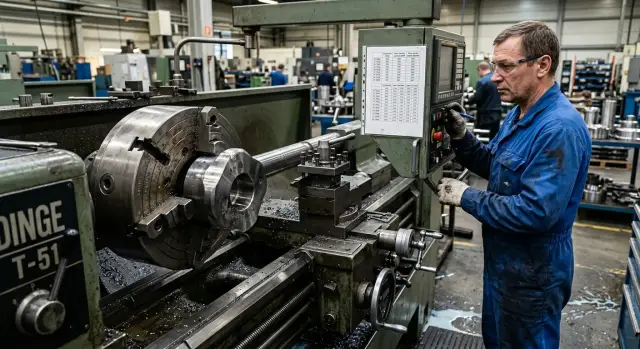
Why the catalog weight is not the same as your job
The number in the catalog looks straightforward: there is an allowable mass, so the part fits. But the spindle does not accelerate only the workpiece. It rotates the entire assembly: the chuck, jaws, adapter tooling, and the part itself. That means the catalog limit almost never matches the real job.
This is where the reserve usually disappears. If you look only at the workpiece mass, it seems like you are still far from the limit. But a heavy chuck uses up that reserve immediately, even before the part is mounted. For a turning center, this is not a small detail but a direct load on the spindle, drive, and clamping system.
Most often, the calculation does not include the mass of the chuck, jaws, adapter plate, flange, mandrel, and other tooling. Another separate issue is overhang. When the part sits far from the spindle, the load increases even at the same mass.
It is not just about kilograms. Where the weight sits matters. If the heavy jaws and part are moved farther from the axis, the total assembly inertia grows faster than the scale reading suggests. At low speed the machine may still run smoothly, but as speed rises, the allowable spindle speed drops very quickly.
The same part can also behave differently in different tooling. In a light chuck with short jaws, it may run without issues. In a heavy chuck, with a spacer and a long overhang, you will already need to reduce speed and accelerate the spindle more carefully. The part mass is the same, but the load on the assembly is not.
That is why catalog numbers should not be read as a direct promise for any setup. They are a reference, not a ready-made operating mode for your package. When selecting a turning center, this point often matters more than it first seems: a machine with a good reserve on paper may feel tight in real production.
What to add up before calculating
The turning center catalog gives limits for mass and speed, but you need to calculate more than just the blank. The spindle accelerates the whole rotating assembly. If you leave out even one heavy component, the calculation will no longer match what happens on the machine.
Start with the mass of the blank after setup. Not the drawing weight and not the purchase weight, but the part in the form it will actually enter the chuck. If the part still has excess stock, casting scale, a process tail, or an unmachined end face, that also goes into the calculation.
Then add everything that holds and rotates the part:
- the chuck or faceplate;
- the jaws;
- the adapter ring, flange, or spacer;
- the mandrel and fasteners;
- the workpiece itself in its real condition.
But the sum alone is not enough. You also need to look at how that weight is distributed. A short part close to the chuck loads the assembly more gently than a long blank with a large overhang. A compact mass at a small diameter behaves more calmly than a heavy ring at a large diameter.
If the part sticks out far forward, the machine has a harder time accelerating and stopping it. On paper, the mass may still fit within the limit, but the safe speed will already need to be reduced. The same logic applies to heavy large-diameter jaws: even a small increase in weight has a big effect if that weight is farther from the axis.
The practical approach is simple. First add up all the elements of the setup. Then separately assess two things: the part overhang and the location of the main mass. If the heavy parts are far from the spindle or spread across a large diameter, leave a reserve. For selecting a turning center, that reserve is more useful than trying to hit the exact catalog limit.
It is better to spend ten minutes on a proper calculation than to reduce speed at startup and start chasing vibration later.
How inertia reduces the allowable spindle speed
Catalog speeds apply not to every setup, but to specific conditions. As soon as you mount a heavy chuck, adapter plate, and massive workpiece, the operating mode changes. The spindle is no longer accelerating an abstract machine, but a specific assembly with your mass and geometry.
That is why mass alone does not tell the whole story. Where the mass sits is much more important. If the heavy part is moved farther from the axis of rotation, inertia grows more strongly than the kilogram figure suggests. Because of this, the allowable spindle speed often has to be reduced well before the catalog maximum.
During acceleration and braking, such an assembly behaves more rigidly. The drive has to work harder, the spindle reaches speed more slowly, and frequent stops add extra load. The machine may still run, but the bearings, belts, and clamping unit wear out faster.
It gets worse when the mass is off-center. A long part with a large overhang, an asymmetric shape, or poor balancing noticeably increases the load on the chuck. At speed, the jaws hold under tougher conditions, and the clamping reserve disappears quickly.
The problem is not limited to noise. Vibration affects size and surface finish. The diameter starts to wander, the part develops chatter marks, and the insert wears out faster than usual. Often people first check the tool and feed, even though it makes more sense to look at the chuck and part mass, the overhang, and the balancing.
It also happens that the chuck is within spec and the blank is too. But together, with the overhang and outer diameter taken into account, they create so much total assembly inertia that the safe speed ends up 20-30% lower than expected. On paper everything lines up; in practice, it does not.
That is why the reserve for part and chuck mass should be assessed together with inertia, not just by the maximum mass. If you are discussing a machine with a supplier, give four parameters right away: chuck diameter, blank mass, overhang, and required speed. That is more useful for the calculation than a single line from the catalog.
How to check the assembly before startup
Before the first run, write down the full rotating assembly on paper, not from memory. The mistake is usually not in the blank itself, but in the details: jaws, adapter plate, flange, fasteners, mandrel, and nonstandard tooling all add mass and inertia.
If you count only the part and the chuck, the picture often looks too optimistic. To verify it, you need to add up all the parts the spindle will accelerate and brake in real operation.
After that, a short check is enough:
- list all rotating elements;
- add up their mass from the specification or by actual weighing;
- compare the result with the chuck limit and the spindle limit;
- check the working speed for your actual operation;
- leave a reserve if there is a risk of imbalance, a rough blank, or a sharp acceleration.
You need to look at two limits at once. The first is set by the chuck. The second is set by the turning center itself in terms of mass, inertia, and spindle speed. If one assembly passes and the other does not, you cannot start it.
A simple example: the chuck weighs 58 kg, the jaw set 8 kg, the adapter flange 6 kg, the fasteners 2 kg, and the workpiece 24 kg. That already adds up to 98 kg. By that one number alone, it may look acceptable, but with a shifted center of gravity or a rough blank with runout, the reserve disappears very quickly.
Also check the working speed for the operation separately. For rough turning of a heavy part, a lower speed is often enough compared with what the cutting data might suggest. That is a normal compromise. It is much worse to run at catalog speed and get vibration, bearing overheating, or an emergency stop.
If the calculation is close to the limit, reduce not only the speed but also the acceleration rate. The combined inertia of the assembly loads the mechanics most strongly at startup and braking.
A trial run is best done in steps: first at reduced speed, then with a short stop to check noise, runout, and heating. If the machine behaves calmly, you can raise the speed further. If you are not sure, check the catalog data for the machine and the tooling again.
Example with a heavy blank
Suppose you have a blank weighing 42 kg. The chuck weighs 28 kg, and the jaws with the adapter add another 6 kg. The total assembly mass is 76 kg. At first glance, everything looks calm: that weight may fit within the machine’s allowable range.
This is where many people make a mistake. They look only at the total weight and forget that the spindle feels not just kilograms, but how that mass is distributed around the axis.
If the blank sits close to the chuck and runs at a moderate speed, the cycle often goes through without surprises. The part holds size, the sound is even, the tool cuts smoothly, and the spindle does not jerk during acceleration or braking.
But the picture changes if the part sticks far out of the chuck. A long overhang shifts the mass outward, and the total assembly inertia grows much faster than the kilogram figure suggests. The machine may still turn that setup, but not at the speeds you would expect from the catalog.
It becomes even more noticeable when the operator raises the speed closer to the upper limit. Chatter appears, vibration increases, and the surface finish gets worse. Sometimes the first thing to give up is not the bearings or the drive, but the stability of cutting itself: the tool starts to sing, and the size drifts after a few passes.
The conclusion is simple. By mass alone, the assembly may still pass, but by inertia and overhang, it may not. That is why, when selecting a turning center, it is better to calculate not only the mass of the chuck and the part, but also the overhang length, jaw type, adapter, and acceleration profile.
Where people make the most mistakes
The most common mistake is counting only the mass of the blank. But the spindle rotates the whole assembly. If you look only at the part weight, the reserve becomes imaginary.
The second mistake is related to speed. Many people take the top value from the machine catalog and assume it is available for any setup. In reality, the catalog maximum often applies to a lighter and better-balanced assembly. As soon as you install a heavy chuck and massive jaws, the operating mode changes. Sometimes very noticeably.
The third mistake seems minor, but it happens all the time. The technologist calculates one tooling set, and the operator installs another because it is more convenient for clamping the batch. On paper there was one chuck size, but in production a heavier one was used. On paper there were standard jaws, but in the shop they were bored-out jaws. After that, comparing the result with the calculation no longer makes sense.
Another common miss is underestimating overhang. A heavy short blank with its center of mass close to the spindle often runs more smoothly than a lighter but longer part. The weight is lower, but the inertia and load on the operating mode are higher.
If you want a quick self-check, just answer five questions:
- what is included in the total mass of the assembly besides the part;
- at what speed the assembly will actually run during the shift;
- which jaw and adapter set will really be installed;
- where the center of gravity sits after installation;
- whether the calculated tooling set matches what is on the machine.
If you skip even one of these points, the machine will not necessarily fail right away. More often, it simply will not reach the required speed, will run more harshly, and will take more time to set up.
What to check in the catalog and with the supplier
The machine catalog gives only part of the answer. For real work, you need to check not just the part mass, but the mass of the entire rotating assembly: chuck, jaws, adapter plate, mandrel, and the blank itself.
That is why it is better to ask the supplier not “what mass can the machine handle,” but “what part can be mounted with this specific chuck and at what speed.” That is a very different level of precision.
In the catalog and in the quote, it is useful to check four things:
- the maximum part mass specifically with the required chuck and jaw set;
- the chuck speed limits, not just the spindle limit;
- the mass of the standard tooling included in delivery;
- the acceleration and braking time of the heavy assembly.
If the supplier lists the chuck mass separately, that is already good. But it is still not enough. Sometimes the machine passes by mass, but the chuck already reduces the allowable speed noticeably. In that case, the machine’s passport speed remains only the upper boundary without your part.
Also clarify which tooling is considered standard. It happens that the base machine comes with one chuck, but your part needs another one that is heavier. A difference of a few dozen kilograms can significantly change the total assembly inertia and the machine’s behavior during acceleration and braking.
A good supplier does not answer in vague phrases. They calculate the job from the drawing or at least from the part’s mass, diameter, and length. If the case is uncertain, it is better to discuss the startup in advance: what speed will be used for the first run, which chuck will be installed, what limits will be set in the program, and who confirms the safe mode.
It is useful to ask for a written reply. A short table with part mass, chuck mass, speed limit, and acceleration time helps avoid arguments after startup. If the numbers do not match at the inquiry stage, they definitely will not improve in production.
Pre-shift check
Before a new shift, five minutes is often enough to avoid extra vibration, spindle overheating, or the part slipping in the jaws. The mass of the assembly and its inertia rarely forgive rushing, especially if today’s blank is different from yesterday’s.
First, add up everything that actually rotates. The total includes the chuck, jaws, adapter plate, mandrel, and the part itself. If the chuck weighs 42 kg, the jaws 6 kg, the mandrel 4 kg, and the blank 25 kg, the assembly already comes to 77 kg. That is how the reserve is checked, not by the blank mass from the job sheet alone.
The order can stay very short:
- write down the total mass of the rotating assembly;
- compare it with the chuck and spindle limits;
- assess the part overhang from the jaws and the clamping reserve;
- set reduced starting speeds;
- watch the sound, runout, and heating during the first minutes.
Mass alone is not enough again. A long part with a large overhang can behave worse than a heavier but shorter blank. If the part sticks out far, the clamping load rises and the real reserve drops. That is why it is useful before startup to check how much length is clamped in the jaws, whether there is a thin section near the clamping point, and whether a steady rest or tailstock is needed.
The first start is best done at reduced speed. First watch the acceleration, then increase the speed in steps. That makes it easier to catch a problem before cutting, not after marks on the part or an emergency stop.
There are three signals you should never dismiss as normal machine noise: a new hum, rapid heating around the spindle area, and a fine tremor on the body or part. If even one of these appears, stop the machine and check the setup again. Very often the reason is simple: the mass of soft jaws was not included, the overhang was too large, or the part was clamped more weakly than the material required.
What to do next
If doubts remain after the calculation, do not start the machine by guesswork. A mistake here quickly turns into losses: the spindle takes longer to accelerate, operating modes have to be reduced, and accuracy slips at the worst possible moment.
Create one working sheet for your assembly. Enter the mass of the part, chuck, jaws, adapter plate, mandrel, and all tooling that rotates with the spindle. Next to it, write down the diameter, part overhang, material, and planned speed. That way you will see not only the weight, but the real picture of the assembly.
Then compare at least two or three tooling options. Often the problem is not the part itself, but the fact that a heavy large-diameter chuck eats up the reserve. A lighter chuck or a different clamping scheme can sometimes give a better result, even if the part mass does not change.
Usually it makes sense to check several options: the current chuck and jaws, a smaller-diameter chuck, lighter jaws, lower speed with a recalculated cycle time, or another machine if the job is already too close to the limit.
If you are only selecting a turning center, discuss this reserve before you buy. You need real data about the part, tooling, and operating modes, otherwise the choice can easily drift toward a machine that is too weak or simply inconvenient.
For that discussion, the supplier usually needs a basic set of data: a drawing or at least the part dimensions and material, blank mass, chuck type, tooling mass, required speed, and a plan for similar parts in the future.
If the job is uncertain, it is better to discuss it right away with those who select not just the machine, but also the working setup of the assembly. EAST CNC specializes in selecting CNC turning machines, delivery, commissioning, and service, so it is better to talk about the workpiece mass, chuck type, overhang, and allowable speed before purchase and before startup. That is much cheaper than looking for the limits on a machine that is already running.
FAQ
Why can’t I look only at the workpiece weight?
Because the spindle does not rotate only the part. It accelerates the chuck, jaws, flange, mandrel, fasteners, and the workpiece itself, so the mass reserve often disappears even before startup.
What should be included in the assembly mass calculation?
Take the entire rotating assembly in its real setup: the chuck or faceplate, jaws, adapter plate, flange, mandrel, fasteners, and the workpiece with allowances. Don’t rely on memory—use the actual machine configuration.
How does part overhang affect machine operation?
A large overhang moves the mass farther from the spindle and increases inertia noticeably. Because of that, the machine has a harder time accelerating and braking, and the allowable spindle speed has to be reduced.
Why do heavy jaws change the operating mode so much?
Because weight at a large diameter puts more load on the assembly than the same weight closer to the axis. Heavy jaws and spacers quickly eat into the reserve for speed and clamping force.
How do I know when the speed needs to be reduced?
First, check the calculation: if the assembly mass and geometry are close to the limit, don’t use the maximum speed from the passport. On the machine, watch the acceleration, noise, runout, and heating—if any of these increase, the speed is already too high.
What should I check before the first startup?
Assemble the full setup on paper and compare it with the limits of the chuck and spindle. Then start in stages: low speed, a short stop, and a check of noise, heating, and runout.
What if the calculation is almost at the limit?
Don’t try to hit the exact passport number. Reduce the speed and acceleration rate, and consider a lighter chuck, different jaws, or another clamping method.
Why does the same part behave differently in different tooling?
Because not only the mass changes, but also its position. In a light chuck with short jaws, the part may run smoothly, while in heavier tooling with a spacer it can start vibrating at the same settings.
What should I clarify with the supplier before buying the machine?
Ask not for a general mass figure, but for the allowable setup with your chuck, jaws, overhang, and target speed. Also ask for the mass of the standard tooling and the chuck speed limits.
What are the signs that the assembly is overloaded?
Usually the first signs are a new hum, slight vibration, increased runout, or rapid heating around the spindle. If that starts happening, stop the machine and recheck the assembly mass, overhang, and clamping.