
Pallets for Housings and Fast Family Changeovers
Pallets for housing parts help establish common reference surfaces, reduce setup time, and move a shop between part families faster.
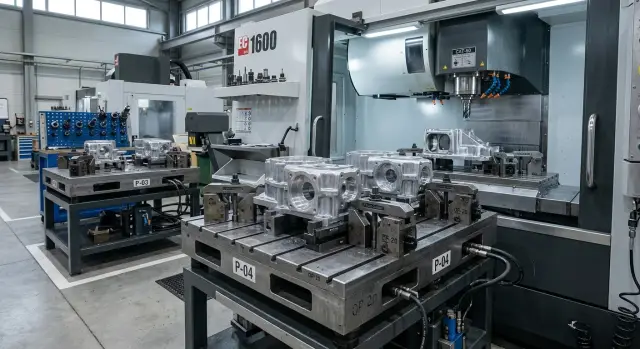
Why the shop loses time when switching housings
Most of the time is lost not during cutting, but before the first good part. With housings, this is especially clear: the parts look alike, but almost every batch needs a new setup, a new check, and a couple of test passes.
The problem starts with the datum. The setter once again has to decide which surfaces are the best and most accurate to reference on the next housing. Today they use a machined shelf, tomorrow a side wall, the day after a cast pad, because it “fits better.” Externally, the parts belong to one family, but the rule changes every time.
Because of that, the program and the fixture often follow different rules. In the CNC program, zero is set from one locating scheme, while on the machine the part is actually sitting in another. The difference may be small, but that is enough for a housing. A shift of a few hundredths of a millimeter can move hole coordinates, ruin coaxiality, and make it hard to assemble a cover or seat a bearing.
With mistakes like this, the shop loses time twice. First during setup: position the part, check it with an indicator, correct the offset, and run the first piece. Then during inspection: measure the part, find out where the datum drifted, put the part back on the machine, and redo the setup.
It is especially frustrating when the housings differ only slightly. For example, in the morning you run one type of pump housing, and after lunch a similar housing with a different boss height and a different hole pattern. It seems like the changeover should take 10 minutes. In reality, the setter moves stops, finds the base plane again, adjusts the offset, and carefully brings out the first part. Half an hour disappears before the first cut.
If there is no common rule for locating housing parts on the shop floor, every experienced employee invents their own convenient method. As long as the same person runs the job, it still works. Once a different shift comes in, repeatability drops.
That is why delays when switching part families are usually not caused by the machine itself. The reason is simpler: the datum has not been fixed as a single system. As long as the program, the pallet, and the setup sheet speak different “languages,” the shop will keep losing time and producing scrap on similar housings.
What one pallet system gives you
When the shop uses one locating scheme, switching a housing stops feeling like a small retooling of the entire department. The datum, the part zero, and the inspection points stay familiar. What changes is the blank or adapter, not the whole way the part is mounted.
For series where the housings are similar in machining logic, this creates a very noticeable effect. The technologist does not build the fixture from scratch for every new position. They carry over the same logic: where to take the datum from, where to check the seating, how to handle the first setup, and what to inspect before the start.
Put simply, one pallet system removes unnecessary decisions. The operator does not have to remember a new clamping scheme every time. They place the blank on familiar supports, see misalignment faster, and understand sooner whether everything has seated correctly.
Usually, without a standard, the time is lost not on swapping the pallet itself, but on the small things. You need to check the sheet, find the right stops, recheck the height, and verify zero again. When the datum is shared, most of these actions are already predictable.
Most often, the following stay unchanged:
- pallet position on the table
- the common system of reference surfaces
- inspection points after setup
- the logic of the first and repeat setup
Because of this, part families can be changed without completely redesigning the fixture. This is especially useful when the shop runs pump housings, gearbox housings, or flange-type assemblies with different dimensions but similar geometry. The base is the same; only the elements adapted to the specific size change.
There is another benefit: fewer random errors. When the mounting scheme is the same for all similar parts, the shop notices deviations faster. If the blank is not seated correctly, it becomes obvious right away, not after the first machined surface.
For the shop, this means a steadier pace of work. For the operator, less hassle during changeovers. For the technologist, it is easier to keep setup sheets, programs, and inspection points in one understandable system. That is why pallets for housing parts usually pay off not only through machine time, but also by reducing confusion between similar products.
Which surfaces to use as the base
For one pallet system, the datum must repeat across the whole housing family. Look not for the most convenient surface on a single drawing, but for the one that appears on almost every part with similar dimensions and machining logic. Most often, this is the housing support plane, a flange, or an already machined pad from which dimensions can be held easily.
If there is no common clean plane yet, use a stable rough surface, but only for the first setup. After that, it is better to move the part to finish datums right away. When rough and finish datums are mixed in one scheme, the shop quickly gets extra variation and longer setup times.
A good locating scheme for a housing is usually simple: one main plane, two supports in the second direction, and one anti-rotation stop. That is enough to keep the part from rocking or shifting during clamping. If you add too many points, the setter will start “fitting” the part by hand, and the whole point of standardization disappears.
There is a simple test. Put two parts from the same family side by side and check four things:
- the same base plane works for both parts;
- the supports land on stiff areas, not on a thin wall;
- the anti-rotation stop does not interfere with loading and unloading;
- the tool can reach all required sides without moving the pallet.
A weak casting skin is not suitable as a datum. It gives different support heights, can crumble, and ruins repeatability. If the housing is cast, it is better to seat it on machined pads or leave a small allowance in advance for the first base plane. You lose a little time on the first pass, but then the whole part family will sit on the pallet the same way.
Another common mistake is choosing the datum only for clamping convenience. For a pallet, that is not enough. You also need to check right away whether the spindle can reach holes, pockets, and side faces without a long tool overhang. Otherwise, the part seems to be positioned correctly, but the cycle grows by 15–20 minutes because of extra repositioning.
Simply put, a good datum for a housing part keeps repeatability, matches the geometry of the part, and does not interfere with machining. Then family changeovers follow one scheme instead of starting over for every housing.
How to implement the system step by step
Start not with the pallet, but with the parts themselves. Group the housing parts by two simple signs: overall size and locating scheme. If ten housings have a similar bottom plane, similar height, and the same mounting logic, there is no need to treat them as ten different cases. That makes it faster to see where one CNC pallet fixture can cover an entire family at once.
Next, look for a common set of supports and clamps. In practice, a few standard points are enough: a support plane, two side stops, and one end stop. If a part needs a spacer, it is better to add it as a changeable insert rather than build a new scheme from scratch. Pallets for housing parts deliver results when the fixture changes by rule, not by the setter’s memory.
Lock in one locating rule
Choose the pallet zero point and do not move it unless there is a strong reason. It is usually placed where it is easy to measure the blank, check tool reach, and transfer the program between similar parts. Then write this rule into the setup sheet in plain language, without ambiguity.
The note only needs to state:
- where the pallet zero is located
- which surfaces are considered datums
- which supports and clamps are used by default
- when a transition element is needed
That is how standardization of reference surfaces appears, instead of a set of verbal habits. For switching part families, that matters more than any pretty CAD drawing.
Then take two or three parts from different but similar groups and run a trial batch. It is better to choose not the easiest parts, but the ones that used to lose time. The trial shows where a stop interferes with the tool, where a clamp blocks the machining zone, and where housing locating starts drifting because of excess clearance.
After the trial, measure not only cutting time, but the whole setup changeover. How many minutes were spent moving supports, finding the right clamps, checking zero, and taking the first control measurement? If the gap between two parts is still large, adjust the stops instead of blaming the losses on “complex part variety.”
On shops that machine series housings on machining centers, this approach usually reveals weak points quickly. One accurate verification cycle is better than a month of small fixes on the fly.
Example of switching between two housing families
At a shop that runs pump and gearbox housings, the biggest time sink is not cutting, but the new setup. If both part groups rest on the same reference planes, the changeover is much faster.
Take the first group: pump housings with a similar height. The length and some hole locations differ a little, but the bottom support plane and the side datum are the same. That means the pallet, stops, and zero point can stay the same.
The second group is gearbox housings. They are larger in shape, but they are located on the same planes. That is where the savings come from: the operator does not search for a new mounting scheme and instead works with the same familiar logic.
In practice, the changeover is simple. The operator removes the pump housing, leaves the pallet on the table, and changes only the spacers for the new part height. After that, they take a different setup sheet that shows the spacer size, clamping scheme, and program number.
With this setup, they do not touch:
- the pallet zero point
- the position of the reference stops
- the tool offset routine
- the general logic of the CNC program
That gives a clear result. If the switch to another housing family used to take, for example, 40–60 minutes, standardizing the reference surfaces can cut it to 10–15 minutes. In small and medium batches, that is already a noticeable difference over a shift.
This method works well: both setup sheets keep the same datum labels. Then the operator sees that datum A is the bottom plane, datum B is the side, and all differences are reduced to spacers and clamps. There are fewer mistakes because the person is not changing the whole setup, only a couple of clear elements.
That is where pallets for housing parts bring real value. They remove unnecessary decisions during changeover. When the zero point stays the same and the program is built on one scheme, the shop switches between pump and gearbox housings faster, without long on-site fitting.
If a new group of parts goes beyond the old size range, the system is not torn apart. The technologist simply creates a second set of spacers and a separate setup sheet, while keeping the same datums and the same mounting principle. That is much more convenient than starting every setup from scratch.
How to keep order in sheets and pallets
Disorder usually starts not at the machine, but in the naming. If the same pallet is called P-12 in the production assignment, PAL12 in the program, and simply “big left” on the shelf, people waste time searching and make more mistakes. One marking scheme removes half of these issues.
The easiest approach is to give each pallet a short code and repeat it everywhere without exceptions: on the pallet itself, in the setup sheet, in the program name, and in the measurement log. This is especially useful for a pallet system for housing parts, because there are many similar parts and the difference between them is sometimes only a few millimeters.
What to keep in the sheet
The sheet should be kept next to the program number, not in a separate “for later” folder. The operator needs one set of data in one place. A short one-page or one-screen sheet works well if it includes:
- a locating diagram with clear supports and stops
- support height and all spacers by number
- clamping force for each clamp type
- part zero and the control dimension after setup
- a note on which family the part belongs to
If this data is not at hand, people start remembering “how it was set last time.” On the shop floor, that almost always ends with extra checking, and sometimes with scrap.
Support height and clamping force are better recorded as required fields, not as margin notes. Height changes the datum position. Clamping force affects repeatability, especially if the housing has thin walls or a long shelf. When the values are written down, family changeovers go smoothly: the operator changes the supports according to the sheet instead of from memory.
Also mark parts that fall outside the family. Do not hide them in the common sheet just because the housing is “almost the same.” Give them their own index, for example with an EX note, and their own datum sheet. Then nobody will place a nonstandard part on the usual pallet for housing parts without checking.
Good order looks boring, and that is a plus. If the pallet code, datum sheet, and program match at a glance, the shop changes part families faster and with fewer questions.
Where mistakes happen most often
When pallets for housing parts are introduced, what usually breaks is not the mechanics, but the logic of the system. People want one universal scheme, but leave no margin for differences in size, height, and stiffness. In the end, the pallet seems to fit everything, but in practice every new part still has to be adjusted by hand.
A bad idea is to place all families on one plate without a size range. If one housing is 40 mm shorter, while another is taller and heavier, the stops and clamps start working at their limit. Changeovers take longer than they should, and repeatability drops.
Another common mistake is related to clamping. It is placed where the tool can reach it easily, not where the part actually carries the load. If the clamp presses on a thin wall, the housing shifts already during the first operation. On the table everything looks fine, but the dimension
Quick check before start-up
Even a good pallet system will not prevent scrap if nobody does a short check before the start. At this stage, people often lose not hours, but the first part, the tool, and a calm shift.
If the shop already uses pallets for housing parts, this check takes 3–5 minutes. But it immediately shows whether the fixture is ready for work or whether the housing will move on the first pass.
First, check the base plane. It must be free of chips, oil clumps, impact marks, and small burrs. Even a thin speck under the part creates a tilt that later looks like a “mysterious size drift.”
After that, check the supports. They must be in exactly the places specified for that housing family, without “almost the same as last time” repositioning. One extra shim or a mixed-up support height changes the seating more than it seems.
The zero point must match the setup sheet not by memory, but in fact. The operator checks the pallet number, the locating scheme, and the active offset in the program. If there is confusion here, the machine will honestly machine the part, but not where it should.
It is also worth looking at the clamp separately. It should hold the housing firmly, but not pull it sideways or lift an edge. This is easy to miss when the part seems to be seated “about right,” and then shifts by a few hundredths after tightening.
Usually, this short sequence is enough:
- clean the datum and check that the part contacts the supports;
- verify the support positions against the setup sheet;
- check the pallet zero and active offset;
- tighten the clamp and make sure the housing did not move;
- send the first part for control measurement of the key dimensions.
The first part should not be judged by eye. It is better to measure the dimensions tied to locating right away: height from the base, hole position, and parallelism of the support surface. If they are within tolerance, the whole part family usually runs without surprises.
In practice, this order is especially useful where housings of different sizes are changed often. For shops with CNC pallet fixturing, this is not an extra formality, but a quick filter for errors before the batch starts. It is better to spend a few minutes before start-up than to later trace the cause of dimensional drift across the entire lot.
Where to start on your shop floor
Do not try to cover the whole part flow at once. For the first trial, one housing family is enough, especially where the dimensions differ but the locating does not change much. That way you can see faster where time is being lost and avoid confusing the shop with too many variables.
It is better to choose parts that run regularly, not once a quarter. Then the comparison will be fair: today you set up with the old method, tomorrow you use the common pallet and look at the numbers, not the impressions.
Choose one repeatable datum. Usually, this is the support plane plus two more surfaces that let the part seat easily and consistently every time. If each position needs new pads, spacers, and a separate clamping logic, a single system will not give the desired effect.
Next, you need a simple time check:
- time the changeover from removing the previous setup to the first good part;
- separately record the time spent finding the pallet, fasteners, and setup sheet;
- repeat the same operation on a common pallet for that family;
- compare not only the changeover minutes, but also the time to the first dimensional check.
Many people look only at the actual mounting and forget the small things. Yet those often eat up 10–20 minutes: the operator searches for stops, rechecks tool reach, and verifies part zero again. If the common pallet removes even part of these actions, the difference becomes visible within just a few shifts.
A good pilot does not need to be large. Five to ten repeats on similar parts are enough to answer two questions: how stable the datum remains and how quickly the shop reaches the first good part. After that, you can decide whether it is worth applying the scheme to other families.
If the trial shows results, it makes sense to calculate pallets for housing parts in money terms: how many shifts per month you save and how many changeovers you eliminate. That kind of calculation quickly clears up doubts and helps you make a decision without arguments.
If you are choosing a machining center or a line for this kind of setup, EAST CNC can help assess the task. The company works with CNC lathes, machining centers, and automated lines, and also handles selection, commissioning, and service. For a shop, that is useful when a pilot needs to be turned into a normal working system, not left as an experiment.