
Pallet changer: when it actually makes a difference
A pallet changer helps where the machine often waits for loading. We look at which batches and operations reduce spindle downtime and where the option doesn’t pay off.
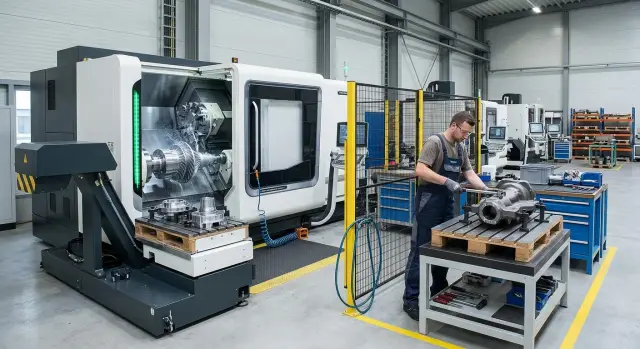
Where the shop loses time without a pallet changer
Losses start not during cutting but right after it. The program ends, the spindle stops, and the machine waits for a person. At that moment the equipment produces nothing, even though the shift continues and the operator is busy elsewhere.
On the shop floor this looks routine, so downtime is often underestimated. The operator removes the finished part, clears chips, loads a new blank, checks the datum, blows off the machining area and only then starts the next cycle. Each action is short by itself. Together they create a noticeable pause.
The simple difference is this: while the tool cuts metal, the machine makes a part. While the operator prepares the next blank, the machine stands still. Both times matter to the shop, but money is made during cutting.
Even if each action takes 20–40 seconds, the sum grows quickly. Suppose the machining cycle is 6 minutes and loading/preparation between cycles takes 2 more minutes. Then out of an 8‑minute total takt, a quarter of the time the machine is not cutting. Over a long shift that becomes hours of spindle downtime.
This is where a pallet changer helps. The operator prepares the next part off the machine while the current cycle runs. The machine does not wait for the table to be cleared, the blank to be fixed, and the fixture to be blown out. The pause between cycles shrinks to a minimum.
But such automation is not useful for every job. If the batch is small, tooling changes almost for every part and setup takes longer than loading, a CNC pallet changer brings little benefit. A similar situation happens with very long machining cycles: if the machine cuts for 40 minutes and reload takes 2 minutes, there is a gain, but it’s less noticeable.
The shop loses most time where cycles are short or medium and manual actions repeat dozens of times per shift. In those conditions spindle downtime reduction becomes visible almost immediately: the machine waits for the operator less often and part output evens out.
For which jobs the effect is obvious immediately
A pallet changer gives the clearest result where the machine runs steadily and time is lost specifically on manual loading. If the program runs 7–10 minutes and the operator then spends 3–4 minutes removing the part, cleaning the fixture, loading a new blank and checking the clamp, the spindle waits too long.
The fastest gains appear on repeat batches. The part is the same, the fixture isn’t changed many times per shift, and the process is already tuned. There’s no need to re-find the regime every time, so pallets do their job: one in process, the other being prepared.
This works best in serial metalworking where orders come in tens or hundreds of items. On such batches, even a couple of minutes saved per cycle quickly adds up to hours per week. This is especially true for CNC lathes and machining centers where the operator performs many identical actions between cycles.
The effect is usually immediate if four conditions are met:
- the batch repeats without frequent retooling;
- the blank takes significant time to load and remove manually;
- the machine runs steadily without constant stops and adjustments;
- the next part can be prepared outside the machining area.
The ideal case is when two parallel tasks exist on the shop floor. The machine should cut while the operator prepares the next part. Without a pallet changer these tasks run sequentially; with it, simultaneously.
A simple example: a batch of 150 identical housings. One part takes 9 minutes to machine. Removing the finished part, cleaning and loading a new blank takes another 4 minutes. Without a pallet changer a full cycle stretches to 13 minutes. With a changer most of these 4 minutes are removed from spindle downtime because the operator prepares the next pallet beside the machine.
This approach is especially effective when the job doesn’t change every half hour. If the shop makes parts for automotive units, construction equipment, ship components or other repeat products, a pallet changer often delivers a clear gain from the first period of operation. Not because the machine cuts faster, but because it waits for a person less often.
When a pallet changer hardly helps
A pallet changer does not remove every kind of downtime. It’s useful where delay occurs specifically at blank change and the operator can ready the next part off the table. But if time is spent on setup, measurement or continuous process adjustments, pallets swap quickly yet the shop still waits.
A common case is small batches. Ten parts of one type in the morning, six different ones after lunch, a trial series in the evening. The operator changes tooling each time, loads a new program, checks zero, runs the first part and measures it. In that flow a CNC pallet changer saves seconds or a couple of minutes but doesn’t remove the main source of loss.
The same applies to parts that require long manual alignment before every cycle. If the blank needs careful fixturing, runout correction, special clamping or manual positioning, a pallet won’t speed up preparation by itself. The complex work just moves from the table to the pallet and the person spends almost the same time.
Where the real delay is
Sometimes an operation looks short and automation seems like a sure help. But you must look at the whole cycle.
A pallet changer gives little effect if the program runs 40–60 seconds and then the operator spends 3–5 minutes inspecting the first part. The same happens when the shop constantly waits for tools, regrinding, insert changes or stops due to scrap and dimensional adjustments. If parts require long washing, measuring or rework after machining, the problem is not the pallet.
In that situation talking about reducing spindle downtime sounds good, but the numbers don’t add up. The spindle is idle not because pallet exchange is slow, but because the whole process around the machine is unoptimized.
A simple guideline: if non-cutting time mainly consists of loading/unloading, a pallet changer is often appropriate. If the pause is eaten by setup, alignment, measurement, tool wait or scrap handling, those issues should be addressed first.
You can see this with a basic calculation. Say the machining cycle is 6 minutes. A pallet change may save 20–30 seconds. But if the operator spends 4 minutes fixturing and another 3 minutes taking the part to inspection, the gain almost disappears. The system becomes more complex while output grows little.
So before purchasing, honestly break down a typical job by minutes. That analysis often reveals an unpleasant but useful fact: the problem isn’t the pallet, it’s that the shop lives from one re‑setup to another.
How to quickly calculate the effect for your job
Guessing from a catalog is pointless. The effect of a pallet changer is clear from a simple calculation: how many minutes the spindle is cutting and how many minutes it waits while the operator removes the part, loads the new blank and reestablishes the datum.
First take one representative job where the routing is stable. It’s better to measure the average cycle over a shift or several shifts, not the best single part.
What to measure
Five numbers are enough:
- average machining time per part under cutting;
- time to remove the finished part;
- time to load the new blank;
- time to establish datum, clamp and start the next cycle;
- number of repeats of this job per month or quarter.
Measure at the machine with a stopwatch. On paper a change often looks like “a couple of minutes,” but in reality it’s 3–4 minutes: the operator clears the table, adjusts the clamp, checks fit and confirms the start.
Then add all manual actions between cycles. That is the pause during which the spindle does not work. If the part’s machining takes 8 minutes and removal, loading and fixturing take 3 minutes, the losses are already visible. If machining takes 35 minutes and the pause is 1.5 minutes, the effect will be smaller.
How to convert this to a shift
Multiply the pause between cycles by the number of parts per shift. Suppose the machine makes 30 parts and each pause is 3 minutes. That’s 90 minutes of spindle idle per shift.
Next estimate how much of that pause a CNC pallet changer will actually remove. Usually not all of it: some time remains for cycle confirmation, checks and small operator actions. But if a 3‑minute pause drops to 30–40 seconds, the machine regains over an hour of pure cutting time per shift.
Compare output before and after. If a shift frees up 70–80 minutes and the cutting cycle is 8 minutes, that’s almost 9–10 extra parts. In serial work that increase is visible not just on paper but in actual output.
One more simple filter: how often the job repeats. If that batch appears once every six months, savings on a single case look good on paper but the decision is debatable. If similar parts arrive weekly, the calculation rests on real shop loading.
If you discuss equipment with a supplier like EAST CNC, these numbers give a solid basis. Without them it’s easy to buy automation for the idea rather than for the hours the machine will actually spend cutting.
A simple shop example
A batch of 240 identical housings runs at the shop in two shifts. One part’s machining cycle is 18 minutes. Without a pallet changer the operator waits for the cycle to end, opens the machine area, removes the finished housing, clears the fixture, loads a new blank and checks fixturing. If done confidently, this takes 3–4 minutes. All that time the spindle isn’t cutting.
With a pallet changer, the work changes. While the machine processes the current part, the operator installs and clamps the next blank on the second pallet and checks the stop. When the cycle ends, the machine swaps pallets in about 20–30 seconds. Cutting resumes almost immediately.
Over a long series the difference is clear. If average savings are 3 minutes per part, on a batch of 240 housings the shop recovers about 12 hours of machine time. That’s not a “paper” benefit. In those hours the machine can make extra parts, and the operator no longer needs to rush at the machine door every time.
Now another job. Sixteen different parts arrive: a few brackets, a couple of flanges, a small housing, then another shape. The operator changes jaws, moves stops, adjusts tool overhang, checks the first part and makes corrections. One setup can take 10–15 minutes or more.
In that scenario a CNC pallet changer helps little. Yes, it removes a minute or less for the blank swap. But the main time sink is retooling. The operator cannot prepare the next blank as quickly as with identical housings because the next part is already different.
The comparison is simple. For a long series of identical housings a pallet changer significantly reduces spindle downtime. For a set of varied parts with frequent tool changes it hardly affects output.
The effect appears where the operator can prepare the next blank off the machining area while the machine runs. If the job relies on long re‑setups and constant first‑part checks, pallets don’t fix the core problem.
Mistakes in selection and start‑up
The most common mistake is buying a pallet changer for rare or one‑off jobs. On paper the logic seems simple: while the machine cuts one part, the operator readies the next. But with small and varied items everything comes down to re‑setup. One part today, another tomorrow, a different base, jaws and program the next day. In the end the pallet swaps quickly, but the shop still waits due to preparation.
Many underestimate fixturing time. A pallet exchange can take seconds, but the fixture doesn’t prepare itself. It must be assembled, positioned, clamped, zeroed and the first part run. If that takes 40–60 minutes, a CNC pallet changer won’t solve the problem. It only moves some downtime to another point in the process.
Another mistake is looking only at price. Cheaper isn’t always better. If the goal is reducing spindle downtime, first identify where that downtime actually occurs. Sometimes the machine waits for a crane, inspection, tools, blanks or an operator busy on another station. Then the purchase seems logical but output barely changes.
Keep a simple downtime log for a week. Four questions usually suffice:
- how many minutes pass between cycle end and the next start;
- how much time is spent setting up fixtures;
- who prepares the next blank while the spindle runs;
- where queues form after machining.
Mistakes often begin at start‑up. Equipment is delivered but workflows don’t change. Operators aren’t told which pallet to prepare first, where to store fixtures, how to mark setups and when to check clamps. Without this people quickly return to the manual routine. Formally loading automation exists, but in practice the shop works as before.
Training must be more than a formality. The operator should confidently do three things: prepare the next pallet calmly, keep the correct sequence, and spot risks before cycle start. Without that, stops and small mistakes increase rather than output.
Another common issue is inflated expectations. In serial metalworking a pallet changer works well where the machine was truly the bottleneck. But if the shop bottlenecks at inspection, deburring, washing, heat treatment or lack of blanks, unfinished parts will simply pile up. Parts leave the machine earlier but then wait in the next queue.
A sensible order is: first map the structure of downtime, then check repeatability of orders, and only after that choose configuration. If batches repeat, tooling is standard and the operator can ready the next pallet during cutting, the solution is usually justified. If every job is unique, start by improving setup and routing.
A short check before deciding
Match this option not to advertising but to how your shop actually runs day to day. If parts come in repeat batches and the operator often waits for a load window, a pallet changer usually pays off. If the mix jumps and setups change almost every job, the benefit may be small.
Before deciding, honestly answer five questions.
-
Does the batch repeat without constant changes? A pallet changer shows strength where the same part or family returns regularly. If every new job requires different tooling, base and long checks, the system will spend time on preparation.
-
Does the operator spend notable time on loading? Look not at the cycle time on paper but at the pause between a finished part and the next start. If removal, cleaning, loading and checking take 3–7 minutes, there’s room for improvement.
-
Can the part be fixtured outside the machining area? This is one of the clearest signs. While the machine processes the current pallet, the operator readies the next one nearby. The spindle doesn’t wait for the person to clear the table, wipe it and set the blank.
-
Is the machine busy most of the week? If equipment runs only one or two days out of five, fix orders first. If the machine is occupied almost constantly, even a small gain per pallet change turns into noticeable hours per week.
-
Is commissioning and service available? Automation doesn’t work on “install and forget.” You need commissioning, logic checks, operator training and clear service support. For companies in Kazakhstan this is often easier to handle with a supplier that manages the whole project. EAST CNC offers consulting, selection, delivery, commissioning and service, so you can discuss not just the option but the entire implementation.
Quick guideline
If you answer “yes” to four out of five points, a CNC pallet changer is worth calculating. If two or fewer are positive, don’t rush. It’s wiser first to improve fixturing, setup and loading schedules.
A good sign is when you can name the exact minutes of lost time per shift. A bad sign is buying “for future needs” when nobody knows where current downtime comes from.
What to do next
Don’t decide from a catalog or someone else’s experience. First collect data from your shop. Without numbers, payback discussion turns into a debate of feelings.
Record spindle idle minutes between cycles for several shifts, ideally 5–10. Note the reason: blank change, fixture setup, operator wait, first‑part inspection, retooling, or minor fault. Often you’ll find several causes at once.
Then separate orders into repeat and one‑off. For repeat jobs calculate average cycle, average non‑cutting time and number of identical parts per shift. For one‑offs also track how long setups, tool selection and first‑part checks take. If the mix changes every day, a pallet changer may be less useful than it seems.
Quickly check the parts themselves:
- can the next part be prepared off the machining area;
- is the datum stable and does clamping take too long;
- does the batch repeat often enough for the second pallet to be used regularly;
- will the shop be limited by inspection, tooling or measurement queues.
Compare a pallet changer not with an ideal picture but with other ways to remove downtime. Sometimes a second fixture, an external prep station, a more convenient clamp, changing operation sequence or simply discipline in bringing blanks works faster. Sometimes the best step is a different loading automation method.
If you’re already considering a fleet update, discuss the whole task with the supplier, not just the option. For talks with a vendor prepare four things: drawings or photos of parts, batch sizes, actual cycle time and idle time between cycles. With this data it’s easier to understand whether a pallet changer is right for your jobs and where it will truly help.
A good outcome of this check is clear: you understand which jobs save hours per month with the option and which only add cost and complexity. Then the decision becomes calm and sensible: buy a machine with a pallet changer, look for another automation format, or first eliminate simpler losses.