
Packaging Machined Parts for Transport Across the CIS
Packing machined parts for shipping across the CIS: how to preserve surfaces, dimensions and edges during long routes, multiple handlings and cold conditions.
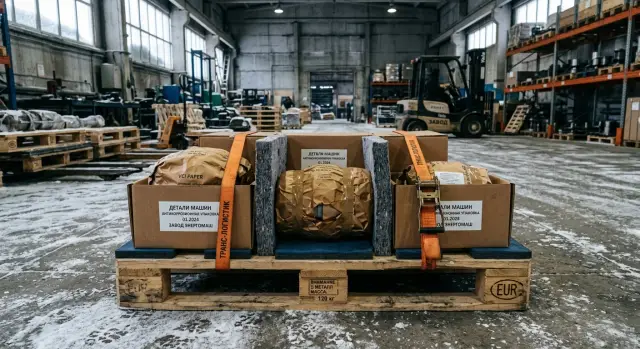
Why parts get damaged in transit
Problems often start long before acceptance. A part can leave the shop clean and precise but pick up scratches, dents and corrosion while on the road. For shipments across the CIS this is common: routes are long, there are multiple handlings, storage conditions change, and different people handle the load at each stage.
Scratches usually come not from accidents but from ordinary handling. A box is lifted, set down abruptly, slid on the floor or tilted by a forklift — and the part inside shifts slightly. Sometimes a few millimeters are enough to ruin a ground surface or a fit diameter.
The worst thing is that the outer packaging can look fine. The box may be intact, the strapping unbroken, labels in place. But inside the parts have rubbed against one another the whole trip. The defect is often found only at assembly, when there is little time to replace the part.
Condensation works fast too. If the cargo sat in the cold and then went into a warm warehouse or a closed truck, moisture appears on the metal. A surface that was clean at dispatch can show spots within a few hours. A thin film does not always protect.
Play inside the crate hits the most sensitive zones. Not only external walls suffer, but also reference faces, edges, threads, holes and thin protrusions. For precision parts even a small impact can change geometry where it isn’t immediately visible.
Often one weak packing element ruins the whole batch. The outer crate may be strong, but the internal fixture breaks on the first bump. Or the crate is good but there is no proper padding between parts. The shell stays intact while the internal protection fails.
In practice the picture is simple. A batch of housings travels from Kazakhstan to a neighboring country, goes through two handlings and spends the night in a cold warehouse. In the morning the boxes look fine, but some parts already have moisture and small dents on the edges. The cause is almost always the same: internal clearance and weak protection against temperature change.
What to check before packing
Good packaging doesn’t start with film or the box — it starts with the part itself. If you ship it as it came off the machine, small chips, abrasive dust and coolant residues will quickly damage the surface in transit. On a long route this happens more often than you might think.
First clean the part. Remove chips from grooves, pockets and threads, blow out hard-to-reach places, and wipe away coolant and moisture. If abrasive dust remains on the surface, it will act like sandpaper on the road.
Next mark the areas that must not be in contact with a hard support, strap or clamp. These are usually ground bases, fits, lapped faces, thin edges and finished cylindrical surfaces. Don’t keep this information in your head — note it on the packing card, a label or at least a diagram for the batch.
Check the weak points separately. Threads can deform from even a light knock. Sharp edges dull quickly. Thin walls and long projections can lose geometry if the part is over-tightened. Ask yourself a simple question: where will it be damaged first if the box is tilted or set down hard?
Before packing, record four things:
- the actual mass
- the center of gravity
- safe lifting points
- which side the part can rest on
This is not a formality. When loading a heavy housing or shaft, an error in the center of gravity often results in a strike against the crate or an adjacent part. If the part will be lifted with slings, a forklift or by hand, decide the lifting points in advance.
A good example is a housing after machining with a finished base and several threaded holes. If you simply wrap it and drop it in a box, the base will rub on the bottom and threads will collect dirt. If you first clean the housing, plug the threads, mark the base as a no-contact zone and indicate how to lift it, it will arrive in the same condition it left the shop.
This check takes little time. It saves long disputes later about whether damage occurred at the shop, at the warehouse or in transit.
How to choose packaging for the part and the route
Packaging type depends on more than weight. Parts are more often damaged by friction, point loads, bending and moisture. If the route includes several warehouses and handlings, the risk grows even for visually strong parts.
So start by examining the part, not the box. A shaft’s weak point is straightness and geometry. A housing’s weak spots are bases, corners and machined faces. A ground part’s surface is the first to suffer. Once you understand this, choosing the crate is easier.
Finished and ground zones are best separated with soft, low-lint padding. Ordinary cardboard and coarse cloth often leave marks. Loose materials absorb oil, crumble and stick to metal. When a surface must arrive without scratches or stains, it needs neutral padding and clearance from hard crate walls.
A recurring mistake with long shafts and rods is supporting them only at the ends. In transit the part bends under its own weight and from shocks during handling. These items need stiff support along their length so the shaft doesn’t "play" inside the packaging or roll.
Heavy housings need extra rigidity. If a box only holds the load statically, that’s not enough. Forklifts, braking and rough roads create short impacts, and a weak crate will start to flex. For a massive part a pallet box or a sturdy frame with a proper base is better than saving on walls and fasteners.
What the route changes
Winter shipments add two common problems: condensation and corrosion. When metal moves from cold to warm, moisture forms quickly. That’s why an airtight layer, moisture protection and corrosion inhibitor are often added to the main crate. For some parts a preservative oil and a sealed bag are enough; for precision items it’s wise to include desiccant.
If cargo goes from Kazakhstan to another CIS country with several transfers, err on the side of stronger packaging. An extra 2–3 kg of crate usually costs less than rework, grinding or remaking a part.
Step-by-step packing of a part
A precise part is ruined not only by a big shock but by small things: empty space in the box, film pulled too tight, or the contact of two edges. Pack in a clear sequence without rushing.
First prepare the part. Remove chips, dust and abrasive residues, then ensure the surface is dry. If the part will travel a long time after turning or milling, apply a thin protective coating on areas at risk of corrosion.
Next cover the surface. Clean paper, VCI paper or soft film work well. Don’t pull the material too tight. Strong tension often leaves marks on thin edges and can shift the protective layer where it’s needed most.
Then build the internal supports. The part should not move inside the box, but it must not be clamped so tightly that it deforms. Place pads where the part could shift during braking, turns or handling. For a housing these are usually the corners and lower support areas. For a shaft place supports under the journals, not on the working surface.
If several parts share one box, use partitions, trays or firm inserts between them. Even identical parts shouldn’t touch; otherwise one becomes a hammer for the other.
Label the outer crate with top, weight and lifting points. This looks like a small thing, but such marks often prevent an impact to a base or a threaded end.
For a small batch build one trial box and shake it by hand. Good packaging doesn’t rattle. If something moves inside, the motion will be worse on the road.
How to protect bases, edges and threads
Precision parts are ruined by small details. A strap rests on a base, the box is set on an edge, a thread snags on a neighboring part. The size may still be within tolerance, but assembly becomes difficult. Treat bases, edges and threads as separate risk zones.
Don’t cover bases only with general film. Film keeps dust and moisture out but doesn’t absorb impact or prevent point pressure. Put separate pads made of dense plastic, stiff cardboard or thin polymer sheet on reference and support surfaces. The pad should fully cover the working face and not slip inside the packaging.
Edges need rigid protection too. If the edge is thin or still sharp after machining, it needs hard protection rather than a soft layer. Use corner protectors, U-profiles and simple inserts that take the hit for the part. This is especially important for housings, flanges and parts with long machined edges.
Cover threads and fittings right after inspection, not at the last minute. A cap or plug solves two problems: the thread won’t be crushed and dirt won’t get inside. For long or fine threads film is not enough; use a rigid protective element that won’t fall off during handling.
One simple rule for strapping: straps, ties and clamps must not touch precision surfaces. Place a pad or a spreader between the strap and the part. Otherwise even a strong crate won’t prevent a mark on a base or a dent on a ground face.
For CNC-machined parts this is especially noticeable. A batch of housings may arrive in intact boxes but with damaged threads and battered bases due to direct clamping. From the outside everything looks fine, and defects appear only at assembly.
Considerations for winter and multiple handlings
In winter the damage usually comes not from cold itself but from temperature swings. Metal cools quickly in the truck or on a yard and then goes into a warm room. Condensation forms and even a clean part can get stains or light corrosion.
If a box arrives from the cold, don’t open it immediately. Let the parts warm up inside the packaging so temperatures equalize gradually. Condensed moisture will form on the outside of the crate rather than on the metal.
There’s also the opposite mistake. A part is packed in a warm shop and the film is drawn tight while humid air remains inside. On the road that air cools and the packaging traps moisture next to the surface. So metal must be dry before packing, and cold parts should not be wrapped tightly right after being brought into warmth.
In winter crates must withstand rough handling as well as cold. If cargo goes through several terminals, boxes will almost certainly be moved by forklifts, stacked, and sometimes bumped on corners. In such cases a rigid base, strong corners, a proper lid and reliable internal fixation are critical.
Treat the pallet as part of the packing, not a formality. Add stiffness, place pads under load points and check how the cargo behaves when tilted. If the pallet shifts slightly, that movement will increase during handling.
For a long route ask yourself: what happens if the box is tilted, shaken and set on an edge? If the answer is calm, the packaging is correct. If you have doubts, add braces, cushioning pads or a stiffer crate before dispatch.
Common mistakes when sending parts
Most problems come from rushing before dispatch. Even a strong crate won’t help if a heavy housing is set on thin cardboard and shipped without a rigid base. On the road such a part will quickly push through the bottom, shift and get a strike on an edge or a base.
A frequent mistake is to wrap everything in stretch film and call it done. Film protects from dust and holds small items, but hardly cushions impacts. Without internal pads, spacers and fixation, the parts will still move in the box.
Parts are often packed wet after washing to save time. This is a bad idea. Residual moisture in a closed crate creates condensation, and the risk is higher in winter. The box may look fine from the outside while stains and light corrosion appear inside.
Mixed packing causes many defects. When precise parts are packed with rough blanks in one box, the precise items almost always suffer. The blank is heavier and stiffer and acts as an impact load during jolts.
Cutting corners on padding backfires quickly. One sheet of cardboard between metal parts rarely helps for long routes and multiple handlings. Cardboard crushes, edges begin to rub, and acceptance becomes a dispute about where the damage occurred.
If you sum it up simply: place heavy parts only on rigid bases, dry parts completely before packing, don’t mix precision items with rough blanks, fix the load inside rather than rely only on outer film, and don’t skimp on protecting edges, bases and protrusions. For valuable parts an extra 15–20 minutes of packing almost always costs less than reworking a batch.
Example: shipping a batch of housings
A batch of housings after finishing leaves Almaty for Tashkent. The route isn’t the longest, but for precision parts it’s enough: the truck may be transshipped, boxes may sit in a cold warehouse, and even a small hit to the packaging can leave a mark on a finished face or damage an edge.
These housings have three weak spots: machined bases, threads and thin edges. If you simply stack the parts in a common box with cardboard separators, the acceptance will almost certainly find scuffs, dents and damaged thread starts. So this starts not with the box but with knowing which surfaces must not touch anything in transit.
At packing each part is first cleaned from chips and coolant, then wrapped in a light moisture barrier. The housing is placed in its own cell rather than in a shared crate. Inside the cell are soft pads that support the part at less sensitive zones, not on the finished faces. This simple approach prevents the housing from moving and rubbing the neighboring part.
Place a card with the batch number inside each packing unit. If a scratch or impact mark is found at acceptance, production and the warehouse immediately know which shipment it came from. Without this note the dispute tends to drag on.
For winter shipments add a layer of moisture protection. When cargo moves from cold into warmth, condensation forms quickly. If a part is tightly wrapped without moisture protection, you can get surface spots within a day even if the box never fell.
At acceptance you don’t need to remeasure the entire batch. Random checks are usually enough: look at finished faces, check edges, ensure threads are not crushed, and measure a few dimensions that most depend on housing geometry. This saves time and quickly shows whether the packaging survived the trip.
Quick checklist before dispatch
A few minutes before shipping can catch mistakes that later cost more than the crate itself. This applies especially to precision housings, flanges and parts after finishing.
Check the surface by hand and with a clean cloth. The part must be dry, free of chips, abrasives and coolant traces. Then shake the crate after fixation. Nothing inside should shift, touch the walls or strike neighboring parts.
Next, check where straps, corners and clamps lie. They must not press on bases, fits, threads or finished faces. Then make sure the marks for weight, top and lifting points are clearly visible to the loader.
One often-forgotten detail: the recipient should not cut film or straps right next to the part. Leave a safe layer of cardboard, padding or a free zone for the knife.
For precision parts it helps to do a small test: tilt the box slightly and rock it. This often reveals poor fixation better than a visual inspection. For batches going across the CIS with handlings and cold, duplicate important marks inside the crate. A short note with the part number and an unpacking diagram helps the recipient return the part to its place after inspection and avoid mixing the order of removal.
What to do before the next series
One successful shipment doesn’t guarantee the next will go the same way. If a packer later assembles the part from memory and substitutes materials with what’s on hand, the risk rises again. When a scheme works, lock it in as a standard.
A standard needn’t be long. Record which materials go on each part, the wrapping order, where to place protection for bases, edges and threads, and exactly how the part sits in the box, on the pallet or in the insert.
Include routine photos: the part before packing, after preservation, in its intermediate wrap, in the crate and after fixation. Store these photos in the part’s routing card or the order folder accessible to production, quality control and the warehouse, not in chat. A new employee will understand the correct version faster.
If a series is just starting, discuss packaging before the first part, not after the first complaint. At this stage agree on surface requirements, acceptable contact marks, crate type and shipping method. The rules for a housing with precision fits and for a rough blank will differ.
Sometimes the problem starts even earlier — at process and equipment selection. If a part leaves machining near tolerance limits, long transport only increases risk. For such tasks it’s useful to look at production stability in advance. In this regard materials and practical tips from EAST CNC’s blog at east-cnc.kz can be a good starting point, and when launching new series the company’s specialists help select equipment and provide a full cycle of services — from consultation to commissioning and service.
Turn a good result into a repeatable rule: one clear standard, a few photos and a short note in the routing card usually preserve more parts than any last-minute repacking before the truck.
FAQ
Why can a part get scratched if the outer box looks intact?
This happens often. The outer box can keep its shape while the part shifts inside, rubbing against a wall, a pad, or another part. The problem is usually not the outer box itself but the internal play, weak internal fixation, and contact points on the finished surface.
What should I check on the part before packing?
First remove chips, dust, coolant residues and moisture completely. Then identify where the part is vulnerable to impact, friction and pressure. If the surface is clean and dry and the weak zones are marked in advance, the chance of damage during transit is much lower.
Which areas on the part must not be pressed and how to mark them?
Mark bases, fits, ground faces, threads, thin edges and long projections. These are the zones you should not press with straps or rest on hard supports. It’s better to show this on a diagram, label or packing card rather than rely on memory.
What packaging is suitable for a heavy housing?
Use a rigid base and packaging that resists not only weight but also shocks during handling. A pallet box or a strong crate usually works better than a thin cardboard box. Inside, support the housing at less sensitive points rather than on the finished bases.
How to pack a long shaft so it keeps its geometry?
Don’t place a shaft only on its two ends. It needs support along its length or supports under the journals so it doesn’t bend or roll inside the crate. For long shafts, the stiffness of the internal cradle matters more than the thickness of the outer box.
What is best for protecting bases, edges and threads?
Film alone is rarely enough. Put separate pads on bases, protect edges with angle profiles or U-shaped sections, and cover threads with caps or plugs. That way the protection takes the load instead of the working surface.
Is moisture protection needed for winter shipments?
Yes. In winter you almost always need moisture protection. The issue is usually the temperature change: when metal moves from cold to warm, condensation forms on the surface. A dry part, a protective coating, sealed packing and desiccant for precision items reduce the risk of spots and corrosion.
Can I ship a machined part wrapped only in stretch film?
No. Stretch film holds small pieces together and keeps dust out, but it does little to absorb impacts or prevent movement. If there are no internal pads, spacers and fixation, the part will still knock against the crate. Treat film as an outer layer, not the whole packaging.
How to quickly check packaging before dispatch?
Gently tilt or shake the box after fixation. Nothing inside should rattle, move or touch the walls. Then check where straps and clamps lie and make sure marks for weight, top and lift points are clearly visible.
What should be done after the first successful shipment?
Record the working method as a standard right away. Note the materials, wrapping order, support points, protection for weak zones and include a few photos of the part in the pack. That way the next batch will be packed the same way, not by memory or random materials.