
Packaging Machined Parts Without Scratches on the Shop Floor
Packaging machined parts takes more than film and boxes: we break down trays, separators, preservation, and transport around the shop floor without unnecessary defects.
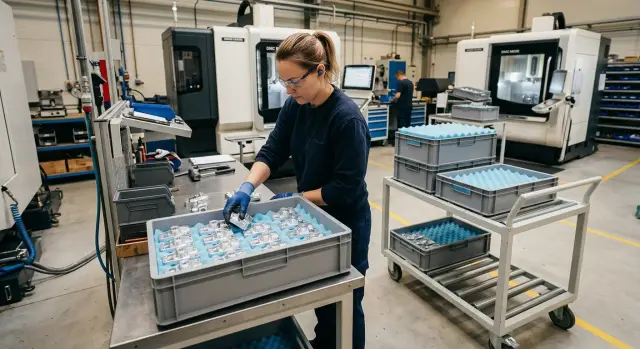
Where parts get scratched after machining
A part often comes off the machine looking fine, and the first visible mark appears ten minutes later. The reason is usually not the tool or the cutting settings. The marks show up when the part is lifted, placed into a container, carried to the next operation, or simply left on a table next to another batch.
The most common case is simple: parts are poured into one shared box. Even if each part looks clean on its own, they rub against each other during movement, with edges, chamfers, and finished surfaces all making contact. On soft materials, this shows right away. On steel, the mark may only appear later, when the surface is wiped clean and the light hits it from a different angle.
The second problem is chips left in grooves, holes, and steps. They act like an abrasive. Move the part a few centimeters, let a chip get between the tray wall and the surface, and there is already a long scratch on the finished area. It gets especially nasty when fine chips stick to coolant and nobody notices them.
Coolant itself often ruins the result too. It collects dust, fine chips, and dirt from gloves, then spreads all of that across the surface. That leaves not only stains, but also thin matte scuffs. Then it looks like the packaging of machined parts is to blame, even though the mark appeared long before that.
There is also a human factor. A worker grabs the part by the finished area, sets it on a dirty bench, turns it in their hands to check the size, and leaves fingerprints, small scuffs, or dents from a neighboring part.
Scratches usually appear in four places:
- when the part is removed from the machine and placed into a container
- in a shared box without separation
- on the waiting table between operations
- during short transport across the shop
If the batch is already finished and the surface has to stay clean, you need to look beyond the machine. Most often, the damage starts where someone simply “placed it there for a moment.”
What to remove before packaging
First, remove not the part into the tray, but everything that could leave a mark on its surface later. For packaging machined parts, this is a common cause of hidden defects: the part came off the machine in good shape, and the scratch was found at the next station.
The first issue is chips hiding where they are not easy to see. They often remain in holes, grooves, and threads. If you place such a part into a tray or stack it on another part with only a separator in between, the fine chip becomes an abrasive. This is especially common with bushings, fittings, and parts with internal threads.
After blowing it off, wipe the part free of coolant and fine dust. An oily film is not always a problem by itself, but fine metal dust quickly sticks to a tacky surface. Then it ends up on the separator, on gloves, on the bottom of the tray, and starts scratching the whole batch.
Another common miss is burrs on edges and ends. Sometimes the part looks neat, but a thin burr catches on another part, paper, or a tray cell. That creates streaks, and the packer thinks the container is the problem. In reality, the part itself is scratching.
Keep hot parts separate from those that have already cooled. A hot part is easier to damage in contact, and if you stack it with cooled parts, moisture and dirt build up on the surface faster. On top of that, separators can stick to warm metal or leave a mark.
In practice, four steps are usually enough before packaging: blow chips out of cavities, remove coolant and dust, check edges with a gloved finger, and let the part cool to a normal temperature. It takes a couple of minutes, but then you do not have to go through the whole tray again and argue about where the scratch came from.
How to choose a tray for the part
You choose a tray not by the overall size of the part, but by how it rests. If the part sits on random points, it shifts every time the cart hits a bump. That is how scratches appear after machining, even though the operation itself went fine.
First, find safe support points. These should be areas where a small mark will not affect fit, runout, or appearance. On a bushing, it is often convenient to support the part on the end face and outer surface, if that surface is rough or less sensitive. A polished face, ground diameter, or finished thread is better not to place on the bottom at all.
If the part is round, a simple flat tray often makes things worse. The part rolls around, hits neighboring parts and the walls. In that case, you need a tray shaped for the part: a V-groove, cutout, low stop, or separate pocket. Even a small amount of fixing usually solves half the problem.
For heavy parts, look not only at the material, but also at stiffness. If the bottom flexes, the part starts pressing on one edge and shifts into a corner. There it quickly picks up dents. A rigid tray made of thick plastic, plywood, or metal with a soft insert holds its shape better and behaves more calmly during transport around the shop.
For precise surfaces, it is better to make separate pockets right away. Yes, that tray takes up more space. But the parts do not rub against each other, and the operator does not need to move them by hand every time.
Before starting a batch, check the tray with four questions:
- Where is the part safely supported?
- Can it roll or shift?
- Does the bottom flex under the full load?
- Do the parts touch each other?
For packaging machined parts, one simple rule works almost every time: the less movement the part has in the tray, the fewer random scratches show up at the next station.
What separators to place between parts
If packaging machined parts is done in a hurry, scratches often appear not on the machine, but already in the tray. Usually the container is not the real problem; the separator is: too thin, dirty, or the kind that leaves lint on the surface.
Use soft material only on non-working areas. If the separator touches a fit, a ground end face, or a thread, it can stain the surface, dent an edge, or leave a mark that later has to be removed.
Dirty cardboard should be taken off the table right away. Dust, old chips, and metal crumbs quickly turn it into sandpaper. Even neatly stacked parts then rub against the debris and get fine scratches.
Choose thickness based on actual contact, not by eye. After placing the part, press the top part lightly with your hand and check whether it reaches the one below. If the two parts touch metal-to-metal even in one spot, the separator is not doing its job.
Different parts suit different materials:
- expanded polyethylene - for clean milled and turned surfaces
- dense lint-free paper - for light parts without sharp edges
- thin plastic or a soft sheet polymer - when the part is heavier and may crush paper
- VCI paper - when you need to separate parts and provide basic corrosion protection at the same time
Before starting a batch, test the material on one or two parts. Run the separator across a dry surface, press lightly, then remove it and check whether it left lint, stains, oil marks, or a texture imprint.
On simple bushings, the mistake shows right away: thin paper between end faces may work, but between outer diameters it no longer does. For flanges, the problem is different - the separator can slide if it is too smooth. In both cases, it is better to use material that is a little thicker than to sort the batch later because of scratches.
How to package a part step by step
Scratches often appear not during transport between stations, but in the 20–30 seconds when the part is being placed into a tray in a hurry. That is why packaging machined parts should be simple, consistent across the shift, and clear without extra questions.
It is best to keep one routine and not skip steps.
-
First remove chips, dust, and coolant residue. Then look at the gloves: if they have fine chips, a burr, or dirty oil on them, they will become the cause of scratches on the finished surface.
-
Before loading, place the first separator in the tray. It should cover the hard bottom and not slip. For small parts, dense cardboard, expanded polyethylene, or a clean sheet material without abrasive dust is usually enough.
-
Place the part on the supports evenly, without tilt. If the part rocks, it will rub with every bump from the cart. Supports are better placed under areas where a small mark does not affect size or fit.
-
Cover all possible contact points with a second separator. This is especially important if parts are stacked in several layers or if there are sharp edges, threads, ground bands, and chamfers nearby. The separator should keep metal apart, not just sit nearby for show.
-
Label the tray right away. Usually five notes are enough: part name, batch number, date, quantity, and a note about the finished surface if it must not be touched. When a tray is not labeled, people start moving it, opening it, and checking it again for no reason.
If the part is heavy or the shape is awkward, add one simple rule: after loading, gently rock the tray by hand. If the part shifted, the packaging is not ready yet. It is better to fix that at the machine than later to search for where the fresh scratches came from.
When preservation is needed
Preservation is needed when time passes between machining and the next operation, and the metal has a chance to meet moisture, dust, or dirty hands. If the part moves on almost immediately and stays in a dry shop, extra oil only gets in the way. It dirties part trays, attracts dust, and later adds another washing step before assembly or inspection.
Apply the protective compound only to a dry surface. If water remains after washing, or droplets are still sitting in grooves or threads after blowing off, the compound will go on unevenly. Under that film, the metal rusts faster than it would without it. Dry the part completely first, then apply a thin, even layer.
The protection method depends on the storage time and route. For packaging machined parts, one simple rule applies: the longer the storage and the worse the conditions, the stronger the protection needs to be.
- Up to 1 day in a dry room: a clean tray, separators between parts, and dust protection are often enough.
- Several days in the area or warehouse: a light protective compound without a thick oil layer works well.
- Transport between shops where there is damp air, drafts, or open doors: use a compound plus closed packaging.
- Long shipping or a cold warehouse: add a bag, paper, or film to help control condensation.
For storage, it is better to protect the part not only from water but also from dust. Fine chips and abrasive dirt stick easily to an oily film. Then they scratch the surface at the next move.
A good rule of thumb is simple: if the part may sit overnight, travel outdoors between buildings, or wait through the weekend, preservation is already justified. For example, turned bushings after the evening shift may look dry, but by morning moisture often settles on them because of temperature changes. A thin protective layer and a closed box can save the batch from rust spots and repeated cleaning.
How to move parts around the shop
Even good packaging of machined parts will not save a batch if the cart shakes the trays at every floor joint. After machining, the surface is already clean and precise, so even a small bump leaves a mark: a hit against the side, a shift inside the tray, a sudden stop.
Start with the cart itself. The shelf should be level, with no dents, sticking bolts, or tilt. If the tray rocks by even a couple of millimeters, it will start bouncing on floor seams, and the parts inside will rub against each other.
Any play should be removed right away. Most often, a rubber mat, a thin foam sheet, or simple edge stops on the shelf are enough. The point is simple: the tray should not slide forward, back, or sideways when the operator goes around people, racks, or brakes sharply.
A heavy top layer often damages precise parts more than the transport itself. If thin rings, bushings with finished surfaces, or ground parts are lying below, you should not place heavy boxes, fixtures, or blanks on top. Even without a visible impact, the load causes dents, which are then found during inspection.
A good setup is simple:
- place trays only on a level shelf;
- remove play before moving;
- do not load heavy items on top of precise parts;
- secure the batch before turns and braking.
Speed matters too. If you push the cart too fast, the tray starts acting on its own. On the shop floor this may look harmless, but after a couple of turns, small parts shift to one side. That is how scratches appear on end faces and marks on fit surfaces.
In metalworking shops, this is a small thing with an expensive outcome. The part leaves the machine without complaints, but by the time it reaches washing, assembly, or packaging, it already has a scuff. It is better to spend a minute securing the batch than later to figure out where the defect came from.
Mistakes that bring defects back
The most frustrating part is that the part is already finished, the size is correct, the surface is clean, and the scratch appears only after machining. Usually it is not one big cause, but small habits on the shop floor. Because of them, good packaging of machined parts becomes just a formality.
A common mistake is pouring small parts into one box. For washers, bushings, pins, and short shafts, that almost guarantees metal-to-metal contact. While the box is carried or moved, the parts rub against each other, strike edges, and get marks that were not there after machining.
Replacing a proper separator with the first piece of film you find does not work any better. Thin film often slips, bunches up, and does not keep parts apart. If chips or dust remain on it, it becomes a source of scratches itself. The saving is only on paper: one spoiled tray costs more time than choosing the right separator.
Another common story is parts riding through the shop in the same cart with tools, chucks, jaws, or fixtures. Even if everything sits nearby for only a few minutes, a heavy item can shift on a bump and hit the finished surface. Then the argument is no longer about the process, but about where exactly the defect appeared.
Labeling is also often seen as an unnecessary delay. As a result, batches get mixed up: parts from different operations are stacked together, trays are swapped, and preservation is applied to the wrong batch. Then inspection finds not only a scratch, but also confusion about size, material, or production stage.
Worst of all is when all these mistakes happen at once. Small bushings were dumped into a box, separated with thin film, placed in a cart next to tooling, and not labeled. By the time it reaches the next station, it is no longer a finished batch, but a source of defects.
If the surface of the part matters, treat the last few meters of travel as strictly as the machining itself. Usually, defect returns start not at the machine, but where someone decided to save two minutes.
A simple example: a batch of bushings after turning
A batch of steel bushings was received at the station after turning. The size was within tolerance, the surface came out smooth, but by the next operation some parts already arrived with matte streaks on the outer diameter. The reason was simple: the operator placed the bushings into a regular plastic box, just as they had done many times before.
While the box was carried from the machine to washing, then to inspection, and дальше across the shop, the bushings kept shifting. Each part touched the side surface of the next one. For a rough blank this would not matter, but for a finished surface that kind of contact is enough to create scuffs and fine scratches.
The fix did not require expensive packaging. The team replaced the shared box with a tray with pockets sized for the bushing. A thin soft liner was placed on the bottom, and a separator was added between rows. The part stopped rolling, hitting the wall, and rubbing against the neighboring bushing.
After that, the work rule was changed too:
- only one bushing per pocket
- if a part is loose, use another tray
- if the tray is carried over an uneven floor, do not overload it
At first, this kind of packaging of machined parts may feel like extra fuss. In reality, it removes defects that appear after the machine. The station stops wasting time on reinspection, polishing, and arguments about where the scratch came from.
This example has a clear lesson. If the outer diameter, end face, or chamfer is already finished, you should not store such parts in bulk even for a short time. For bushings, rings, and similar parts, a separate pocket works better than any “let’s just stack them neatly.”
Short checklist before passing the batch on
Before sending the batch to the next station, one minute of checking is enough. That minute often saves the whole packaging of machined parts, because a small miss later turns into scratches, stains, or size mix-ups.
Check five things:
- There are no chips on the surface of the part or inside holes. Even fine metal dust later works like sandpaper, especially when the tray shakes during transport.
- Coolant is not collecting at the bottom and running along the tray. If liquid remains, the separator gets wet, dirt sticks faster, and the metal may darken.
- The parts do not touch each other. If there is no gap or separator between them, marks will appear before they reach the warehouse.
- The tray holds the weight without flexing. If the bottom sags, the parts move toward the center, hit edges, and press against each other.
- The label is easy to read right away. The worker should understand in one second what batch this is, how many pieces are inside, and where it needs to go next.
In practice, two small things cause the most trouble: chips in a hole and a weak tray. From the outside, the part looks clean, but when turned over, fine crumbs fall out of the hole. Or the tray seems fine at first, but under a full load it sags by a couple of centimeters. That is already enough for the parts to start rubbing.
If the batch is small, it helps to set one simple rule: the packer does not close the tray until they run a gloved hand over the top layer and check the bottom for dryness. This habit removes a lot of hidden defects right in the shop, instead of after a complaint from the next station.
What to do next on the shop floor
Start with the parts that scratch most often. Usually it is 2–3 items where defects keep coming back. Do not try to change the whole process at once. First, close the most common losses.
For each such part, set one clear standard: which tray to use, how many pieces to load, which separator is needed, and where the part should sit with the finished side. If packaging machined parts is done from memory every time, the routine breaks quickly, especially on shifts with different operators.
It helps to record it in a simple way:
- a photo of the part in the tray
- the number of parts in one container
- the separator material and thickness
- who places the part after machining
- where the condition is checked before the next operation
Then walk the whole path of the part through the shop. Look not at the paperwork, but at real movement: removed from the machine, placed on a table, moved into a tray, taken to washing or inspection, then to the next operation. Often the scratch does not appear in one place, but at the junction of two simple actions. For example, a part is removed carefully after turning, but then it is slid across a metal table or placed into a shared box without separators.
If you are reorganizing the line, discuss it with the machine supplier right away. With EAST CNC, it makes sense to talk not only about the machine itself, but also about how the part moves between operations, the packaging next to the machine, and service without unnecessary downtime. This is especially useful when several machines are installed and the part passes through several hands.
A good result looks simple: problem parts have their own tray, their own separator, and a short path with no unnecessary transfers. That alone is enough to remove a noticeable share of scratches.