
Outsourcing Metalworking Operations: What to Keep In-House
Outsourcing metalworking operations should be judged by lead time, defects, and load. We compare heat treatment, grinding, gear cutting, and inspection.
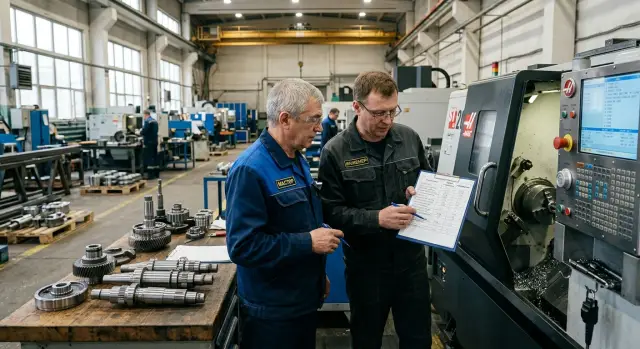
Why this choice is often judged incorrectly
The mistake usually starts with a very simple number: how much one operation costs per part. On paper, a contractor can look cheaper than your own department. But outsourcing metalworking operations rarely comes down to a single line in a price list.
The unit price tells you almost nothing without the lead time, queue, and flow of the batch. If parts have to be sent out for heat treatment, then wait for a contractor’s opening, then come back and move through the route again, the shop loses days. In that time, work-in-progress grows, assembly slips, and the next operations sit idle.
People also often forget the small expenses that add up quickly:
- packaging and round-trip transport
- incoming and repeated inspection after the batch comes back
- downtime on your own department while waiting for parts
- re-runs if the contractor misses the deadline or returns defective parts
There is another common mistake. Production looks at one operation in isolation, even though the part lives through the whole route. If a shaft warps after outside heat treatment, grinding will take longer or the part will be scrapped. If gear cutting by a contractor produces an error, the problem will show up not in that operation, but later, when machine time, tools, and inspector labor have already been spent.
That is why the result can look strange: the operation seems cheap, but the part ends up expensive. This is especially common for batches where repeatability and a short cycle matter. For gear shafts, the difference can be swallowed not by the contractor’s price, but by one extra transport run and two days of waiting.
A proper calculation looks not at the cost of a step, but at the full price of a good part by the end of the route. If you calculate it that way, some “profitable” outside operations no longer look profitable.
What data to gather before calculating
You cannot work from memory. If the number is not in a table, it is usually replaced by a guess, and then outsourcing metalworking operations seems either too expensive or unexpectedly profitable.
Start by fixing the batch size and how often it repeats. For a one-off batch, expensive fixtures and long setup often do not pay off. For a weekly repeat, the picture changes: even a small gain per part makes a noticeable difference over a month.
Then break down your own operation by time. You need not vague wording, but three numbers: how long setup takes, how long one part takes, and how many hours the department is actually available by shift. If the machine is only free at night or between urgent jobs, that is already part of the cost and part of the lead-time risk.
The contractor’s cost should also include more than the unit price. Add everything that happens around the operation:
- packaging before shipment;
- transport both ways;
- receiving the batch after return;
- incoming inspection and sorting;
- downtime of your assembly or next operation while waiting for parts.
Also count losses separately. Every route has defects, rework, and scrap. If some parts go to rework after heat treatment or grinding, you need to know who pays for the repeat work, who covers transport, and how many blanks must be kept in reserve.
Translate the deadline into numbers too. Do not write “needs to be fast.” Write: the customer expects shipment in 12 days, assembly starts on Wednesday, and there are 2 days of buffer. Then it becomes clear where the route will meet the schedule and where one delay at receiving will break the whole plan.
Usually one working table is enough. It should show, for each operation, volume, repeat rate, time, load, losses, logistics, and the hard deadline. After that, the comparison becomes sober, not based on guesswork.
How to compare your own department and a contractor
The mistake is usually simple: the shop compares the price of one operation, not the whole path of the part. If a blank is sent out for heat treatment, then comes back for grinding, and only after that goes to inspection, you need to calculate the entire loop.
First, break the route into separate steps. Not only cutting, heating, or grinding, but also the inspection points between them. If after an operation you check hardness, runout, or size, that is part of the route too. Without this, the calculation almost always comes out too pretty.
For each operation, write down the direct costs:
- machine or furnace time
- operator labor
- tools, fixtures, and consumables
- defect and rework at a level that is normal for you
- energy, if it noticeably affects the price
Then add what is often forgotten. For a contractor, that means packaging, loading, delivery, receiving, waiting in the queue, and downtime of the next department if the batch does not return on time. For your own department, it means changeover, internal movement, an inspector’s time, and losses from underused equipment during pauses.
Then compare not in the abstract, but on the same batch. Same drawing, same material, same volume, same tolerances, same level of inspection. If you calculate your own department on 500 parts and the contractor on 50, the result will be false.
It helps to put both options on one sheet: “do it in-house” and “outsource it.” Look not only at the unit cost, but also at the total lead time. Sometimes the contractor charges more per part, but frees up a bottleneck and you ship the order two days earlier. Sometimes it is the opposite: the price is lower, but the route stretches because of logistics and waiting.
For a decision on outsourcing metalworking operations, that is usually enough to remove the most common mistakes. If one option shifts the deadline for the whole order, that is what should drive the choice, not just the price of one operation.
What decides the heat treatment question
Heat treatment is rarely chosen based only on a rate per kilogram or per cycle. Usually two things decide everything: whether your part flow is steady, and how much hardness and geometry change after quenching.
If batches come in bursts, your own department often burns money for nothing. Today there is load, then the furnace sits idle for a week, while people and maintenance costs do not disappear. In that setup, a contractor is usually more efficient, especially when the batch does not repeat and the settings have to be tuned almost from scratch.
Your own heat treatment makes sense in another case. If hardness and distortion often disrupt the route, an outside contractor starts slowing down the whole shop. The part comes back harder than expected, size drifts after quenching, grinding cannot remove the allowance, inspection sends the batch back for another check — and you lose not only money, but days.
Before calculating, it helps to break your costs into simple lines:
- energy consumption for the full cycle
- maintenance of the furnace, fixtures, and sensors
- heating, soaking, and cooling time
- repeated hardness check after questionable batches
- losses in the next operation because dimensions shift
The last point is often underestimated. If a shaft moves by 0.08 mm after heat treatment, the grinder has to remove more stock, works longer, and catches defects more often. On paper, heat treatment by a contractor may look cheap, but after that the whole tail of the route becomes more expensive.
There is also a simple practical sign. If the technologist and the foreman argue several times a month about hardness, structure, or distortion, it is better to keep the operation closer to home. When the batch is stable, the cycle is well known, and the part behaves predictably after the furnace, a contractor usually handles the job without extra costs.
With heat treatment, the price of the cycle matters, but more often the decision comes down to the price of the deviation after the cycle.
How to look at grinding
Grinding is often compared only by the hourly rate. That is a weak calculation. After heat treatment, the part is already expensive, and any scratch, edge chip, or dent during transport costs much more than the difference in the contractor’s rate.
If the tolerance is tight, it is usually better to keep grinding in-house. The reason is simple: the size often starts drifting after the first measurement, and the operator needs to correct it right away. When the measurement is next to the machine, the shop spends 10–20 minutes on it, not a day on shipping, waiting, and arguing over who went out of tolerance.
This is especially noticeable on parts after quenching. The first part is measured, the technologist makes an adjustment, and the second one is already closer to the middle of the tolerance band. If that cycle happens inside your department, you catch the size quickly. If grinding is with a contractor and inspection is with you, the reaction is delayed, and the batch may have to be reworked.
There is a case for outsourcing as well. If the profile is rare, the wheels and fixtures are special, and the load is low, your own department may sit idle for weeks. Then outsourcing metalworking operations works better: you pay for a finished operation, not for a machine that sits most of the month.
The usual picture looks like this:
- Your own department is better if the tolerance is tight and corrections are needed on almost every batch.
- Your own department is better if inspection must happen immediately after the first pass.
- A contractor is better if the profile is rare and the volume is unstable.
- A contractor is better if that operation runs in a steady flow, without long changeovers.
Do not forget the transport risk after heat treatment in your calculation. Add packaging, interdepartment logistics, repeated incoming inspection, and possible damage-related scrap. Even 1–2 damaged parts in a batch can quickly eat up all the savings.
Another hidden cost is corrections after the first measurement. Those must be counted separately. If the contractor charges for an extra pass, urgent program adjustment, or repeated inspection, the low unit price no longer looks low.
For grinding, the rule is simple: the faster the size drifts and the more expensive the mistake, the closer the machine, measurement, and decision-maker should be to each other.
How to look at gear cutting
Gear cutting is often calculated too roughly. People take the contractor’s price per part and place it next to their own hourly rate. That comparison breaks down from the start. In this operation, the money usually sits in setup, fixtures, inspection, and defect risk, not only in the price of one tooth or one part.
If the module is rare, the profile is non-standard, and the cutter or broach is expensive, outsourcing is usually the smarter choice. Especially when such parts come only a few times a year. The contractor spreads the fixture cost across many orders, while you keep a machine, tools, and setup staff for rare batches.
The opposite situation is also common. If one part family repeats every week, the calculation changes in your favor. The operator already knows the route, the fixture is not collecting dust on the shelf, and defects on the first parts almost disappear. For gear shafts with the same modules and fits, your own department often ends up cheaper and calmer in terms of deadlines.
Count setup separately. Do not hide it in the tooth price or the unit price. On a batch of 30 parts, setup may eat up all the savings, while on a batch of 500 it is hardly visible. That is why the same operation gives a different answer for a small batch and for a repeat series.
Another common mistake is comparing quotes without the same accuracy requirements. One contractor quotes grade 8, another grade 7. One includes deburring and runout inspection in the price, the other does not. On paper one offer is cheaper, but in fact you get a different part.
The bases must be checked before and after gear cutting. If the turning datum shifts, the teeth can be cut correctly relative to the chuck, but incorrectly relative to the bearing seat. Then the problem will show up during assembly. That is why people look not only at the tooth profile, but also at runout against the same datums the part will use later in the route.
In short: rare modules and expensive tooling are usually better outsourced. A repeat part family that runs every week is usually better kept in-house. In outsourcing metalworking operations, this is one of the most sensitive calculations, and mistakes here are costly.
Where intermediate inspection should stay
Intermediate inspection is almost always better kept inside the shop if it affects the fate of the next expensive operation. The most common mistake in outsourcing metalworking operations is to count only the inspector’s hours and forget the cost of late defects.
The first check after setup should not be sent outside. The operator and setter are still catching variation, tuning the settings, and watching how the tool behaves. If you wait for outside inspection, the shop may produce dozens of parts with the same size drift.
Then look not at habit, but at risk. If after turning the part goes to grinding, gear cutting, or another expensive stage, critical dimensions should be checked before it moves on. One missed defect before such an operation costs much more than an extra 5–10 minutes at the inspection station.
A good rule is simple: the more expensive the next step is, the closer the check should be to it. This especially applies to reference diameters, runout, concentricity, allowance, and surface positions that determine the whole next route.
It usually makes sense to outsource only rare measurements, where there is no reason to keep a separate device or specialist in-house. These may be complex reports, one-off checks on a coordinate machine, roughness confirmation on disputed parts, or non-standard customer requirements. Everything needed every day to decide “pass it on or not” is better kept in-house.
A small example. An inspector spends 8 minutes checking a batch after setup. It seems like extra workload. But if, without this check, 20 parts move to the next operation and come back as scrap, you lose not 8 minutes, but material, machine time, tools, and schedule.
Inspection points should be placed in three places:
- right after setup
- before an expensive or irreversible operation
- before shipment to a contractor and after return from the contractor
This approach usually means fewer unnecessary checks and fewer surprises in cost.
Example for a batch of gear shafts
Let’s take a batch of 120 gear shafts. Turning stays in-house: the route is familiar, setup is short, and the people and machine are already loaded for this kind of part. The debate usually starts later — with gear cutting, heat treatment, grinding, and where to place intermediate inspection.
For gear cutting, the contractor gave a tempting price: 2,700 KZT per part versus 3,050 KZT in-house. On the batch, the difference looks good, about 42,000 KZT. But the contractor added 4 days of waiting in the queue, transport both ways, and the risk of shifting the next operation. If the order is urgent, this “cheap” operation often ends up costing more than it seemed in the first line of the calculation.
Heat treatment is different. For a batch of 120 pieces, a contractor may be more efficient if you do not have your own furnace or if it runs in bursts. Here it is not only about the money per part, but also about load, energy, defects from an unstable cycle, and parts sitting idle between shifts.
For such a batch, I would more often keep grinding in-house. After heat treatment, size often shifts more than expected from the previous batch. If grinding is in your own shop, the foreman sees it the same day and can quickly adjust the allowance or the setting. When grinding is with a contractor, you find out later and lose another 2–3 days.
Intermediate inspection after the gear cutting should not be removed just to save money. One check of the profile and pitch before the furnace can save the whole batch. If the teeth are off, you catch the error before heat treatment, not after it, when the cost of scrap is completely different.
For this batch, the decision often looks like this:
- turning — in-house
- gear cutting — in-house, if your own machine is available without a queue
- heat treatment — with a contractor, if the lead time is normal and quality is stable
- grinding and intermediate inspection — in-house
On such a route, the shop usually pays a bit more for individual operations, but keeps the deadline and protects the batch better from hidden defects.
Where people most often make mistakes
Mistakes do not appear in Excel, but in the way the comparison is made. In outsourcing metalworking operations, many people look only at the unit price and miss what eats money and time between operations.
The most common trap is calculating the part without setup. For a long series, that is still tolerable. For small and medium batches, everything changes: setup, trial parts, delivery, and waiting for a contractor’s time slot can easily make a “cheap” operation more expensive than doing it yourself.
The second mistake hurts more. The shop does not include the risk of returning a batch after a hardness, geometry, or roughness nonconformance. If a part comes back after heat treatment or grinding, you do not just pay for rework. You lose the queue, shift the next step, and may miss the whole order.
People often confuse machine load with department throughput. A machine can be 85% busy, while the department is idle on measurement, fixture waiting, or bringing in blanks. The reverse also happens: one machine is free, while the whole flow stands in front of it. You need to calculate the route as a whole, not just one OEE screen or spindle hours.
Another expensive habit is keeping a rare operation in-house just “in case.” If gear cutting is needed twice a month and the machine sits idle the rest of the time, the cost quietly rises: depreciation keeps going, tools age, and the operator loses practice.
There is also the opposite mistake. The shop outsources a step that sits in the middle of the route and controls the whole deadline. On paper the contractor is cheaper. In reality, any delay breaks the schedule and the next department waits.
It is usually worth checking the calculation again if you see several signs at once:
- only the unit price was compared
- return transport and reruns were not counted
- one machine’s load was checked instead of the whole flow
- a rare operation was left without proper load
- a step was outsourced even though it shifts the whole order
If the same mistake has happened at least twice in a quarter, it is not a coincidence. It is a calculation rule that the shop needs to change.
Short checklist before deciding
Before choosing, do not look at the price of one operation, but at the whole path of the part through the shop. In outsourcing metalworking operations, the mistake usually sits in lost days, defects between steps, and idle load on your own department.
Check five questions.
- Will the operation have steady load for at least the next few months? If batches are rare and jump around in volume, your own department may sit idle more often than it works.
- How many days will the contractor’s queue, transport, receiving, and return add? On paper the operation may be cheap, but in practice the part drops out of the flow for almost a week.
- Who will catch the defect before the next expensive step? If a defect after heat treatment or grinding is found only at the end of the route, you lose not one part, but all the work already put into it.
- Do you have enough people, measuring tools, and space inside? A machine does not solve the problem by itself if there is no one to handle setup, no way to check size, and nowhere to store blanks between batches.
- What happens to the deadline if the contractor shifts the slot by just three days? For an urgent order, that is already enough to shift assembly, shipping, or the next operation.
One simple sign helps quickly rule out weak options. If an outside operation looks cheap but adds waiting and extra buffer time every time, the savings are usually only apparent.
And vice versa: if the load is stable, inspection can stay next to the machine, and the people and measuring tools are already there, your own department often gives a calmer deadline and a clearer cost. The decision should be made only after this quick check, not based on a contractor’s rate or a machine price alone.
What to do after the calculation
The calculation itself does not solve the problem yet. You need a short action plan based on facts, not on averaged numbers from old tables.
First, pull data on the last three batches of similar parts. Look not only at the operation price, but also at actual machine time, setup, defects, downtime, transport to the contractor, incoming inspection, and returns for rework. These small details are where the calculation most often breaks down.
Then take one route and calculate it in two versions: in-house and outsourced. No phrases like “it usually works out this way.” If a batch of gear shafts took 8 days, and after outside heat treatment some parts had to go for repeated inspection, put exactly that into the model.
Do not try to change the whole shop at once. It is better to start with one operation where the losses are already visible.
- Choose the operation that most often delays the schedule or creates extra defects.
- Check the calculation on one trial batch, not on the annual plan.
- Compare the result by money and by part lead time, not by the price of one operation.
- Lock in the decision for 2–3 months and watch the facts, not expectations.
If the calculation shows that some turning or milling steps are better brought back in-house, you do not have to buy “with extra margin” right away. Choose a machine that fits the new route and your product range. For such tasks, EAST CNC can help with CNC machine selection, commissioning, and service if you are rebuilding the route for in-house work.
And do not treat the decision as final. A batch of 40 parts and a series of 400 live by different economics. As soon as volume grows, the mix of parts changes, or the tolerance gets tighter, recalculate the route again. In outsourcing metalworking operations, that is normal practice, not a sign of a mistake.