
Organizing a Chip Area Without Disrupting Forklift Operations
Organizing the chip area separates forklift routes and part flow: we explain how to place containers, mark aisles and set removal schedules to avoid downtime.
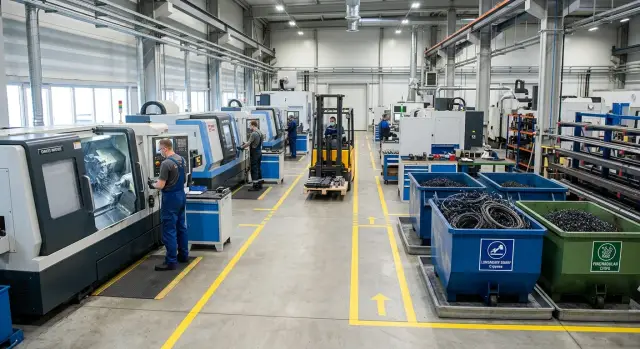
Why chips start to slow production
Chips rarely stop a cell by themselves. Output drops when chip containers occupy the same space as raw material supply, part removal, and forklift turning. Small delays then repeat many times during a shift and quietly eat up hours.
If a container stands in an aisle, the forklift can no longer travel straight. The driver brakes, reverses, goes around a cart, or waits for someone to move a pallet. At that moment raw material doesn’t reach the machine and finished parts pile up at the exit. One pause feels minor. Ten pauses in a shift already disrupt the whole pace.
The problem is more obvious with long chips. They hang over the container edge and catch on wheels, forks, and low carts. The forklift moves slower because the driver doesn’t want to wind chips onto a wheel or drag them across the floor. If the chips are heavy, a full container is harder to pick up and safely move in one go.
Operators quickly get used to inconvenient arrangements, but that only makes things worse. If the container is far away or you need to go around pallets to reach it, chips start to be piled “temporarily” next to the machine. An hour later that’s no longer a small heap but an obstacle for feet, carts, and the raw material box. On turning areas this happens all the time: several discharges are postponed and the free space by the machine disappears.
Often everything depends on a single shared aisle. The forklift and hand carts use it, pallets stand there, and people walk to the machines through it. While load is low the area tolerates this setup. When output grows, every extra maneuver turns into a queue.
Usually it looks like this: a container is placed closer to the machine to dump chips faster. It extends into the aisle by several centimeters or more. The forklift no longer picks up a pallet on the first pass, and parts and raw blanks wait until the aisle is cleared.
So the chip area affects not only cleanliness. If chips impede movement even at a single point, they slow the entire output.
Where to start measuring on the shop floor
A tape measure, chalk and a simple shop plan are more useful than guessing by eye. First you need to understand where equipment already loses time and where people get into extra traffic.
Measure aisle widths at their narrowest points, not just the nominal row width. A forklift may run straight without issues but catch a pallet or container where an upright, a machine overhang, or a pallet of finished parts narrows the passage.
On the plan mark not only meters but obstacles. Pallets by machines, raw material containers, scrap bins, finished parts at exits and temporarily placed carts usually cause the most delays.
Then check the forklift turning points with a full container. Empty containers are easy to remove. A full one changes visibility, braking distance and turning radius. If the driver has to reverse twice, the area already wastes time on every removal.
Also record how much chip each machine produces per shift. Don’t take a shop-wide average. One CNC lathe may produce heavy short chips, a neighbor may produce long spirals. Mixing those wastes effort both for removal and for loading containers.
Keep a simple log for three to five shifts if possible. Note which machine the chips came from, how many containers left, and when peaks occur. Then it becomes clear whether one removal per shift is enough or a container already overflows by midday.
Don’t group heavy, long or mixed chips together at the measurement stage. For each type note volume, weight and temporary accumulation spots. Long chips catch on container edges and block dumping faster. Heavy chips reach the weight limit even when the container looks only half full.
If the area is busy, walk the forklift route on foot carrying the container footprint. This simple check shows immediately where the floor must stay clear and where a container can remain until the end of the shift. After that the layout is based on facts, not guesses.
How to separate movements without extra crossings
When the forklift travels the same path as raw material supply, the area quickly trips over itself. The driver waits for a container, the storeman waits for an aisle, and the container stands where it’s inconvenient for everyone. For heavy and long chips this is especially bad: they can’t be cleaned by hand and can’t be removed in a minute.
Normal operation starts with a simple rule: chip removal needs its own route. The forklift should enter, pick up the full container and leave along a dedicated line, without crossing the metal supply to the machines. If you can’t do this for the whole shop, at least separate the final stretch near the machine and the accumulation point.
Do not place containers on the raw material path even if it’s “convenient for now.” Temporary solutions quickly become permanent. As a result any supply of bar, forging or part stacks goes through a bottleneck, and one extra maneuver delays two operations at once.
A poor layout is one where the forklift picks up chips then reverses to turn around. Backing up wastes time and increases risk. Better to leave a turning spot where it can turn without reversing and approach the container at a clear angle.
Mark not just the route on the floor but also parking and waiting boundaries. Then the driver won’t leave equipment “for a minute” by the machine and containers won’t end up in the aisle. Simple markings often remove more confusion than a full rearrangement of containers.
In practice a few rules are enough: chip removal follows its own aisle, containers stand away from raw material supply, the forklift has room to turn without reversing, and short cut-throughs across the working area are closed.
People often underestimate that last point. If a short cut across the cell is left open, everyone will use it because it’s faster for one trip. After a week that “shortcut” starts to cut into the main flow and the scheme stops working.
If chips are heavy and come out in long ribbons, it’s better to make the route slightly longer but freer. Five extra meters of travel cost less than a stopped machine because an aisle is blocked.
Where to place containers for heavy and long chips
A full container of heavy chips is best placed closer to the exit of the cell. The reason is simple: the shorter the distance to the removal point, the less the forklift drives past machines and people. If the container is deep inside, each change takes extra minutes and more often blocks the aisle.
For long chips choose the spot not only by route but by container shape. Long chips need containers with extra length so coils and strips don’t hang out. When chips hang over the edge the forklift catches them with forks or wheels and the operator then has to remove the protruding pieces by hand.
There must be a clear approach from the machine side. The operator needs a straight, short path to dump chips with a hook, shovel or cart without extra turns. If you have to walk around a pallet, column or someone else’s container between the machine and the bin, chips quickly start to accumulate on the floor.
Leave some free space around the container for cleaning. The floor near the chip area rarely stays dry: fine particles, oil and coolant collect there. If you press the container against the floor or wall, cleaners can’t reach under it and the dirt stays for weeks.
Also avoid pressing the container to a wall. The forklift needs an angle to insert forks and space for slight alignment. When a bin is too close to a wall the driver makes extra maneuvers, occupies the aisle longer and more often bangs the container edge.
A simple scheme works well on a typical turning area: place heavy-chip containers nearer the exit and main forklift route, and long-chip containers where the operator approaches straight from the machine. Leave gaps between container, wall and neighboring bins for forks and cleaning. One more rule: don’t put a container where the forklift must reverse into the working aisle.
This approach noticeably improves performance even on small CNC cells. Sometimes moving a container just 2–3 meters removes an extra turn, frees the aisle and makes removal smoother.
How to restructure the area step by step
A sudden rearrangement rarely helps. It’s better to change the area step by step and immediately observe the result during a real shift. Otherwise it may look good on paper but create a new bottleneck at the machine.
First record what you have now. Take a simple shop plan or use chalk on the floor: mark the forklift route from entry to container, turning point, waiting spot and exit. Separately note where long chips lie, where heavy ones accumulate and where the driver brakes or reverses. These places usually turn out to be the main obstacles.
Then clear the aisle. Remove everything not involved in chip removal: empty pallets, spare containers, carts, spare tooling and temporary boxes. On many floors this alone allows the forklift to pass without extra maneuvers.
After that change one element, not the whole scheme. Often moving a single container 0.5–1.5 meters lets the driver approach it directly without a second pass. This is especially noticeable where heavy or long chips fill a bin faster: any extra turn instantly costs time.
Measure by a full cycle over a shift, not by eye. Time the approach to the container, how long loading or replacement takes, the exit from the area, how often the driver stops or reverses, and whether the maneuver interferes with machine work.
Even a small shift can make a difference. If a container sat beside a turning machine and the forklift corrected position twice, moving it closer to a straight corridor can cut the time for one removal by several minutes. Over a shift that becomes noticeable.
If the trial works, fix the layout immediately. Paint floor markings, label the full and empty container locations, and mark the aisle boundary. For a shift a short rule is usually enough: full containers stay only in the marked zone, empty ones in the waiting area, and the aisle is never occupied even briefly.
Example for a cell with two lathes
On a cell with two lathes the problem often looks simple: everything runs smoothly in the morning, but by mid-shift the forklift already interferes with people and output. One machine may produce short heavy chips while the other gives long spirals. Later batches swap and the load on the chip area shifts.
The worst choice is to place the long-chip bin between the machines. Its volume grows quickly, it catches on cart wheels and narrows the aisle. If the forklift also needs to enter there, operators start waiting for it to clear the passage.
A practical scheme is simpler. Give each machine a small bin that lasts roughly half a shift. The operator drops chips there without calling the forklift every hour and without blocking material supply. Put a large bin for long chips at the row end where it doesn’t obstruct machine doors or pedestrian paths.
For short heavy chips place a second container closer to the main removal route but not directly at the machines. This keeps the cell tidy and lets the driver pick up both bins in one loop without extra reverse maneuvers.
During a shift this can work like this:
- in the morning the forklift brings bar stock and then avoids entering the machine zone unless necessary;
- in the first half of the day chips collect in small bins by each machine;
- after lunch the driver picks up the large long-chip bin and the heavy-chip bin in one pass.
This order reduces crossings. The forklift doesn’t fight for the same corridor with an operator carrying tools or changing blanks. People move one way, equipment another.
For output the goal is not a perfect paper layout but that the area quickly receives material in the morning and calmly disposes of waste during the day without stops. For two lathes this is usually enough: small bins at machines, a large one at the row end and one removal trip in the second half of the shift.
Common mistakes
On CNC turning cells issues rarely start with the chips themselves. Layout is usually to blame. Mistakes seem small at first but then the forklift waits for an aisle, the operator waits for removal, and output drops.
The most common mistake is placing one large container where two smaller ones would work better. On paper one bin looks simpler: fewer containers, fewer removal points. In practice it’s harder to pick up, harder to turn and awkward to bypass when nearly full. Two bins often work better: one receives chips now, the other stays as a reserve or for a different chip type.
Another error is focusing only on volume and ignoring chip shape. Long spirals occupy space irregularly, catch on edges and quickly block loading. Heavy wet chips create another problem: the container may not look full but it reaches weight limits. If you count only cubic meters the removal schedule almost always breaks.
A shared aisle carrying both finished parts and waste rarely works. In that scheme the forklift inevitably interferes with production. One removal can stop raw material supply, part removal or access to the machine. This is one of the costliest mistakes because it creates extra crossings all day.
People also schedule removals strictly by the clock and leave no reserve after setup. Right after setup, tool changes or first runs the chip flow can change sharply: it may increase, get longer, and fill the bin faster. Without a buffer the aisle clogs well before the next scheduled trip.
One other stubborn mistake is checking the route in too-convenient conditions: dry floor, empty container, free turning. That’s rarely how it is in real work. With coolant on the floor and a full bin of heavy long chips the forklift behaves differently: it brakes longer, turns worse and the driver finds it harder to keep distance.
A good plan is tested not in average conditions but in the worst ones. That’s where weaknesses appear.
Quick check before start-up
If the forklift makes an extra turn next to a machine the area isn’t ready. Before launch walk the route on foot, then run a forklift through it with a typical load. This shows quickly where it catches an angle, slows down or waits for someone to clear the aisle.
This check usually takes 10–15 minutes. It’s not for reports but to prevent the shift from losing time on day one.
Check five things:
- the forklift travels its route without reversing in narrow spots or going around containers;
- the operator reaches the container quickly and doesn’t cross the finished parts flow;
- the container doesn’t block a machine door, electrical panel, tool cabinet or service area;
- there is room around the bin for a broom, shovel and cleaning cart;
- everyone on shift knows when chips are picked up and where the empty container should stand.
Watch actual human movements, not just the diagram. An operator with a full shovel moves differently than through an empty aisle. A forklift with a container full of heavy long chips also behaves differently: wider turn radius, poorer visibility and longer braking distance.
What is obvious immediately
If the container is only convenient on paper this becomes clear quickly. A cabinet door won’t open fully, cleaning gathers debris around edges, and operators start cutting across the parts route. After a few shifts this turns into delays.
On a CNC lathe cell it helps to run one full trial cycle: chip dumping, placing an empty bin, operator walking to the machine, forklift returning along its route. If any step requires a “please move” gesture, fix the scheme right away.
Before start-up do a few simple things: mark the empty-container waiting spot on the floor, give the shift a concrete pickup time instead of “when full”, assign someone to call the forklift and confirm the aisle is clear, and remove everything temporarily placed nearby—pallets, boxes, spare tools.
A good layout looks boring, and that’s fine. People move predictably, the forklift doesn’t fight the aisle, and chips leave without stopping production.
What to do next
One week of observation usually gives more value than a long argument over the layout. If you’ve already defined containers, aisles and turning points, you now need a simple check during real work.
Start a short log for each forklift trip and each delay. Write the departure time, where the chips were picked up, how long the trip took, where you waited and why. Note separately when long or heavy chips blocked access, prevented dumping or made turning difficult. After 5–7 shifts the picture usually becomes clear.
Look at four things: how many trips per shift each container needs, where the forklift loses minutes reversing or waiting, at what fill level the bin starts to obstruct the aisle, and which hours the removal load most pressures production.
Don’t treat the first layout as final. After the first full loading check whether the route stayed free. If the forklift still catches an angle, waits by a machine or makes an extra loop, move the bin 30–50 cm, change its facing or remove one obstacle from the aisle. Small shifts often solve the problem faster than buying new containers.
Discuss chip collection and removal before rearranging the area or buying a new machine. Otherwise the machine might be placed where electrical or foundation conditions are convenient rather than where people, containers and forklifts move. Fixing that later is more expensive: moving containers, changing pickup schedules and accepting extra stops.
If the cell uses CNC lathes, raise this question early with the equipment supplier. EAST CNC, эксклюзивный официальный представитель Taizhou Eastern CNC Technology Co., Ltd. в Казахстане, handles selection, supply, commissioning and service, so the chip area can be considered before the cell goes live. That is usually easier than fixing a cramped layout after commissioning.
Good chip area organization doesn’t look complicated on paper. On the shop floor it depends on details: one extra trip, one awkward turn, one overflowing bin. Remove those obstacles and production runs smoother.