
One Turret or Two: How Production and Setup Change
One turret or two: we analyze how a second turret affects batch output, operation balance, downtime and setup time on a lathe.
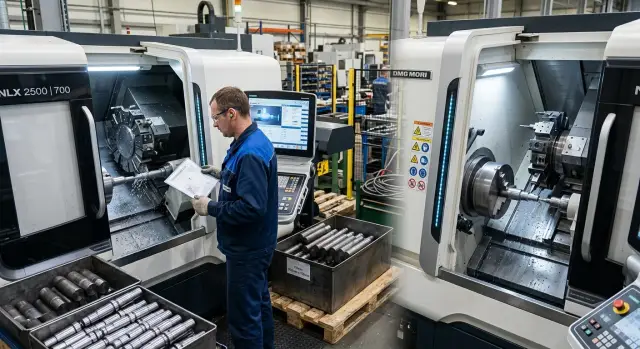
What the choice is about
The question “one turret or two” rarely comes down to which machine is objectively “better.” It’s usually about how your shift is organized, how many parts you need to produce, how often the product mix changes, and how long setups take.
A single-turret layout is a simpler scheme. Such a machine is easier to set up, check and start. If parts change frequently, batches are small and orders are mixed, that simplicity often brings more value than an extra speed figure on the spec sheet.
A two-turret machine works differently. It shortens the cycle where operations can be split between two stations and run in parallel. This is especially noticeable in stable series manufacturing when output is limited by machining time rather than by setup, measurement or tool change waits.
The trade-off between speed and flexibility usually looks like this: two turrets often win on repeating series; one turret wins in mixed production where today you turn a bushing, tomorrow a shaft, and the next day a small repair part.
The strongest influences on the choice are part shape and length, batch size, setup frequency and how operations are distributed in time. If a part is simple and most of the cycle is taken by one or two operations, the second turret may barely be used. Then you pay for a capability you rarely use.
If the part is more complex and the route can be split into two parts, the picture changes. In series machining of short shafts or housing blanks one turret can cut metal while the other prepares the next step. In that case the machine idles less and output rises without extra operator fuss.
A common mistake is to look only at maximum productivity. In practice the benefit is calculated differently. If a second turret truly shortens the cycle and does not make setup a separate headache, the extra cost can pay off. If it sits idle half the shift, it’s wiser to buy a simpler machine and invest in tooling, fixtures and service.
How a second turret affects batch output
A second turret changes not only the machine layout but the rhythm of work itself. Some operations no longer run strictly in sequence but at the same time. While one tool turns the OD, the other can drill, face, or chamfer the other side if the route allows.
Because of this, part cycle times often shrink by tens of seconds rather than just a few. The clearest gains appear where the program has many short transitions: facing, drilling, boring, grooving, cut-off. On a single-turret machine the spindle waits while each operation takes its turn. With two turrets some of these pauses disappear.
Where output grows faster
The biggest improvements usually come for parts that require two-sided machining or a mix of external and internal operations. In such cases the second turret helps combine roughing and part of finishing, link main spindle and counter-spindle work more tightly, and reduce waiting between tool changes.
This directly affects batch output on a lathe. The spindle produces only when it’s cutting metal. When it waits for a tool change, turret indexing, or part transfer, output drops. With two turrets the spindle’s load is generally higher because less time is lost to sequential completion of short operations.
On small batches the effect may not be dramatic. If you need 20–30 parts with complex setup and synchronization, cycle savings may not offset the extra preparation. There is a gain, but it is often modest.
On medium and long runs the difference becomes obvious quickly. Suppose one part takes 3 minutes 40 seconds on a single turret and 2 minutes 50 seconds on two turrets. A 50-second saving seems small, but over a 500-piece batch it’s almost 7 hours of pure machine time.
There is a limit. If the part is simple and the cycle is dominated by a single long turning pass with one tool, the second turret changes little. It pays off where operations can run in parallel without extra stops or tool conflicts for the same zone of the part.
How operation balance changes
In the “one turret or two” debate it’s often not the number of tool positions but the balance of time that decides. If operations are unevenly distributed, a second turret won’t give the theoretical gain — it will just wait.
The most common imbalance is between roughing and finishing. Roughing removes a large allowance and runs longer. Finishing is usually shorter: one precise pass, sometimes a groove or thread. When these blocks differ greatly, the batch rhythm is disturbed.
Where waiting appears
On a single-turret machine this imbalance is hidden inside the cycle. Tools run in sequence and the entire part follows the pace of the longest operation. If the roughing pass is 70 seconds and everything else is 25 seconds, the cycle still obeys those 70 seconds.
On a two-turret lathe the imbalance becomes visible. The first turret may be occupied with roughing while the second finishes its part in 20–30 seconds and then idles. It looks like two stations are working, but the rhythm is still set by the longest operation.
That’s how a bottleneck appears. Other actions are ready but the part can’t be handed on. Parallel work exists, but its effect is much smaller than expected.
How to even out the load
Usually the fix is not a general rule but a second-by-second breakdown of the route. Look at the real duration of each operation, not just the type. Sometimes moving drilling, grooving or a semi-finishing pass to the less-loaded turret is enough. Sometimes a long processing zone needs to be split into two more even blocks.
If the first turret does rough turning for 65 seconds and the second only handles facing and finishing for 18, parallelism barely works. But if you add drilling, a groove and another pass to the second turret, you might get 40 and 43 seconds. Such a cycle usually produces steadier batch output and less idle time.
The point isn’t to load both turrets to 100 percent. The point is to make their times close. When the difference is small the machine runs smoother, the setter keeps a stable cycle easier, and the batch moves without long pauses.
What happens to setup time
People often focus on part cycle time and forget setup — but setups matter just as much. If the machine cuts faster but needs extra hours of preparation, the benefit disappears quickly.
For simple parts the difference in setup time is usually small. If you turn a bushing or shaft with a couple of diameters, a groove and a thread, one turret often needs 4–6 tool positions. The setter fits a cutter, drill, grooving and threading tools, checks offsets and runs a trial part. The scheme is straightforward and issues are easy to find.
For complex parts things get heavier. One turret may need 8–12 positions. Two turrets often require 10–14 positions in total because some operations are duplicated or distributed between stations. With more tools comes more adjustments, checks and places where the order can be mixed up.
A second turret does not speed up setup by itself. On the contrary, it adds synchronization. You must verify how both turrets approach the part, whether they interfere, when each tool comes in, and what safe clearance remains. So on a two-turret machine the setter spends more time not only installing tools but also checking the program.
The risk of error also grows in common places. You can mix up an offset, put a tool in the wrong position, set an incorrect projection or shift an operation in time. Then the turrets may contend for the same machining zone. These mistakes happen on simple machines too, but they are fewer and easier to find.
If a batch is small and the part is simple, the extra complexity rarely pays off. Suppose you reconfigure the machine several times a week and run short series. Then saving 10–15 seconds per part may not cover the extra 40–90 minutes of setup and verification.
Two turrets make sense in another situation: the batch repeats regularly, one turret is heavily loaded by the part, the cycle is long, and the team knows how to check synchronization and keep setups steady. Then longer preparation pays back in volume.
When one turret is enough
One turret often meets the need without noticeable loss if the part is simple and the cycle short. In such jobs the second turret rarely reveals its advantage: it barely increases output but almost always complicates setup and program checks.
This is the case for bushings, rings, simple fittings and other parts with few transitions and clear geometry. If the machine spends most of its time on one long pass, boring or cut-off, there’s little to parallelize. A second turret will wait for the longest operation to finish.
For small batches a single turret is also often more convenient. Today you run 30 pieces of one part, tomorrow 20 of another, then a small rush job. The more frequently the assortment changes, the more you feel the cost of extra setup: more tools to mount, more offsets to check and more vigilance for potential collisions.
A simple sign: the turret is rarely fully filled. If a part typically needs 5–7 positions and the rest stay empty, a second turret won’t solve the real problem. First fully use what you have: optimize toolholders, reduce unnecessary changes and lay out operations in a clear sequence.
Choose one turret when the cycle is short and without a long chain of transitions, batches are small, setups are frequent, and one operation is significantly longer than the rest and sets the whole pace. For a small shop this is often the most reasonable option. The operator starts a part faster, the programmer gets the program tuned more easily, and the shop manager can count real machine loading more simply.
Practically speaking: one turret is good where it’s more important to switch quickly to the next part than to shave a few seconds from an already short cycle.
When two turrets are justified
A second turret is not needed in every shop. But there are tasks where it gives not just convenience but a clear increase in output.
The first obvious case is a part with many transitions in a single setup. If one turret must sequentially do facing, drilling, boring, threading and finishing, the machine loses time on position changes and waiting for each step to end. Two turrets remove part of this queue: one handles external operations while the other works on internal features or a neighboring section of the part.
This is especially visible in repeating batches. When a shop runs the same nomenclature for months, gains of a few seconds per part turn into hours quickly. For automotive, construction equipment or medical component series this approach often pays off.
Another scenario is when you need to compress the cycle without expanding the machine park. If space is tight, staff are limited and output must increase, a two-turret lathe can provide the needed margin. It doesn’t work miracles alone, but it removes small idle times between operations that on a single turret look insignificant.
A second turret also performs well where you can machine two zones of the part with almost no mutual waiting. While one station works one side, the other takes the opposite side or prepares the next stage. This tightens the cycle and evens out machine loading.
Usually two turrets are justified when several conditions coincide: the part is complex, the batch repeats for a long time without frequent retooling, the single-turret cycle has reached its practical time limit, and operations can be split between turrets without interference. Without these conditions the benefit diminishes quickly.
How to decide step by step
It’s better to decide based on your part, not a catalogue. If you don’t have a list of operations with times, the “one turret or two” debate quickly becomes guesswork.
Start by breaking processing into real actions: facing, rough turning, finish pass, drilling, boring, threading, cut-off and inspection stops. Even a simple part often hides 2–3 places where the machine waits for a tool or the second side.
Then follow these steps:
- Map the route for the part.
- Time each transition separately.
- Note where the spindle, turret or operator waits.
- Compare cycle, setup and shift output for both layouts.
- Calculate payback using your batch, not “ideal” percentages.
Measure by single parts, not by eye. If roughing is 18 seconds and drilling 11, that’s already a basis for a calculation. When you only see total cycle time it’s easy to miss where a second turret helps and where it only adds complexity.
After measurements look for idle time. Often the issue is not the longest operation but waiting between transitions, tool changes and part hand-offs. On a two-turret machine some actions can run in parallel, but only if operations do not interfere and the setter can repeat the setup reliably.
Then compute shift output. Suppose one turret yields a 92-second cycle and two turrets 70 seconds. On paper that looks great. But if setup with two turrets increases from 1.5 to 3 hours, the gain on small batches may vanish.
Calculate payback conservatively. Use your average order, your retool frequency and your real downtimes. If a machine costs more but saves 20–25 seconds per part on a 300-piece batch once a month, that may not be enough. If the same part runs every shift, the math changes.
A simple example for a real batch
Take a typical task: a batch of 500 identical steel shafts. The part needs OD turning, face undercut, a groove and axial drilling. This is normal series work where the difference between one and two turrets shows up in shift hours, not in marketing numbers.
On a single-turret machine everything runs in sequence: turn the OD, index the turret, then drill and groove. On a two-turret lathe some steps can run simultaneously: one turret machines the outside while the other performs axial work. The part is the same but pauses between transitions are fewer.
Example numbers:
- single turret: cycle 3 min 40 s per part, initial setup 1 h 20 min;
- two turrets: cycle 2 min 35 s per part, initial setup 2 h 5 min;
- batch: 500 shafts;
- shift: 8 hours.
Now compute the batch. On a single turret 500 parts take about 31 hours 54 minutes including the first setup. On two turrets the same batch takes about 23 hours 37 minutes. The difference is over 8 hours — almost a full shift.
First-shift output is also clear. Counting from zero, after setup a single-turret machine will produce about 109 parts; a two-turret machine about 137. On paper that’s +28 parts per day. For a long series the difference is significant.
But the flip side: initial setup on a two-turret machine is longer. The operator must fit more tools, verify synchronization and calmly run the first part. If the shop runs long series, this pays off. If the batch is small and setups occur every few days, the extra 40–50 minutes at the start eat into the benefit.
The conclusion is simple. For series work two turrets usually yield more parts per shift and finish batches faster. For a shop with frequent part changes one turret is often more convenient: it loses on cycle but wins on calmer and shorter setup.
Mistakes when choosing a machine
Most often people choose a machine by catalogue numbers. They look at max rpm, power and rapid travel and then expect the same in the shop. But batch output depends on more than rated speed. If a part needs frequent tool changes, approach from different sides and a precise operation order, raw numbers quickly lose meaning.
Another common mistake is not breaking processing into steps before purchase. For one part two turrets will indeed shorten the cycle. For another they change almost nothing because the bottleneck is clamping, measuring or waiting for the next operation, not cutting. Without route analysis it’s easy to overpay for a machine that doesn’t add value.
Shops often miss on short batches. When an order is small and the mix changes often, time is spent on preparation, not the cycle. You must mount tools, verify the program and measure the first part. In this work a two-turret lathe often does not pay off.
Another practical error is expecting people to adapt quickly after delivery. Two turrets offer more options, but also more places for mistakes: in trajectories, synchronization and tool sequence. If setters and operators only used simpler schemes before, plan training and first-run support.
Also clarify who is responsible for commissioning and service. This matters when the machine is bought for a specific batch and downtime is costly. If you don’t know in advance who will do start-up, who helps with the first parts and how quickly issues are resolved, you can lose more time than you gain on cycle.
What to check before the next step
Decide “one turret or two” based on your numbers. The same machine may be great for a 50-piece series and redundant for rare 8–10 piece jobs.
First, collect facts about current and recurring batches. If a part returns every month, even a small cycle saving becomes a noticeable output increase. If a batch is rare and the mix changes each time, extra complexity will likely only add headaches.
Before proceeding check five things:
- the real batch sizes you actually repeat, not what’s on paper;
- how long each operation takes: turning, drilling, threading, grooving, cut-off;
- how many tools are needed per part with allowance for wear and replacement;
- who will do commissioning, start-up and ongoing service;
- which models to compare specifically for your drawings.
Don’t rely only on the rated cycle. It’s more useful to time real part activities: approach, cutting, tool change, and first-piece check. Often the decision changes after such a calculation. If one long operation lasts 45 seconds and the rest fit into 8–12, a second turret may not solve the problem — the bottleneck remains.
Also count tools. For a simple part one turret often suffices. For a part with many diameters, holes, threads and grooves spaces may already be tight. Then the operator must swap tools more often, affecting setup time and error risk.
Clarify service before purchase. Who will come for commissioning, how long will it take to put the machine into operation, is there help tuning it to your part — these questions save days or weeks.
If you have a drawing, material and typical batch size, the discussion with a supplier becomes concrete. EAST CNC can help choose a CNC lathe for your parts, machining type and loading plan. Such a conversation usually narrows the choice to a few realistic configurations instead of a long “just in case” list.
FAQ
When does a second turret actually increase output?
A second turret helps when operations can run in parallel. This is typical for series parts that require both external and internal machining, drilling, grooves, facing and work on both sides. If a single-turret machine loses time waiting between steps, a second turret can noticeably shorten the cycle.
In which cases is one turret sufficient?
One turret is often enough for simple parts, short cycles and frequent job changes. It starts faster, is easier to check and usually takes less time to set up. For a small shop with mixed part types this is often the calmer option.
How much can two turrets reduce a part cycle?
Sometimes the difference is large. If the cycle shortens by 40–60 seconds, on batches of several hundred pieces you quickly gain hours of pure machining time. Still, you should calculate based on your own part, not average figures.
Why don't two turrets give double the output?
Because the overall rhythm is still set by the longest operation. If one turret is busy for 65 seconds and the other finishes in 20, the second just waits. Two turrets help only when the route can be split roughly evenly by time.
Which is more important when choosing: cycle time or setup time?
For short runs, setup often matters more. If a second turret saves 10–15 seconds per part but adds almost an hour for tool setup, synchronization and program checks, the advantage disappears. For long series the situation usually reverses.
Does it make sense to have two turrets for small batches?
Usually not, if parts are simple and batches are small. Frequent retooling erodes much of the benefit of a shorter cycle. For recurring orders the answer may be different.
How to tell if a part is well-suited to two turrets?
Break the process into steps and measure each operation. Look for operations that do not interfere with each other and can run at the same time. If you see two groups of actions with similar durations, a two-turret layout looks reasonable.
What mistakes are common when choosing between one and two turrets?
People often focus only on catalogue numbers and forget real shop work. Another mistake is not timing setups, first-piece checks and tool counts. That leads to buying a complex machine that doesn’t deliver in practice.
What should I prepare before talking with a supplier?
Prepare the part drawing, material, batch size, list of operations and approximate times per step. It helps to know how many tools are needed and how often you change the assortment. With this information the discussion becomes practical and model comparison is easier.
Do you need a more experienced setter for a two-turret machine?
Yes. A more experienced setter is usually needed. They must not only fit tools but also check synchronization, safe clearances and the order of the two units. If the team only used simpler machines before, plan time for training and the first starts.
How to test whether two turrets are worth it for my production?
Measure each transition separately, note where the spindle, turret or operator waits, and compare cycle, setup and shift output for both layouts. Use your real batch sizes and realistic downtime assumptions rather than ideal figures.