
On-machine probe: when it's needed and when it's not
An on-machine probe is not always necessary. We explain where it saves time, improves dimensional stability and justifies the investment.
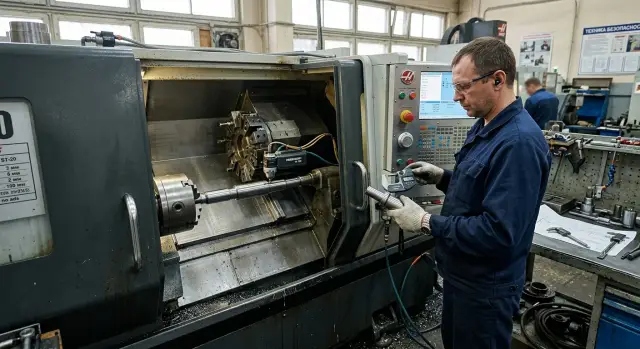
Why inspection starts to slow work
The problem often begins in a place you don't expect. The cutting itself can be fast and stable, but the operator increasingly stops the cycle for yet another measurement. While the spindle is stopped, chips are cleaned, the part is wiped, the tool is taken and the size checked — more time passes than it seems.
Those pauses hardly show up in reports. There is machine time, parts out and major downtime. Minutes between cycles are usually lost. If a single measurement takes 2–3 minutes, over batches of 20–30 parts that becomes a noticeable portion of a shift.
Manual part inspection particularly slows work where the size is checked not once but after each important operation. On paper it looks logical: better measure one more time than produce scrap. In practice the machine waits for the person, and the person constantly switches between machining and checking.
There is another issue — every operator has their own approach. One measures right after cutting while the part is still warm. Another waits longer. A third presses the micrometer harder or measures at a different point. Formally the check is the same, but repeatability of decisions differs.
So the shop's discussion is not usually about accuracy in general. The real question is how much inspection eats into time and whether you can keep results stable across a shift. When a size drifts, scrap is often discovered not on the first part but later, after several cycles when tool wear or temperature has accumulated.
This is where the question of an on-machine probe comes in. Not because manual checking is inherently bad — it simply falls behind when pace, a unified approach and early detection of drift matter.
This is most noticeable in series production and on parts with several critical dimensions. The more control points, the greater the chance that in-machine measurement is not just an option but a way to return time to the shop and make output more consistent.
Where time is lost with manual inspection
Manual inspection seldom seems slow if you only look at the measurement itself. Losses begin around it. The operator stops the machine, moves the tool to a safe position, opens the work area and only then approaches with a micrometer or caliper. Each time it’s a little, but over a shift it adds up to tens of minutes.
Another hidden loss is preparing the part for measurement. Chips must be removed, coolant wiped off, and the measuring tool checked for cleanliness. Otherwise the operator measures a film of fluid or tiny chips on the surface instead of the metal. If the part has just come out of cutting, sometimes you also need to wait so the size doesn’t “wander” due to temperature.
Most time is usually spent on the first part after setup. One dimension rarely suffices. Several diameters, length, depth, runout and hole position must be checked. Nearly every parameter is measured separately. If access is awkward, the operator wastes extra seconds turning the part, lighting the area or re-wiping the datum.
After measurement the work does not resume instantly either. The operator returns to the control, applies a correction, closes the area and restarts the cycle. Then they wait for results and check the size again. If the deviation remains, the loop repeats. Even a simple adjustment easily takes 5–10 minutes; complex parts take more.
Losses are especially noticeable where the product mix changes frequently. With small batches and constant changeovers this scenario repeats at almost every start. In the end, time is spent not on cutting but on stops, walking to the machine and repeated checks.
A simple example: a batch of 20 parts where the first part requires checking six dimensions. Stopping, cleaning, measuring and entering a correction can easily take 12–15 minutes. If there are three such starts per day, the shop loses nearly an hour just on manual inspection. That’s why a probe often pays back not on one long run but where there are many starts and each first part needs lengthy checks.
What changes for dimensional repeatability
Repeatability problems are often caused not by the machine but by the inspection method. One operator presses the micrometer harder, another measures in a different spot, a third checks the part after it has cooled. The check may look identical, but results differ.
On-machine measurement removes that variation. The probe follows the program: it approaches the same point, touches the part in the same cycle and measures at the same moment in machining. The spread between checks becomes smaller. That’s especially visible on long runs when parts run day and night.
The most noticeable effect is where a size drifts slowly rather than failing suddenly. The tool wears gradually, cutting-zone temperature changes, and diameter or length starts to “creep.” With manual checks such a shift is often noticed only at the next inspection, when several parts have already approached the tolerance limit. A probe catches the drift earlier and allows timely correction.
This is particularly useful in four cases: long runs where manual measuring is inconvenient; when the size drifts gradually instead of abruptly; in multi-shift work where each shift measures differently; and on parts sensitive to small deviations.
Manual inspection of course remains. No one cancels the first part check, selective batch inspection and final acceptance. But between those points results become more even because the machine itself tracks small dimensional drift.
On a simple turned part this becomes apparent quickly. If a diameter slowly changes by 0.01 mm over several dozen parts, a person may not notice immediately. A probe will detect it earlier. For the shop this does not mean “magical accuracy,” but a calmer run, fewer disputes between shifts and fewer parts that later require re-checking by hand.
Where a probe makes a noticeable difference
A probe helps most where an error surfaces late and is expensive. If an operator repeatedly removes parts for manual inspection, then returns them to the chuck and re-checks the datum, the shop loses not seconds but a significant amount of time.
A good example is stepped shafts with multiple diameters and faces. On such a part dimensions are interrelated. After an adjustment the datum or tool correction may shift, and the problem rarely stays in one place. A probe more quickly shows exactly where the deviation appeared and helps restore dimensional repeatability without extra trial passes.
There’s also benefit in other situations. If the part references a datum and you need to quickly confirm that the datum is maintained after an adjustment, a probe helps. If batches are small and you restart the first part frequently, manual checks start to eat too much time. For expensive blanks you want to catch an error before a full cycle finishes. And if a part is processed in several passes, late-found scrap is particularly painful.
This is most visible in small-batch work. Today one part, tomorrow another, then back to the first — in such work a probe is often needed not for maximum speed but for a calm startup. It helps confirm the first good part faster and avoids repeating the same manual checks.
On a simple bushing with one OD and one face the effect may be modest. If the cycle is short, the size is single, and the operator comfortably measures it by micrometer in a minute, the big gain from a probe may not be there. The same often applies to stable series of simple parts where the process is already tuned.
In short: a probe pays off best where there are many interdependent dimensions, frequent changeovers, costly errors and long waits for results.
How to decide if a probe is right for you
The decision usually depends on your parts and shift losses, not a catalog. If the same items repeat regularly, the operator frequently grabs measuring tools, applies corrections and still notices size drift too late, a probe almost always makes sense.
Don’t try to look at all parts at once. Better take the list of items the shop runs most often each month. Those are usually the ones that consume time. One-off jobs with simple tolerances rarely deliver quick payback; series parts do.
Next, count not just parts but how many times the operator touches them by hand. For each item note how often per shift the operator stops the machine, cleans the area, measures, records the result and enters a correction. Even if one cycle takes 3–4 minutes, the shift total becomes notable.
A simple table is enough: which part runs most often, how many checks per shift, how many minutes per manual inspection and how often the size drifts enough to require rework or scrap.
Also look separately at losses from late-detected dimensional drift. That’s often forgotten. Five minutes for a check is obvious, but two ruined blanks at the end of a batch hit finances harder. If that happens occasionally, a probe can pay back faster than expected.
Simple example: a shop turns the same bushing in two batches per shift. For each batch the operator makes 6 manual checks, each taking 4 minutes. That’s already 48 minutes per shift only on inspection, not counting rework. If once a week a delayed correction ruins 1–2 blanks, the case becomes even clearer.
Compare not with abstract benefit but with real numbers: how much you lose now and how much the option costs on one machine. Often it makes sense not to equip the whole fleet at once but to start with one machine and two or three dimensions that most often cause trouble. This approach is convenient where repeated parts are made for automotive, construction or medical equipment.
If you’re choosing a new machine, discuss the probe in terms of specific parts, tolerances and shift losses. That yields a calm, precise decision without unnecessary cost.
A simple shop example
Imagine a typical shift: one lathe runs a batch of 40 stepped shafts. The part isn’t the most complex, but there are several dimensions and at least two hold tight tolerances. On paper everything looks calm. In practice inspection starts to quietly eat time.
Without a probe the operator normally acts like this: starts the first part, stops the machine, opens the work area, removes chips and coolant, measures the size and, if needed, enters a correction. Then they repeat a few times during the batch to avoid missing tool drift.
Even if one check takes 4–5 minutes, the batch accumulates a noticeable pause. There’s the first part after setup, a check after correction, several selective checks and sometimes a repeat if a size raises doubts. In total it easily reaches 20 minutes or more. And that’s not just a number in a spreadsheet: the machine is not cutting metal during that time.
There’s a second problem. Tools rarely fail suddenly. Size usually changes quietly: first all parts are mid-tolerance, then nearer the limit, then one or two parts go out of tolerance. If the operator doesn’t check every part, they may recognize this late.
With a probe the scheme changes. After startup the machine checks chosen dimensions itself and after a correction quickly confirms that the size returned to the target. The operator doesn’t need to stop the process every time for manual checks on operations where the in-machine measurement already covers the main risk.
On a single part the difference may seem small. But on a batch of 40 shafts the effect is visible: fewer stops, steadier repeatability and a lower chance of detecting scrap only at the end of the batch.
Most common mistakes
The most expensive mistake is simple: the shop buys a probe when the root cause is actually in setup. If the chuck holds the part inconsistently, the tool is worn or the datum is poorly chosen, a probe will only honestly show the spread. It won’t fix bad clamping or remove the cause of drift by itself.
People also confuse the measurement goal. Don’t measure everything just because you can. If you run a cycle for each diameter, groove and chamfer, the machine wastes time without benefit. Usually it’s enough to measure dimensions that actually affect fit, concentricity, depth or the risk of scrap in the next operation.
Another common source of false results is a dirty contact point. Chips, a drop of coolant, buildup on a face or a burr easily give extra hundredths. After that the probe is blamed, though the issue is cleanliness. In small batches this is especially noticeable: one part measured clean, the next with chips, and it looks like the size “wanders by itself.”
Probes are also overestimated. They don’t replace acceptance tests and don’t cancel manual inspection entirely. First runs, disputed dimensions, surface finish, shape and thin walls still require conventional checks. A probe is good where quick, repeatable in-cycle control is needed, not for eliminating out-of-machine checks entirely.
There is a human factor too. If the operator doesn’t know when to trigger the measurement, what tolerance is programmed, or what a result means, the benefit will be small. One person sees a correction and applies an unnecessary shift; another ignores a warning because the part “still seems OK.” The same machine then produces different results in different shifts.
A practical approach is simple: first fix setup problems, then choose 2–4 sizes for in-machine control, keep the contact zone clean, keep manual final checks for the first part and acceptance, and train the operator to read results without guessing. Then the probe starts saving time. Otherwise it becomes an expensive option that only adds cycles and disputes at the machine.
Quick check before deciding
Don’t reduce the decision to “a probe is needed by everyone.” It pays off where inspection regularly consumes time and errors are costly. If you have a simple part and a long-stabilized process, there’s no rush.
Just look at a shift without theory. Where exactly are minutes lost? Who most often measures the size? How many times is the machine stopped just for a check? Usually the answer is visible in a single workday.
What to watch for
- The first good part after a changeover takes too long to achieve.
- The operator often interrupts the cycle to measure manually.
- Size predictably drifts with tool wear.
- The part is expensive and the cycle is long.
- There isn’t always a skilled setter on shift.
Small example: a machine makes a housing part in 18 minutes, and after every tool change the operator spends another 5–7 minutes on manual checks. Over a shift that easily becomes a lost hour, not counting the risk of discovering scrap on the third or fourth part instead of the first.
A probe is especially useful where there are many changeovers, short runs and expensive blanks. If parts are simple, the series runs stably for weeks and the operator rarely interferes, the purchase can be postponed. In that case first count the facts: how many inspection stops per shift, how long the first part takes and how often size drifts due to tool wear. If the numbers are small, manual checks will do for now.
What to do next
Don’t decide based on impressions. Take a group of parts where inspection is already eating time: for example a batch of bushings, housings or shafts with several dimensional zones. Compare the same route in two variants: how work goes now and what changes if you add in-machine measurement.
Look not only at the measured dimension. A probe often pays off where you least expected: not by saving minutes on a single check but by smoothing the shift — fewer stops, fewer needless checks and fewer readjustments after the first parts.
For comparison, simple numbers are enough: minutes to start a batch, how many times the operator stops the machine per shift for inspection, how many parts go to rework or scrap, and how steady dimensional repeatability is from first to last part.
At first keep manual final inspection. That’s safer and fairer for comparison. The probe shows how the process behaves inside the cycle, while manual checks confirm the outcome. After a few batches you’ll see where data match and where the process still needs tuning.
If a batch is small and parts are simple, the effect may be modest. If runs are long, dimensions sensitive and the operator often removes parts for checks, the difference usually shows in the first days. Pay attention to new-batch startups: that’s where extra touches, trial passes and pauses occur most often.
It’s convenient to keep a short table for two weeks. That’s enough to compare manual inspection and in-machine measurement without arguments about what “feels faster.” You only need minutes, number of stops and real scrap.
If you are choosing a new CNC lathe, discuss the probe option from the start, not after launch. At EAST CNC such decisions are usually analyzed using concrete parts, batch sizes and inspection requirements. That helps see where a probe truly brings value and where conventional inspection is sufficient.
FAQ
Is a probe needed on every lathe?
No. A probe is not necessary on every lathe. If the part is simple, with few dimensions and a short cycle, and the operator can quickly and reliably measure manually, the benefit may be small. The option usually pays off where there are many stops for inspection, frequent changeovers and tight tolerances.
When does a probe pay back fastest?
A probe pays back fastest in series and short-series work where getting the first part to size takes a long time and the batch is checked many times. If the operator stops the machine several times per shift to clean the part, measure and enter corrections, a probe typically quickly returns the lost minutes.
What does a probe give first: less scrap or a faster cycle?
Usually both. It saves time and reduces costs from late-detected scrap. The machine waits less for manual checks, and dimensions are less likely to drift unnoticed due to tool wear or heat. The biggest effect is in cases where the error appears gradually over several parts.
Can a probe completely replace manual inspection?
No — it does not fully replace manual inspection. You still need to check the first part after startup, final acceptance, disputed dimensions, threads, shape and surface finish with conventional tools. A probe covers quick, repeatable in-cycle checks, not all inspection outside the machine.
On which parts does a probe show the biggest effect?
Most visible on stepped shafts, housing parts and other items with several interrelated dimensions. After an adjustment, multiple sizes can shift at once, and a probe helps quickly identify where the deviation appeared. It’s also useful for expensive blanks where a late scrap is costly.
When does a probe give almost no benefit?
If you have a simple bushing with a single OD and one face, a short cycle and a long-established stable process, the benefit may be limited. In such cases the operator can measure with a micrometer in a minute without noticeably slowing the process. It’s better to count actual stops per shift before adding the option.
Does a probe really detect dimensional drift earlier?
Yes — that’s one of its strengths. A probe measures at the same programmed point and at the same moment in the cycle, so it detects gradual dimensional drift earlier. This is especially useful on long runs when the tool wears slowly and manual checks are not done on every part.
Why does manual inspection slow work so much?
Losses are not only the measurement itself. The operator stops the machine, moves the tool to a safe position, removes chips and coolant, wipes the part, measures, returns to the control, enters corrections and restarts the cycle. One check is small, but over a batch it adds up to tens of minutes.
What should I check before buying a probe?
First, look at the facts per shift: how often the operator stops the cycle to measure, how many minutes are spent on first-part setup, how often size drifts because of tool wear and how many blanks are lost to late correction. If the numbers are significant, a probe generally makes sense.
Where should I start implementation if a probe is needed?
Start with one machine and a few critical dimensions that most often cause delays or scrap. Don’t try to measure everything at once — that only lengthens the cycle. Compare two to three weeks of operation before and after implementation by minutes, stops and actual scrap to see the real effect.