
Oil Mist at the Machine: Extraction for Turning and Milling
Oil mist at a machine degrades air, settles on components and floors. We review extraction options for turning and milling and how they affect cleanliness and equipment life.
Why oil mist becomes a problem so quickly
Oil mist forms during cutting when the contact zone between tool and metal heats up, coolant hits hot surfaces and breaks into very fine droplets. The chuck, spindle and internal airflow instantly pick up this suspension and spread it around the work area.
The first signs appear within a few hours. A thin sticky film settles on the viewing window, door handles, buttons, sensors and cable channels. Then residue shows up on the control panel, lights, control cabinet and even on tools left nearby.
The problem rarely stays inside the machine. The operator opens the door to measure a part, change a tool or remove chips, and part of the aerosol escapes. If extraction is weak or absent, contaminated air drifts through the shop and deposits on neighboring machines, racks, containers and finished parts.
Because of this, cleaning quickly becomes a daily routine. The floor gets a thin oily layer and becomes slippery, especially at walkways and loading zones. Dust sticks to surfaces, gloves and rags get dirty almost immediately, and transparent shields cloud much faster than expected.
This is especially noticeable in a small area. One machine running a shift without proper extraction is enough for sticky residue to appear not only on the enclosure but also on a workbench several meters away by evening. That’s usually how persistent dirt begins—then it’s hard to control.
How turning and milling differ
On a lathe the cutting zone is often better enclosed. The part rotates inside a housing, and chips and coolant mostly stay near the chuck and tool. If the enclosure is sealed and the doors keep aerosol out, airflow is easier to capture at a single point.
A milling machine is more complex. The cutter cuts from different sides, the table moves, and coolant jets hit the tool at varying angles. So the mist tends to scatter more widely, especially if the work area is opened often or doors are left ajar.
Spindle speed and coolant feed have the biggest effect on mist density. The higher the speed and the more aggressive the cooling, the more the fluid breaks into fine aerosol. On a lathe this is obvious during high-speed finishing cuts. On a mill it happens with small tools and intense coolant feed.
Machine layout also changes airflow. In vertical centers mist and small droplets often rise with warm air and then settle on doors, lights and cable channels. In horizontal machines the flow often moves sideways, mixes with chips and stays longer inside the chamber if extraction is poorly located.
The mix composition also depends on the workpiece material. When cutting steel and cast iron, fine dust and abrasive particles often join the oil mist. With aluminum there’s more light suspension and sticky deposits. Stainless steel can produce a denser aerosol due to cutting modes and coolant volume.
That’s why extraction for turning and milling is rarely identical. A lathe often needs local capture from an enclosed area. For milling you must consider spray direction, chamber volume and how the operator opens the machine during a shift.
Where ventilation affects cleanliness and component life
Poor ventilation first shows up on surfaces, not in the air. An oily film quickly covers glass, lights and inner housings. After a shift the window hazes, light output drops, and the operator spends extra time wiping and checking the cutting zone.
Later oil mixes with fine chips and dust to form sticky grime. It works into sensors, limit switches, connectors and cable glands. Contacts perform worse, connectors are harder to service, and sensors start to glitch because of the buildup.
Clean air directly impacts the life of components that are often remembered too late. Radiators and ventilation grilles in control cabinets gather greasy dust fast if extraction can’t cope. Cooling weakens, internal heat rises, fans run longer and wear out sooner.
The same happens to seals and doors. If oil constantly settles along edges, dirt acts like an abrasive and damages rubber sooner. Doors stop closing tightly, allowing more contaminated air inside.
A good extraction system doesn’t make the shop sterile, but it noticeably changes daily work. The floor near the machine is less slippery, tool trolleys and cabinets don’t build up sticky layers, and manual cleaning takes 15–20 minutes instead of an hour. In a small shop this is immediately obvious: brighter light, cleaner cabinets, fewer small failures and less time spent constantly cleaning around the machine.
Common extraction solutions at the machine
Shops usually install local air capture directly at the work zone rather than relying only on general ventilation. On a closed lathe or machining center, air is taken from the enclosure while the oil mist is still inside. This works better than room extraction because the aerosol doesn’t have time to settle on doors, controls, floors and nearby equipment.
The most common option is a mist collector with a mechanical first stage. It draws air from the cutting zone and catches large oil droplets and heavier fractions on the first stage. This is a standard choice where a noticeable volume of coolant is present but the main fraction is not the finest aerosol.
If the machine runs at high speed, feeds coolant under pressure or cuts for long periods inside a closed chamber, a mechanical stage is often not enough. Coalescing filters are added: they gather fine oil droplets into larger drops, making it easier to separate oil and route it to drainage. This is especially useful where sticky film appears on windows and cabinets after a shift.
Electrostatic units provide steady performance where mist is very fine and load varies during the day. For example, on milling centers with active coolant feed and frequent mode changes they often keep the air cleaner than a simple mechanical scheme. But these systems require regular cleaning, otherwise effectiveness drops quickly.
General shop ventilation does not replace local extraction. It dilutes air only after the mist has escaped. By then aerosol has already settled on guides, housings, lights and the floor. Local capture works at the source, while room ventilation handles the remainder.
In practice shops often use a two-part approach: take air from the machine enclosure and place a separate cleaning unit nearby or on top. For areas with CNC lathes and machining centers this is usually the most straightforward solution. Air is cleaner, oil film is reduced, and the service area doesn’t get dirty as quickly.
How to choose extraction step by step
Start with the machine, not the catalog. Mist almost always behaves differently than photos or spec sheets suggest. One enclosure holds aerosol well, another leaks it through door gaps, the top or the loading zone.
First, observe where mist exits in normal operation. Run the machine in the operations you use every day. If a cloud appears at the door, near the chuck or by the spindle, you should capture air close to that spot.
Then compare different operating modes. Roughing usually produces more splatter and heavier fractions. Finishing often leaves finer aerosol. Long uninterrupted runs load the filters the most. These differences are more important than attractive numbers in equipment descriptions.
Next check installation needs: space for the unit, a short duct route, power supply and an accessible condensate drain. If the unit sits far away or air is routed through a complex path, suction drops and maintenance becomes harder.
Decide where cleaned air will go. Returning it to the shop saves heat in winter but requires strong filtration. Exhausting outside is simpler but removes heat and changes the shop’s air balance.
Finally, consider maintenance. Filters, collection trays and drain points should be reachable without disassembling half the machine. If access is inconvenient, cleaning will be delayed and performance will fall.
A frequent mistake is choosing equipment by the largest number in the spec sheet instead of by your real shift. A lathe with frequent door openings usually needs a performance margin. For a milling center the enclosure volume and cycle duration are often more important.
What’s commonly installed on lathes
On closed CNC lathes local extraction taking air from the top of the enclosure is most common: warm mist rises and is easier to catch before it exits when the door opens. If the machine runs at moderate regimes and doesn’t throw much coolant, a compact mist collector is often sufficient.
But selection depends less on model and more on the actual coolant volume in the cutting zone. With heavy coolant flow a small unit will quickly reach its limit. It may run but the chamber will still hold suspension and windows will have a sticky film. For such use choose a system with margin rather than one sized right at the minimum.
On standard production lathes top intake from a closed hood works well. For intensive coolant feed you need a stronger unit. Long workpieces or through-spindle work can require special ducting because internal flow changes more than it seems from the outside.
Long bars change the picture significantly. If a bar passes through the spindle or a bar feeder is used, mist may travel along the part or toward the door instead of rising directly to the top inlet. In that case not only stronger suction but also the correct intake location helps.
Cast iron is a special case: the chamber can contain not only coolant aerosol but also dry fine dust. A basic oil-mist filter won’t handle that mixture for long. It clogs faster, suction drops, and internal residue returns. For cast iron choose a scheme designed for mixed flows.
In short: don’t just fit any fan unit to a lathe. Systems that account for the enclosure, coolant flow, part length and material work better, keep the window clear for a shift and last longer.
What’s commonly installed on milling centers
On milling centers extraction is chosen by machine layout and coolant feed mode. Mist behaves differently than on a lathe: at high spindle speeds it fills the upper chamber faster and stays airborne longer.
On vertical centers the flow often rises to the door and roof. A local mist collector is usually mounted on the machine, taking air from the upper zone. If the filter inlet is too low, some suspension remains under the roof and escapes after the door opens.
On horizontal machines the flow often moves toward chips, the pallet area or the side of the enclosure. A single top intake may not be enough. It works better to take air from where mist actually accumulates during the cycle.
Milling centers often have a roof-mounted or over-mounted mist collector. If the machine runs at high speed or supplies coolant through the tool, finer filtration is almost always required. On horizontal centers an additional intake near the pallet or side pocket can help where aerosol accumulates.
Fine filtration is needed more often than first-time users expect. At high spindle speeds and pressured coolant droplets get much smaller. A coarse filter captures only part of the suspension; the rest settles on doors, sensors, cable channels and inside control cabinets.
A single general hood over the machine rarely delivers a normal result under these conditions. If the operator frequently opens the door, the flow breaks and mist escapes to the shop before reaching the extraction. For milling centers a local system near the source that works with the closed processing area is almost always better.
Frequent mistakes in selection and installation
The most common mistake is simple: rely only on general ventilation and expect the problem to disappear. It rarely does. Room systems renew air but fail to capture aerosol at the cutting source.
The second common error is choosing an undersized cleaning unit. On paper airflow may look adequate, but in practice it isn’t. The sign is immediate: window hazes, doors get sticky film, oil settles nearby. For high-speed, heavy-coolant work it’s better to have performance margin from the start.
Installation causes many issues. Long ducts with extra bends reduce suction significantly. Every extra meter and each turn steals part of the flow. As a result the extraction seems poor even though the problem is the connection scheme.
Another mistake is neglecting maintenance. Units can’t run unattended for months. Collected oil must be drained, housings cleaned, filters checked and replaced on time. If not, performance drops, noise rises and grime returns to the shop.
People also overlook machine behavior. If an operator leaves the door open during a cycle or opens it right after stopping, the flow breaks and mist escapes before the system can capture it.
Before installation check a few things: where mist forms, which mode is the heaviest, how air will be routed, where collected oil will go and how the operator opens the door. This takes little time but often prevents extra cost and a dirty floor around the equipment.
A quick check before buying
One short test is often more useful than long spec tables. If mist is visible during operation, look not only at the collector’s specs but at how aerosol actually leaves the work area.
During a trial run walk around the machine. Sometimes mist first exits not at the door but through the roof, body gaps or the rear wall. That immediately changes the choice: where to place the intake, which duct is needed and whether one suction point is enough.
Also examine the heaviest mode. On a lathe it may be a long run with active coolant feed; on a milling center it may be pocketing or closed-cavity work at high speed. It’s important to know when mist appears and how many continuous minutes it lasts. A short burst and a dense cloud for 40 minutes are different challenges for extraction.
Before ordering answer five simple questions: where mist exits first, which mode produces the densest release, who will change filters, where condensate will drain and how much free space exists above and beside the machine.
Many misjudgments about filters come from one reason: on paper maintenance looks simple, but in reality access to the unit is inconvenient and replacements are delayed for weeks. As a result suction falls, residue grows on the housing and the operator zone air worsens.
Condensate is the same story. If the drain is inconvenient, it’s checked less often and leaks or dirty floors appear near the machine.
A good extraction system is not only about power. It must fit your shop without major modifications and remain convenient in everyday use.
Example for a small shop
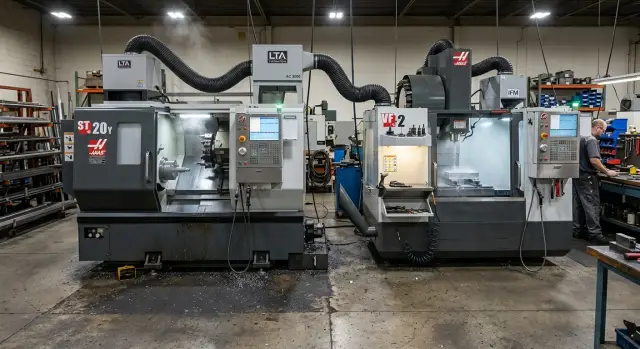
Imagine a small shop with one enclosed CNC lathe and one vertical machining center. Both use coolant and within a few shifts oil mist starts to settle on glass, doors and nearby cabinets.
On the lathe air is usually easiest to collect from the top. Warm mist rises and large droplets and chips fall sooner. So a top intake from the enclosure works predictably: it captures suspension from the upper zone, doesn’t interfere with the operator and noticeably reduces window residue. The floor around such a machine stays cleaner and cleaning time is shorter.
The vertical center is different. The cutter spreads coolant more widely and flow often moves to the roof and upper corners. If the intake is too low, fine suspension remains under the roof and later forms sticky film on doors and cover. For milling, extraction works better when the intake is nearer the roof or the upper rear of the cabinet.
The difference appears in daily shop work. The lathe operator wipes glass and handles more often, but overall cleaning is quicker. The vertical center’s upper panels, inner walls and door area take longer to clean because fine mist spreads wider.
Filters behave differently too. On the lathe they may be checked less often if the enclosure is tight and airflow is well balanced. On the vertical center filters are inspected more frequently, sometimes weekly. There’s more fine suspension and it clogs cleaning stages faster. In a two-machine shop this difference becomes noticeable in the first month.
What to do next
Start by observing the machine, not the catalog. Identify the modes where mist is densest: finishing passes, high speeds, heavy coolant feed or long series runs. These modes should form the basis of your selection; otherwise specs may look fine on paper but the system will be weak in practice.
Make a simple area map recording four things: what machine you have and how enclosed the work zone is, which coolant and how it’s fed, which material you process most often and how many hours per day the equipment runs. These data eliminate many selection errors because the same mist behaves differently on steel turning, aluminum milling and short infrequent cycles.
Then honestly estimate costs. Compare the extractor price not only to the purchase budget but to time spent on cleaning, hood washing, filter replacement, downtime for cleaning and recurring complaints about air. Sometimes a more expensive system pays for itself because the machine needs fewer cleaning stops.
If you’re buying a new CNC machine, plan extraction from the start. For EAST CNC customers it’s convenient to do this alongside machine selection, commissioning and service. That way you identify which ventilation scheme fits your machine and operating modes before installation instead of reworking the shop afterward.
With a list of modes, an area map and a rough cost estimate, discussions with suppliers become faster and more concrete. You talk about a tailored solution for your machine, material and shift instead of an abstract extractor.
FAQ
What is oil mist and why does it spread quickly through the shop?
A fine suspension of coolant and oil created in the cutting zone when heat, rotation and internal airflow break the fluid into tiny droplets. It quickly escapes when the door is opened and settles not only on the machine but also on the floor, cabinets and nearby equipment.
Why is general ventilation often insufficient?
Usually not enough. General ventilation dilutes the air only after the mist has left the machine. Local extraction at the work zone catches the aerosol before it settles on windows, controls and the floor.
How does extraction for a lathe differ from extraction for a milling center?
On a lathe the cutting zone is often easier to contain because the part rotates inside an enclosure and chips and coolant stay near the chuck and tool. On a milling center the aerosol spreads wider: the cutter works from different sides, the table moves, and the door is opened more often. So milling extraction is usually designed with more attention to the spray direction and chamber volume.
Where is it best to place the air intake on a lathe?
Most often the air is taken from the top of the enclosure. Warm mist rises, so it’s easier to capture before it leaves the machine. If the machine runs with a long bar, a bar feeder or through-spindle work, the pickup location should be checked on an actual cycle rather than placed arbitrarily.
Where is it better to place extraction on a vertical milling center?
Usually the intake is placed nearer the roof or the upper rear of the cabinet. On vertical centers fine mist often accumulates near the top, and a low intake leaves some mist under the ceiling of the cabin. If the flow moves toward the door or corners, that should be accounted for during installation.
When is a basic filter enough and when do you need a coalescing or electrostatic unit?
A mechanical stage is often enough with medium coolant volumes and larger droplets. A coalescing filter is needed when the mist is fine and a sticky film appears on windows and doors after a shift. Electrostatic units are used where modes change a lot and finer cleaning is required, but they must be cleaned regularly.
How do I know the extraction is undersized?
You’ll see it quickly: windows haze, sticky residue stays on doors and controls, the floor near the machine becomes slippery, and the chamber holds a visible suspension even with the unit running. Often the cause isn’t only the unit itself but long duct runs, extra bends or a poorly located intake.
What should I check before buying an extraction unit?
First, see where the mist appears earliest and which mode produces the densest release. Then check where the unit will sit, plan a short duct run, decide where condensate will drain and whether filters are easy to change. If maintenance access is hard, the system will be cleaned too late.
Where is it better to direct the cleaned air: back into the shop or outside?
Returning air to the shop helps retain heat in winter but requires thorough filtration. Exhausting outside is simpler to understand but removes heat and alters the shop’s air balance. The choice depends on the shop layout, climate and how cleanly the system treats the air after the machine.
How often should a mist collector be serviced?
Check based on the actual load, not the calendar. For long, high-speed cutting with heavy coolant feed, inspect filters and drains more often. Don’t wait for heavy buildup: clogged filters reduce suction, increase noise and let grease return to the operator zone.