
Oil Mist at the Workstation: When a Dedicated Exhaust Is Needed
Oil mist at a workstation is not always removed by general ventilation. Signs that threaten people, CNC electronics, sensors and part cleanliness — and when a local exhaust is needed.
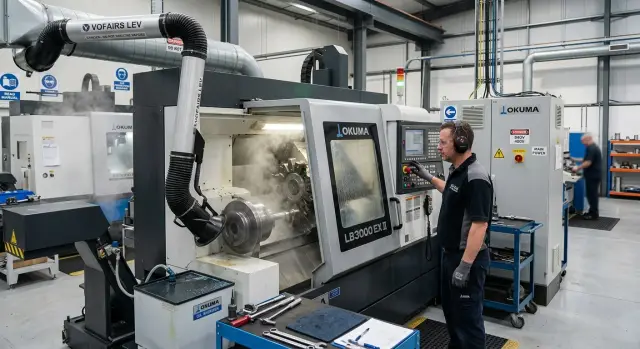
Why oil mist becomes a problem quickly
On the first day, oil mist near a machine rarely looks dangerous. It’s barely visible, so ordinary cleaning and the general ventilation often seem enough. But tiny droplets quickly spread around the machine and settle where you least expect them.
A film forms fast. Droplets land on the machine covers, the floor, handles, the screen, cabinet doors and nearby surfaces. At first it’s a faint stickiness, then a thin film that immediately attracts dust and small chips. The surface may look clean in the morning, and by the end of the shift it looks grey and greasy.
This dirt is not just an orderliness issue. The floor becomes slippery, control panels show fingerprints, and deposits get pushed through gaps and ventilation holes. If a control cabinet stands nearby, the oil-and-dust mix doesn’t stay only on the outside.
Smell also says a lot. If the shop still smells of oil after cleaning, the source is still active. You removed what had already settled, but new droplets remain in the air. In an hour or two they settle again on surfaces, and the odor returns.
The worst part is that the operator breathes more than what’s visible. The smallest particles hang in the air longer. A person may not notice a dense haze at first but by mid-shift the air feels heavy, clothes smell of oil, and there’s a sticky feeling on the face or glasses.
This usually follows a pattern: in the morning the area looks clean, by midday surfaces already have a greasy layer, by the end of the shift dust and fine chips stick to the film, and cleaning only helps for a short time.
In metalworking this is especially noticeable near CNC machines where coolant or oil is constantly splashing inside the work area. If the source runs every day, oil mist doesn’t build up slowly; it contaminates the area much faster than it seems at first glance.
Why general ventilation is not enough
General ventilation changes the air in the whole room, but rarely removes contamination right where it appears. With oil mist this is especially clear. It forms at the cutting zone in fractions of a second and initially stays near the machine, not at the ceiling.
The problem is air movement. Supply and exhaust in a workshop are usually sized for overall exchange: remove heat, odors, and excess humidity. But oil particles are very fine and light. By the time the general flow reaches them, the mist has already settled on doors, the control panel, sight glass and nearby surfaces.
With CNC machines the situation is often worse than it looks. A sealed enclosure by itself does not solve the issue. It only changes internal airflow: some areas create recirculation, some form stagnation, and each door opening can push mist out. As a result part of the aerosol circulates inside and part escapes into the working area.
There’s another reason. Droplets form right at the tool-workpiece contact where temperature and speeds are high. General ventilation is designed for the room volume, not for such a local point. So it almost always lags.
When several machines stand nearby, the load rises sharply. Even if each machine emits moderately, together they create a constant background. The room air may seem normal, but a light haze already hangs over the processing line that general exchange can’t remove quickly enough.
It looks simple: air goes up to the ceiling and is exhausted, but the mist stays near the machine; sight glasses quickly get a sticky film; when a door is opened odor and aerosol escape into the aisle; neighboring machines also get oily deposits.
If the oil mist stays close to the source, general ventilation is already chasing it instead of preventing it. In that mode it might dilute the problem across the shop but won’t remove it where it begins.
Signs you can’t ignore
If oil mist is visible not only in the air but also remains on surfaces within a single shift, the problem has gone beyond regular cleaning. That means the aerosol is not being taken where the shop ventilation should collect it, but is settling near the machine, on parts and inside cabinets.
The first clear signal is a quickly clouding sight window covered by a greasy film. The operator cleaned it in the morning, and by lunchtime visibility is already worse. That’s not trivial. If the film appears so fast, the mist accumulates right in the work zone and can’t escape.
The second signal is noticed underfoot. The floor near the machine becomes slippery again an hour after cleaning, even though there are no leaks and no coolant running out. That means the liquid comes from the air, settles in tiny droplets, and makes the area hazardous.
Next to suffer are areas you don’t notice at first glance. Dust starts to stick inside the electrical cabinet; cables and terminals get dirty deposits. For CNC electronics this is bad: dust by itself is unpleasant, but a dust-and-oil film holds longer and is much harder to remove.
There’s a quieter sign too: a thin film remains on finished parts even though cutting parameters didn’t change. A part may look fine, but it no longer feels clean to the touch and needs wiping before packaging or the next operation. In a production line that quickly eats up time.
People usually notice the problem before instruments. If staff increasingly complain of odors, sore throats or throat irritation by the end of a shift, don’t write it off as "normal shop air." When the air irritates, general ventilation is already failing to keep up with the needs of continuous work.
One incident doesn’t prove you need a machine-mounted exhaust. But if two or three signs repeat over several days, don’t delay. In that case local air collection at the source usually helps more than another round of wet cleaning.
What suffers first
The first victims are not the walls or the overall room air, but small sensitive areas. Oil mist settles as a thin sticky film where surfaces must stay clean: connectors, circuit boards, buttons, screens and sensors.
For CNC electronics that’s especially unpleasant. Dust quickly clings to the oily film and a light deposit turns into a thick dirty layer. Because of this connectors contact worse, fans pull more dirt into the cabinet, and boards face a higher risk of faults and overheating.
Sensors react early too. If deposits form on the sensor housing or its working area, it no longer reads positions, markings or edges accurately. At first it seems minor: an extra stop, a restart, a manual size check. But across a week those small issues add up to noticeable time losses.
Next the part itself suffers. After machining it takes longer to clean before the next operation, painting, inspection or packing. If the line runs without long pauses, this slows throughput: the machine is ready to deliver the next part while the previous one is still in washing.
The floor and everything people touch become coated. Door handles, buttons, the control panel, tool trolleys and measuring tables turn slippery. Cleaning needs to be done more often, but the pollution source remains.
Another effect that’s often tolerated too long: people simply find it harder to work all shift. The air feels heavy, a fine spray settles on faces and glasses, and clothing absorbs the coolant smell faster. On day one it may go almost unnoticed, but fatigue and irritation build quickly.
In practice the picture is usually this: a lathe runs in tolerance, parts meet size, but the control cabinet gets dirty faster than usual, sensors sometimes misfire, and the operator wipes the panel several times by shift end. That’s no longer tidy housekeeping; it’s a sign that general shop ventilation can’t remove oil mist where it forms.
A quick check in one shift
Often a normal shift shows the full picture better than instruments. If oil mist escapes the machine’s work area, you’ll see it on the sight glass, the floor, the CNC cabinet and even in the air near the door.
One simple rule: don’t specially clean the area before the midday test. It’s better to see how it behaves in normal mode, when the machine or several machines run without long pauses.
Five observations are enough in one shift:
- Photograph the machine’s sight glass at the start and again at the end of the shift. If transparency drops noticeably, the aerosol isn’t staying inside the work area.
- Wipe the cabinet housing or door with a white cloth. Dry dust and an oily smear are different. If the cloth picks up greasy residue, the mist settles where it shouldn’t.
- Walk past the machine door at a normal pace. If your sole starts to slip or the floor shines even after recent cleaning, fine spray is leaving the machine and settling nearby.
- Stand near the machine after an hour of continuous operation and assess the smell. A strong coolant or oil odor often means general ventilation can’t capture contaminated air at the source.
- Compare a single machine to a zone where several run together. If deposits appear faster on a group and the air feels heavier, the load already exceeds what ordinary room exhaust can handle.
Do this check on a typical production day, not during a short demonstration run. Otherwise the picture will be too mild.
If you notice two or three signs at once, don’t wait. A separate exhaust at the machine is needed not when complaints have become constant, but earlier—when deposits appear on surfaces, the floor becomes slippery, and the CNC cabinet gathers an oily film.
A good rule: if contamination is visible within one shift without special instruments, the problem is already significant.
How to decide if you need a local exhaust
Look not just for smoke or smell, but where and how quickly the aerosol settles. If oil mist is visible only during cutting, that’s not necessarily decisive. But if after a couple of hours a sticky film appears on the cabinet, panel, protective covers and floor near the machine, general ventilation is insufficient.
It’s more useful to collect simple observations over one or two shifts than to argue by eye. This especially helps where multiple CNC lathes work and the load changes by hour.
Understand four things: which operations create mist most often, where it settles fastest, how the situation changes with different numbers of machines running, and whether surfaces stay clean until the end of the shift after normal cleaning.
If deposits return quickly, it’s not a housekeeping issue. Air doesn’t carry the aerosol away from the zone where it originates. In that situation a machine-mounted exhaust usually works better than trying to boost overall room exchange.
Pay special attention to control cabinets. For CNC electronics these are among the most sensitive spots. If a greasy film forms on the cabinet door or near ventilation grilles, fine particles are already moving around the shop where they shouldn’t.
Another simple sign: after 4–6 hours the floor around the machine is slippery again, parts need extra wiping before packing, the control panel and screen require repeated cleaning, and neighboring equipment also shows residues. That’s a signal to provide local air extraction.
Keeping metalworking clean is not only about wiping traces. You need to intercept mist near its source. If the morning is clean but by midday the film returns, the solution is usually an exhaust at the machine rather than another rag.
A simple shop example
In the morning the area looks normal. One CNC lathe runs in routine mode, the operator feels fine, and general ventilation seems to cope. The air doesn’t seem dirty, the panel shows no obvious deposit, and the issue can be easily missed.
An hour later neighboring machines start and the situation changes quickly. The air becomes heavier, there’s a coolant smell at the workstation, and a thin haze hangs over the processing zone. It’s not always visible under bright overhead lights, but people notice other things: they wipe their face more often and smooth surfaces become slippery to the touch.
By lunch the traces are visible. A thin oily film appears on the cabinet door, the panel, the screen and buttons. The operator wipes once, then again. End-of-shift cleaning takes longer than the usual ten minutes—often half an hour or more. If several machines work nearby, residue spreads to tool trolleys, luminaires and protective covers.
This example shows when oil mist stops being background. General extraction removes some contamination from the room but can’t capture aerosol at the source. Fine particles spread across the area and settle where they’re not expected. For CNC electronics that’s a bad scenario: the film traps dust and dirt gradually reaches areas that must stay clean.
When a local intake is placed near the mist formation point, the difference is often noticeable in the same shift. The air feels lighter, the panel stays clean longer, and there’s less sticky residue around the machine. From that moment a separate exhaust stops being optional and becomes a normal operational measure.
Mistakes when choosing an exhaust
Most problems arise not because the exhaust is too weak, but because it’s chosen by rough criteria. For a CNC machine this often ends the same way: air seems to go out, but oily spray remains on sight glasses, inside electrical cabinets and on nearby equipment.
The first mistake is looking only at the room’s overall air exchange. General ventilation dilutes contamination but doesn’t always catch aerosol where it forms. If oil mist appears right at the cutting area, calculations by room volume aren’t enough.
The second mistake is placing the intake too far from the source. When the duct is installed "where convenient" instead of near the emission point, mist spreads inside the enclosure and escapes when the door opens. Then people assume a more powerful system is needed, while the real issue was incorrect intake placement.
The third mistake concerns airflow inside the enclosure. Many check the exhaust specification but not how the flow behaves around the chuck, tool and part. If there are stagnation zones, part of the aerosol will recirculate and settle on walls and cables.
The fourth, simpler mistake is remembering filters only after installation. If filters are hard to reach, they are cleaned less often. The system quickly loses suction and the operator notices it by smell, deposits and sticky surfaces.
The fifth mistake is buying an exhaust without tying it to actual machine operating modes. Two visually identical machines can have very different loads: different spindle speeds, different coolant feed, different door opening frequency and different materials. For CNC lathes that cut almost continuously, this matters a lot.
Before purchasing, check where mist forms inside the enclosure, how often the operator opens the door, how many hours the machine actually cuts per shift, whether filters are accessible without disassembly, and whether the airflow pulls air through the electronics or panel.
If the supplier asks about these details, the conversation is productive. That’s crucial when selecting equipment and peripherals: the exhaust must work with the machine, not just hang nearby.
What to do next
Don’t buy an exhaust by sight. First collect simple observations over two or three shifts while the machine runs in normal mode, not after a deep cleaning for a demo.
You don’t need long records. It’s enough to know where and when oily deposits appear, how fast doors and screens get dirty, whether mist appears near the loading area, and how long cleaning takes at shift end.
A short observation log works: which hours show more mist, which operations produce stronger smell and haze, where the film settles, how often the sight glass needs wiping, and whether the picture changes with different coolant feed.
Then discuss the exhaust not separately from the machine but together with cutting modes. The same machine behaves differently in roughing and finishing passes, at different spindle speeds and with different coolant pressure. Sometimes the problem is not only the air but how the coolant jet hits the cutting zone and how doors open between cycles.
Consider daily operations too. If the floor is slippery after a shift, the CNC cabinet collects sticky dust, and service spends extra time cleaning fans and filters, general ventilation is at its limit. Protecting CNC electronics becomes an operational task, not theory.
If you consider economics, include not only the exhaust price. Count minutes spent on daily cleaning, how often cabinets need attention, and how quickly sensors, sight glasses and lights get dirty. Over time these losses are usually more significant than they seem in the first month.
If a shop is being planned or restarted, solve this question in advance. At EAST CNC, the official representative of Taizhou Eastern CNC Technology Co., Ltd. in Kazakhstan, you can discuss layout, machine selection, commissioning and service in advance so a separate exhaust doesn’t become an urgent rework after launch.
If oil mist returns within one or two shifts after cleaning, don’t postpone the decision. First observe real working conditions, then decide on exhaust based on facts, not impressions.