
New or used machine: where the savings end
New or used machine: compare repair, geometry, electronics and downtime after startup to calculate the real price.
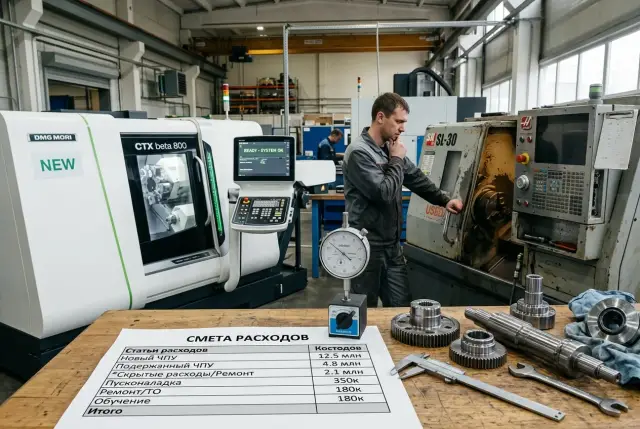
Why a low price often misleads
The lowest price almost always looks convincing. A difference of a few million tenge at the start seems decisive. But for a workshop money is spent not on the day of the deal, but during the machine’s first year of operation.
When comparing a new and a used machine people often look only at the seller’s invoice. That’s where the calculation ends. That’s the main mistake. The true cost of the machine becomes clear after commissioning, when the first parts, adjustments and stoppages begin.
For a cheap option the entry ticket is low. Post-startup expenses can repeat month after month. If the spindle overheats, geometry drifts or electronics break cycles, the shop pays again. The discount is already forgotten, but the losses remain.
Usually money goes to repairing hidden defects, fine-tuning accuracy, replacing sensors, drives, boards and cables — and most of all to downtime. This item is underestimated most often. One day of stoppage is not only a service visit. It’s an idle shift, shifted deadlines, contract penalties and parts that weren’t shipped on time. If a shop works to order, even 2–3 days of downtime can wipe out the entire benefit of a "successful" purchase.
Example of downtime. A small section bought a machine 15% cheaper than new. After commissioning it turned out some electronics had to be replaced and accuracy had to be re-established. Repairs took 10 days, plus several days for trial parts and adjustments. On paper there was a saving. In reality the shop lost time, material and some orders.
Therefore, it’s better to count not the entry price but the price of the first year. That includes commissioning, tuning, consumables, repairs, operator training and the cost of each day of stoppage. A new machine is often more expensive upfront, but with lower risk and faster commissioning it can be cheaper in the end.
A sober calculation begins with a simple question: how much will the shop pay not for the purchase, but for each month of operation after it?
What makes up the full cost of a machine
The invoice price almost never equals the full startup cost. When a shop compares options, it often only sees the purchase figure and doesn’t add everything needed before the first good part.
First add logistics. Delivery, unloading, lifting, installation and connection themselves add a noticeable sum. If the machine is heavy you need a crane, slings and time when the area can be stopped without losses.
Then comes shop preparation. A machine may require a foundation, a level surface, additional power capacity, compressed air and decent access for maintenance. Sometimes the machine fits by dimensions, but there isn’t enough room nearby for the control cabinet, chip conveyor or a tooling trolley.
A separate cost item is everything the machine needs to run on day one. Chucks, jaws, toolholders, cutting tools, measuring equipment, coolant and consumables are rarely fully included in the base price. On paper the machine is bought, but without tooling it simply stands idle.
People often remember too late who will deliver and place the machine, whether there is enough power and air, what to equip the first commissioning with, who will perform commissioning and who will train the operator. With new equipment some of these questions are easier to close in advance. With a used machine such costs often fragment across several contractors and the estimate grows in pieces.
A good calculation includes not only the purchase but also commissioning, the first shifts and basic maintenance. If training isn’t in the estimate you pay with the tuner’s time. If service isn’t included you pay with downtime. If tooling isn’t provided, commissioning is postponed even when the machine is already in the shop.
The full cost of a machine is the sum required to reach stable operation, not the moment the invoice is paid.
How to inspect a machine before the deal
Buying a machine from photos and a short video is a bad idea. If the seller can’t show it running, you’re already taking extra risk. For used equipment the most expensive part of the deal often begins not on the payment day but after commissioning in the shop.
First request documents and the machine’s history. You need concrete data: operating hours, repairs, spindle replacement, ball screw and linear guide replacements, servodrive changes, sensors and CNC board work. If nothing has been recorded, that’s a warning. Then the real condition will have to be found by hand and instruments.
An inspection without power reveals almost nothing. The machine should be viewed under power in a real cycle. The CNC screen, spindle sound, axis movement, tool change, coolant feed and hydraulic behavior say much more than a clean casing and fresh paint.
What to check on site
Before the deal it’s useful to run a short checklist:
- the alarm log and current errors on the CNC
- control cabinet: dust, overheating, signs of repair, fan condition
- sensors, limit switches and cables for kinks
- axis backlash and smoothness of movement at slow feed
- signs of oil, coolant and lubricant leaks
Also ask for a trial part. Prefer a simple part with dimensions that are easy to check with a micrometer and an indicator. Measure it after the machine has warmed up. A cold machine can look acceptable, then after 30–40 minutes start to drift, especially if there is geometry wear or thermal stability issues.
A normal scenario: the seller runs the machine, lets it warm up, makes a part, then repeats the cycle. If the second size has already drifted, the cause is rarely minor. For a small shop this means not a quick adjustment but calling service and losing orders.
One more often-missed question: what happens after purchase. Find out in advance how long spare parts take, who does commissioning and how quickly a service engineer will arrive. For Kazakhstan this is especially sensitive. Even a small breakdown becomes expensive if the machine stands for a week awaiting a board or sensor. Inspection before purchase is not only checking hardware but also checking who will be responsible for the machine after the deal.
Where a used machine most often pulls money away
When a shop compares options the eye almost always catches the purchase price. But real losses often begin after delivery, when the machine must be commissioned and run in series without failures.
The most expensive story is the spindle. Worn bearings first reveal themselves by noise, heating or vibration marks on the part. Then the estimate grows quickly: disassembly, replacement, adjustment, accuracy checks and sometimes a rerun of the whole machining process.
From the outside such a unit can look normal. The problem is that in a short inspection the seller shows the machine "alive" but doesn’t let it run under load for several hours. The buyer learns the true condition only at their shop.
Hydraulics and lubrication systems rarely hit with one big bill. They do it little by little but constantly. A leaking seal lets oil into the work area, oil mixes with chips, cleaning time grows, and the operator starts seeing small failures and stops.
A used machine’s turret also often gives not the most obvious but still costly defect. It loses position by fractions of a millimeter, indexes more slowly or sometimes requires repeated indexing. For a single part this is annoying. For a series it means lost tempo, scrap and stressed tuning staff.
Small repairs are almost always underestimated. Today a sensor is replaced, tomorrow a connection is tightened, the day after they search for an error in the cabinet, then call hydraulics service. Individually the amounts seem tolerable. Over a month they add up to a noticeable expense, especially if the machine also stands idle for half a shift.
A small shop feels this fastest. One lathe stops and the whole schedule shifts: blanks pile up, people wait, urgent orders slip. The saving at entry disappears not because of one big breakdown but because of a chain of “small things” that no one budgeted for.
So inspection must go beyond an external check and a five-minute test run. If the seller can’t show the spindle, hydraulics, lubrication and turret accuracy under real conditions, the risk of hidden post-startup costs is too high.
Geometry and accuracy after commissioning
After commissioning a machine can make one good part and still be problematic. On turning this shows quickly: the first feature is within tolerance, but over a length of 150–200 mm a taper appears. Size holds sometimes and drifts by a few hundredths at other times, although the program hasn’t changed.
This typically behavior belongs to machines with worn guides, ball screw pairs or feed units. Externally this isn’t always visible. The machine can move smoothly, be quiet and pass a short check, but under load the geometry behaves differently.
For a shop this means not only scrap. The operator constantly adjusts offsets, changes tools more often and takes longer to bring a batch into tolerance. On paper the deviation looks small. In production it eats hours.
What shows up only after a series of parts
One successful measurement means little. You need a series of several identical parts in a row, preferably after a normal working warm-up. If the first part is 30.00 mm, the third 29.97 mm and the sixth 29.94 mm, that’s not a coincidence.
Warm-up changes things too. A tired machine often shows one result cold and another after 20–40 minutes. Metal expands, assemblies change behavior, and dimensions begin to wander. For small batches it’s inconvenient. For series production it’s direct losses.
In practice people watch four things: the first and last part size in a series, taper over length, repeatability after a stop and restart, and machine behavior after warm-up.
Correcting such geometry is hard. Simple adjustments help not always and often only briefly. Scraping, guide repairs, screw replacement, realigning assemblies and rechecking are expensive. Sometimes the bill approaches the difference between a new and a used machine.
If the machine was bought to save money, that saving often ends here. The purchase discount looks attractive until the first month of work, then it disappears into scrap, long tuning and missed deadlines.
Electronics and downtime in the first months
Mechanical problems in a used machine are often visible in advance. Electronics are worse. At idle everything may look normal, but under load old drives, encoders and power supplies start to fail. The machine sometimes runs, sometimes trips, sometimes loses position after several hours.
That’s why the debate usually ends not by purchase price but by the first months after commissioning. If a drive overheats, an encoder gives false signals or the controller loses parameters, the shop pays not for a part but for waiting on repairs.
One of the most unpleasant small things is a dead battery. It can erase CNC parameters or axis settings. The machine may be physically intact, but commissioning stalls. Then begin searches for archives, manual parameter entry, limit checks and test starts. On paper this is a “small expense,” but in practice it can take several days.
The same goes for sensors, relays and cables. A part may be inexpensive, but because of it an entire shift is lost. In used machines it’s often not the most expensive unit that fails but the most inconvenient: a chafed cable in the feed circuit, a corroded connector, a tired cooling relay. The operator spends more time chasing errors on the screen than producing.
Count downtime immediately in money. Per hour that’s wages, electricity, rent and stoppage of neighboring operations. Per shift it’s undelivered parts and postponed shipments. Per week it’s penalties, lost orders and extra urgent purchases for repairs.
Before the deal clarify one question: who will service this machine in your region. Not in theory, but in practice. Who will come, who works with this CNC system, and is there access to parameters, sensors and drives. If support is far away downtime quickly stretches. With a new machine and a clear commissioning and service plan this risk is usually lower.
Example for a small shop
A small shop buys a used lathe because it’s 20% cheaper than new. On paper the choice looks reasonable: if a new machine costs 25 million tenge, a used one can be bought for 20 million. The 5 million difference seems like a good startup buffer.
But after delivery it turns out the machine isn’t ready to run "out of the box." The shop buys a chuck, a set of holders and cutting tools, then replaces the coolant pump. Next an encoder fails, then geometry correction surfaces. These items alone can easily cost about 3.75 million tenge. Little of the initial saving remains.
Then the most expensive item appears: downtime. The machine was to produce a batch of bushings for an urgent order, but after repairs and tuning it stands idle for several more days. The operator waits, the tuner postpones the run, and the customer isn’t obliged to wait.
The shop faces an unpleasant choice: subcontract part of the work at a higher price or lose the order. In both cases money leaves not for hardware but for disrupted production.
When comparison is built only on purchase price the calculation almost always breaks at commissioning. A used machine is cheaper until the first repair. After that the difference may shrink to a few hundred thousand tenge or disappear entirely. For a small shop one missed batch often costs more than the 20% discount.
Mistakes when comparing options
The mistake usually starts with the first figure on the invoice. The purchase price is visible immediately, everything else hides in details that surface after delivery.
The first mistake is counting only the machine cost and not adding tooling, delivery, commissioning and operator training. The second is believing the seller’s “everything works” without measuring, test passes and a trial part. The third is not budgeting for repairs in the first months as if expenses end at purchase. The fourth is treating new and used as equal-risk options when their commissioning conditions differ greatly.
On-site checks quickly sober you up. The seller may honestly say the machine is "in good condition," but without backlash checks, spindle inspection, feed tests and repeatability checks these are just words. If the machine doesn’t hold size on a test part, the cheap entry will be expensive later.
People also forget hidden startup costs. You need chucks, tools, adapters, sometimes a new compressor, power stabilization or site modifications. You also need someone to commission the machine so it doesn’t make week-long mistakes on first orders.
For a small shop the difference is most noticeable. Suppose a used lathe is 20% cheaper than new. Then the shop spends on transport, tuning, sensor replacement, hydraulic repairs and three days of downtime. If you add a missed delivery penalty, the saving no longer looks convincing.
With new equipment the picture is usually clearer. If the supplier’s commissioning and service are defined in advance, costs can at least be estimated. That doesn’t make a new machine cheap, but it makes the decision more predictable.
A good comparison is simple: count the sum until normal operation in a shift, not the entry price. If that sum isn’t on paper, it’s too early to decide.
Quick check before deciding
Before purchase it’s useful to make a short one-sheet calculation. It quickly sobers you when both options look attractive only by the invoice price.
Check five things:
- request a trial part and measurements after warm-up;
- list assemblies that will soon ask for money;
- clarify lead times for spare parts and service;
- calculate delivery, unloading, site preparation, connection, commissioning, training and the first set of tooling;
- determine how many days of downtime your shop can tolerate without missing orders.
A good quick test: take the purchase price, add expected repairs, commissioning and two weeks of possible downtime. Then compare that total to the price of a new machine. Very often the difference no longer looks large.
For a small shop this is obvious. If one lathe produces most of the shafts or bushings, any pause hits not only revenue but delivery times to the customer. In such a situation it’s better to overpay upfront than to urgently source electronics, pay for emergency repairs and explain a delayed order.
What to do next
Don’t chase the cheapest option. Look for a machine that will start reliably and make your parts without excessive scrap and stops. The decision usually becomes clear after a 12-month calculation, not after seeing the first price on the invoice.
First gather your baseline figures: which parts you make most often, the materials you use daily, the tolerances you actually need, how many hours the machine should run per shift and how much the shop loses per hour of downtime. Without these numbers any choice is a guess.
Then put a new and a used machine on one cost table for 12 months. Enter not only the purchase price but delivery, tooling, commissioning, operator training, consumable replacement, potential repairs, geometry checks, electronics tuning and weeks of downtime after startup. If a used machine is cheaper at purchase but stops twice in the first quarter, that “saving” quickly disappears.
It helps to calculate a simple scenario. Suppose the shop loses 80,000 tenge per day of downtime. If a used machine stands for 5–7 days after commissioning because of a sensor, drive or geometry correction, you already lose a noticeable sum. Add a service engineer trip, consumables and scrap from first parts and the picture changes dramatically.
Ask the supplier for not a glossy presentation but a clear commissioning plan. It should include delivery times, commissioning scope, a list of service works, what is checked at startup and terms of ongoing maintenance. For used machines, clarify separately who is responsible for geometry, spindle, CNC, drives and electrics in the first month.
If you need a new machine with a clear commissioning and service plan in Kazakhstan, EAST CNC can handle selection, delivery, commissioning and service. The company works as the official representative of Taizhou Eastern CNC Technology Co., Ltd. in Kazakhstan, so before purchase you can already understand who will be responsible for putting the machine into operation and what happens after commissioning.
A good solution usually looks boring on paper. But after six months it still works as planned.
FAQ
Is it worth buying a used machine if it’s 15–20% cheaper?
Often no. If a used machine is 15–20% cheaper, that difference can be eaten up by repairs, accuracy tuning, tooling and downtime in the first months. Don’t look at purchase price alone — compare the total for the first year of operation. That gives a fair picture.
What should be counted besides the invoice price?
Add delivery, unloading, installation, connection, commissioning, operator training, tooling, cutting tools, coolant and an initial supply of consumables. If these items aren’t in the estimate, the invoice number tells you very little about real startup costs.
How to inspect a machine before the deal?
Ask to see the machine running, not just photos or a short video. The seller should show warm-up, a test part, cycle repetition and measurements after machining. Also request the machine’s service history and operating hours. If there’s no data, the risk is significantly higher.
Why is a test part after warm-up so important?
One good part doesn’t prove anything. A machine can hit tolerance cold, then drift after 30–40 minutes of work. A test part after warm-up immediately shows whether the machine holds repeatability and if there are geometry issues.
Where does a used machine usually start to cost extra?
Most often it’s the spindle, hydraulics, lubrication system, turret, sensors, cables and old electronics. Individually these faults look affordable, but over a month small repairs and stops add up to a large expense.
How to calculate downtime cost for a shop?
Take the loss per hour or per day: wages, rent, electricity, undelivered parts and the risk of missing shipments. Then multiply by the expected days of downtime. For a small shop, even 2–3 days of downtime often wipe out the purchase discount.
When does a new machine actually become cheaper?
A new machine pays off when the shop needs quick commissioning, stable tolerances and predictable service. It’s more expensive upfront but usually carries lower risk of unplanned expenses. If one machine handles most of the workload, it’s often better to pay for predictability than for repeated stoppages.
What to ask the seller first?
Ask about operating hours, repairs, spindle or ball-screw replacements, linear guide and servo changes, sensor and CNC board replacements. Also clarify who will do commissioning and how fast service arrives. Find out lead times for spare parts in your region — for Kazakhstan this directly affects startup time.
Can you tell in advance if the electronics will cause trouble?
Partly yes. During inspection, check the alarm log, current CNC errors, control cabinet condition, fans, connectors and cables. But electronics often fail under load. Without a real cycle and warm-up, you won’t see the full picture.
How to quickly compare new and used before deciding?
Put both options on one sheet for 12 months. Enter purchase price, commissioning, tooling, training, potential repairs and at least two weeks’ downtime risk. If you need a new machine with delivery, commissioning and service in Kazakhstan, it’s easier to work with a supplier who covers the whole path.