
Launching a New Machine: How to Calculate Tooling for 3 Months
Launching a new machine requires the right stock from day one. Learn a simple way to calculate tooling and fixtures for three months without excess inventory.
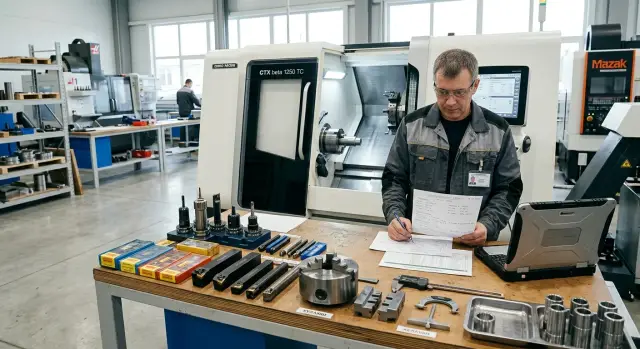
Why it’s easy to buy too much at the start
When a new machine is launched, people often buy tooling with a big safety margin. The reason is simple: downtime feels scarier than an extra invoice. If the CNC machine is already on its way to the shop floor, the buyer, technologist, and foreman all want to close the risk right away and order “a little extra, just in case.”
That is how a set appears that includes almost everything from the catalog: extra tool holders, several similar inserts, rare drill diameters, spare chucks for operations that do not even exist yet. On paper, it looks reasonable. On the shop floor, it quickly turns out that part of it just sits there unused.
For companies in Kazakhstan, this is especially familiar. When a new turning machine is launched for the first time, many people worry about delivery delays and order more than they need for the first few weeks of work. The fear is understandable, but the warehouse should not be a place for expensive guesses.
Extra items freeze more than just money. They take up shelves, complicate inventory tracking, and make it harder to see what the shop uses every day. A couple of months later, some boxes are still unopened, while the fast-moving items still need urgent reordering.
But the opposite extreme is dangerous too. If you buy too little, the warehouse runs dry in the first week. Then the machine stops because of one insert or collet, and urgent delivery costs more than a proper stock level.
The problem usually starts when people calculate from the catalog instead of from the parts. The catalog shows what can be mounted on the machine. Production should calculate what will actually cut metal in the first three months.
One and the same machine can be equipped in dozens of ways, but a batch of bushings, shafts, and flanges does not need the whole range. If the shop starts from part families, the picture gets much simpler: which operations repeat, which tools wear out faster, and what can be standardized across several products.
A good start looks boring, and that is normal. Not the maximum set, but a working kit for specific parts plus a sensible reserve. That approach gives the shop a smooth launch without extra boxes in storage and without a cash gap caused by buying “just in case.”
What to include in the calculation
For a new machine launch, it is not enough to calculate only inserts and cutters. Tooling and fixtures are not one line in the budget, but a set of items without which the machine will not reach a normal rhythm. If you forget even one group, the warehouse may be full, but work will still stop over something small.
First, split the cutting tools by operation. Roughing usually uses up resources faster, so it needs its own stock of tool holders, inserts, drills, and parting tools. Finishing lasts longer, but the requirements for size and surface quality are higher. If the routing includes grooves, threading, or deep drilling, count those items separately too. One “universal” set rarely covers the full cycle without losses in time or quality.
Fixtures are often underestimated, even though setup quickly gets stuck without them. For a CNC machine, you need more than just a chuck and standard jaws. The calculation usually includes soft jaws for boring, collets, arbors, adapter sleeves, stops, clamps, and simple locating elements. If the part is thin, long, or has an unusual shape, you may need another set for a different clamping method. That is cheaper than losing a shift to reworking the setup.
Measuring tools are listed separately. A setter and an inspector will not get by with one caliper. You need micrometers for the working ranges, indicators, bore gauges, thread gauges, and simple templates for standard sizes. When measuring one part takes an extra 5 minutes, the monthly loss becomes more noticeable than the price of part of this kit.
Another group is consumables that go fast in the first few weeks. These are usually replaceable inserts and screws for them, small-diameter drills, taps, coolant filters, abrasives, and cleaning supplies for the machining area. These items are not expensive one by one, but they are the ones that most often break the rhythm.
Before ordering, it helps to mark what comes with the machine and what needs to be bought separately. Then the tooling stock calculation will be based on the real routing, not on a general “just in case” list.
What data to collect before the first purchase
The first purchase almost always suffers from one of two extremes: people buy too much, or they buy only enough for startup and hit downtime two weeks later. To avoid guessing, collect the starting data in one table. Even rough numbers are better than ordering by eye.
First, you need a production plan for at least three months. Not a perfect one, but a working one. For example: in the first month, the machine is busy with setup and trial batches, in the second it reaches 60% load, and in the third it reaches 80%. This rough plan immediately changes the number of cutters, inserts, drills, and clamping fixtures.
Then make a short list of the parts that will truly run on the new machine. Not all the parts in the shop, only the ones you have already decided to put on this machine. At the start, plans and wishes often get mixed up: a part seems suitable, but in practice it stays on the old equipment or is outsourced. If you include it in the purchase, the warehouse will grow for no reason.
After that, check three things for each part: material, size, and batch repeatability. Steel, stainless steel, aluminum, and cast iron wear tools differently. The part diameter and length affect the choice of tool holders, chuck, jaws, and tool overhang. Batch repeatability shows whether it is better to keep more identical items on hand or buy the minimum and reorder quickly.
Also record the machine’s operating mode. One shift and two shifts create very different consumption, even with the same monthly plan. It also helps to note how many hours will really go to setup, changeover, and first adjustments. A new machine rarely starts working at full strength on day one.
The most common mistake is not separating the operations that will actually run on this machine from the ones that will stay elsewhere. For a CNC lathe, that may include rough turning, finish turning, drilling, threading, and parting off. Grinding, heat treatment, or part of the complex transitions may stay in another area. If this separation is missing, unnecessary tooling ends up in the request.
It helps when the technologist, shift foreman, and buyer review this data together. Even if the supplier, for example EAST CNC, helps with commissioning, the production team still provides the starting numbers. The more accurate the input, the smoother the new machine launch will be in the first three months.
How to divide parts into families
If you throw all parts into one table, the calculation quickly goes off track. Some items consume tool life almost nonstop, others come in small batches once a month, and still others need a special chuck or jaws. That is why it is better to divide parts not by name, but by how the machine actually processes them.
First, look at the material and the routing. Parts made of carbon steel, stainless steel, and aluminum should not be mixed into one group, even if they look similar. They have different insert wear, different cutting conditions, and often a different set of tool holders, drills, and taps. For a CNC lathe, this is especially noticeable: a steel shaft and an aluminum bushing may take the same time on the drawing, but they use tools very differently.
Then separate short runs from recurring items. A one-off batch of 20 pieces should not pull the same amount of tooling stock as a part you will turn every week. If you mix them into one family, the warehouse almost always grows too large.
It helps to check each part with four questions:
- What material is it made of?
- Which operations happen almost every time?
- Is it a one-time order or a recurring item?
- Does it need a special clamp or separate fixture?
If the answers match, the parts can stay in one group. If even the clamping or routing differs, it is better to create a separate family.
Similar operations should also be grouped together. For example, several parts may differ in diameter and length, but all of them go through rough turning, finish turning, drilling, and parting off. For purchasing, that is one consumption pattern. There is no need to create a separate group for every small shape difference if the tooling set is the same.
Parts with unusual clamping should be kept separate. Soft jaws, rare-size collets, special arbors, steady rests, or nonstandard clamps are better not hidden inside a general group. These are the items that most often cause extra spending at the start.
A simple example: steel shafts in recurring production are one family, aluminum bushings in small batches are the second, and stainless flanges with special clamping are the third. This approach helps you buy exactly the tooling and fixtures needed for a new machine launch, rather than items that will sit on a shelf.
How to calculate a three-month stock
It is easier to calculate stock by part family than by the tool catalog. That way you see the real consumption, not an abstract “just in case” list. For a new machine launch, this is almost always more accurate than buying based on experience from another area.
Start with one part family and lay out the full routing. Not in broad terms, but by operation: rough turning, finish turning, drilling, boring, parting off, inspection fixtures. Then assign a specific tool and the needed fixture next to each operation: holder, insert, drill, chuck, collet, jaws, arbor.
Next, calculate consumption not for the warehouse, but for one part or one batch. If one insert lasts 120 parts, and you plan 960 parts over three months, the math is simple: 960 / 120 = 8 inserts. If the tool is changed not piece by piece but as a set during changeover, calculate by set. This approach better reflects real CNC machine work.
A useful calculation scheme looks like this:
- define the production plan for each part family for 3 months;
- convert tool life into parts, cutting length, or batches;
- divide the plan by tool life and round up;
- add reserve only where it is needed.
The reserve should not be the same for every item. If an insert is available from several suppliers and arrives quickly, 10-15% is often enough. If the machine will stop without a special arbor, you can keep a larger reserve. In practice, it helps to split items into two groups: consumables and startup-critical items.
Also mark anything that is slow to arrive or rarely kept in stock. These are usually nonstandard fixtures, special jaws, live tooling, some holders, and measuring items. For those, it is better to have not just a reserve, but a second working set.
A small example. Part family A needs 2 inserts for roughing, 1 insert for finishing, 1 drill, and a set of soft jaws. The three-month plan is 600 parts. The roughing insert lasts 100 parts, the finishing insert 200, and the drill 800. That means you need 6 roughing inserts, 3 finishing inserts, and 1 drill. Then add reserve: for example, 1-2 extra inserts and a second jaw set if the lead time is long.
That gives you a stock level that covers the first three months without tying up too much money in inventory and without risking a stop.
Example calculation for a simple part set
The shop is launching three part families: shaft, bushing, and flange. They are made from two materials, regular steel and stainless steel. For the calculation, that already makes six working positions, but that does not mean you need a separate kit for each one.
If the outer passes and facing are similar, one set of tool holders is often enough for rough turning. Mostly the inserts and cutting conditions change, not the whole fixture setup. That sharply lowers the first invoice when a new machine is launched.
Let’s take a simple monthly plan: 300 shafts, 200 bushings, and 100 flanges. Over 3 months, that comes to 1,800 parts.
For the example, let’s assume these norms:
- one roughing edge lasts about 180 parts
- one finishing edge lasts about 60 parts
- reserve for disruptions and setup: 20%
- soft jaws are needed only for recurring batches
Let’s calculate the roughing group. If almost every part goes through one roughing operation, then you need 1,800 / 180 = 10 edges. Add reserve and you get 12 edges. Even with two materials, that is not a reason to buy a second set of tool holders. It is smarter to buy one working set and extra inserts for 12-14 edges.
The finishing group is different. Shafts and bushings are usually more demanding when it comes to surface finish, while flanges are often simpler. If 300 shafts and 200 bushings per month go through finishing, that is 1,500 parts over 3 months. At a life of 60 parts per edge, you need 25 edges, or 30 with reserve. So finishing inserts run out much faster, and it makes sense to buy more reserve for them than for roughing inserts.
It makes little sense to save on soft jaws if the batch repeats every week. You can prepare one set for the shaft and bushing, and a second set for the flange. That saves time during changeover and gives you stable clamping.
But it is not worth duplicating rare fixtures right away. If one boring arbor is needed only for one bushing version and the batch runs once a month, one piece is enough at the start. It only makes sense to buy a second one after the first month, when you can see the real load on the CNC machine and the frequency of repeat orders.
Where people most often make mistakes
The most expensive startup mistake is buying a full set for every possible job. On paper, it looks safe: “let’s have stock for any situation.” In reality, a new CNC machine in the first few months usually does not run everything, but only 2-4 part families with a clear set of operations.
If the shop is launching turning for shafts and bushings, it does not need a wide range of rare arbors and special holders “for the future.” It is better to cover the confirmed operations: rough turning, finish turning, grooves, parting off, drilling. The rest can be bought after the first repeat orders.
People often mix up the main stock and the safety stock. Main stock is needed for the production plan and normal tool consumption. Safety stock is for delivery delays, scrap, breakage, and an unexpected increase in load. If you put everything into one number, the warehouse quickly grows, and then extra items sit there for months.
Another common case is expensive rare fixtures for one part. A customer brings a complex part, and the shop immediately buys a dedicated set for it. Then the batch runs once, and the fixture sits unused. For that purchase, ask a simple question: will this part repeat at least once more in the next three months or not?
Many people underestimate the small items. They buy holders and arbors, but forget replaceable inserts, screws, clamps, and other consumables without which the tool simply does not work. The machine will not stop as often because of a missing expensive assembly as it will because of a lost screw or a box of inserts that ran out.
It helps to check the calculation against a short list:
- what is needed for confirmed operations, and what was bought “just in case”
- where the main stock is, and where the safety stock is
- which items depend on only one rare part
- whether there are enough inserts, screws, clamps, and spare small parts
- whether the setter and the technologist reviewed the calculation
The last point is missed especially often. A manager or purchaser may calculate consumption neatly from the catalog, but the setter knows where the tool life is shorter, where access is awkward, where an insert chips at entry, and where one universal solution is enough instead of three separate ones. The technologist also notices extra items quickly.
A regular review takes half an hour. But after that, the order becomes much more accurate: less money tied up in inventory, fewer urgent purchases, and fewer stoppages in the first month of work.
Quick check before ordering
Before sending the request to purchasing, it helps to do a short review. It takes 15-20 minutes, but it often removes extra items from the order and helps keep the warehouse from being filled with things that will not be needed in the first quarter.
During a new machine launch, people usually do not make mistakes in the main set, but in the small things. They add rare holders “just in case,” duplicate inserts for similar operations, or take too much stock for items with low wear. That is how money goes out right away, while some boxes sit untouched for months.
Check five things:
- You have a clear list of part families that will actually go into production over the next three months.
- For each operation, one main tool is chosen instead of two or three similar options without a reason.
- For each item, you have a minimum for startup and a separate reserve for disruptions, scrap, and the first setup.
- Rare items are put on a separate list so they do not get mixed with mandatory purchases.
- The person who places the order sees the boundary: what must be bought now, and what can wait until after the first batches.
If even one point is not covered, it is better not to send the order yet. Otherwise, purchasing quickly turns into a bundle of assumptions. For a turning group, this looks familiar: there is already a working set of holders and inserts for outer turning, but for one rare groove, a second, almost unused set gets added. It is smarter to move that tool to the second purchase wave and buy it after the first month, once the real load is known.
A good sign is when you can show the list to anyone involved in the launch, and they immediately understand the logic. These items are for daily work. These are kept as reserve. These are bought later if the plan is confirmed. Without that clarity, even an accurate tooling stock calculation loses its meaning.
If the machine is launched with the supplier’s involvement, for example during commissioning, it is useful to review the list again before the final order. One short check often removes extra items better than explaining later why half the fixtures are still sitting on the shelf.
What to do after the first month
After a month, the picture almost always changes. Some items go faster than planned, others sit untouched, and part of the consumption appears only during setup and the first trial runs.
First, put the plan and actuals into one table. Look not only at the total quantity, but also at consumption by operation: roughing, finishing, parting off, drilling, threading. That shows where the calculation was accurate and where you built in too much reserve.
It helps to check four things:
- which inserts, holders, and arbors were really in use
- which items were taken from the warehouse but never mounted on the machine
- what was changed more often because of setup, runout, parameter adjustment, or first rejects
- how closely the actual machine load matched the plan by shifts and batches
After that, remove from the second order anything that did not go into use. If you bought tooling “just in case” and did not touch it during the month, do not automatically order the same amount again. It is better to keep the money for consumables that really go fast.
Also look separately at the items that were changed often during setup. These are usually spare inserts, drills in common diameters, collets, chucks, soft jaws, adapter sleeves, and small fixtures. On paper, they are easy to underestimate, but on the shop floor they are what saves a shift from stopping.
Agree on the second order based on the real machine load, not the optimistic startup plan. If you expected 22 shifts and actually ran 14, the stock for the next two months should be calculated from the actual numbers with a small reserve, not from the nice forecast.
A simple example: you expected to produce 600 parts, but made 380. Roughing tools were used almost as planned, because setup and trial parts created extra consumption. At the same time, some finishing inserts were still almost full. That means the second order should keep the roughing group closer to the actual numbers and cut back the finishing group.
If, after the first month, it becomes clear that the problem is not only the stock, but also the machine choice itself, the fixtures, or startup service, it is worth discussing that with EAST CNC. The company handles supply, commissioning, and service, so the conversation will be practical and will avoid extra purchases just to fill the warehouse.