
New equipment or contract manufacturing: how to choose
New equipment or contract manufacturing: compare lead times, quality, workload and downtime risk to choose the right option for the year ahead.
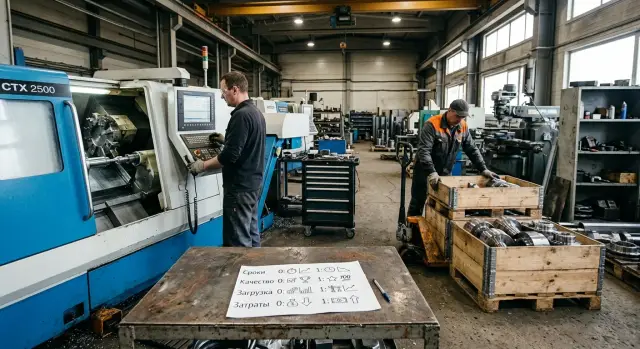
Why this choice is often confused
When a shop chooses between having its own machine and using a contractor, the decision is often made under the pressure of a single urgent order. You need to ship a batch quickly, and the short path is tempting: either urgently find contract manufacturing or buy a machine so you won’t depend on anyone. Both options can look sensible if you only consider this week.
The problem is that the unit price rarely shows the whole picture. A contractor’s price list may look calm, but it hides queues, transport, incoming inspection and rework if a dimension drifts. With your own equipment the opposite mistake happens: people only count the machine price and forget about tooling, fixtures, trial runs, downtime between batches and operator time. On paper one option looks cheaper, but three months later the result can be the reverse.
Yearly planning makes the confusion worse. Load in spring is different from autumn, and winter orders may fall or suddenly spike. If you calculate from one lucky month, the estimate almost always misleads. A small shop sees 70% load today and thinks a new machine will pay off quickly. Then two big clients shift the schedule and the machine sits idle part of the time. The same happens with a contractor: in a quiet month everything is smooth, but in season lead times stretch.
Another trap is relying on a single good experience. A contractor once produced a complex batch on time and without defects. That’s a positive sign, but it doesn’t answer other questions. What happens with a series of repeat orders? How will they act in peak season? Who will take an urgent rework if the drawing changes mid-process? One successful case does not replace a system.
This is common in metalworking. The mistake is usually not in the technology itself but in a short planning horizon. If you look not at one stressful order but at least 12 months, the picture becomes noticeably more honest.
How the two paths differ in practice
Buying a machine immediately changes the shop’s rhythm. The equipment is on your floor, so you decide when to run a batch, where to place an urgent job and how much time to allow for changeovers. If a client asks in the evening for 20 more parts, the answer depends on your shift, not someone else’s queue.
But a machine doesn’t run by itself. You need commissioning, tooling, programs, an operator and a clear maintenance schedule. Even if the vendor helps with startup and service, you still need someone inside to monitor the first batch, cutting conditions and defect rates.
Contract manufacturing is easier at the start. You don’t have to buy equipment immediately, recruit an operator or keep tooling for every task. For a new product or irregular orders this is often more convenient: you send the drawing, agree requirements and receive finished parts.
In practice the difference shows up in a few areas. Owning a machine gives fast access to production for urgent orders, but requires ongoing attention to setup, service and people. A contractor relieves some startup burdens but adds queueing, transport and extra approvals.
The most noticeable hidden difference is in the small details. Working with a contractor consumes time not only for cutting metal. Hours go to sending drawings, clarifying tolerances, agreeing material, packing, transportation and acceptance. If the first batch has a deviation, the cycle restarts.
A simple example: a small shop needs bushings monthly and occasional urgent reworks between batches. A contractor will cover planned volume without extra investment. But if the customer frequently changes dimensions and asks for “next-day” shipment, owning a machine gives more freedom and fewer headaches.
One option buys control. The other gives a flexible start. Which is better depends on where your pain points lie: deadlines, people or approvals.
How lead times affect the decision
Lead times often decide faster than price. It’s important not only when you get the first batch, but how quickly repeat orders flow in 2, 4 and 8 months.
With contract manufacturing the first batch often comes faster. The contractor already has machines, staff and a working route. But on repeat orders the picture can change: you enter someone else’s queue, renegotiate dates and depend on their load.
With a new machine it’s the reverse. Before launch you lose time on delivery, trial parts and program tuning. After that, repeat orders usually proceed more steadily: the part is already mastered, fixtures are in place and the schedule is under your control.
First batch and urgent orders
It’s common to count routine and urgent orders together, but they should be considered separately. If 90% of the work can be planned two weeks ahead, a contractor can meet demand without pain. If urgent jobs arrive weekly, an external provider will slow the whole area.
Ask yourself a simple question: how much time is spent around the machining, not on machining itself? Include changeovers, transport to and from the contractor, incoming inspection, agreeing corrections for the first batch and waiting for a slot. Sometimes cutting takes six hours while logistics and acceptance eat three days. On paper the contractor looks fast, but in practice it’s not.
What happens in peak season
The worst failures usually happen not in quiet months but at peak load. If a contractor serves several large clients, your order can easily drop in priority. If the machine is on your floor, the risk is different: a breakdown, lack of an operator or delayed tooling.
It’s useful to calculate the bad-case scenario. How many days will you lose if your machine stops? Three days, a week, more? Discuss this when buying: service speed and commissioning affect real startup as much as the machine price.
A practical rule: if you need a fast first batch, a contractor often wins. If you need predictable repeats and quick reaction to urgencies, an owned machine usually gives a firmer schedule.
Who keeps quality under control
When a part falls out of tolerance the issue rarely comes down to the machine alone. More important is who notices the deviation first and who stops the run before scrap accumulates. If this isn’t defined in advance, disputes begin at the worst possible moment.
On your floor problems are usually spotted sooner. The operator senses a change in the tool, the setter notices size drift after warm-up, and the inspector can recheck the first part right at the machine. This doesn’t eliminate errors, but often reduces their scale: instead of twenty bad parts you lose two or three.
With contract manufacturing it’s different. A contractor may keep good standards, especially if they have established controls and clear acceptance procedures. But if a batch arrives out of tolerance, time is spent not only on inspection. You must agree who is at fault, what counts as scrap, who pays for rework and when replacements ship.
At startup answer a few simple questions. Who measures the first part after setup? Who authorizes running the series? Who checks sizes mid-shift? Who decides if a size starts drifting? These look like formalities until the first failure.
Suppose a contractor shipped 300 parts and your incoming inspection found a one-dimension shift. Then follow returns, sorting, re-measurement and new logistics. Even if the contractor admits the error, you still lose days.
In-house control is usually costlier in people and time but clearer to manage. You decide how often to measure, when to change a tool and when to stop production. This matters when size drifts gradually during a shift rather than failing suddenly.
Before doing economics, add returns, rework, re-inspection and downtime caused by delayed batches to your spreadsheet. These costs often break the contractor’s attractive on-paper price.
If you have tight tolerances, frequent setups or costly assembly downtime, internal control usually brings more peace of mind. If the part mix is steady and the contractor reliably holds dimensions and quickly resolves disputes, outsourcing can work fine too.
How to calculate annual workload
When choosing between your own machine and a contractor, count annual workload by month, not as a single number. Averages almost always hide trouble: over the year the machine may seem acceptably loaded, but in two or three months the shop is pushed to the limit.
Start with a simple 12-month plan. For each month list which parts you’ll make, quantities and required delivery dates. This reveals not only volume but the rhythm of work.
A table needs only five columns: part name, planned monthly quantity, delivery deadline, whether the order repeats or is one-off, and the machine you plan to use.
Count recurring items separately from one-offs. Series parts give clearer load because the cycle and setup are known. One-off jobs look attractive on paper but often consume time for setup, trial parts and program adjustments.
Then split cutting hours and setup hours. This is where mistakes are common. A manager sees 120 hours of pure cutting and thinks the month is nearly empty. But if that month has 18 different batches, setups, tooling and first parts easily add 40–60 hours.
Compare average load and peak load. If average is 65% but some months hit 95% or more, that’s a risk. Any delay in material, tooling or inspection will immediately shift shipments.
Add often-forgotten items: staff vacations, operator training, repairs and scheduled maintenance, time to commission a new machine and the first weeks of tuning the process. For new equipment this is critical. Even with good vendor support a shop doesn’t reach full pace on day one.
If after this the machine is consistently busy at least 70–75% without peak overload, buying looks reasonable. If load is spiky with gaps and short bursts, contract manufacturing usually brings less risk and fewer wasted costs.
Example for a small shop
Imagine a small shop turning bushings and shafts for construction equipment. Orders are light in winter, increase in spring, and urgent add-ons come in summer that must be handled quickly. In this case decide by repeatability and time losses, not by mood.
Using a contractor looks convenient until the schedule starts shifting. The price may be fair, but if shipments are repeatedly pushed two weeks your shop loses not only the deadline but also freedom to act. Deadlines then depend on an outsider’s queue, not your foreman.
For bushings and shafts this is clear: parts seem simple but are often ordered in batches with predictable geometry. If the same series repeats nearly every month, an owned machine pays off not just on paper but in practice: setups are not reinvented, the operator holds the size faster and inspection stays inside the shop.
Check three things: which items the shop makes almost every month, how many days are lost to contractor delays, and what the machine’s utilization looks like in quiet months, not only in season.
If there is steady load for most of the year, buying is reasonable. If the spike lasts only two or three months and then the machine is idle, the investment may be unnecessary.
A mixed approach often makes the most sense: do recurring bushings and shafts in-house to keep lead time and size under control, and send peak summer orders and rare parts out. This reduces contractor dependence without buying excess capacity for a short season.
Such examples show the real picture: not every owned machine is profitable, and cheap contract work quickly becomes expensive if it disrupts the monthly plan.
How to decide step by step
Decision gets easier when you move from “I feel” to numbers across 12 months. One stressful month easily pushes you to buy a machine or outsource everything, but that’s almost always a poor basis.
First separate recurring parts from one-offs. If the same group of parts comes every month with similar tolerances and stable volumes, it strongly favors buying. If orders constantly change and batches are small, contract manufacturing often carries less risk.
Then count not only the part price. A missed shipment, urgent rework, re-inspection, extra logistics and assembly downtime also cost money. If one delayed batch costs, for example, 800,000 tenge, a cheap contractor no longer looks so cheap.
A five-step approach helps:
- Take the 15–20 most frequent parts and see how often they repeat per year.
- For each group estimate losses from scrap, delays and urgent starts.
- Compare three scenarios: buy the machine, outsource, or split the flow between them.
- Check commissioning separately: who installs equipment, trains the operator and provides service.
- Decide for a year and set a review date, for example in 3 or 6 months.
On step three many shops first see the real picture. Buying includes not only the machine cost but tooling, fixtures, floor space, an operator, setup and service. Contracting adds dependence on someone else’s schedule, transport time and the risk that urgent jobs fall into their queue. A hybrid scheme often feels calmer: you keep recurring parts in-house and outsource peaks and rare items.
Don’t skip the commissioning step. Even a good machine is useless if no one manages startup and training. If you’re evaluating equipment in Kazakhstan, discuss the whole introduction cycle with the vendor. EAST CNC’s offering includes consultation, selection, delivery, commissioning and service, and such things strongly affect the real production start.
A simple guideline: if the machine will be busy almost every working day across the year, buying is usually justified. If usage is jumpy and the part mix varies, a contractor or hybrid approach usually offers a calmer outcome.
Costly mistakes
The most common mistake is simple: buying a machine for one rare part. On paper it looks logical—there is an order, a drawing, a clear volume. But three months later that part drops in priority, the machine stands idle and carries monthly costs.
This error happens when people compare options only by the current project. Keep the horizon at a year, not a single urgent job, or a one-off task will dictate the whole budget.
A second expensive mistake is looking only at the hourly rate. A low contractor price or an attractive machine payback doesn’t prove anything. If parts come back with defects, the operator spends extra time on tuning, or a batch goes to rework, real cost quickly rises.
Always count quality control in money and time. One percent scrap on a simple part is tolerable. One percent scrap on a complex tight-tolerance batch can erase the savings promised by a low price.
Don’t rely on average utilization. The average hides unpleasant peaks. In April the machine may idle, and in September the shop can’t meet orders. The same applies to a contractor: available in quiet months, postponing jobs in high season.
Also avoid giving all volume to one contractor. While things go well this is convenient. But one breakdown, tooling supply failure or priority shift at the partner and your lead times slip.
Always have a backup plan. It can be simple: a second contractor for some part families, time buffers for critical batches, a clear plan what to keep in-house and what to outsource, and a list of parts that can quickly shift to another route.
This is especially visible with seasonal orders. A small shop may be quiet one month and then receive in two weeks a volume that breaks the schedule. Without a backup the choice becomes panic, not economics.
A solid decision rarely rests on a single number. You need three things: real workload, clear quality control and a fallback plan for failures.
Quick checklist before deciding
If you’re stuck, do a short check on one sheet. It quickly removes debates and shows your weak point: lead times, quality, load or people.
First gather actual parts for the next 12 months. You need at least five data points: part ID, monthly volume, material, tolerances and desired delivery date. Without this comparison slips into feelings.
Then verify five items:
- Calculate annual volume per part group. If 2–3 items repeat steadily and occupy a significant part of the month, buying looks clearer. If orders fluctuate, a contractor often brings less risk.
- Fix how much delay you can tolerate — not “as fast as possible”, but for example up to 3 days without breaking assembly.
- Write down how you’ll accept parts: which dimensions you measure, how, how many pieces per batch and who signs acceptance.
- Appoint one responsible person. For a new machine this person leads commissioning, training and the first batches. For outsourced work they manage schedule, drawings and quality issues.
- Prepare a fallback for peak season.
A small example: the shop makes recurring bushings and flanges, but receives a sharp spring growth. On paper the machine is 70% loaded and buying seems easy. But if a new part is being set up at the same time, without a backup contractor the shop can miss deadlines.
This check won’t give a perfect answer but quickly shows where the cost of error is highest. If you can’t clearly describe acceptance, allowable delay and a peak reserve, it’s too early to decide.
What to do next
First collect facts on a single sheet. One table shows more than five conversations and a couple of gut feelings. For each option write annual volume, deadlines per group, scrap rate, downtime, hourly cost, setup cost and supply risk.
Then see where money leaks now. Usually the problem isn’t the part price itself but queueing, rework due to scrap or idle time when the machine exists but has no work. Count honestly and the choice becomes much clearer.
Ask four questions: which parts are series items each month and which are one-offs; how many days are lost waiting for a contractor; what does one case of scrap or urgent rework cost; and is there enough load for the machine to run most of the month?
If numbers show a stable series, clear load and notable losses when outsourcing, buying can be reasonable. If clarity is absent, don’t try to solve everything at once. Often it’s better to keep series parts in-house where lead-time and quality matter, and outsource rare items. This hybrid approach reduces risk and avoids an expensive mistake.
Recount numbers in 2–3 months. If queues shrink, scrap decreases and load stays at the needed level, you’ll have a working basis for the next step instead of an opinion.
FAQ
When is owning a machine usually better than a contractor?
Owning a machine usually pays off when the same parts are produced almost every month and urgent jobs come frequently. You can schedule batches yourself, keep setups on hand and be less dependent on someone else’s queue.
When is it better to outsource parts?
Contract manufacturing suits one-off, rare or new parts when volumes fluctuate and the shop doesn’t have steady annual load. This way you avoid investing in a machine, tooling and staff before it’s necessary.
Why can't you look only at the part price?
Because the part price never shows all surrounding costs. Delivery, incoming inspection, agreeing corrections, returns and urgent rework quickly add to the apparent cost.
How to honestly calculate a machine's annual workload?
Count month by month for 12 months, not a single yearly average. Separately include cutting hours, setup, the first part, maintenance, staff vacations and time needed to start new jobs.
Which is better for urgent orders — own machine or contractor?
If urgent jobs occur often, owning a machine is typically more convenient because you decide what to run today. A contractor works when their schedule allows, so they fit rare urgencies better.
How do I know a contractor is harming lead times?
Look at actual schedule shifts over recent months, not promised lead times. If you regularly lose days waiting for an available slot, transport and re-acceptance, the external route is already slowing your shop.
Who controls quality better?
On your own shop you usually notice dimension drift sooner and can stop a run before many parts are scrapped. A good contractor can keep steady quality too, but disputed batches cost more days for returns and replacements.
Does a hybrid approach make sense?
Often yes. Make repeat parts in-house and send peak-season and rare items out. This reduces dependency while avoiding buying too much capacity for a short season.
What to check before buying a new machine?
First check demand and the commissioning plan. You need an operator, tooling, fixtures, floor space, a CAM program and a clear service plan—otherwise the machine won’t reach required throughput.
What should I ask the supplier before buying?
Discuss the full cycle, not just price and model. If you work with EAST CNC, clarify consultation, selection, delivery, commissioning and service — these aspects strongly affect the real production start.
How to decide after comparing numbers?
If the same parts repeat monthly with stable volumes and you have noticeable losses caused by outsourcing, buying can be reasonable. If the picture is unclear, keep recurring items in-house and outsource one-offs.
When is buying a machine justified?
If a machine will be busy most working days across the year, purchase is usually justified. If workload is spiky with long idle periods, contracting often carries less risk and fewer fixed costs.