
Minimum Quantity Lubrication (MQL): When It's Better Than Flood Coolant
Minimum Quantity Lubrication (MQL) reduces mess and fluid use where flood coolant doesn't provide a clear benefit. We review materials, operations and the limits of the method.
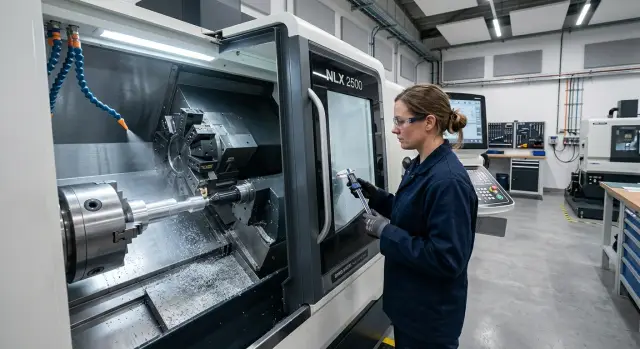
Why the same process gives different results
The same cutting settings can behave differently even on adjacent machines. On one machine the chip comes out dry and short, and the cutting zone stays visible. On another everything sprays out: splashes on the guard, mist in the air, a puddle at the door.
Usually the reason isn't a single setting. Material, chip form, tool geometry, feed and how the liquid or oil reaches the cutting zone all affect the outcome. If the jet misses the cutting edge, the coolant no longer works as the operator expects. It just washes the inside of the machine.
Many operators expect coolant only to cool, but that's not enough. In some operations the tool needs a thin lubricant film at the contact point to reduce friction and prevent built-up edge. In others you first need to remove chips quickly, otherwise they get back under the edge and spoil the surface. That is why identical spindle speed and feed don't guarantee the same result when fluid delivery is different.
This is most visible on aluminum. If chips are light and the tool is sharp, MQL often performs cleaner than a continuous flood. The oil reaches the cutting area and doesn't turn small chips into a sticky wet mass. The machine stays drier, and so does the floor. But in a deep pocket or where chips don't evacuate by themselves, a fine oil mist is not enough.
Another common mistake is choosing the delivery method out of habit. If a shop always used heavy flood in an area, they keep it even where it only spreads mess and increases fluid consumption. Conversely, MQL is sometimes applied for cleanliness even when the operation actually needs strong heat removal or active chip wash.
In practice it's more useful to look at what specifically interferes with this operation. If the tool overheats, you need heat removal. If material sticks, lubrication comes first. If chips clog the cutting zone, the deciding factor is how quickly they are taken away from the tool, not the system name.
What changes when you replace flood coolant with MQL
With MQL the cutting zone receives not a coolant bath but a very small dose of oil in a compressed-air jet. The goal is different: not to soak the tool, but to deliver lubricant precisely to the contact between the edge and the metal.
The practical difference is large. Flood coolant works in liters per minute and handles cooling, heat removal and chip wash. MQL works on a different scale: milliliters rather than liters. There is almost no strong cooling, but friction is often noticeably lower.
This changes the process logic. If the operation mainly suffers from dry friction, built-up edge and material sticking, MQL often gives a cleaner cut and steadier running. If the metal holds heat in the cutting zone for a long time, a little oil is not enough and flood coolant usually behaves more stably.
Put simply: MQL wins where lubrication matters more than cooling. You can spot this by tool wear. If the tool is not failing because it 'burned' but because material is sticking, rubbing and tearing the edge, MQL is often more beneficial.
Switching to MQL changes more than the cut. There are fewer puddles and drips on the machine, chips come out drier, the work area is easier to inspect and the operator spends less time cleaning. This is especially noticeable at the end of a shift: with flood coolant the area around the work is often a liquid suspension, while with MQL the edge and chips remain visible. Such small differences help a lot: built-up edge, tool wear and feed problems are easier to detect in time.
But the approach has a hard requirement: the oil must reach the cutting zone precisely. If the nozzle looks away, the effect quickly disappears. Flood coolant can partly forgive a mis-aim because of the volume; MQL requires accurate setup.
Which materials benefit most from MQL
MQL works best where the tool needs a thin lubricating film rather than a large volume of coolant. If the material does not overheat the edge quickly and chips evacuate without clogging, the process often becomes cleaner and coolant consumption significantly drops.
Aluminum, steel and cast iron
Aluminum and many alloys respond well to MQL. In drilling and milling a thin oil film reduces sticking on the edge and helps chips leave the tool. As a result surfaces are often smoother and the work area cleaner than under a continuous flood.
Aluminum has a weak spot — long sticky chips. If they collect in a pocket, wind around the cutter or clog a deep hole, you must change the approach. MQL barely washes chips away, so lubrication alone may be insufficient in such cases, even though the material itself cuts easily.
With steel the picture is calmer. Common structural and low-alloy steels often run fine with MQL at light and medium regimes, especially when the tool is sharp, the overhang short and the feed not overloaded. Shops get less mist and less dirt, and coolant consumption falls without clear loss of quality.
Cast iron often asks for less flood. It forms short chips and the graphite content helps cutting. Pouring a lot of coolant can turn dust and fine chips into an abrasive muddy slurry that is hard to clean from the machine and guides.
Stainless steel and titanium
Stainless steel is more demanding. It heats the edge quickly, produces stringy chips and tolerates weak heat removal poorly. MQL may work for light finishing passes, but the process window narrows quickly once load increases.
Titanium is even more restrictive. It traps heat near the cutting edge and tools wear faster. For long operations, heavy removal or difficult chip evacuation, flood coolant is usually more reliable.
In practice choice almost always boils down to chips. If chips are short and dry, MQL often performs well. If they are sticky, stringy and prone to snagging, solve chip evacuation first, then count fluid savings.
Which operations most often favor MQL
MQL performs best where precise lubrication of the cutting zone is needed rather than a large volume to cool and wash chips. Typically these are fast operations with good chip evacuation and short contact time between tool and metal.
Drilling often shows the benefit immediately. For through-holes of small and medium diameter MQL reduces sticking to the drill and keeps the work area cleaner. This is especially handy on aluminum and other ductile materials, where flood coolant often spreads mess over the table while delivering less benefit than expected.
In milling MQL works well for face milling, edges and shallow pockets. When the cutter throws chips out quickly, a thin oil film is often enough. On these passes you'll commonly see two things: smoother cutting and a large drop in coolant use.
There's a caveat with pockets. If a pocket is deep and narrow and chips accumulate inside, minimal lubrication may not suffice. Flood coolant or at least a precisely targeted air blast often behaves more calmly there.
On turning MQL is more suitable for short passes: facing, chamfering and finishing. When the tool is in cut for a short time, lubrication reduces friction and the part stays cleaner. For long heavy cuts in ductile metal the situation changes: heat builds up and flood coolant usually keeps the process more stable.
Interrupted cuts generally pair better with MQL than long heavy continuous cuts. Between impacts the tool can cool slightly and the thin oil dose works more effectively. Continuous deep cuts build heat faster and require a more careful selection of parameters.
Threading deserves caution. Cutting threads with taps or thread mills can work well, but this operation should be tested separately for each part. Many factors matter: material, thread pitch, depth and chip outlet.
A short guideline: through drilling, milling faces and edges, shallow pockets and short finishing turning passes are good candidates for MQL. Deep drilling and long continuous cuts should only be converted after testing.
A good sign for MQL is simple: chips evacuate freely, the tool does not overheat and surface quality is maintained. If even one of these falls off, flood coolant is the safer option.
Where flood coolant remains the better choice
MQL is not always the winner. If temperature in the cutting zone rises quickly and chips evacuate poorly, a conventional flood usually gives a calmer and more predictable result.
This is most apparent in heavy roughing of steel and stainless. When large amounts of metal are removed, the tool stays in contact with the part for long periods, heat accumulates without pauses and a thin oil film is not enough. Flood coolant not only lubricates but also actively removes heat. In these regimes that often matters more than saving fluid.
Deep drilling typically remains a flood-coolant domain. In a long hole chips rub on the flutes, re-enter the cutting edge and clog the channel. MQL may not handle chip removal well, especially with small diameters and ductile materials. Flood coolant, though rougher, washes chips away and reduces the risk of drill breakage.
The same applies where fine chips must be constantly swept out of the working area. In pockets, slots and small cavities chips tend to linger near the tool and the cutter begins to cut a mixture of metal and chips. Surface quality degrades quickly and the edge wears out earlier than expected.
Flood coolant usually wins where there is deep drilling with poor chip exit, heavy roughing with large allowances, long continuous cuts without cooling pauses and ductile materials that produce stringy chips. It is also needed when you must constantly flush chips from the cutting zone.
Long turning passes are a special case. In continuous, high-feed cuts the insert heats rapidly. At first MQL may seem to hold and reduce fluid consumption. Later tool life falls, size drifts and inserts must be changed more often. Any fluid saving then disappears.
You usually spot trouble by simple signs: the cutting edge darkens, chips change color, the surface tears and cutting sound becomes harsher. If the process reaches this point, return to flood coolant and consider not only fluid savings but tool life, cycle time and scrap rate.
A practical rule: if the process suffers more from heat and poor chip evacuation than from mess, flood coolant is the more sensible choice.
How to test MQL on your shop
Start with one part where the cycle is well understood and any scrap is easy to detect. Choose a regular part rather than the hardest one; a machined aluminum housing or repeated drilling in a serial batch is a good example.
The first test should be conservative. Don't change tool geometry, feed or speed at the same time as switching the lubrication system. If you switch to MQL and change the cutter on the same day, you can't fairly compare it with flood coolant.
Before starting, check the actual oil delivery to the cut. The nozzle must target where the tool enters the material, not towards the chip flow or the machine body. Inspect the spray cone before cutting: if it is ragged, too wide or barely visible, the test will likely give misleading results.
Compare not impressions but a few simple measures: how many parts a tool runs before noticeable wear, whether the surface comes out cleaner, whether the work area stays dry and visible, and how much cutting fluid and oil were used per shift.
Don't judge by the first successful part. One part often looks fine even with a suboptimal setup. A realistic picture requires two or three shifts, preferably on the same batch and with the same quality requirements.
Keep a short log. Note date, material, operation, tool, cutting data, nozzle position and wear outcome. Five minutes of recording later shows why one test worked and another failed.
If after two or three shifts the tool life is no worse, parts stay clean and fluid consumption drops, you can extend the test to similar operations. If results fluctuate, first correct nozzle aiming and oil dosage; most problems are there rather than with the MQL concept itself.
Common mistakes when switching to MQL
Failures usually come from small settings, not the technology itself. On paper it's simple: less oil, cleaner area, lower fluid consumption. On the machine it's stricter. A mis-aimed nozzle or wrong air/oil mix spoils the first parts.
The most frequent error is nozzle positioning. It is set "about near" the tool instead of aimed precisely at the cutting zone. Then the aerosol goes sideways, the edge cuts nearly dry and the operator concludes MQL doesn't work. On drilling this shows quickly: heat rises, chips darken and hole finish worsens.
A second typical problem appears after an initially successful test. Parameters are immediately pushed up because the process seems stable. But the margin for a clean edge is often smaller than expected. This shows on aluminum and when milling with long overhang: the part may still meet dimension, but built-up edge or small burrs appear.
Oil dosage is also easy to get wrong. Too little oil turns MQL into near-dry machining: the tool keeps cutting but friction increases and surface quality suffers. If the part shows streaks, matte spots or torn marks, first check actual oil consumption and nozzle aim before blaming the tool grade.
Another mistake relates to chips. After switching from flood many expect chips to clear themselves. MQL doesn't wash them away like a flood. So in drilling and deep pocketing check chip breakage and evacuation separately. Long, sticky chips will quickly clog a channel.
One pass proves almost nothing. A valid test needs a series—20–50 parts at least. Only then do you see tool wear, dimensional repeatability and surface cleanliness trends.
Typical failed transitions look the same: the edge loses cleanliness, chips cling to the tool, dimension drifts after several parts, oil consumption is low but wear increases. The first part is often fine, the tenth noticeably worse.
If you watch a series rather than one pretty pass, you find mistakes quickly. Then MQL delivers what it promises: less mess, lower fluid use and consistent results on a production batch.
Short checklist before starting
Before the first MQL trial rule out cases where the system will likely hit overheating or poor chip evacuation. If the material holds heat and the cutting zone clogs quickly, you won't get cleanliness or saving; flood coolant usually gives a steadier result.
Before launching check these items:
- the material must not overheat the cutting edge too fast;
- chips should evacuate freely without accumulating in a slot, pocket or deep hole;
- the tool must be sharp and able to eject chips properly;
- the nozzle must reliably hit the cutting edge;
- the operator should clearly see the cutting zone and be able to remove chips quickly.
A simple test often shows the picture in 20–30 minutes. Use an aluminum part with open milling or shallow drilling, install a new tool, check nozzle angle and watch three things: cutting-zone temperature, chip form and edge condition after a series of passes. If chips are dry, not sticky and don't remain in pockets, it's a good start.
If two or more checklist items fail, don't increase parameters and wait for a miracle. Fix the cause first: change the tool, re-aim the nozzle, reduce overhang or simplify the toolpath. That sequence usually saves both oil and set-up time.
Shop example and what to do next
A small shop turns aluminum bushings in batches of 30–80 pieces. The part is simple: OD turning, boring, facing and sometimes a single drilled hole. With flood coolant the machine quickly gets covered in fine wet residue; sticky grime builds on the chuck and guards and the operator spends time cleaning besides machining.
On such tasks MQL often yields a cleaner, calmer process. Aluminum doesn't like extra slurry on the part: coolant droplets mix with chips and stick to the surface, then interfere with inspection. With MQL the cutting zone stays lubricated but there is no constant wet mist and puddles around the machine. After a batch the part is easier to remove, stack and hand off without extra wiping.
Savings are not uniform. The most noticeable gains are: lower coolant consumption, less cleaning time and cleaner parts after machining. If batches are small, these effects are the most visible. Cycle time may not improve; sometimes tool life changes little, especially if the original settings were already gentle.
Sometimes the difference is barely noticeable. If the bushing is turned quickly and most delay comes from loading and measuring, MQL won't halve the cycle. It simply removes extra wet work around the machine.
For a first try pick a low-risk part: aluminum or another easy-to-cut material, short cycle, open cutting zone and straightforward control of dimension and roughness. It's convenient if you can compare a batch within one shift.
Start with that bushing rather than a complex part with deep holes or tight thermal tolerances. After one or two shifts you can see what changed: cleaning time, how much fluid was added, chip shape and whether size drifts.
If a question remains about where MQL fits and where flood coolant is better, analyze it per operation and per machine. EAST CNC works with machine tools, solution selection and service for shops in Kazakhstan and CIS countries, so such a detailed discussion is usually more useful than general advice.
The main idea is simple: MQL is not inherently better. It works where the process needs precise lubrication rather than a large quantity of fluid. If you first understand what limits cutting in your case—friction, heat or chips—the choice between MQL and flood coolant becomes much easier.
FAQ
When is MQL truly better than conventional flood coolant?
MQL is worth using where the process needs lubrication at the cutting contact rather than heavy cooling. Typical cases: aluminum, light cutting modes in steel, cast iron, open milling, through drilling and short finishing passes.
Can any operation be switched to MQL?
No. Not every operation is suitable. Stainless steel, titanium, heavy roughing and long continuous cuts usually run more stably with flood coolant because it removes heat and chips more effectively.
On which materials does MQL give the best results?
Aluminum often responds well to MQL if chips evacuate freely. Common structural steels can also work fine on light to moderate cuts, and cast iron often needs little flood coolant because it produces short chips and graphite helps cutting.
Is MQL suitable for deep drilling?
Deep drilling is not a good candidate for an immediate switch. In long holes chips quickly clog the flutes, and without a strong fluid flow you risk overheating, built-up edge and drill breakage.
How to test MQL on my shop without unnecessary risk?
Start with a simple, repeatable part whose quality is easy to monitor, and don't change cutting data at the same time. Compare tool life, surface cleanliness, chip shape and how much time is spent cleaning the machine.
Why does MQL sometimes fail on the first parts?
Most often the nozzle is the problem. If oil and air miss the cutting edge, MQL becomes almost a dry operation: heat rises, chips darken and hole surfaces degrade.
Why is the first part good but later size and surface drift?
This often happens when the first part runs on a fresh cutting edge, but lubrication or chip evacuation falls short afterwards. Check performance over a series of parts, not a single piece.
Does MQL speed up machining?
Not necessarily. MQL usually reduces mess, produces drier chips and lowers fluid consumption, but cycle time often stays the same—especially when loading/unloading or inspection dominate the cycle.
Where does MQL work best on a turning center?
On a lathe, MQL works best for short passes: facing, chamfering and finishing cuts. For long continuous cuts in ductile materials, flood coolant is generally safer until proven otherwise by testing.
How can I tell if MQL is suitable for my specific operation?
Look for simple signs: the cutting edge doesn't darken, chips don't stick or clog the cutting zone, the surface remains smooth and tool life stays at least the same. If any of these fail, switch back to flood coolant and investigate.
How many parts should I test to judge MQL reliability?
Compare tool life over a series (20–50 pieces), watch chip behaviour, check surface quality and note how much time is spent cleaning. If tool life drops or chips begin to cause problems, re-evaluate nozzle position, oil dose or return to flood coolant.