
Moving to High-Volume Production: What to Change in Fixturing and Inspection
Moving to high-volume production requires revisiting fixturing, locating, and inspection. Let’s break down what to keep, what to replace, and where time is most often lost.
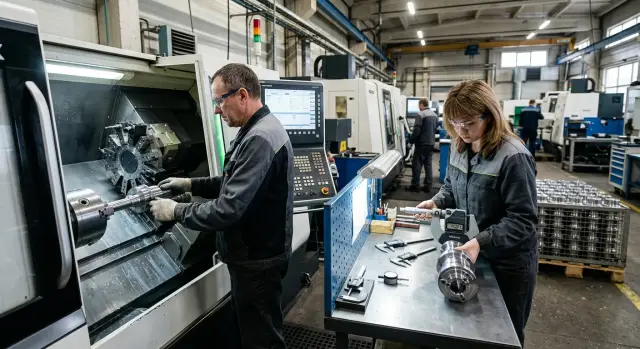
Why a batch of 500 breaks the usual approach
A batch of 20 parts can forgive small imperfections. The operator has time to notice a size drift, adjust the offset, clamp the blank tighter, or measure the part by hand once again. This kind of production depends on the person’s experience, not on a stable process.
When there are 500 parts, the same setup starts to fall apart. A small glitch repeats dozens of times and turns into downtime or a pile of scrap. If the jaws seat the blank a little differently every time, that is no longer a one-off error, but a constant loss of size.
On a long run, the cost of every small detail changes sharply. An extra two minutes for setup on a small batch is hardly alarming. In series production, it eats up a shift. The same goes for inspection: on 20 parts you can calmly check dimensions with a micrometer after a few passes, but with 500 parts frequent machine stops break the rhythm completely.
A large batch quickly exposes variation that used to be tolerated. Blanks do not arrive exactly the same. Tools wear gradually. The chuck, stop, mandrel, and program may each seem fine on their own, but together they create a drifting result. On a short batch, this is often masked by manual corrections. On a long one, the time margin disappears.
A simple bushing is a good example. On 20 parts, the operator checks the diameter every 3-4 parts, sometimes changes the offset, and finishes the order without much drama. On 500 parts, that habit creates a queue of measurements, extra restarts, and fatigue. And fatigue quickly leads to mistakes in series production.
Moving to a large batch is almost always about repeatability, not the machine itself. The part has to seat the same way every time, the fixture has to hold the clamp without surprises, and inspection has to catch size drift before scrap builds up. If that is missing, a batch of 500 breaks the usual approach in the very first shift.
What fails first in the fixture
When a batch grows from 20 to 500 parts, the fixture starts behaving differently. With a small volume, minor deviations are easy to miss. In series production, they build up and quickly turn into scrap, downtime, and extra corrections.
Most often, the clamp gives way first. Soft clamps are convenient during a trial run because they are easy to adjust. But after dozens of cycles, they no longer hold the part the same way every time. The clamping force changes, the part shifts slightly, and the size drifts. On a turning operation, this shows up quickly: one part stays in tolerance, the next one already needs a new correction.
Reference surfaces also cause trouble. Chips, oil, and fine dirt get into support points faster than people expect. A thin chip under the reference surface is enough to raise the part by a few hundredths. On a 20-part batch, the operator can still catch that right away. On 500 parts, the pace is higher, attention drops, and the error repeats again and again.
Manual part loading also breaks repeatability. If the blank comes out of the chuck at a different length each time, the actual machining position changes. A variation of just a few tenths of a millimeter already affects the size, chamfer, or groove depth. Then it is easy to blame the tool or the program, even though the reason is simpler: the part sits differently every time.
A universal fixture rarely helps in series production. It is convenient for small batches because you can clamp different blanks without spending time on separate tooling. But in a large batch, that flexibility only gets in the way. The operator makes extra motions, moves components around, and checks the seating by hand. One extra action on every part turns into a noticeable loss of time by the end of the shift.
Another weak point is tool changes without a rigid stop and without a clear return point. Then every replacement brings a new length or position correction. That is acceptable for a few parts. In a long run, this setup shakes the whole process.
If the size is drifting, first check not the program, but the repeatability of the part’s contact with the fixture. A clean reference surface, a rigid clamp, a fixed overhang, and a clear tool setup usually help more than constant adjustments during the batch.
Where inspection starts slowing production
On a small batch, inspection often depends on the operator’s attention. They measure almost everything, write down the results, and notice problems by eye. On a 500-part batch, that approach starts dragging production down. The machine runs fast, but inspection begins to take over the shift.
The most common mistake is simple: the operator measures too many dimensions on every part. If a bushing needs two fit diameters and a length, there is no need to recheck every chamfer and groove each time. On a 20-part batch, this is still tolerable. On a large run, the machine sits idle, and the person gets tired and makes more measurement errors.
The second problem is the wrong inspection tool. A caliper is convenient as a universal option, but for series checks it is often too slow and not accurate enough. If a dimension repeats hundreds of times, a gauge or go/no-go template is better. One pass with a gauge takes seconds and gives a clear answer without debate: the part passes or fails.
Manual recording also slows things down more than it seems. The operator stops the cycle, measures the part, writes down the number, and goes back to the machine. If this happens dozens of times in a shift, minutes are lost, and then hours. Worse, it is easy to mix up the line, the part number, or the inspection time in the log.
The most expensive failure happens when dimensions are checked only at the end of the batch. Then tool drift or temperature drift is noticed too late. Instead of three bad parts, the shop gets thirty. For a move to series production, a simple rule is usually enough: the first part, then control at a set interval, and a separate check after insert change or setup change.
On a turning section, the working scheme is usually simple. The operator checks only the dimensions that really tend to drift during the run. For frequent checks, a gauge is used instead of a caliper. Results are recorded quickly and in a short form. If a size goes out of tolerance, the supervisor gets the signal right away.
Another cause of delays is unclear roles. The operator sees a questionable dimension, puts the part aside, and waits. The supervisor is busy. The inspector will come later. Meanwhile, the machine may keep making the same scrap. A clear order is needed: who stops production, who confirms the measurement, and who gives the correction instruction. Otherwise, inspection on a batch turns into a queue of questions.
How to reorganize the process
When the batch grows, the process has to be rebuilt, not just run longer with the same cycle. On 20 parts, you can rely on the operator’s experience. On 500, that approach almost always causes extra stops, size variation, and arguments at the machine.
First, split the dimensions into two groups. The first includes everything that affects fit, concentricity, runout, and assembly. The second includes dimensions that matter, but will not ruin the part immediately. Both groups need checking, but at different intervals.
Then remove the manual actions the operator repeats on every part. If they are moving a stop, adjusting a shim, or setting a clamp to a mark every time, the problem is not the person, but the process. For series production, it is better to build a clear fixture once than to hope for care 500 times.
Rigid reference surfaces and the same clamping force give a quick result. If the part lands in the same place every time and is clamped with the same force, the variation drops immediately. On a turning operation, this often solves half the problems before the cutting parameters are even tuned.
How to assign inspection
The inspection frequency is better chosen by risk, not by habit. A critical diameter can be checked on the first few parts in a row, then every 5 or 10 parts. A secondary dimension may only need to be checked every 30 or 50 parts. Using the same pattern for every dimension only slows production down.
The first 10-20 parts should be checked more closely than usual. At this stage you can see how the tool behaves, whether the unit heats up, and whether the size shifts after changing the blank. If the process stays stable, it is better to lock it into one mode: the same reference surfaces, the same clamp, the same control points, and the same correction limits.
If the size drifts, you need a short instruction without arguments or guesses. It should clearly say who stops the machine, which dimension is rechecked first, what correction can be made without the supervisor, and how many following parts are checked in a row. For a simple bushing, that is already enough: the outer diameter is under more frequent control, the end face and chamfer are checked less often, the clamp is set against a rigid stop, and the operator has one rule for when a deviation appears.
Example: a bushing, 500 pieces instead of 20
Let’s say the shop is turning a simple bushing on a CNC lathe. On a 20-piece batch, the operator can work almost in manual mode: after a few parts, measure the size, adjust the offset a little, and start the cycle again. It is slow, but acceptable.
On a 500-piece batch, the same approach breaks down quickly. The machine stops all the time, the operator gets tired, and the result does not improve. The size seems under control, but the output comes in bursts, and scrap still slips through because inspection turns into constant fuss.
Very often, the first problem is not the program at all, but the blank feed. If the overhang is slightly different every time, the part length drifts, the chamfer behaves differently, and the tool takes on extra load. A simple mechanical stop removes that variation. The blank seats the same way every time, and the process immediately becomes calmer.
Then you change not the whole inspection, but its form. The internal diameter is easier to check with a go gauge than with a micrometer after every part. The operator spends seconds, not minutes, on the check. They do not argue with the instrument reading and do not lose pace on unnecessary movements.
The working scheme for such a bushing usually looks like this: the first 3-5 parts are checked more closely to catch startup deviations; after that, you move to sample inspection, for example every 25th part; a separate check is done after insert change or bar-feed setup; if the size drifts, you stop and check several of the last parts, not just the current one.
This kind of routine keeps the pace and does not let scrap spread far through the batch. If the 25th part is out of tolerance, you check a short section between two control points instead of searching for the problem among hundreds of bushings.
That is what moving to large-series production really means in practice: not measuring more, but reducing variation in locating and cutting down the time spent on routine checks. For a batch of 20, manual adjustment can still save the day. For a batch of 500, you first install the stop, then speed up inspection, and only after that look at more complex fixture changes.
Mistakes that stop a series run
A series rarely stops because of one big reason. More often, it is broken by habits that worked fine on a batch of 20 parts, but on 500 start eating up time, tooling, and patience.
The first mistake is keeping the old fixture just because it already exists. On a small batch, the operator can still tweak the setup, tighten the clamp, and catch the size with a correction. In a large batch, that approach quickly creates uneven clamping, throws off part locating, and causes repeated setups. If the fixture needs constant tightening and adjustment, it is no longer suitable for series production.
The second mistake is trying to measure every dimension on every part. It sounds safe, but in practice inspection on a batch turns into a bottleneck. The machine waits, the operator gets tired, and inspection still does not prevent a system error. It is much smarter to group dimensions by frequency: some are checked during setup, others at a set interval, and the most sensitive ones stay under tighter control.
The third mistake seems minor, but it is often what causes the series to drift by the middle of the shift. The reference surfaces are not cleaned during the run. Chips, oil, and fine dirt change the part’s seating by fractions of a millimeter, and the size starts wandering without an obvious cause. Then people look for the problem in the program or the tool, when they only needed a clear cleaning routine between cycles.
Another weak point is changing the tool by wear based on guesswork. On a small batch, that sometimes passes. On a long run, this kind of estimate gets expensive: one insert runs 15 minutes too long and drags in scrap, vibration marks, and extra stock removal during adjustment. Series production likes clear replacement intervals, not guesses.
A simple lack of consumables near the machine also hits output hard. If inserts, holders, probes, or fasteners are stored in another area, every small stop drags on. Five minutes of searching can easily become half an hour of downtime in a shift.
Warning signs are usually visible right away: size corrections increase hour by hour, inspection takes more time than machining, reference surfaces are cleaned only after the first bad part, and inserts are changed too late or searched for at the last minute. If that has already started, the series will not straighten itself out. First remove the everyday chaos around the machine, then review the fixture and inspection plan.
How to know what to change first
When moving to a large batch, you should not change the most visible unit first, but the one that most often stops production. One awkward clamp or one extra setup creates more losses than an old but working handle. If parts pile up at the machine, look at the fixture. If the queue grows at inspection, the bottleneck is control.
It helps to watch one shift and note where the minutes go. Usually the problems show up quickly: the operator spends a long time setting the part, adjusting the stop, checking the size after each setup, or waiting for approval of the first good part. On 20 parts, that can still be handled with attention. On 500, that buffer runs out fast.
After that, check what actually gives repeatability in setup. If the part sits a little differently every time, the series will drift in size even if the machine is in good condition. Look at the reference surfaces, stops, clamps, and the setup sequence itself. A good locating scheme removes unnecessary motions and reduces the risk of placing the part incorrectly.
Then calculate the time spent measuring one part. You do not need a spreadsheet calculation; a stopwatch is enough. If inspection takes 2 minutes and machining takes 3, production will soon be limited by measurement, not by the machine. In that case, the first step is to simplify inspection: keep frequent checks only for dimensions that really affect fit and scrap.
Four numbers are enough to choose a priority: how many minutes of downtime the issue creates per shift, how many parts go to scrap or rework, how much a fixture improvement or new inspection method costs, and how many shifts it takes to pay back. Then the comparison becomes realistic. If an improvement costs as much as 30 damaged parts, and you lose 50 in a week, the answer is obvious. If a unit does not affect takt time or size, it is better left alone for now.
First change what keeps the production rhythm and repeatability. Everything else can wait. That order is what most often saves a series run from unnecessary scrap and stoppages.
Quick pre-start check
Before the first long shift, you do not need to check the whole machine. It is enough to go through a few places where series production most often fails. On a batch of 20, small flaws can still be caught by hand. On 500, they quickly turn into scrap, downtime, and arguments between the shift and quality control.
Before starting, make sure of five things. The fixture should clamp the part the same way every time. The operator needs a quick and clear way to clean chips from the reference surfaces. Inspection should be planned in advance: what is measured at the start, what at intervals, and what after a tool change or pause. The supervisor should have enough tools and consumables for at least one shift. And everyone on the shift should know who stops production when a deviation appears.
This list seems simple, but it shows weak points in the process very well. If even one item is covered only in words, the problem will show up within the first few hours.
There is also a simple pre-start test. Run 15-20 parts in a row, then stop, clean the work area, clamp the part again, and repeat the check. If the size holds and people do not make extra motions, the series is ready for normal pace.
What to do next
Do not rebuild the whole shop floor at once. Take one part that has already grown into a batch, or will definitely grow soon. The best choice is a part that is still handled the usual way today, but operators are already losing time on setup, inspection, and tool adjustments.
First, collect numbers across several shifts. Look not only at cutting cycle time, but at the whole path from clamping to final measurement: how many minutes are spent on setup and locating, how often the operator stops the machine for measurement, how many times per shift the tool is adjusted or changed, which dimension drifts most often, and how many parts go to rework or scrap.
That check quickly reveals the weak spot. On a small batch, an extra two minutes for inspection barely matters. On a batch of 500, that is already hours of downtime. The same goes for tooling: a small amount of play or an awkward clamp is tolerable on 20 parts, but on a large run it starts creating size variation and operator fatigue.
After the measurements, make a short list of improvements. A long one-month plan is usually not needed. Most often, a few clear changes are enough: a firmer clamp, clearer locating, a separate template for the first part, a gauge for the frequent dimension, and a fixed tool-change point based on actual tool life.
If the issue still cannot be solved quickly, it is worth looking beyond one operation. Sometimes the problem is not the fixture, but the machine itself, its rigidity margin, or the way the series is started up, which no longer fits the new volume.
In such cases, an outside review of the process can help. EAST CNC, east-cnc.kz, works with CNC lathes and serial metalworking: they help with equipment selection, delivery, commissioning, and service. The company also has its own blog with equipment reviews and practical metalworking advice when you need to quickly check your approach before launching a series run.
A good next step is simple: choose one part, measure the real losses over a week, and approve 3-5 changes before the next batch. After that, it will be clear where the bottleneck is in your shop.
FAQ
What usually fails first when moving from 20 parts to 500?
First check the clamping, the reference surfaces, and the blank overhang. On a short run they still tolerate small variation, but with 500 parts the same variation quickly turns into scrap, extra corrections, and stoppages.
Do I need to change the machine right away if the batch grows?
No, the machine is often not the real issue. First remove manual tweaks, add a rigid stop, stabilize the clamping, and cut out unnecessary measurements. Only then can you see whether the machine can handle the new volume.
How do I know whether the problem is in the fixture and not in the program?
Watch how the part seats in the fixture several times in a row. If the size changes after every new setup, look at the referencing, clamping, or dirt on the supports. If the setup repeats consistently, then check the program and the tool.
Why does cleanliness of the reference surfaces matter so much in a long run?
Set a simple rule: the operator cleans the reference surfaces during the run, not after the first defective part. Even a thin chip under the part can shift the seat by hundredths, and the run immediately starts drifting.
How often should dimensions be checked in a batch of 500?
At the start, measure more closely: the first few parts in a row, then at a clear interval. For dimensions that really tend to drift, keep frequent checks. Measure everything else less often so the machine is not stopped for no reason.
What is better for series production: a caliper, micrometer, or gauge?
If a size repeats hundreds of times, use a gauge or a go/no-go template for frequent checks. Keep the caliper for rough checks, and the micrometer for setup and questionable cases. That way the operator spends less time and makes fewer mistakes.
What should be done after changing an insert or tool?
Make a separate check right away and do not assume the new insert will sit exactly like the old one. Check the size on the first parts after the change, and only then return to the normal inspection interval.
Does it make sense to make a dedicated fixture for one part?
Yes, if the part runs often or the volume has already grown. Universal fixtures are convenient for trial runs, but in series production they add extra motions and more often create inconsistent clamping.
When should production be stopped instead of just adjusting the correction?
Stop immediately as soon as a dimension that affects fit, assembly, or part geometry goes out of tolerance. Then check several of the last parts between two control points to see where the drift began.
Where should I start if I need to get a process ready for high-volume production quickly?
Take one part and one shift. Time the setup, cleaning, measurement, and adjustment, then remove the biggest bottleneck first. Usually the first step is to add a stop, simplify inspection, and keep consumables near the machine.