
Relocating a Machine Inside the Workshop: How to Preserve Accuracy
Moving a machine inside the workshop requires securing components, checking level and running trial parts. We cover the workflow and when a full geometry check is needed.
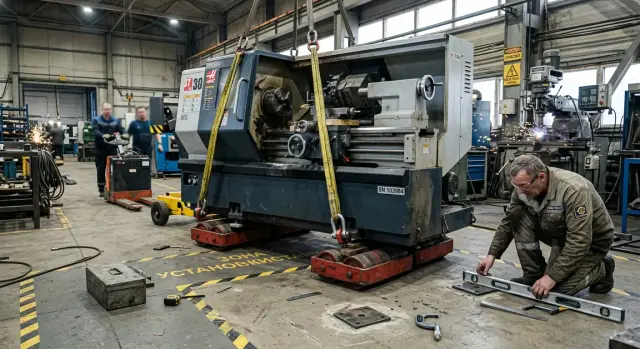
Why accuracy is lost even after a short move
A machine weighs several tons, and even a short move changes how loads pass through the bed, guides and supports. While it stands in one place, the metal has already "settled" under its own weight. When the machine is lifted, put on rollers, or dragged across the shop, the load path changes. After reinstallation it is not exactly the same as before.
The floor also often surprises. A few millimetres difference between the old and new support points already affects the level. If one foot bears more solidly than another, the bed twists slightly. The eye won't spot it, but the spindle and axes will feel it immediately.
Errors rarely show up at the moment of moving. Usually everything appears normal: the machine powers up, axes move, there are no alarms. The shift becomes visible on the first part. After a move a lathe may cut diameter almost as before, but a cone will appear along the length that wasn't there earlier.
Even the same route inside the shop gives no guarantees. Today the forklift lifted a bit higher, tomorrow a little closer to the edge. A wheel might pass over a joint, or the machine could be held suspended longer than usual. Each detail changes load on the frame and assemblies in its own way.
Therefore moving a machine inside the workshop is not just "push it and switch it on." If you don't check the supports, level and basic accuracy after relocation, deviations will show up in production as scrap.
What to secure before starting
Even a short move can shift things that look stationary. The most at risk are assemblies with travel, backlash or their own weight: the carriage, spindle group and axes. Secure them only as the manufacturer prescribes in the manual or passport.
If the machine has transport locks, clamps or service plates, use them. Don’t invent solutions with straps, wooden wedges or random shims — you can easily damage guides, covers or sensors.
Remove everything that can shift or strike assemblies during a jolt. People often forget small items: a tool in the turret, chuck keys, mandrels, a probe, fixtures on the table, removable guards and trays. One forgotten key can cost more than the move itself.
A good habit is to label cables, hoses, connection points and the positions of supports and anchors. That saves assembly time. Even better, photograph everything before disassembly: overall machine view, supports, anchors, shims under the feet, level readings if the machine was previously aligned. Those photos quickly show what changed after installation.
Many assume that moving the machine to an adjacent area needs no preparation. That’s a common mistake. A hard forklift start or passing over an uneven floor seam can apply loads that later shift accuracy.
If you’re unsure about securing points, consult the service documentation or discuss procedure with the service team. For a complex CNC machine this is cheaper than searching for the cause of vibration, cone or dimensional drift after the first start.
How to prepare the new site
The new location often determines whether the machine keeps its accuracy after relocation. Even if the move takes half an hour, a weak floor or an extra slope will later cause bed distortion, vibration and prolonged alignment.
First check whether the area will carry the machine's weight along with fixtures, plates and loads at support points. Don’t rely only on the rated mass. On CNC machines the load is often unevenly distributed; one support can receive noticeably more load than another. If in doubt, verify permissible floor load with the shop engineer.
The area itself must be clean and solid. Remove chips, debris, old shims, oil and anything that could slip under a foot. If the surface crumbles, peels or has already settled, stop the move until repairs are done. A small defect under a support later becomes a geometry problem.
Make a simple layout before starting: mark the machine outline, support points, rigging path and turning space. Leave clearance for doors, service and removing guards.
Check the entire path. Often the obstacle is not the machine itself but a column, cable tray, low crane beam, protruding box or narrow opening. A few centimetres error stops work at the worst moment.
Pay attention to cable runs, air and coolant supply and the control cabinet location. Don’t position the machine so you must route cables through a walkway or force service staff to go around a column.
On floors that host heavy lathes and machining centres, good site prep usually saves more time than the move itself. A well-prepared pad immediately reduces the risk of bed twist.
Step-by-step moving procedure
Even moving a machine 10–15 metres requires discipline, not haste. The greatest problems come not from wheels or pallet jacks but from forgotten air supplies, full coolant tanks, open guards or wrong lift points.
First the team fully prepares the machine for shutdown. Disconnect power, isolate air, detach cables and hoses that may be stretched or broken during movement. If the coolant tank is full, drain or lower it to a safe level. Remove anything inside the machine that can shift and overload during a turn or jolt.
Next remove protruding or easily damaged parts: handles, external guards, trays, thin screens, sometimes individual sensors or hanging assemblies. Protect guides, seating surfaces and the spindle nose with clean covers so chips, dust or accidental hits don't reach them.
Lift the machine only according to the manufacturer's scheme. If the documentation shows specific lifting eyes, a spreader or sling order, do not deviate. Move the machine without jerks, constantly checking the route and clearances. Any haste here will show up later on the trial part.
After placing the machine in the new spot do not fully tighten anchors right away. First set it on supports, check seating, bring it to level and only then proceed to final fixing and reconnection.
What to check immediately after installation
Do not run a part right after installation. First make sure the machine stands level and nothing pulls it to one side.
Start with the level. Check the bed longitudinally and transversely with a precision level at the manufacturer-specified points. Even a short move to a neighbouring pad can introduce a different tilt. A common mistake is leveling, tightening anchors, and then finding the machine "moved" again.
Next check the supports and seating. Each support must actually bear; nothing should hang in the air. Anchors should not distort the bed when tightened. If one point pulls harder than the others, accuracy and axis travel will suffer quickly.
Inspect anything that may have been damaged during movement: cables, cable trays, lubrication and coolant lines, guards, limit switches, guide curtains — everything must lie freely without kinks or tension. If the forklift pressed a guard or cable, the issue may only appear at full axis travel.
Before cutting, run an idle cycle. Move the axes through full travel at low and medium feed, spin the spindle at several speeds without tool or workpiece, and check for jerks, abnormal noise, vibration, alarms, and correct lubrication without leaks.
If the machine runs smoothly without errors, that’s a good sign — but not enough. On a CNC lathe also check reference zeros, return-to-home and basic repeatability with a simple test. Spend half an hour now rather than hunting for the cause of scrap from the first batch.
How to assess accuracy after the first run
After the first start, don’t rush to load the machine into a full production shift. First let it do a simple verification job to see how it behaves after relocation.
Use the same fixtures, the same tool and the same program as before the move. That makes comparisons easier and avoids guessing the source of deviations. If the move was smooth, differences may be small but still measurable.
For the first control, four checks are usually enough: spindle or arbor runout, axis repeatability on a short travel, basic dimensions on a trial part and surface condition after the first cut.
Make a simple trial part: face, outer diameter, a bore or pocket with clear dimensions. Don’t start with complex geometry. If the machine already pulls on basic operations, errors on a complex part will only be larger.
Compare the new measurements to those before the move. Look not only at absolute deviation but at its pattern. If a size consistently shifts in one direction, the cause is often support seating, level or displaced assembly. If scatter varies part to part, look for backlash, runout, clamping issues or repeatability problems.
After the first hour of work listen again and re-check control zones where safe. Extra heat, new noise, jerks on feed and heavy axis motion often tell more than a single successful part.
Record all deviations in a log: dimension, regime, tool, temperature, operating time. Don’t fix things "by eye" at the machine. Quick adjustments mask the root cause and make it harder to decide whether re-geometry is needed.
When a full geometry check is required
Sometimes accuracy doesn’t go immediately after a move. The machine may start normally, pass basic checks and still show dimensional drift in the first production run.
A simple alignment is not enough if the machine was carried with a twist, abruptly lowered, or lifted not at the factory-specified points. The same applies when moving to a new foundation, a soft screed or a noticeably sloped floor. If after leveling the machine still won’t hold size on a trial part, or anchors, supports or antivibration mounts were changed or major assemblies removed, don’t delay a full geometry check.
The most common hidden failure is bed twist. You may not see it externally, but a cone, axial drift or scatter after warm-up quickly appears on parts.
A new site has more effect than it seems. If the machine stood on a solid slab before and now sits on a different base or next to a floor joint, load distribution changes. On a CNC lathe this often manifests as a repeatable error rather than random scrap.
A typical scenario is simple: after relocation the machine is leveled, tool and chuck checked, and the program unchanged — but the trial part is still a few tenths off at one end. In this case endlessly tweaking supports is pointless. Check the geometry.
A special situation is when the machine was partially disassembled during the move. If mechanics removed the tailstock, carriage, column, or support elements, or changed anchoring, the original positions are no longer guaranteed. Then a re-geometry is almost always needed.
If simple leveling doesn’t remove the error, check straightness, parallelism and concentricity, then run another trial part. For these tasks, service support is especially useful.
Where mistakes happen most often
Most problems come not from the rigging itself but from small decisions like "this will do." Accuracy is lost more often due to two or three small mistakes in a row than a single big error.
The first frequent mistake is leaving everything as-is on the machine. Fixtures, blanks, heavy jaws, tool blocks and other extras add weight where it’s not needed. Moving parts take extra load, and guides and fastenings suffer during a jolt. Removing unnecessary items is usually faster than later debugging dimension drift.
The second, cruder mistake is lifting or dragging the machine by non-structural points — covers, doors, the electrical cabinet or a random section of the casing. Externally it may look fine, but later you get misalignment, poorly fitting panels, strained cables and a bed that settles incorrectly. If there's no slinging scheme, stop and confirm the lifting order rather than grab the most convenient spot.
After installation many rush even more. They start the machine and hand it back to production without an idle run or trial part. This is bad practice. First check return-to-zero, axis travel, lubrication, absence of foreign noises and a simple test cut. That launch usually takes less than an hour but can save an entire shift.
Another common confusion is chasing the wrong cause of scrap. After a move a dimension "floats" and the operator starts changing inserts, blaming the chuck or material. Sometimes tooling is the cause, but after relocation the alignment is more often the culprit. If cone appeared right after moving and dimension drift varies by position, check machine seating and geometry first before questioning tool wear.
Usually the one who loses out is not the slow mover but the person who declares the job done too early.
Short pre-start checklist
Before the first cut, don't rush. Even after a short move the machine can look stable but lose precision in details.
First ensure the machine is level and there is no difference in support points. Then check anchors and support bolts: tighten evenly without tilting. Next run axes and spindle idle. Motion should be smooth, without jerks, odd noises, drive errors or unusual heating.
The next step is a simple trial part. Measure not only dimensions but form: runout, taper and repeatability on a second pass. Problems often show up exactly here. Finally hand over recorded notes to the operator: the new installation location, check results, updated offsets and remarks after start-up.
If at least one check fails, do not put the machine into production. One extra hour of checking is almost always cheaper than a batch of parts with dimensional drift.
Keep a consistent inspection template for all relocations. Then mechanic, setup technician and operator focus on the same points and don’t argue from memory. This is especially useful when the shop has multiple machines.
Example: moving to an adjacent pad
A CNC lathe was moved to an adjacent pad because a new line was being launched. The move took about an hour: the machine was shut down, moving parts secured, carefully trundled along the route and set on the new spot.
At first everything seemed fine. The distance was short and shop conditions nearly unchanged, so part of the team expected a quick restart. But the new pad had a slight floor tilt. This wasn't noticed immediately — and that was the problem.
The machine showed no obvious faults. The spindle started, axes moved without noise and there were no screen errors. That makes it easy to assume the move had no consequences. In practice, accuracy can go without alarms.
The first trial bushing showed the issue. The size drifted, and the next part repeated the deviation. That meant it wasn't a bad blank or an operator error. The team stopped and returned to basics: checked supports, level and basic geometry.
They re-set the supports and watched how the machine changed position when anchors were finally tightened. That’s a common moment: you can level the machine, but it shifts slightly during final fixation. After a geometry re-check they ran another trial part. The bushing fell into tolerance and subsequent parts were stable.
This example is sobering. If the floor under the new pad differs in stiffness or flatness, check accuracy even after a short move. Sometimes support adjustment and control measurements are enough. If the deviation remains, check geometry rather than endlessly adjusting program offsets.
What to do after relocation
Work doesn't end after installation. A common mistake is to connect, run an idle test and immediately return the machine to production. Don’t do that.
One person should accept the machine after the move and collect check results. Usually the foreman, setup technician or quality engineer takes this role. Better to assign one responsible person than split tasks — that avoids confusion over who checked alignment, who ran the test part and who released the machine.
Their job is to control the alignment, run the trial part, record sizes and remarks, and then decide whether the machine may enter production.
One trial part is not enough. The machine may hit the correct size on the first cycle and then drift after warm-up, tool change or repeated cycles. Check the first batch — at least several consecutive parts. Until the controller or foreman confirms stability, keep the machine out of the normal schedule.
If doubts about geometry remain, don't procrastinate. Rechecking is almost always cheaper than scrap, urgent rework and downtime. When dimensions float, axes run unevenly, surface finish changes or the operator constantly tweaks offsets without a clear cause, call service.
For consultation, solutions, commissioning and post-installation service in Kazakhstan many contact EAST CNC, the official representative of Taizhou Eastern CNC Technology Co., Ltd. The company works with metalworking machines and maintains a blog with practical materials on this topic, so that contact is useful for heavy CNC lathes, complex fixtures or moves to a new foundation.
A normal outcome after relocation is simple: one responsible person is assigned, measurements are recorded, the first batch is checked and a decision is made. That way the shop works on facts, not luck.
FAQ
Do I need to check the machine after moving it a couple of meters?
Yes. Even moving a machine a few meters changes how loads go through the bed and supports, which can shift level and geometry. First check the seating on the supports and the level, then run the machine idle and make a simple trial part. Only after that should you return the machine to production.
What must be removed or secured before moving?
Remove anything that might shift, hit components or add extra load: tools, fixtures, keys, removable guards, trays and similar items. Fix moving assemblies only with the transport stops and clamps specified in the documentation. Do not replace them with straps, wedges or random shims.
Can I move the machine with fixtures and a full coolant tank?
You shouldn't. A full coolant tank, heavy jaws, mandrels and fixtures add weight and increase load on components during bumps or turns. Drain or lower coolant to a safe level, remove excess items, and only then move the machine. This reduces the risk of distortion and hidden damage.
How can I tell if the new location is suitable for the machine?
Check the floor and the support points, not just the total weight in the passport. The area must carry the load without sinking, should not crumble, and should have no pronounced slope. Before moving, clean the site, remove old shims and oil, check the route and leave room for doors, the control cabinet and service access.
Why does a cone appear on parts after moving?
Most often the bed is slightly twisted because the support or floor is different. The eye doesn't notice it, but the part will show runout along its length. If cone appeared right after moving, first check level, supports and anchor torque. Don't start by adjusting the program.
What should I check right after installation?
Don't cut a part immediately. First check the level at the manufacturer-specified points, make sure each support actually bears load, and ensure anchors are not pulling the bed. Then inspect cables, hoses, guards and curtains, run the axes through full travel and spin the spindle at several speeds without tool or workpiece.
When can I run the first part after moving?
Only after a smooth idle run with no jerks, noise, errors or leaks. Also check return-to-zero and simple repeatability of the axes. If the machine behaves normally, perform a short test run using familiar tooling and program. That makes it easier to see what changed after the move.
How to quickly assess accuracy after the first run?
Use the same program, the same tool and a similar blank as before the move. Then measure spindle or arbor runout, a basic dimension, form and repeatability on a second pass. Don't try a complex part first. A simple sleeve, diameter, face or bore shows loss of accuracy faster.
When is a full geometry check required rather than just adjusting supports?
If simple leveling doesn't remove the error, don't delay. Re-geometry is needed after lifting with a twist, abrupt seating, moving to a different foundation, changing anchors, or removing major assemblies. Also do it when a size consistently shifts to one side while tooling, chuck and program haven't changed.
Who should accept the machine after relocation?
Assign a single responsible person: the foreman, a setup technician or a quality engineer. They check leveling, run the test part, record results and decide whether the machine is fit for production. For heavy or complex machines or new foundations, involve service in advance.