
Modular Fixture or Welded Jig: Which to Choose
Modular fixture or welded jig: we analyze which is more cost-effective for short and medium runs and calculate payback without undue optimism.
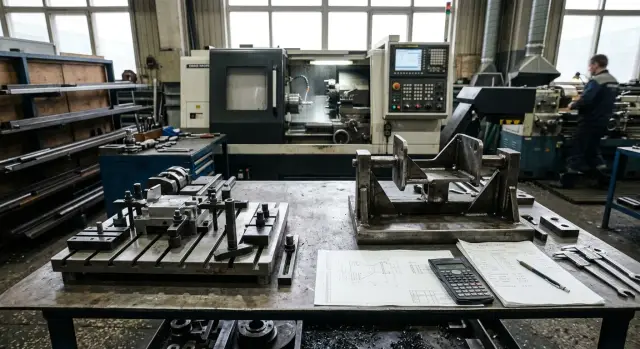
What's the real difference
The difference is simple: a modular fixture adapts to different parts, while a welded jig is usually made for one specific part or a very narrow group of similar parts. That affects not only accuracy but also how quickly a cell can actually start working.
If the part changes often, the modular option is almost always more convenient. You can assemble it, reconfigure it and put it back into production without long waits. With a welded jig it's different: you first need to design it, fabricate it, test it, sometimes rework it, and only then mount it on the machine.
In the debate "modular fixture or welded jig" people often look only at manufacturing cost. That's not enough. A far more useful question is: how often does your part change? If today you're running one batch, next week another, and a month later the drawing is already revised, a rigid one-part fixture quickly becomes a liability.
This difference immediately hits the time-to-first-part. A modular fixture helps get the first good part faster. For short runs this is often more important than a perfectly matched bespoke construction. When an order is urgent, an extra 5–7 days to make a welded jig can cost more than the estimate suggests.
The welded jig has a strong advantage: it often provides a more stable datum for a repeating part. If the process is already settled, this reduces scrap risk and shortens time across identical batches. But as soon as geometry changes, such a fixture stands idle or needs modification.
In practice, look at four things: how often the range changes, how long retooling takes, how many parts are lost at first run, and how many hours the machine waits for a fixture instead of working. While an operator rebuilds a setup or waits for a ready jig, the machine doesn't earn. In machining this becomes obvious quickly. So choose a CNC fixture not by purchase price alone, but by how the solution affects startup, scrap and machine utilization.
What matters for short and medium runs
For batches up to a few dozen pieces the rule is usually simple: if the order is one-off or repeats are uncertain, a modular fixture usually wins. It's faster to assemble and it doesn't tie the shop to a single part or force you to pay for welding, finishing and storage for 20–30 pieces.
A welded jig usually makes sense where the same part comes again and again and the savings per setup become visible in money. If the operator saves 2–3 minutes per piece, that looks good only on paper. For a batch of 15 pieces such a saving rarely covers the cost of making the jig.
Short and medium runs can be divided into three scenarios. First — a one-off order where the priority is to launch the part quickly and not lock capital in fixturing. Second — a repeat order, where you look beyond the first batch to 3–4 identical runs per year. Third — a stable flow, where convenience, setup speed and fixture life become primary.
A medium run alone isn't yet an argument for welding. A batch of 120 pieces looks solid, but the part might receive a new datum, an added hole, or a shifted tolerance on one face. Then a welded fixture must be cut, re-welded and rechecked. A modular fixture is often cheaper in that situation, even if the cycle is slightly longer.
Recurring orders change the picture. If the part returns every two months in a similar form, a welded jig has a chance to pay off. But calculate honestly: not only machining time but also setup, fabrication, inspection after assembly, storage space and the risk that the order will stop in six months.
A useful question for choosing a CNC fixture is: how many identical runs do you realistically expect, not hope for? If the answer is "one" or "maybe one more", the modular option is usually safer and cheaper. If the answer is "we run this regularly without downtime in the schedule", a welded solution can be considered seriously.
When a modular fixture is more convenient
A modular fixture wins where parts change often and a batch doesn't last months. If today the cell machines a housing, next week a flange, then a shaft with a different datum, assembling a new solution from standard elements is usually faster than waiting for a separate welded jig.
The most notable advantage is a fast launch of a new part. The technologist doesn't start from scratch: they take plates, stops, clamps and posts and assemble a scheme for the current geometry. In practice this often saves days, not just hours, especially when an order is urgent and retooling occurs between regular shift assignments.
This fixture type is also good when the clamping scheme is still being refined. The first version is rarely perfect. During trial machining you may find a stop interferes with the tool, a clamp blocks access, or the part is better located differently. In a modular setup you correct this by repositioning elements, not by remaking the whole jig.
A good example is a shop taking short and medium runs of similar housings. Dimensions are close, but holes, windows and datum points differ. Modular fixtures give more freedom. You can reconfigure for the next part without new welding, painting and trimming.
This approach works well if the assortment changes every week or more often, batches are small but sometimes repeat, parts go through trial and correction stages, and machine downtime for startup costs more than the fixture itself.
But flexibility demands discipline. Assembly must be neat: clear assembly diagrams, correct tightening torques, and checking the datums. If the operator assembles "by eye", a modular fixture quickly loses value. Variation appears, repeatability drops, and tuning drags on.
So this approach works better where components are stored in fixed places, simple assembly cards are used and the first part is checked without rush. For many shops with mixed CNC loading this is more practical than making a new welded jig for every new task.
When a welded jig pays off
A welded jig doesn't always pay off. But if a part is produced in repeated batches and its geometry stays stable, this option often gives better results than a universal modular assembly.
Its strong point is stiffness and repeatability for a single task. When an operator places the same part on the same operation day after day, a well-made welded jig eliminates extra moves, reduces datum errors and keeps dimensions more stable.
This is especially noticeable on parts where you cannot reestablish the datum each time without losing time. If the shop regularly machines the same bracket or housing, it's often more convenient to make one rigid setup than to assemble fixturing anew every time.
When the choice is usually justified
A welded jig makes sense if several conditions coincide:
- the part's design doesn't change between batches;
- the machining route has been proven in practice;
- the batch repeats frequently enough;
- the time saving per setup is already noticeable.
The main benefit is narrow specialization. The jig is made for one part or one operation. Therefore the operator places the blank faster and variation between setups is usually lower.
But this solution has its cost. You need time for design, fabrication, assembly and tuning. After first runs shops often still make adjustments: shift stops, change clamps, reinforce weak spots, add tool access. If the part may change in a month, these expenses quickly become pointless.
So a welded jig is chosen not because someone wants to make something "more reliable", but because the process is already stable. If the machining scheme is clear, batches repeat, and every extra minute on setup counts, a welded construction usually pays off fastest.
For CNC machining shops this is often a simple calculation: less setup time, less dimensional spread, fewer manual adjustments by the operator. If these conditions hold for several months, the investment looks reasonable.
What costs are made of
If you look only at manufacturing price, the choice will almost always be wrong. To compare modular fixturing and a welded jig, split costs into one-off and recurring expenses.
Start with the base: buying modular components or fabricating the welded jig. Include design, materials, machining, assembly and pre-run checks. The welded option's upfront sum is often higher if the part is simple. A modular kit's entry cost can be higher too, but parts may be reused in other projects.
What shows up right away in the estimate
After the fixture price comes setup. These are direct costs: how many hours the technologist and setter spend on installation, alignment, trial passes and producing the first good part. Multiply these hours by the machine-hour cost. If the machine is idle for 6 hours, the shop pays not only for labor but also for lost machine time.
For short and medium runs separately count retooling between batches. One extra hour to change a batch seems small until such changes happen ten times a month. Then the difference between "quickly moved modules" and "took off, cut, rewelded, requalified" becomes clear in the numbers.
What is often forgotten
Early estimates rarely include tuning after trial parts, small repairs, storage, labeling and finding fixtures in the warehouse, rechecking after long idle periods, and losses from initial scrap.
Initial scrap should be counted separately, not hidden in the overall sum. On the first parts the shop loses material, machine time and sometimes cutting tools. If the blank is expensive, even 3–5 spoiled pieces noticeably change the payback calculation.
A fair calculation looks like this: one-off costs plus tuning, all retoolings, maintenance, storage and initial scrap. Only then do you see which option is truly cheaper for your run, not just on paper.
How to calculate payback step by step
Payback is calculated on the shop's normal work, not on the best day of the month. To decide whether a modular fixture or welded jig is more profitable you need simple numbers: how many parts you make, minutes per setup, and the cost per machine minute.
A convenient step-by-step approach:
- Calculate the annual volume. If a batch is 80 parts and it repeats 6 times a year, use 480 parts for the calculation. If volume fluctuates, use the lower bound, not the most optimistic plan.
- Measure setup time for the part in both options. Don't use "eyeball" numbers. Time 10–20 setups and take the average. If a modular fixture requires 4 minutes and a welded jig 2.5 minutes, the saving is 1.5 minutes per part.
- Convert those minutes to money using the shop rate. If a machine-minute with operator costs 350 tenge, 1.5 minutes saved on 480 parts gives 252,000 tenge per year.
- Subtract all one-off expenses. Include not only fabrication but tuning, trial parts, machine fitting and small adjustments after launch.
- Check two scenarios. For a conservative case use a smaller volume and slightly more tuning time. For an aggressive case use the planned loading and the real cost of downtime if the launch is delayed.
The formula is simple: payback_period = total_costs / annual_savings. For months divide the annual savings by 12.
For example, a jig costing 900,000 tenge including tuning. With a yearly saving of 252,000 tenge the payback is about 3.6 years. If in an aggressive scenario savings rise to 420,000 tenge, payback drops to about 2.1 years.
If payback only works with full load and no interruptions, the risk is high. If the fixture pays off even in the conservative plan, the decision looks much more sober.
Example calculation for a simple part
Take a simple steel plate for CNC machining: 80 good parts per batch, 6 holes, one reference plane and two faces where dimension matters. The blank costs 6,000 tenge each. Assume a machine hour is 25,000 tenge and an hour of setup and assembly is 18,000 tenge.
Let's count without ideal conditions. For the modular fixture plan assume 2 scrap parts per batch. For the welded jig assume 1 scrap part. This is a typical working margin.
| Cost item | Modular fixture | Welded jig |
|---|---|---|
| First-batch setup | 108,000 tenge | 54,000 tenge |
| Fixture fabrication | 25,000 tenge (wear on kit) | 430,000 tenge |
| Machine time | 24.6 h x 25,000 = 615,000 tenge | 18.9 h x 25,000 = 472,500 tenge |
| Scrap losses | 12,000 tenge | 6,000 tenge |
| Total for first batch | 760,000 tenge | 962,500 tenge |
Why is the modular option cheaper at the start though its cycle is longer? Because the welded frame consumes money before the first part: material, welding, machining of datums, clamps, and inspection. For 80 pieces that is a noticeable sum.
Now add a repeat order two months later for the same 80 parts. For the modular fixture the technician reassembles using the saved assembly card, spends 2 hours and replaces a couple of worn elements. For the welded jig assembly is faster, but you must fetch the frame from storage, check geometry and make minor clamp adjustments.
Second-batch numbers: modular — 36,000 tenge for setup, 10,000 tenge wear, 615,000 tenge machine time and 12,000 tenge scrap. Total 673,000 tenge. Welded jig — 18,000 tenge for setup, 20,000 tenge small repairs, 472,500 tenge machine time and 6,000 tenge scrap. Total 516,500 tenge.
The total for two batches is almost equal: 1,433,000 tenge for the modular option versus 1,479,000 tenge for the welded one. The difference is only 46,000 tenge. That's the honest conclusion: for a single short run the modular fixture is usually financially safer. If the order repeats and geometry doesn't change, the welded jig quickly catches up and may later become advantageous.
Where mistakes are common
When deciding whether a modular fixture or welded jig is more profitable, people most often look only at manufacturing cost. That's the most visible number in the quote, but not the most complete. If you don't add setup time, the first shifts after launch and possible reworks, the calculation almost always leads you astray.
The first mistake is assuming the fixture is ready the moment it arrives at the shop. In reality the operator must install it, set the datum, check tool access, make a trial part and tweak programs. For short runs these hours easily consume the difference between the cheap and the expensive option.
The second mistake appears at first launch. Estimates often assume a too-low scrap rate, as if a new fixture works perfectly from the start. That rarely happens. Even with a good design the first few parts may be used for checks, clamp adjustments or program corrections.
Another common error is not counting downtime while waiting for a fixture rework. This is especially noticeable with welded jigs: if after launch you find interference with a tool or inconvenient datum, the jig goes for rework and the machine waits. On paper the rework looks moderately priced, but in reality shifts are lost and deliveries slip.
People also overestimate volume. They plan a part will run for a year, but after three months the order changes or the model is discontinued. Then the expensive special fixture never pays off. This is a common trap for medium runs: volumes are no longer tiny and you want to "do it properly", but part lifetime is still uncertain.
A more down-to-earth issue is storage. Fixtures take space, must be labeled, transported between cells and rechecked before installation. If a shop has dozens of similar jigs, finding one takes not five minutes but half an hour or more. Over a month that becomes a noticeable time loss.
A useful check is five lines:
- how many hours for the first setup;
- how many parts you truly expect to scrap at launch;
- how many shifts you'll lose if rework is needed;
- what volume is confirmed by orders and what is still just a forecast;
- where the fixture will be stored and who will look for it.
If you don't have precise answers for at least two points, the payback calculation is still raw. For CNC turning shops this is a frequent story: the fixture itself is priced quickly, while everything around it is left for later. True costs hide in those surrounding details.
Quick check before ordering
Before ordering it's easy to look only at price. In practice the choice between a modular fixture and a welded jig usually collapses to a few simple questions. If you don't have answers, you're buying risk, not a fixture.
First check actual output, not the plan. If you truly will make 300–500 identical parts in 12 months, an expensive rigid fixture may pay off. If the batch repeats monthly and the machine sits on one part for long periods, the picture differs.
Run through a short checklist:
- how many parts will you really produce in 12 months accounting for pauses, retoolings and canceled orders;
- how often designers change dimensions, datum or tolerances even on an "almost the same" part;
- who on the shift will assemble, set and check the fixture and how much time they normally spend on setup;
- whether the fixture provides enough stiffness and doesn't block tool access, probe or chip evacuation;
- how many days you are willing to wait for the first run if the fixture must be fabricated, tuned and rechecked.
One precise answer here can change the decision immediately. If the drawing is revised every two months, a modular scheme is usually safer: reconfiguration is faster and cheaper. If geometry is stable and runs are steady, a welded jig often gives a firmer datum and fewer surprises in the series.
Also look at the people, not just the hardware. A fixture that an experienced setter assembles in 20 minutes may take a less experienced crew an hour or more. That's not trivial. On short runs such losses quickly eat all savings from the purchase.
If you can't answer several questions precisely, pause the order. First confirm volume, frequency of changes and who will set the fixture in the real shift. After that the decision usually becomes much clearer.
What to do next
Put the calculation into a single table before launching the batch. Not in your head or in correspondence with a supplier, but in one file showing all figures: fixture price, setup time, retooling time, initial scrap risk, post-launch rework, storage and maintenance. Then the choice won't depend on a foreman's habit or the phrase "we've always done it this way".
One price alone is not enough. Sometimes a welded option is cheaper up front but eats money in reworks and long retoolings. A modular fixture may look pricier on paper but causes less downtime if the range changes often.
Then check the fixture against the machine and the part. The fixture must fit not only by size but also by tolerances, tool access, clamp stiffness and cycle time. If a fixture adds even 30–40 seconds to setup every part, on a batch that quickly becomes hours.
Before launch verify at least five things: how many minutes it takes to locate and clamp one part, whether the fixture blocks the tool or chip flow, whether the clamp scheme holds required tolerance without long tuning, whether you can quickly switch to a neighboring part or size, and who will service the fixture after launch.
If you're preparing a new series, discuss fixturing during equipment selection. For a CNC lathe this is especially important. The chuck type, workspace size, presence of a sub-spindle, turret head and automation directly affect which fixture will work smoothly and which will start causing problems in the first month.
In practice it's best when the technologist, setter and machine buyer look at the task together. Then you avoid a situation where the machine is purchased but there's not enough space, stiffness or service access for the needed fixture.
If the task is turning, tie the machine and fixture choice together from the start. EAST CNC, the official representative of Taizhou Eastern CNC Technology Co., Ltd. in Kazakhstan, works on such tasks: equipment selection, supply, commissioning and service. When the solution is considered as a package it's easier to understand which fixturing approach for short or medium runs will give acceptable costs and not delay the first run.
FAQ
What is better for a one-off order?
For a one-off order, a modular fixture is usually chosen. It lets you assemble the setup faster, test the first part, and avoids spending money on a dedicated jig for a batch that may never repeat.
When does a welded jig pay off?
A welded solution typically makes sense where the same part arrives regularly and the drawing remains stable for a long time. Calculate based on minutes saved per setup, the cost of a machine hour and the actual number of repeats per year.
Is a welded jig always more accurate?
Not always. A welded jig often holds the datum more stably for the same part, but a modular fixture wins when you need to change the clamping scheme quickly and refine the setup without rebuilding the frame.
Which matters more: fixture price or time to start?
First look at time to start and machine downtime. A low manufacturing price quickly loses meaning if the shop waits a week for the fixture, struggles to find the datum, or writes off the first blanks as scrap.
How to quickly calculate payback?
Take the annual volume, measure setup time for both options and convert the difference to money using your shop rate. Then subtract manufacturing, tuning, trial parts, retoolings and repairs — that will show the realistic payback period.
Which costs are usually forgotten in the calculation?
People often forget the first tuning, initial scrap, storage and searching for fixtures in the warehouse. They also commonly omit machine downtime while a fixture is sent for rework after initial trials.
What to do if the part drawing changes often?
If drawings change frequently, a modular fixture is usually safer. You reposition stops and clamps to the new geometry instead of cutting and re-welding a finished frame.
For a run of 80–120 pieces, which is usually more profitable?
For a run of 80–120 pieces, the modular option is often cheaper at the start, especially if repeats are uncertain. If the batch repeats unchanged many times, a welded jig can quickly catch up and later give lower unit cost.
Who should choose the fixture?
Preferably the technologist, the setter and the person responsible for the machine decide together. That way you immediately see if the fixture has enough stiffness, doesn't block the tool, and how long setup takes.
Can you start with a modular fixture and later switch to welded?
Yes. A common and sensible approach is to start with a modular fixture, validate the process and repeat frequency, then make a welded jig if the order stabilizes and the geometry stays fixed.