
Mistakes When Choosing a Turret Head for a Mixed Part Assortment
Common mistakes when choosing a turret head: how station count, driven tooling and holders affect shop flexibility and changeover time.
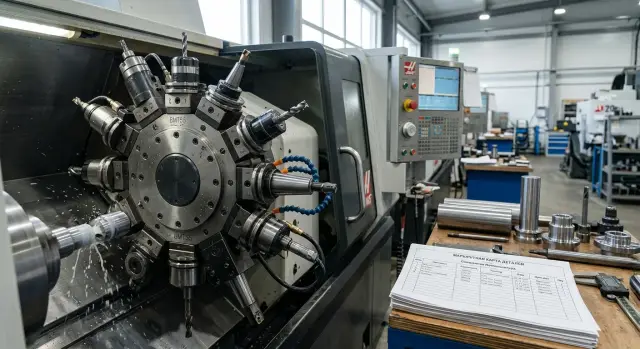
Why a mixed part mix quickly causes problems
On a shop with a mixed assortment, the machine rarely runs in a steady rhythm. In the morning a short bushing is on the program, an hour later a shaft with drilling, then a housing part requiring threading. Each batch needs its own set of inserts, drills, taps and its own setup logic.
Changing parts itself isn’t the issue. Problems begin when the turret head isn’t suited to that mode. If there are too few stations, no room for driven tooling, or holders are inconvenient to swap, the operator constantly removes fixtures, moves blocks and repositions tools. Time is spent not cutting metal but preparing for cutting.
This is especially painful on short series. With batches of 20–50 parts any extra setup time quickly eats profit. What seems minor on a long run becomes daily downtime here.
Losses usually follow a common pattern. There aren’t enough stations for the full toolset, holders have to be changed between batches, some driven operations are sent to another machine, and after every swap the runout, offsets and datum are rechecked. The schedule drifts. The foreman plans one production rate, but between batches 15–30 minutes of idle time accumulate. Over a shift that becomes hours.
A frequent mistake looks simple: people buy a simpler configuration because the current part "fits" into it. A month later another part arrives and it turns out the station count is marginal, the driven tooling doesn’t cover all operations, and changing fixtures takes too long.
If your shop makes different bushings, flanges, shafts and small housings, you need built-in flexibility from the start. Otherwise you have a machine but almost no available cutting time on it.
What in a turret head affects flexibility
Flexibility isn’t determined by a single catalog number. More important is how many operations the machine covers without extra tool swaps and without a second setup.
The first factor is the number of turret stations. It shows how many tools can be ready to work without manual rearrangement. For a mixed assortment this is critical. Today a bushing, then a shaft with a groove, then a housing with a hole and thread. If there aren’t enough stations the setup tech removes one block, installs another and loses time on every batch change.
But a large station count alone doesn’t solve everything. If some positions are occupied by long boring bars, driven units or bulky holders, neighboring stations can become inconvenient or unusable. So you count not only total stations but those you can actually use without dimensional conflicts.
The second factor is driven tooling. A turret head for a CNC lathe with a driven unit can drill, mill flats and tap threads in one setup. For small batches this is often beneficial: the part doesn’t need to go to another machine, so less time is lost and the datum error risk is lower.
That said, not everyone needs a drive. If the shop mostly turns simple rotational parts without transverse operations, paying extra for that feature will not bring noticeable returns.
The third factor is the type of tool holders. This often determines how long a changeover actually takes. If blocks are easy to remove, reinstall and quickly check, changeovers go smoothly. If holders are rare, expensive or require lengthy adjustment, every new part becomes a separate setup.
In practice a good layout answers four simple questions: are there enough stations for the working toolset, are driven positions needed for real operations, how long does it take to swap blocks, and do long holders interfere with neighboring tools. For a shop that alternates bushings, flanges and small housings, 12 well-utilized stations are often more useful than 16 formal stations half of which you can’t load properly.
How to choose a turret head step by step
Don’t choose a turret by the catalog alone. First look at an actual operations map: what you turn, what you drill, where you thread, and how many times per shift you change tooling.
A working scheme usually looks like this:
- Group parts into families by operations. Collect simple shafts separately, flanges with holes separately, and parts needing transverse drilling or milling in another group.
- For each family count tools for the most complex part. Don’t look at the average — look at the part that stresses the turret most.
- Add reserve positions for spares. If an insert or drill wears quickly, an extra station often saves more time than it costs.
- Mark operations that need driven tooling. Sometimes one or two such operations change the whole configuration requirement.
- Finally check what holders and blocks are available for the chosen standard and how long a real changeover will take.
People often skip the last step. On paper a cheaper option looks fine, but in practice it forces frequent block swaps, searching for rare holders and keeping excess tooling in stock.
A simple example: a shop makes short shafts and small-series flanges. For shafts standard turning tooling suffices. Flanges need driven tooling for end-face drilling. If you choose only for the first group, the machine will be cheaper but you’ll lose time on every swap for the second group.
Therefore station count must be evaluated together with tooling and the changeover schedule. If a pricier option removes 15–20 minutes from a setup and reduces manual swaps, it often pays back faster than initial calculations suggest.
How many stations are really needed
The number of turret stations affects shop flexibility more than a catalog reading suggests. If parts mainly require OD and ID turning, facing and cutoff, 8–10 stations are often enough. This covers basic operations without overburdening the assembly.
On mixed assortments the picture changes quickly. If you regularly drill, thread, bore and occasionally perform simple milling, look at 12 stations or more. Otherwise the setup tech will constantly remove one tool for another, causing lost time and greater risk of disturbing settings.
Count not only the mandatory set but also the reserve. One or two free stations often save changeovers. They aren’t just for "just in case" — they’re for practical needs: a spare finishing insert, a second drill for another diameter, tooling for an urgent part or a tool for trial setup.
A simple guideline: if the entire toolset fits stably without compromises and a little spare remains, the station count is chosen well. If before every new batch you decide what to remove from the turret, there’s already too little room.
The opposite extreme is also harmful. A very large turret costs more, adds mass and can slow indexing. On short cycles this is noticeable. So choosing the maximum "for growth" without calculation is as questionable as an overly tight layout.
Size by the most complex part in your set, not the simplest. For a simple bushing 8 stations may be plenty. For a part needing axial drilling, boring, threading, grooving and cutoff the same set will quickly be exhausted.
When driven tooling is really needed
Driven tooling pays where the part requires operations beyond standard turning. If the part has transverse holes, end-face drilling, tapping by hand in one setup or simple milling of flats, a driven unit keeps more operations in a single setup.
The key question is how many secondary setups it removes. If today the operator takes the part to a drill or mill after turning, the shop loses not only minutes. Queues between machines appear, datum misalignment risk grows and scrap increases.
Even removing one secondary setup on a 200-piece batch can give noticeable savings. On mixed assortments this becomes clear because the route changes from order to order.
But don’t overpay for a drive you won’t use. If the shop only does OD/ID turning, facing, grooving and cutoff, an expensive driven turret often remains idle. This is one of the most common selection mistakes.
Also check drive parameters: speed and torque must match your material and typical tool diameters. Small drills in aluminum need different regimes than larger drills in steel. A drive that spins fast but lacks torque will still push the operation to another machine.
Before ordering answer four questions: which operations do you want to move into one setup, which drill and mill diameters are used most, what materials dominate your range, and how much time is now lost on transfers and secondary setups. After that calculation it becomes clear whether a drive is justified.
How holder types change changeover time
Holder types affect changeover time almost as much as the turret itself. If blocks can be removed and reinstalled with predictable positioning, the operator spends minutes only. If every swap requires lengthy adjustment of height and overhang, changeovers stretch.
A common mistake is buying a rare holder standard because it fitted one task well. Later another order needs different blocks that are hard to source quickly. For a mixed assortment this is inconvenient and costly.
Before buying count not only stations but the full set of blocks: for external turning, internal boring bars, cutoff tools and drilling or special operations. If on paper everything fits in the turret, that doesn’t guarantee comfortable work. A long boring bar may interfere with the neighbor; a cutoff block often needs its own place and mounting angle. The denser the tooling, the greater the interference risk during turret indexing and tool approach.
Repeatability after block replacement is important. A good holder lets you remove a block, put it back and get a predictable tool position. Then the operator performs a quick check instead of a full re-setup. In a shop with many small batches per day this saves real time.
For shops in Kazakhstan and neighboring countries there’s a practical point: rare holders and nonstandard blocks are harder to source quickly for service and spare stocks. If you don’t keep a large tooling warehouse, rely on a common, available standard rather than collecting rare solutions for individual parts.
Example: a shop with mixed parts
Imagine a typical shop that turns a shaft today, a flange tomorrow and a bushing after lunch. Batches are small — 20–80 pieces. The machine lives in constant task changes rather than a long cycle.
It has an 8-station turret. For shafts that’s still enough: OD turning, facing, grooving, threading, drilling, boring and cutoff. But when a flange arrives the operator needs to remove some tools and install another set. The next day a bushing comes and the cycle repeats.
The problem isn’t only extra movements. Each tool change consumes time and with it repeatability. The operator must recheck overhang, offsets and datums. If such swaps happen two or three times a day, the shop loses hours in a week, not just minutes.
It’s worse if the machine lacks driven tooling and the flange needs transverse holes or simple milling. The part goes to a second machine, queues appear, a secondary setup is needed and there’s another alignment risk.
If the same shop switches to a 12-station turret with a unified holder standard, the work changes. The basic toolset can remain in the turret and only part-dependent items are swapped. Usually the turret already includes a roughing insert, finishing insert, grooving, cutoff, a drill and a boring tool. Remaining stations cover threading, spare tools and a driven unit. More operations stay in one setup and changeovers are faster and calmer.
Yes, this option is pricier upfront. But for a mixed shop the turret price alone says little. What matters is how long the machine actually cuts metal versus how long it stands between batches with doors open and tools in hands.
Common mistakes when choosing
The costliest mistakes are usually revealed on the shop floor, not in the catalog. The machine seems suitable but lacks one station for a complex part, a long bar hits a neighbor, or changeovers stretch by 20–30 minutes.
The most frequent mistake is sizing station count by the average part. The average part almost always looks convenient. But the shop lives by its most complex part. If one part requires transverse drilling, boring and a spare for a wearing tool, that part will show whether the turret is sufficient.
The second mistake is buying driven tooling without route calculation. It’s often bought “just in case” and then rarely used. The machine price rises, but the benefit is small. First count which operations you can realistically move off a second machine and how much time that saves.
The third mistake relates to holders. After purchase it turns out the needed blocks are expensive, rare or have long delivery times. A good idea on paper becomes a constant search for tooling.
Another error is filling all stations to the brim. It seems logical but hinders work. Without spare stations there’s nowhere to put a backup cutoff tool, a second drill diameter or tooling for an urgent order.
Finally, people often underestimate dimensional interferences. On a schematic everything fits, but in assembly a long boring bar, angular block or massive holder interferes with neighbors. So verify the layout with real tools and typical parts, not only with tables.
Quick checklist before ordering
Before ordering go through a short list and answer honestly:
- Which part in your range is the most complex by operations?
- How many stations remain free after installing the full toolset?
- Which operations will driven tooling actually remove from a secondary setup?
- How many holders, blocks and adapters must be purchased immediately so the machine won’t wait for tooling?
- Is there a risk of interference between long bars and neighboring stations?
A practical rule: if at least 1–2 spare stations remain after full assembly, work will be noticeably easier. These spots often save you when an urgent part arrives with an extra hole, a second thread or an unusual chamfer.
Look not only at turret price but at the cost of a month of operation. A cheap configuration without station reserve often causes frequent swaps, which consume setup time and increase the error risk during tool changes.
What to do next
Don’t select a turret head by catalog station count alone. First gather real shop data for recent months: part lists, operations per part, diameters, machining lengths and typical batch sizes. Without this the decision is almost always too optimistic.
Then take the most complex part and allocate tools to stations for it. See which stations are taken by turning tools, where a driven unit is needed, how many spots are consumed by drills and boring bars, and whether neighbor space remains.
Compare not just one but two configurations: for example, a smaller-station head with simple tooling versus a variant with station reserve and driven tooling. Count not only machine price but setup time between batches, total tooling cost, spare station availability for urgent orders and the possibility of avoiding a second setup.
At this stage it becomes clear where apparent savings are false. Sometimes a pricier configuration pays off simply because the operator doesn’t spend 20–30 minutes swapping holders between small batches.
If you’re selecting a CNC lathe for a shop in Kazakhstan or other CIS countries, you can discuss this analysis with EAST CNC. The company supplies machines, helps with selection, provides commissioning and service. For the conversation prepare a parts list, operations and desired shift output — then the decision will be based on facts, not guesses.
FAQ
How many turret stations are needed for a mixed part mix?
For a shop producing varied bushings, shafts, flanges and small housings, people usually look at 12 stations or more. That reserve helps keep the working toolset in the turret and reduces touching tooling between batches. If most of your parts are simple and don’t require drilling or threading, 8–10 stations can be sufficient. Still, it’s better to calculate based on the most operation-heavy part, not the simplest one.
When are 8 stations no longer enough?
The issue appears when the operator must decide which tool to remove before a new batch. If one part fits and another doesn’t have room for a drill, boring bar, thread tool or cutoff, then 8 stations aren’t enough. This hits hardest on short runs: every swap eats minutes that add up to hours by the end of a shift.
Does everyone need driven tooling?
No — not for everyone. If the shop mainly turns simple rotational parts without transverse drilling, milling or tapping in one setup, a driven unit often sits idle. Driven tooling is useful where you want to avoid a secondary setup or a second machine, letting more operations be done in a single clamping.
How can I tell if driven tooling will pay off?
Look at the current part route. If after turning the operator takes the part to a drill or milling machine, calculate the time for transfer, waiting and the second setup. If driven tooling removes those steps for frequent orders, it usually pays off. If such operations are rare, the extra cost won’t bring noticeable benefit.
Why do holders affect setup time so much?
Because holders determine the real setup time. A common, well-designed holder allows you to remove and re-mount a block with predictable positioning, so the operator performs a quick check instead of lengthy adjustments. If blocks are rare, expensive or hard to source, the shop ends up spending time finding and adjusting tooling instead of cutting metal.
Should I buy a turret with a large station reserve?
No — buying the largest possible turret without calculation isn’t wise. A bigger turret costs more, adds mass to the assembly and can slow indexing, which is felt on short cycles. A sensible rule: the full working toolset fits without compromises and 1–2 spare stations remain. That reserve is usually enough for practical work.
Which part should I use to size the configuration: the average or the most complex?
Count by the most complex part in your assortment. That part will reveal whether there’s enough room for turning, drilling, boring, threading, spares and driven units. The average part almost always looks fine and gives a false sense of sufficiency; the complex order is what reveals real needs.
Why keep 1–2 spare stations?
Spare stations aren’t decorative. They save you when an urgent part arrives, when a finishing tool needs a spare because of wear, or when a second drill diameter is required. Without that reserve the operator begins removing active tools from the turret — and that’s how extra stoppages between batches start.
What do people most often overlook before ordering?
People often forget checking for dimensional interference. On paper everything fits, but in real assembly a long boring bar or a bulky block hits neighboring positions. Another common miss is underestimating the cost of the complete tooling set. The machine can look like a bargain, but the shop then spends money and time sourcing missing holders, blocks and adapters.
How can I quickly check if a configuration suits my shop?
Collect recent orders and take the most complex part. Lay out every tool it needs and mark where a drive is required, where long blocks interfere and how many stations remain free. Then compare two configurations not only by price but also by setup time. If the more expensive option removes 15–20 minutes per batch, it often pays off within normal operations.