
Milling Stainless Steel on a Thin Wall Without Blueing
Milling stainless steel on a thin wall requires a precise approach: we explain how to eliminate blueing and wall drift by reducing radial engagement instead of lowering speed across the board.
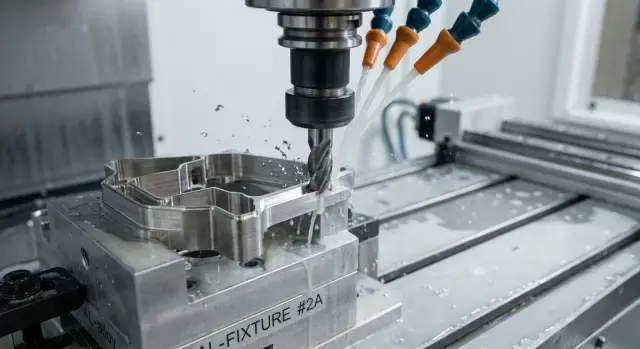
What goes wrong on a thin wall
A thin stainless-steel wall heats up faster than it seems. There is little metal, heat leaves the cutting zone poorly, and the wall itself can easily deflect under the cutter’s side load. At some point, the tool is no longer really cutting — it is rubbing the surface. That is where the blueing and dimensional drift come from.
Usually the problem is twofold. The cutter pushes on the wall, the wall moves aside, and the actual chip thickness drops. When the chip gets too thin, cutting weakens and friction increases. The top edge darkens, and parts of the surface start to shine, as if they were polished.
That is why you cannot blame spindle speed alone. Blueing often appears even at moderate spindle speeds if the tool stays in contact with the metal too long along the side. Simply lowering speed along the whole toolpath does not always help. Sometimes it only prolongs contact and adds heat.
After the first pass, you can usually see several signs right away: the size "drifts" along the height, the wall comes out slightly skewed, the edge takes on a blue or straw color, and parts of the surface become smooth and hot. Burrs on exit and a high-pitched sound are common too. This is no accident. The wall behaves like a spring: during the pass it bends away, and after the tool leaves it partially springs back. That is why measurements after the stop can differ a lot from what happened during the cut itself.
Simple example: a 2 mm wall, a long tool overhang, a gummy stainless steel, and a cutting regime that worked on a stiffer part before. Already on the first pass, the top edge darkens, and the size at the bottom and top no longer matches. This is not a "quirk" of the material. It is what overheating together with side deflection looks like.
Why blueing and drift appear together
Stainless steel does not carry heat away well. If the part is also thin, the heating almost immediately совпадает with elastic deflection of the wall. These processes feed each other.
First the cutter pushes on the wall and bends it slightly away. As a result, the chip becomes thinner, the cut weakens, and part of the contact turns into friction. Friction adds heat. Then the wall springs back partially, the tool bites the material again, and the cycle repeats. You can see this on the part quickly: the color shifts toward brown or blue, the size starts wandering, and the cutter mark becomes uneven.
That is why slowing the pass overall often does not fix the problem. If the tooth stays in contact with the metal longer, and the feed per tooth is already too low, the cutter starts smearing across the surface. Temperature does not drop, but the wall still gets the same side load.
In these conditions, low radial engagement works better than lowering speed overall. The cutter has a shorter contact arc, less friction, and lower side force. Chips come off more consistently, and the wall "runs away" from the tool less. For walls 1.5-2 mm thick, this is especially noticeable.
Where low engagement gives the best effect
Reducing radial engagement is not useful everywhere by default. It is better used where the wall has already lost stiffness and does not handle side force well.
Most often, the method helps on the finishing pass along a long thin wall, in the section after a pocket or back-side relief cut, in the zone where you hear squeal and see hot chips, and where the surface has started to shine from rubbing. On the stiff part of the workpiece, you can keep a normal finishing regime. On the weak section, it makes sense to make a separate pass with a small side step.
The reason is simple. When the cutter takes a smaller width, it pushes less sideways. The wall bends less, and heat leaves more easily with the chip. For stainless steel, this is especially useful: it shows mistakes quickly by color.
On a long wall, this approach is often better than slowing everything down. If you reduce feed and speed everywhere, the tooth rubs the metal longer, and the cycle only gets longer. If you keep a healthy feed per tooth and reduce only radial engagement, the tool keeps cutting instead of sliding over the surface.
Usually this is needed on the last passes, when roughing has left 0.1-0.3 mm per side. One slow finishing pass over the whole allowance looks convenient, but on a thin wall it more often leads to blueing and taper. Several light passes with low engagement give a calmer result.
Simple example: a wall 40 mm high and 2 mm thick after a pocket has been cleared. While there was still plenty of metal around it, everything went smoothly. After the pocket opened up, squeal appeared, and the top of the wall started to blue. At that point, it is better to reduce radial engagement and, if needed, add one more light pass than to choke the whole regime along the length.
How to set up the passes
On a thin wall, the best approach is to separate roughing and finishing clearly. Roughing removes the volume, and finishing brings the size in carefully. When these stages are mixed together, the wall gets too much load at once.
- After roughing, leave a consistent allowance. Do not try to hit size right away. For a thin wall, it is calmer to leave stock for a finishing series of passes.
- On finishing, reduce radial engagement. In most cases this is more useful than simply dropping spindle speed or feed along the whole toolpath.
- Do not choke the feed for no reason. If it is too low, the cutter stops cutting and starts rubbing. For stainless steel, that is a direct path to blueing and rubbing marks.
- Break the remaining stock into several light passes. Two or three gentle touches usually hold size better than one "to size" pass.
- After the first sample, check not only the size but also how the wall behaves along the height. If the top moves more than the bottom, reduce the radial step or add another finishing pass.
For a 2 mm wall and a height of 25 mm, this approach is almost always more stable than one slow pass with an end mill. You do not slow down the whole program; you remove the extra load exactly where the part is already weaker.
What to check in the tool and workholding
Thin walls are often damaged not because of "wrong numbers" in the program, but because of small details in the setup. A worn cutting edge, too much tool overhang, weak part support, and a miss with the coolant can quickly turn a normal regime into a source of overheating.
Tool
Start with the cutting edge. It should be sharp, with no shine on the corners and no small chips. If the edge has burned or rounded over, the cutter is no longer cutting cleanly. It rubs the metal, temperature rises, and blueing appears much earlier.
Do not leave extra overhang "just in case." The farther the tool sticks out of the collet, the easier it deflects and shakes the wall. If the part geometry allows, remove even 5-10 mm of overhang. On a thin wall, this is often more noticeable than tweaking speed.
Another common source of trouble is a ragged edge after roughing. If a burr or buildup remains before finishing, the cutter hits it first and only then enters a stable cut. That makes the wall pull, and the surface darkens in patches.
Clamping and coolant
The part should sit firmly, but without excessive pressure. If the upper part of the wall is left without support, it starts to spring already on the first touch. From the outside everything may look calm, but after the part is removed, the size will shift by a few hundredths or more.
Before the series, check four things:
- the cutter is fresh and has no noticeable corner wear;
- overhang is minimal for this geometry;
- the coolant stream hits the cutting zone directly;
- the wall is not hanging unsupported during the pass.
Coolant should work right at the cut. If the stream misses, heat stays in the part and the tool. On stainless steel, that quickly causes both color and drift.
If you do not have a rigid setup on the first try, it is better to spend 15 minutes on a spacer, soft jaws, or another support point. That is usually cheaper than searching for the cause of scrap after the tenth part.
Example from the shop floor
Imagine a stainless-steel housing with a slot next to a tall wall. The wall is about 3 mm thick and 45-50 mm high. After the slot is cleared, the part loses stiffness, even though that is not always obvious from the outside.
On the first machining version, the operator left one finishing pass with noticeable side engagement. Feed and speed were lowered a bit, hoping to make the cut more carefully. In practice, the top edge turned blue and the wall bent.
The problem was not only speed. With large side engagement, the cutter stayed in contact with the metal too long along the full wall height. Heat built up, the chip did not carry it away well, and the wall deflected away from the tool. Slowing the whole cut only stretched that condition out.
In the second version, the tool was not changed. Only the way material was removed changed: instead of one finishing pass, several passes were made with low radial engagement, about 0.15-0.2 mm per side. Feed was left at a working level so the cutter kept cutting.
The difference was visible right away. The blue edge disappeared, the sound became smoother, the wall was deflected less, and the size after the pass came closer to tolerance. For thin stainless steel, this is a common result. Lower engagement reduces side force exactly where the wall is already weak.
Common mistakes
The most common mistake is lowering speed and feed along the whole toolpath. The cut sounds quieter, but the machining does not always improve. The tool rubs the metal longer, the chip carries heat away worse, and the part heats up more.
The second mistake is making one finishing pass after aggressive roughing. After a large removal, the wall is already "alive." One pass over the remaining stock often does not stabilize it; it only moves the problem to the final size. It is safer to leave a small allowance and remove it in several gentle touches.
The third mistake is pushing a dull cutter to the limit. On stainless steel, that backfires quickly. A shiny rubbing mark appears, the chip darkens, and temperature rises. Saving one cutter can easily end in scrap across several parts.
The fourth mistake is extra overhang for no reason. The tool deflects more, a wave appears on the wall, and the size drifts from part to part. Sometimes removing just 10-15 mm of overhang changes the process more than a long session of regime tuning.
Finally, do not judge the process by sound alone. Look at the color and shape of the chip, the cutter mark on the wall, the part temperature after the pass, and the condition of the cutting edge. Squeal and noise are useful signals, but they do not show the whole picture.
Quick check before a series
Before starting a series, it is best to make one test pass on a blank of the same thickness and with the same wall length. Stainless steel shows mistakes quickly: the edge darkens, the sound changes, and the size starts drifting almost at once.
On the test part, it is enough to check five things:
- the edge color right after the pass;
- the shape and appearance of the chip;
- the wall size after the cutter leaves;
- the surface finish;
- the cutting sound.
The metal after the pass should stay bright. The chip should come off evenly, not turn into dust or smearing. The cutter mark should be free of waviness and random cross marks. If the problem appears only in one place, do not slow down the entire toolpath. Often it is enough to reduce radial engagement on a short section — at the entry, in a corner, or at the exit.
The order of checks is simple: first look at cutter wear and runout, then feed per tooth, and only then change the width of engagement and the finishing allowance. Too little feed often causes blueing faster than a bolder but clean cut.
What to do next
If the wall turns blue and drifts, do not rewrite the entire program right away. Take one part and compare two sections: on one, keep the current toolpath, and on the other, reduce only radial engagement in the thin-wall zone. Usually this test quickly shows whether the problem is overheating or deflection.
It is better to write the results down. Memory is unreliable in these cases. A short note is enough: spindle speed, feed, depth and width of cut, tool overhang, finishing allowance, and what happened to color and size. After a few trials, it becomes clear which regime repeats consistently.
If the part is complex, it helps to look not only at the numbers in the program, but at the whole chain: the machine, the tooling, the pass order, and the rigidity of the clamping. In practice, that is often where the real cause is hiding, not in a single feed line.
For jobs like this, experience from a supplier that works with metalworking not just on paper can be useful. EAST CNC and the east-cnc.kz blog have materials on equipment and practical metalworking tips. And when the issue comes down to selecting a machine, commissioning, or launching a production run, the company handles this in Kazakhstan and other CIS countries.
If the test with lower radial engagement removed the blueing and noticeably reduced drift, the next step is simple: lock in the setting and verify it on a few more parts in a row.
FAQ
Why does a thin stainless-steel wall turn blue on the first pass?
Because a thin wall heats up quickly and easily moves away from the cutter. When the wall deflects, the chip becomes too thin, cutting weakens, and friction increases. As a result, the edge darkens, parts of the surface become shiny, and the size starts drifting along the height. Even moderate spindle speeds do not help if the tool is rubbing the metal for too long.
What should I check first if the edge turns blue and the size drifts?
First, reduce radial engagement in the finishing area instead of choking the whole cut right away. Keep a normal feed per tooth so the cutter keeps cutting instead of sliding over the surface. Then check tool overhang, cutting-edge sharpness, and whether the coolant reaches the cut directly. Very often the problem sits in two places at once: in the pass itself and in the setup.
Does lowering speed and feed across the whole path help?
Usually not. If you simply lower speed and feed along the whole toolpath, the tooth stays in contact with the metal longer and heats the wall more. On thin stainless steel, it is often better to keep a healthy feed and remove the side load by reducing the width of engagement. That way the wall bends less and the chip carries heat away better.
What allowance is best for finishing a thin wall?
Most often, leave a consistent finishing allowance of about 0.1-0.3 mm per side after roughing. That way you are not trying to hit size with one heavy touch. If the wall is high and thin, it is better to remove the remaining stock in several light passes. This keeps the size more stable.
How many finishing passes should be used on a thin wall?
For a thin wall, two or three light passes are usually better than one pass straight to size. The wall bends less, and the cutter does not overheat the top edge. If the top moves more than the bottom after the first finishing pass, add another light pass and reduce radial engagement a little more.
Where does low radial engagement work best?
This method works best where the part has already lost stiffness. Usually that is a long thin wall, the area after a pocket, the zone with squeal, hot chips, or a shiny rubbing mark. On stiff areas, you can keep a normal finishing regime. On a weak section, it makes more sense to make a separate pass with a small side engagement.
How can I tell that the cutter is rubbing instead of cutting?
Look at the tool mark and the chip. If the surface starts to shine, the edge darkens, the chip comes out worse, and the sound becomes high-pitched, the cutter is rubbing more than cutting. Another common sign is that the size changes along the height of the wall. The top moves more because that area is weaker.
How much do tool overhang and clamping affect the result?
Extra overhang makes deflection much worse. Even 5-10 mm of extra length can create a wave on the wall and spread the size from part to part. Weak part support also ruins the result quickly. If the wall is hanging without support, it springs during the cut and partly returns after the cutter leaves.
What should be checked on a test part before starting a series?
Before the series, it is enough to check the edge color, the chip shape, the cutter mark, the size after the pass, and the cutting sound. Stainless steel shows mistakes quickly: the edge darkens almost at once. If the problem appears only in one place, do not change the whole program. It is better to adjust the section where the wall is weakest.
How can I quickly test whether low engagement is the real fix?
Make a simple test on one part. On one section, keep the current pass, and on the other, reduce only radial engagement in the thin-wall area. If the blueing disappears, the sound becomes smoother, and the size gets closer to tolerance, you have found the right direction. After that, lock in the setting and verify it on a few more parts in a row.