
Milling Heat-Resistant Alloys with Small Tools
Milling heat-resistant alloys with small tools requires precise selection of overhang, holder, pitch, and feed, especially when machining narrow slots.
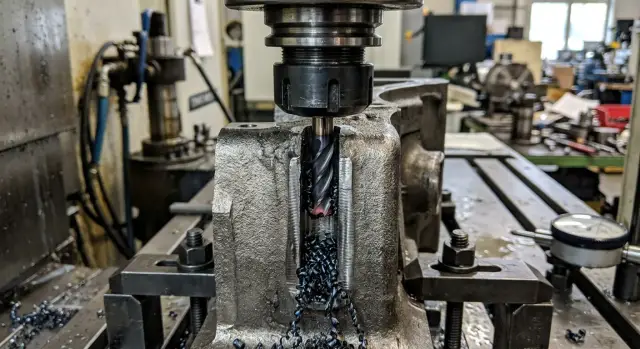
What is the problem with small tools
A small end mill cutting a heat-resistant alloy works with almost no margin. This kind of material does a poor job of carrying away heat, so the heat stays at the cutting edge. A larger tool has more rigidity and mass, but a 3-4 mm cutter has almost no reserve.
That leads to the first problem: the cutting edge overheats quickly. Instead of proper cutting, rubbing begins. For a heat-resistant alloy, that is especially bad because heat and pressure harden the material, and the next pass becomes harder.
The second problem is runout. For a small-diameter cutter, even a slight deviation in the holder or clamping setup immediately changes the load on the teeth. One tooth does almost all the cutting, another only touches the metal, and a third works unevenly. Wear does not happen smoothly, but in bursts.
In a narrow slot, another difficulty appears. Chips have trouble leaving the cutting zone, so they stay between the walls, get caught under the edge again, and scratch the slot. Temperature rises, the surface suffers, and vibration gets worse.
Excessive cutter overhang makes everything worse at once. The farther the tool sticks out of the holder, the easier it is to deflect. For a small diameter, the difference between 12 mm and 18 mm of overhang can be not small, but decisive. You hear it quickly and see it in the part: the cut gets harsher, the wall mark darkens, and tool life drops sharply.
Usually there is not just one cause. Heat stays at the edge, the small diameter reacts strongly to runout, chips do not clear well in a narrow slot, and extra overhang adds deflection and chatter. That is why a small tool fails not only because the cutting conditions are too aggressive. Often the same settings would work fine if the cutter were clamped shorter, runout were removed, and chip exit were opened up.
Why extra overhang eats up tool life so fast
When a small cutter is already working near its limit, extra overhang immediately reduces the rigidity of the whole setup: the spindle, holder, and tool start to behave more softly. The cutting force no longer pushes into one point; it makes the tool vibrate. Tool life is lost before the operator even gets to a normal cutting mode.
With a small diameter, this is obvious right away. The cutter does not just cut — it bends slightly every time a tooth enters the material. In a heat-resistant alloy, that is especially unpleasant: the metal is dense, hard to cut, and quickly heats the edge. One tooth takes more than its share, another rubs the wall. The edge loses its shape early in the job.
Because of that, the slot often starts drifting out of size. Many people first suspect feed or spindle speed, although the reason can be simpler: the tool was extended too far from the holder. Even a few extra millimeters noticeably change the behavior. The sound gets sharper, stripes appear on the walls, and the size shifts from pass to pass.
Chipping also comes sooner than expected. Not because the cutter has worn out completely, but because the edge is catching short overloads. At first, this looks like small spots on the cutting edge. Then one edge chips off, and the tool starts cutting even more roughly. After that, the life is gone for good.
A typical case looks like this: an 8 mm wide slot is cut with a 6 mm end mill, the depth is not great, but the tool is clamped with too much overhang. The cutter deflects, the wall gets a wave, and after a few passes a chip appears. If the same slot is cut with the minimum necessary overhang, the cut is calmer and the cutter lasts longer without any magic in the settings.
If the small tool loses life too quickly, first reduce the overhang. Only after that should you change the step, feed, and spindle speed.
How to match the holder, diameter, and slot depth
First, define the real slot depth, not the desired one. For a small tool, even a 2-3 mm difference changes everything: overhang length, holder choice, and working feed. If the slot is 8 mm deep, do not set up the tool as if it needed a 15 mm reach.
The connection is simple. Slot depth sets the required working overhang, and the cutter diameter shows how sensitive the system is to extra length. For a 4 mm cutter, an extra 5 mm of overhang is far more dangerous than for a 12 mm cutter. That is why the holder should be chosen not with a margin, but for the minimum length that is actually needed.
A good rule is simple: the tool should reach the bottom confidently, and the holder body should not interfere with the walls. You need to check not only the depth, but also the geometry around the cutting zone. In a narrow slot, the cutter may fit by width, while the holder starts rubbing against the upper edges of the part. That quickly ruins both size and tool life.
Before starting, it helps to confirm four things:
- the actual slot depth, not the number from an old process sheet;
- the minimum overhang at which the cutter still reaches the bottom;
- the clearance between the holder, slot walls, and the top surface of the part;
- clamping rigidity, especially if a collet or a thin extension is used.
The last point is often underestimated. An operator picks a longer holder simply because it is closer on the rack. But in a heat-resistant alloy, that kind of convenience can easily consume one or two cutters in a shift. It is better to spend a few minutes on a stiffer setup than to later slow the feed down to a safe but sluggish level.
If the slot is small, for example 5 mm wide and 10 mm deep, look at the whole chain at once: cutter diameter, cutting length, clamping type, and the shape of the holder near the nose. When this setup is assembled without extra length, the tool cuts more evenly, heats less, and holds its edge longer.
How to choose the cutter pitch for a narrow slot
In a narrow slot, cutter pitch should not be chosen by the idea that "more teeth is better." In a heat-resistant, tough alloy, the first limit is often not machine power, but chip evacuation from the cutting zone. If chips are crowded, they do not leave — they start rubbing against the slot walls and the cutter itself.
That is why a coarser pitch is usually safer here. More space remains between teeth for chips, and the cutting edge lasts longer. This is especially noticeable when the slot is almost the same width as the cutter and there is almost no side clearance.
A fine pitch in such a slot looks good only on paper. There are more teeth, the contact seems smoother, but in reality the small cutter heats up faster. The extra heat quickly eats away at tool life, and then come squealing, built-up edge, and chipping.
A simple guideline works well. The narrower the slot is relative to the cutter diameter, the coarser the pitch should be. The deeper the slot, the more important chip volume becomes. The harder the alloy is to break chips, the more cautious you should be with a multi-tooth cutter. If the slot is shallow and there is a little side clearance, you can look at a medium pitch.
For milling heat-resistant alloys, this rule works almost every time: first make room for the chips, then think about the number of teeth. Otherwise the tool will not last long, even if the holder is rigid and runout is within limits.
In practice, the choice usually comes down to two options. For a narrow and deep slot, a coarser pitch is often the better choice. For a shallow slot, where chips escape more easily, you can step up the number of teeth by one level. If you are unsure, it is better to start with the coarser pitch. It is less unforgiving.
How to choose the feed
For a small cutter, feed is better not guessed, but brought up to the working value in short steps. This type of tool has little rigidity reserve, and an error of just a few hundredths of a millimeter per tooth is already audible and visible on the slot wall.
Going straight to a hard setting is usually a bad idea. If the cutter is long, the slot is narrow, and the material is tough, the tool starts rubbing, heating up, and chattering instead of cutting. Tool life drops very quickly.
It is easier to keep the spindle speed constant and change only the feed. That makes it simpler to understand what is actually happening. If everything is changed at once, the cause gets lost.
Setup order
Start with a moderate feed per tooth, slightly below the calculated value for a new tool. But do not lower it too much: if the feed is too small, the edge will start rubbing the material again instead of cutting properly.
Then follow a simple order:
- make a short test pass of 8-15 mm;
- listen to the cut: a steady sound is better than squealing or whistling;
- look at the slot wall: matte streaks and waviness often point to vibration;
- check the chips: fine dust and a dark color often indicate overheating;
- raise the feed in small steps, usually by 5-8%.
After each step, compare not only the sound, but also the tool mark. If the wall looks cleaner and the chips come out more consistently, you are moving in the right direction. If the sound gets harsher, the wall gets rippled, or the spindle starts to howl, step back one level.
In a narrow slot, the limit is felt quickly. At first the cutter runs calmly, but slowly. Then you add a little feed, and the cut becomes cleaner. One more step, and a whistle appears. That is usually the point where the load is already above the rigidity of the system.
When to stop
There are three clear signals: vibration grows, whistling appears, and the chips change for the worse. Do not push the settings just because the tool has not broken yet. In heat-resistant alloys, failure often comes not immediately, but after a couple of passes.
On production lines, this approach is usually cheaper than rushing. A few short test passes almost always cost less than one broken cutter and a damaged slot.
Example with a small slot
A good example is a slot 6 mm wide and 12 mm deep. For this task, a 4 mm cutter is often chosen to leave room for chips and avoid rubbing both walls at once. On paper, everything looks fine, but a few extra millimeters of overhang change the picture right away.
The operator installs a long holder, lowers the cutter to depth, and hears whistling within the first few millimeters. This is not just noise. The tool starts to spring, chips come out worse, and heat stays in the cutting zone. After a few passes, stripes appear on the wall, and the size drifts: the slot sometimes holds its width, then grows by a few hundredths.
Usually feed is not the only issue. Three factors work together here: the rigidity of the holder and the actual overhang of the cutter, the tooth pitch, which may fall into resonance, and the feed per tooth, which finishes off the already vibrating tool.
In that situation, the first step is to remove as much extra overhang as the part and fixturing allow. If the cutter was sticking out 20 mm and can be reduced to 14-15 mm, the difference is usually obvious right away. The cut runs more smoothly, the whistling weakens or disappears, and the chips come out predictably.
If you can choose the tool, a cutter with a coarser or variable tooth pitch often helps in a narrow slot. But even a good geometry will not save a long tool in a weak holder.
Only after the cut becomes calm does it make sense to raise the feed little by little. First check the sound, the wall mark, and the size after the pass. If the wall is clean and the width stays stable, you can add 5-10% and see where the rigidity reserve ends.
This kind of slot shows the real setup very clearly. If the machine, holder, and cutter can handle 6 x 12 mm without whistling or stripes, the setting is close to workable. If not, the small tool's life will be spent not on metal, but on extra overhang.
Mistakes that break a cutter fast
In a narrow slot in a heat-resistant alloy, a small cutter forgives almost no mistakes. If the setup is even slightly soft and the chips are cramped, tool life can end in one or two passes.
The first common mistake is a long holder for the sake of easier access. The tool reaches the cutting zone, but the lever arm grows at the same time. The cutter deflects, the edge works unevenly, and vibration marks appear on the wall. In this material, an overheated edge dulls very quickly.
The second mistake is too fine a pitch in a narrow slot. With a small diameter, it may seem that more teeth will give a smoother cut, but the slot simply does not have enough room for chips. They do not move up; they get caught under the cutting edge again. After that, the temperature rises, the edge chips, and sometimes the cutter breaks almost without warning.
The third mistake is trying to fix deflection by increasing feed. That usually only makes things worse. If the holder is long and the cutter is thin, more feed adds lateral load. The tool does not straighten out; it bends more. In the end, the slot drifts out of size, and tool life ends before the operator has time to correct anything.
The fourth mistake is forgetting to check runout after changing the tool. For a small diameter, that is an expensive miss. Even slight runout overloads one tooth while another is almost left idle. From the outside everything may still look acceptable, but after a few minutes one tooth burns out, and the cutter starts cutting in bursts.
The fifth mistake is making another pass through a slot where chips are still inside. In heat-resistant alloys, those chips are hard and hot. If they are not removed before the next pass, the cutter is cutting not only the part material, but also compacted chips. The edge is damaged very quickly, and burrs often remain on the bottom of the slot.
Almost always, the cutter is killed by not one cause, but a combination of them. A long holder, small diameter, fine pitch, higher feed, and missed runout work much worse together than each problem on its own.
Quick check before starting
A small cutter does not like haste. An extra 2-3 mm of overhang, a soft holder, or a tooth pitch that is too tight often cuts tool life right on the first slot.
Before starting, it is better to check not only the settings on the screen, but the whole tool-and-part setup. It takes a few minutes, but it immediately shows where the system is already at the limit.
The most useful check is short:
- the cutter overhang should cover the slot depth and a small exit, but no more;
- the holder must hold the tool rigidly, with no noticeable runout;
- the cutter pitch must leave room for chips;
- feed must match the diameter and edge condition;
- the test pass should run smoothly, without whistling, shaking, or a dark mark on the wall.
If in doubt, start with a short test pass of 3-5 mm in length and look at the chips. A good sign is that they come out steadily, do not stick in the slot, and do not darken almost immediately.
Watch both the sound and the mark after the pass. A smooth matte trace without stripes usually means the holder, pitch, and feed are working together well. A sharp ring or a wavy wall almost always points to too much overhang or runout.
In practice, this solves more than it seems. If you remove just a few extra millimeters of overhang, the tool often starts running quieter, and tool life rises noticeably even without changing the settings.
What to do next on the shop floor
If you regularly cut narrow slots, you should not judge these jobs by memory. The difference between "works" and "fails" here often comes down to just a few millimeters of overhang.
The easiest approach is to keep a short log for your parts. No big report is needed. It is enough to record the slot width and depth, cutter diameter, actual overhang, and real tool life before changeout.
It is useful to run a simple comparison with two overhang options. Keep one material, one cutter, and one program, and change only the overhang if the part allows it. This kind of test quickly shows where tool life is being lost because of extra length, and where the real issue is the cutter grade or the cutting conditions.
It also makes sense to note not only tool life, but also the condition of the wall after the pass. If waviness appears, stripes show up, or the sound becomes uneven, record that together with cutter pitch and feed. After a few runs, the pattern usually becomes very clear.
For tracking, five lines are enough: slot size and depth, cutter diameter and actual overhang, tooth count or pitch, feed per tooth, tool life, and the wall condition after the pass.
If the operation is repeated month after month and the problem is no longer in the settings, but in the rigidity of the assembly, it is worth discussing machine and fixture selection with EAST CNC in advance. The company works with metalworking equipment and helps with selection, delivery, commissioning, and service, so it is better to have that conversation before an urgent order, not on the day when cutters start failing one after another.
On the shop floor, the most successful setting is usually not the boldest one, but the most repeatable. If you collect a few honest comparisons of overhang, pitch, and feed, decisions become much easier.