
Membrane Chuck for Precision Bushings: When It Pays Off
A membrane chuck for precision bushings reduces ovality and size drift after unclamping. Here’s where it pays back faster than a standard chuck.
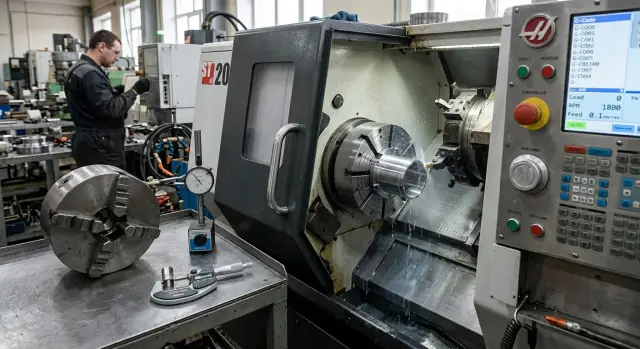
Why a standard chuck damages a thin bushing
A regular three-jaw chuck squeezes a bushing not along the full circumference, but at several points. For a rigid, thick workpiece, that often is not a big deal. For a thin-walled bushing, it is enough for the round shape to turn into an oval even before cutting starts.
The problem begins the moment the tool starts machining a part that is already deformed. On the machine, the size looks accurate, the pass runs smoothly, and the surface looks clean. But after unclamping, the wall partially springs back and the diameter changes. The operator sees one picture in the chuck, while inspection after removal shows another.
If the jaws clamp the bushing from the outside, they push the wall inward. If clamping is from the inside, the thin wall expands outward. In this situation, the source of scrap is not the tool or the cutting mode, but the clamping method itself.
Re-clamping makes things worse. The part is removed for a second operation, set up again, and the force lands slightly differently. Even with careful work, a new setup often adds runout. After that, it becomes harder to keep the outside diameter, bore, and face on one axis.
A good example is a 40 mm bushing with a 2 mm wall. In a standard chuck, it may seem securely clamped. After the finishing pass and unclamping, the bore can shift, and the outside size can slightly drift. At that point, people often start changing feed, speed, and tooling, even though the source of the error is the clamping.
That is why a membrane chuck is not needed as a rare "just in case" setup, but for predictable geometry. It presses more gently and spreads force over a larger area. When scrap appears only after unclamping, the standard chuck is often the cause.
Where membrane clamping really helps
A membrane clamp is not needed for every job. It makes sense where the chuck affects the part more than the tool does. This is usually visible during finishing of a thin-walled bushing, when the size drifts after removal and roundness gets worse than it was in the chuck.
A good example is a bushing with a finished bore and a thin wall. The jaws squeeze it at a few points, the metal is slightly compressed, and after unclamping the part releases internal stress. Everything looked fine on the machine, but inspection shows ovality or a loss of concentricity. The membrane presses evenly around the circumference, so deformation is noticeably smaller.
This kind of clamping is especially useful when the tolerance is strict not only for diameter, but also for shape. If the drawing calls for low roundness error, runout, and concentricity between the internal and external surfaces, a standard chuck often gives inconsistent results from part to part. A membrane chuck does not make the process magical, but it removes most of the variation created by the clamping itself.
There is also a purely economic case where this tooling pays off quickly: repeated batches. If the shop machines the same bushing every week or every month, stability starts to affect money directly. Less time is lost on setup, fewer trial parts are needed, and there are fewer arguments between the operator and quality control. On a production run, even a few minutes saved on setup and a couple of percent less scrap can make a noticeable difference.
Another common case is when size cannot be lost after removal. The bushing is bored almost to final size, and there is almost no allowance left for springback. If the internal diameter changes by even a few microns after unclamping, the whole logic of the finishing operation falls apart. In such work, soft clamping is not just careful fixation, but repeatable results.
Which bushings justify this setup
Most often, a membrane chuck is needed where a standard jaw clamp creates the problem itself. The first type is obvious: the wall is thin and the diameter is already significant. The larger the diameter and the thinner the wall, the easier the bushing is to crush during clamping. On the machine, everything looks calm, but after unclamping the size shifts and the shape changes.
This setup also pays off quickly after heat treatment. Rework in that case is expensive or impossible. The part has already gone through several operations, and time, tooling, and material have already been invested. If clamping ruins the geometry on the final pass, you lose not only one blank, but the entire path up to that point.
The same applies to expensive materials. Stainless steel, heat-resistant alloys, and specialty steels for medical or automotive parts do not forgive extra scrap. When each part costs significantly more than an ordinary bushing, saving money on tooling starts to look strange. One good clamp often costs less than several scrapped batches.
There is another important case: when inspection checks not only the outer or inner diameter. If runout, concentricity, roundness, cylindricity, or fit after assembly are inspected, the chuck’s influence quickly comes to the foreground. In that work, membrane clamping helps precisely because it does not introduce extra deformation that is hard to notice directly on the machine.
Usually, this setup makes sense if several signs come together: the wall is thin for its diameter, the part cannot be easily reworked after the operation, the customer demands stable shape and repeatability, and scrapping one bushing costs more than setup and the chuck itself.
If you have a simple thick-walled bushing with a wide tolerance, there is no reason to overpay. If the part is thin, expensive, and sensitive to clamping, a membrane chuck pays for itself much sooner than it seems at the moment of purchase.
How to tell the problem is really the clamping
If a bushing behaves differently after every re-clamping, look first not at the program or the tool, but at the fixation method. For a thin-walled part, the chuck often changes the shape more than the cutting sound or the surface finish suggests.
The most common sign is simple: the size is fine in the chuck, but after removal ovality appears or the fit shifts. While the jaws hold the bushing, it keeps one shape. As soon as the force disappears, the metal relaxes the wall a little, and the geometry changes.
If the operator reduces clamping force and the spread still remains, that is also a bad sign. Strong clamping often makes things worse, but if reducing the force does not help, the contact scheme itself is not suitable for this bushing.
Look at the type of defect as well. When inspection catches ovality more often than a length shift, the cause is often the chuck. Length usually changes because of the reference, face, heat, or setup. Ovality in a thin bushing is usually tied to how it was clamped.
There is a simple test. Machine the same bushing in the same mode and re-clamp the blank 3-5 times. After each cycle, remove the part and measure the same diameter in two sections and at several angles. If the size changes noticeably from one re-clamp to the next while the tool, mode, and material stay the same, the source of the problem is almost certainly the clamping.
It also helps to check the part in two states: first with a dial indicator while clamped, then after removal with a micrometer or roundness tester, and then again after re-clamping with the same force. If everything is calm in the chuck but the geometry shifts after removal, the chuck is pressing in the wrong place or in the wrong way. That is a typical story for a standard three-jaw clamp.
How to introduce a membrane chuck without unnecessary mistakes
Mistakes usually start before the chuck itself, when it is selected only by the part diameter and not by the real clamping zone and the tolerance after unclamping. First collect data about the part, then choose the tooling.
Start with the drawing. Look not only at dimensions, but also at roundness, concentricity, runout, and surface finish. The material also affects the result: a thin steel bushing, a brass one, and a stainless one behave differently under clamping.
Next, determine where the part can be clamped without harming the working geometry. For one bushing, the outer diameter is safer; for another, the inner diameter. What matters is not the convenient setup, but the point where deformation will be smaller. Then assess the length of the clamping zone. If the membrane presses too close to the thin wall or the finishing edge, the part may drift after unclamping.
Then compare the tooling cost with the real batch volume. For 30 parts, an expensive set often makes no sense. For repeat batches of 500-1000 pieces, the picture changes quickly. It is better to include a trial run right away. Usually 10-30 parts are enough to see whether deformation has gone down and how much time the setup consumes.
Check the size not only in the chuck, but also after unclamping. This is exactly where a standard chuck often gives a false sense of accuracy. In practice, it is useful to take two measurements on the same part: immediately after machining and a few minutes after removal. If the size or shape shifts, the problem is almost always the clamping method, not the tool or the program.
There is a simple filter. If the part is thin-walled, the tolerance is tight, and scrap or long jaw adjustments repeat from batch to batch, a membrane chuck is worth checking. If the bushing is rigid, the tolerance is ordinary, and the batch is one-off, you can stay with soft jaws and careful setup.
How to calculate payback without complex formulas
Payback is calculated not from the chuck price, but from the money lost on each run. If a standard clamp crushes the bushing, you are not only paying for scrap. You are also paying for re-clamping, extra measurements, machine stops, and setup time.
First, add up all launch costs. For a membrane chuck, this usually includes the chuck itself, adapter tooling, setup, the trial batch, and the time needed to fine-tune the clamping force. If several size variants are needed, that should also be included in the calculation.
Then look at how much money is lost per part or per batch with the old clamping method. Usually, four lines are enough: how many parts are scrapped, how much time re-clamping takes, how much extra inspection costs, and how much downtime or cycle slowdown costs.
Then the calculation is simple. Find the saving per part and multiply it by the usual batch volume. For example, if a standard chuck costs you 180 тг in scrap, 70 тг in re-clamping, and 30 тг in extra inspection, the total loss is 280 тг per part. On a batch of 4,000 pieces, that is already 1,120,000 тг. If the tooling package with implementation costs 1,450,000 тг, the payback period will be about 1.3 months.
If the bushings are produced every month, it is more convenient to look at payback monthly. That makes it easier to see whether the purchase will tie up money for too long. If the parts are launched in batches every few weeks, it is fairer to calculate by quarter. Otherwise, the effect can be underestimated and the tooling may seem too expensive, even though it has already paid for itself on real volume.
A good rule of thumb is simple: if the chuck pays for itself in 1-3 months under normal load, the decision is usually reasonable. If the period stretches beyond six months, check the calculation again. Often it forgets the cost of scrap after the finishing operation or does not include operator time for constant measurements. And that is often where the main amount hides.
Example calculation for a bushing batch
Let’s take a batch of 600 stainless-steel bushings. The part is thin-walled, the roundness tolerance is tight, and a standard three-jaw chuck compresses it noticeably in the clamping zone. While the bushing is clamped, the size looks normal. After removal, some parts release stress and the roundness goes out of tolerance.
For the example, let’s use these numbers: the manufacturing cost of one bushing by the final inspection stage is 5,500 тг; scrap due to clamping with a standard chuck is 7% of the batch, or 42 parts; another 60 parts need re-clamping and re-measurement, 4 minutes each; one machine hour with the operator costs 18,000 тг; a membrane chuck with setup and adapter tooling costs 700,000 тг.
Now let’s calculate the losses. Scrap of 42 parts gives 231,000 тг in direct costs. Re-clamping takes 240 minutes, which is another 72,000 тг in machine time. On top of that, the shop spends time on disputed parts: the operator takes them to QC, the supervisor rechecks measurements, and some parts are reviewed again. Even if all of that takes only one hour for the batch, that is another roughly 10,000-15,000 тг in indirect costs.
So the standard chuck creates about 313,000-318,000 тг in losses on one batch.
If you install a membrane chuck, the picture usually changes noticeably. Soft clamping reduces deformation, and roundness scrap drops, say, to 2%. That is 12 parts, or 66,000 тг. Re-clamping is needed for not 60 but 15 parts. That adds another 18,000 тг. Disputed cases take not an hour, but 15-20 minutes.
Then the total loss on the same batch is about 87,000-90,000 тг. The difference versus the standard chuck is roughly 225,000 тг on one run. With tooling cost of 700,000 тг, it pays back in about three such batches. If the bushing is more expensive, the tolerance is tighter, and clamping deformation is stronger, the period shrinks to two runs. If the batch is smaller or scrap is already low, the calculation will not be as convincing.
That is enough to estimate CNC tooling payback without complex tables. Count not only visible scrap, but also re-clamping, extra measurements, and the time spent resolving disputed parts.
Where people usually make mistakes
The most common mistake is simple: a membrane chuck is bought not for one job, but "for all cases." That almost never works. If the shop has both rigid short bushings and long thin-walled parts, it is hard to cover everything with one setup without losses. For an ordinary bushing with a thick wall, a good jaw chuck often gives a normal result without extra cost.
The second mistake is the wrong diagnosis. The operator sees runout, ovality, or unstable size and immediately blames the machine. But the low rigidity of the part itself often creates the same effect. If the bushing is thin, has a long overhang, and a small wall thickness, it gets crushed the moment it is clamped. Then the part is removed, the stress releases, and the geometry shifts with it. In that situation, a new machine will not solve the problem.
Another mistake is keeping the old settings as if only the chuck changed. That is a bad habit. Soft clamping requires rethinking clamping force, feed, depth of cut, and sometimes even the reference setup. If the same force is kept, the benefit of the new tooling can be reduced to zero. If the cutting mode stays too aggressive, the part will still move, only the reason will be less obvious.
People also often save money in the wrong place. They compare only the chuck price and postpone the purchase because it looks high. But the real comparison should include scrap, extra passes, manual touch-up, and lost setup time. If batches are 300-500 bushings, even 3-5% scrap quickly turns into a significant amount.
A separate mistake is buying a full set right away without a trial batch. It is much more reasonable to take one problematic part and test it on a small run. Even 10-20 pieces usually show whether deformation during clamping has changed, whether ovality has gone down, and whether the size holds after removal.
What to check before buying
Before deciding, it helps to answer a few direct questions:
- Is the part wall really sensitive to clamping, or is the problem elsewhere?
- Do you care about geometry after unclamping, not just the size in the chuck?
- Do the batches repeat often enough for the tooling to pay for itself?
- Have you counted not only scrap, but also operator time, extra measurements, and repeat setups?
- Is the shop ready for careful setup and stable control of clamping force?
If the answer is "yes" to most of these points, the purchase is worth serious consideration. If only one point matches, it is better to first check the setup, clamping force, and referencing on the current chuck.
A small example is very telling here. A bushing comes in batches of 400 pieces, and even 3-4% scrap plus repeated inspection already add up to a noticeable monthly amount. In that situation, membrane clamping is bought not for abstract accuracy, but for repeatable batch-to-batch results.
What to do next
Do not buy this tooling based on intuition. First collect numbers from the current process: how many parts are scrapped or reworked, how much time the operator spends on tightening and checking, and what your real monthly bushing volume is.
The easiest way to test the hypothesis is on the same batch. Take parts from the same material, with the same allowance, and the same program. Machine part of them in a standard chuck and part of them with another clamping method. Compare not only scrap, but also size spread, ovality, the number of inspections, and setup time.
After such a test, it usually becomes clear whether a membrane chuck is needed all the time or only for a narrow group of parts. That is important. There is no point putting expensive tooling across the whole product range if it only pays off for thin-walled bushings, tight tolerances, and meaningful production volumes.
If the batch is small and the tolerance is relaxed, a standard chuck may remain the reasonable option. But if you regularly lose parts because the bushing deforms during clamping, a membrane setup often returns the money faster than expected. Sometimes reducing scrap by just a few percent is enough for the difference to become visible within a couple of months.
When the question is not only about the chuck, but about the machine itself, it helps to look at the whole task: the part, the material, the tolerance, the referencing, and the batch launch. EAST CNC works with CNC lathes for metalworking and helps with selection, supply, commissioning, and service. The company also has a practical blog on topics like this, so it is easier to check the solution not through general promises, but through the real part and the real tolerance.
If the trial batch shows smoother numbers and fewer disputed parts, the decision becomes clear without unnecessary arguments.