
Medical Equipment Parts: What Changes on the Shop Floor
Parts for medical equipment require more than precise tolerances. We cover cleanliness, labeling and tool tracking on the shop floor without unnecessary paperwork.
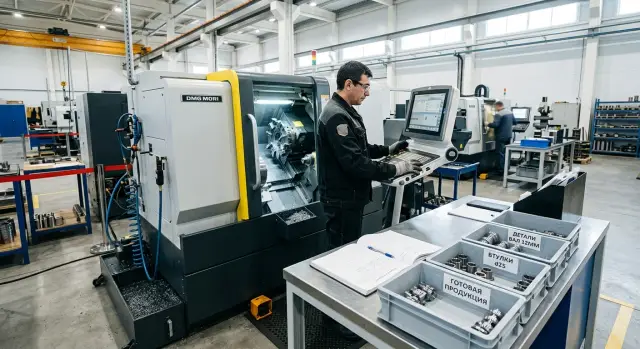
Why a tolerance alone isn’t enough
Dimensions on a drawing are only part of the job for medical equipment parts. A part can meet diameter and length requirements and still cause problems at assembly, washing or final inspection. The issue is often not millimeters but small details that in everyday work are treated as secondary.
The simplest example is chips in slots, holes and internal pockets. On the measuring table the part looks fine, but after turning or milling there can be small particles, traces of cutting fluid or dust from a previous stage. If that part goes forward, the problem is noticed too late, when the batch is already mixed, washed or packed.
The same happens with traceability. A fuzzy tag, handwritten note or a swapped tray breaks the whole chain. Later it’s hard to know which machine made the batch, which tool was used, and who checked the first part. For a regular order this is annoying. For medical parts it’s a direct risk.
A worn cutting tool can also hide behind a “correct” size. The diameter may still be in tolerance, but the surface changes: scratches appear, a burr forms on the edge, roughness varies. On paper everything is within limits, but in reality the part is worse than it should be.
The shop doesn’t need a thick folder just for reports. It needs order that people actually follow every day. Usually a few simple rules are enough: keep a batch separate, use one clear tag with batch number and status, check or change tools by an obvious limit, and make a short mark after cleaning and final inspection.
This kind of order doesn’t slow work. It removes disputes between the operator, inspector and supervisor. Even a modern machine doesn’t replace basic discipline on the floor. A good batch starts with a clean part, readable labeling and clear tool control.
How to separate part flows on the shop floor
When a shop begins making parts for medical equipment, confusion usually comes not from tolerances but from how batches move through the area. If the blank, the semi-finished part, the washed part and the ready-for-packaging part sit near each other, mistakes are almost inevitable. People take the wrong container, put parts in the wrong place and then spend hours sorting.
It’s simpler to separate the part’s path into distinct zones. Store raw material in one place, do machining in another, keep washing separate, and move packaging away from machines and chips. Even in a small shop this works if you don’t skimp on a few meters where batches later get lost.
A common table for all operations usually causes more problems than benefits. On it wipes, mandrels, tags, clean parts and parts waiting for washing quickly get mixed. Instead of a shared table, create simple hand-off points between operations. A part coming from the machine goes only into the washing area’s tray. After washing it moves only into the clean-zone container.
Containers for clean and dirty parts must be distinguishable at a glance. Color, a sticker or the box shape — any method works if everyone understands it. The operator shouldn’t have to read small text and guess. Once a part has been washed, it should not go back into the same container that previously held parts with coolant and chips.
Returns along the route cause the most trouble. A batch reaches washing, some parts are returned to the machine, then sent for washing again — these are the moments status is lost. It’s much calmer to move a batch down a single route without backwards steps. If a problem is found, move the batch to a separate analysis zone instead of returning it to the main flow.
A simple working rule: one stage — one zone, one status — one container, one hand-off — one point. That’s enough to eliminate most confusion without long instructions.
How to keep things clean without extra paperwork
Dirt for medical parts rarely looks like a big problem. More often it’s small metal chips, an oil mark on a container, dust on the bench or mixed-up gloves. Those small things create scrap, extra washing and disputes at inspection.
Order usually breaks down not because of people but because of vague rules. If cleaning is the responsibility of “everyone,” actually no one is responsible. Assign cleaning of the machine, work area and containers to a specific shift. Then each person has a clear moment: finish the run, clean the place and note only what went wrong.
Paperwork should be minimal. At each station a short memo of a few lines is enough: how to wipe the bench, where to place semi-finished parts, when to change gloves, after which operations a part must be washed. People will read a short memo. A ten-page binder at the machine usually stays closed.
The “within arm’s reach” rule works well. Clean wipes, gloves and empty containers should be nearby, not “somewhere in storage.” If an operator has to walk across the area to fetch them, they’ll do it once and then conserve motion. You’ll see the effect on cleanliness immediately.
After operations that create fine chips, wash the part immediately rather than saving it for the end of the shift. Fine chips stick to oil, clog pockets and threads, and then travel with the batch further along the route. For medical parts this habit quickly causes trouble.
Record incidents and deviations, not every wipe-down. For example: the station ran out of clean wipes, a part left without washing, chips found in a container after cleaning, or the operator used the wrong container for clean parts. That’s enough to spot weak points. If the same deviation repeats several times in a month, change the work order, not the form of the log.
How to make labeling clear
Labels must answer three questions: what the part is, which batch it belongs to, and what its status is. If the operator sees one code on the container, another on the blank, and a third in the paperwork, confusion appears in a minute. For medical parts this quickly becomes a sorting risk.
The best practice is the same batch number in three places: on the container, on the part or its tag, and in the paperwork. Don’t invent separate codes for warehouse, machine and QC. One number is easier to check, easier to find in the log, and almost impossible to interpret differently.
One format without free interpretation
A common mistake is each area writing its own way. One person writes the date as 03.04.25, another as 04/03, a third writes only the shift. A week later no one is sure what was meant. Choose one format and stick to it. For example: 2025-04-03 / Batch M-041 / Housing 12.
The same applies to abbreviations. If one employee writes “insp.,” another “chk.” and a third “OK,” people start guessing meanings. It’s better to write simple words in full. It takes a couple of extra seconds but saves hours resolving disputes.
Mark the part’s status without codes. Usually five words are enough: "New", "After machining", "Under inspection", "Ready", "Quarantine". This set is understood the same by the setup technician, inspector and storekeeper. No one needs to remember a color legend or a codebook.
One often-forgotten rule: remove old labels immediately. If an old batch number remains on the container, even a neat new sticker won’t save you. People lock onto familiar codes and take the wrong box. So when returning a container, changing a batch or moving a part to a new status, the old label must be removed right away.
Good labeling does not create extra bureaucracy. It simply makes the part’s path clear at a glance.
How to keep tools under control
For medical parts a tool failure quickly turns a usable batch into a disputed one. Dimensions may stay in tolerance, but the edge drags, the surface changes, and marks appear only at the end of the batch.
Each insert, holder and gauge needs its own place. Not “roughly on that shelf,” but a specific cell with a clear label. When an operator takes a tool and returns it to the same spot, the shop spends less time searching and rarely mixes fixtures between machines.
A simple log helps too. A paper sheet at the machine or a short entry in a spreadsheet works if you record the same things every time: date, machine, operation, tool usage and reason for replacement. That’s enough to see how long a tool lasts in real conditions, not just by a setup technician’s memory. After a few weeks a normal replacement limit appears.
But limits aren’t everything. Change tools not only by a parts count but also by visible wear: cutting force increases, surface cleanliness declines, burrs appear, or the dimension drifts toward the tolerance boundary. If the operator sees these signs, remove the tool immediately — don’t “finish ten more pieces.”
Before a new batch, recheck the setup even if the same machine ran a similar part yesterday. Different material, different overhang, different cutting mode — the previous setup may no longer deliver the same result. For medical parts these small differences become costly.
Disputed tools should not be returned to the common cabinet. Place them in a separate area marked “for inspection” or “for disposal.” Otherwise they’ll return to production and no one will know the source of instability.
In shops with many changeovers, this order shows improvement in the first month. Scrap drops not because of a complex system, but because people stop guessing which tool they are using and what condition it’s in.
How to launch a new batch step by step
When starting a batch of medical parts, collect the launch actions into a short, clear scenario. The less improvisation at the start, the smoother the whole run. Errors usually occur in the first 20 minutes, when someone grabbed the wrong container, loaded the usual fixture, or didn’t record which tool produced the clean surface.
It’s handy to keep one routine for every new batch.
- First, check the drawing, material and accompanying documents. At the same time verify that the blank container and the finished parts container are clean.
- Prepare dedicated tooling for this batch and place tags with the batch number, material and start date nearby.
- After setup, make the first parts and do not delay inspection. Immediately check size, surface, edges and clamp marks.
- If the first part passes, the supervisor or setup tech records the tool, corrections and cutting parameters. No long report is needed — a short card with the insert, holder, feed, speed and depth is enough.
- After the first acceptance, run the batch along a single route with no unnecessary transfers: the same trays, the same inspection station and the same labeling method.
This launch requires no thick folders. You need a clean container, a clear tag and one tool record that is easy to find later.
A small example: the shop starts a batch of stainless-steel housings. The first two parts are within tolerance, but a slight mark from a worn insert appears on the surface. If noticed immediately and the tool change recorded, the batch proceeds smoothly. If not noticed, an hour later you’ll have to sort the whole volume and recheck each part’s surface.
A good launch looks boring. For the shop that’s a plus: one route, one set of rules and minimal extra movement.
Example: a small batch of housings
Take a batch of 50 housings for a medical module. The quantity is small, but these runs clearly show where the shop loses order: parts left open, the tag lagging behind the tray, and tool control done “by eye.”
After turning, the operator places each housing into a closed tray immediately. Not on the bench next to the machine and not in a common container. This simple rule noticeably reduces the risk of dust, stray chips and mix-ups between neighboring batches.
The tag travels with the tray for the whole route: from the machine to intermediate inspection, then to washing and packing. It contains a short set of data: batch number, operation, quantity and current status. If the tag remains at the station, the batch has already fallen out of the process, even if the housings themselves were made correctly.
You don’t need a complex status scheme. Usually three marks are enough: "in production", "waiting for wash" and "ready". That’s enough for the operator, inspector and storekeeper to equally understand where the batch is and what can be done with it.
During acceptance the inspector checks not only size and batch number. They also examine the condition of the cutting edge used in the operation. The logic is simple: if the edge starts to drag or leave a mark, check the last few housings more carefully. That control takes minutes but often prevents re-washing, sorting and end-of-shift disputes.
Only trays marked “ready” go to packaging. If a part finished machining but still awaits washing or re-measurement, it doesn’t belong near packed batches. It’s better to keep a separate shelf for finished trays than to hunt down which housing ended up in the box too early.
Where the shop most often goes wrong
When machining medical parts the failure often starts not at measurement but in small everyday moments between the machine, washing and packaging. Sizes may still be within tolerance, but the batch loses cleanliness, traceability or repeatability.
The most common mistake is using the same container for blanks and finished parts. First it holds raw material with oil and chips, then a clean part after the final pass is placed in it. In this scheme it’s easy to confuse status and removing accidental contamination later is harder.
A similar story is labeling. If the number is written with a marker that washes off during cleaning, the shop creates its own problem. After a shift or rewash the tray loses its number and people start to remember by memory.
Tool errors are usually the quietest. The insert isn’t changed while dimensions still hold because “we can finish a few more.” At this point roughness, edge and stability begin to drift. On housings, bushings and small fits this doesn’t surface immediately but appears near the end of the batch.
Clean parts are often placed next to grease, rags and shop wipes. Formally the area is tidy, but nearby items keep contaminating the surface. After that “neatness” the part goes through another wipe-down, and extra handling only increases risk.
One more mistake looks sensible but brings little benefit: collecting many records that no one reads. People duplicate numbers in several places, spend time on logs, and then nobody checks tool life or reasons for deviations.
Simple rules usually work better: separate containers for raw material, semi-finished and finished parts, durable labeling, a clear tool life limit, a clean area without oil and rags near finished parts, and only the records that the supervisor or QC actually uses to make decisions.
What to check before releasing a batch
The most common failure before shipment is simple: dimensions are fine but the batch raises questions due to dirt, unclear labeling or a missing tool record. For medical parts these small things quickly become delays or returns.
First check traceability. The batch number must be readable immediately, without guessing or oral clarification. It must appear on the container and in the paperwork in the same form. If the storekeeper sees one number and the inspector another, the batch is already problematic even if the parts themselves are good.
Then look at part cleanliness. After the final operation the surface should show no chips, oil marks, dust, lint or stray marker marks. Scrap often happens not at the machine but at the packing bench, when a clean part is placed next to a dirty container or touched with gloves used on greased fixtures.
Separately check the record for the final tool. If a finishing insert, drill or grinding wheel took part in the operation, it should appear in the log. That note helps quickly understand how the surface was produced and whether the tool exceeded its life. When the log is empty, a dispute about the cause of a defect starts from zero.
Dimensions and roughness must match the drawing and the routing card. Don’t limit checks to primary diameters or length. On a small housing a dispute often arises over one fit, edge or surface that required a cleaner finish.
The last step is packaging. It must protect the part from fresh contamination and scratches after inspection. If you put a clean batch into a dusty box, all prior care becomes meaningless.
Where to start without a big rebuild
If the shop is only beginning to take medical part orders, you don’t need to change everything at once. Take one part that’s already in production and map its route on a single sheet: from blank to packaging. That simple route quickly shows weak points where parts sit without tags, where they are moved “temporarily,” and where batches mix.
Next introduce the simplest rules for containers and labeling. Two colors often suffice: one for parts in progress and another for finished or inspected parts. Keep the signature format simple: batch number, operation, date and operator initials. When everyone writes the same way, the supervisor spots an error in a second instead of searching the shop for half a day.
Walk the part route and note where confusion most often happens. Usually this is the bench after intermediate inspection, the waiting area between operations, and the place where the shift leaves containers at the end of the day. If different batches pile up at these points, start by putting order there. Very often this alone noticeably reduces scrap and mix-ups.
Also address when operators delay replacing inserts. That small detail later causes big variation in size and surface. A long regulation is unnecessary here. Provide clear wear signs, the supervisor’s authority to stop a batch, and a short note on tool replacement.
A small start usually looks like this: one pilot part, two container colors along the whole route, one labeling template per batch, a list of points where batches get mixed most often, and one rule for replacing inserts that avoids arguments between shifts.
If a shop plans to take such orders regularly, it’s worth looking not only at shop-floor order but at the equipment itself. For example, EAST CNC in Kazakhstan supplies, commissions and services CNC machines for metalworking, and the company blog has practical materials on shop operation. But even with good equipment, start small: one part, one batch, one week of observation. After that you’ll see what truly obstructs the process and what can be left alone.
FAQ
How do medical equipment parts differ from ordinary parts?
Because it’s not just about dimensions. A part must stay clean, have readable labeling and a predictable surface. If chips remain in pockets, the tag is unreadable or the cutting tool already pulls a burr, assembly and final inspection will fail quickly.
Why can a part be rejected if dimensions are within tolerance?
It happens often. Diameter and length can pass inspection, but the surface may already be degraded, a burr may form on an edge, or fine chips may remain in holes. At inspection such a part looks questionable even if it formally meets the drawing.
How to separate clean parts from dirty ones in a small shop?
Divide the flow into simple zones: raw material, machining, washing and packing. Even in a small shop this works, as long as you don’t stack everything on one shared table. Assign a distinct container for each status so the operator sees the difference immediately.
What must be written on the batch tag?
Usually three things are enough: what the part is, the batch number and the current status. Use the same batch number on the container, on the part’s tag and in the paperwork. Write statuses in plain words, without codes or uncommon abbreviations.
When should I change a cutting tool if dimensions still hold?
Don’t wait for dimensional drift alone. Change the tool as soon as the operator sees a burr, surface marks, increased cutting force, or rising roughness. If a tool is questionable, do not return it to the common cabinet.
Do we need many logs and reports?
No. Extra paperwork only gets in the way. A short record at the machine is enough: date, operation, machine, tool usage and reason for replacement. Record failures and deviations, not every wipe-down.
What to check on the first part of a new batch?
Check more than just size. Inspect the surface, edges, clamp marks, cleanliness and which tool produced the result. If the first part raises doubts, stop the batch immediately rather than after dozens of pieces.
Where do shops make mistakes most often?
Most often the shop creates avoidable problems itself: using the same container for raw and finished parts, leaving an old label on a box, using a marker that washes off, or placing clean parts next to rags. Those quickly cause mix-ups and contamination.
What to check before handing over a batch?
Check traceability, cleanliness, the record for the last tool used, dimensions, roughness and the packaging. The batch number must be readable without guessing, and the packaging must protect the part instead of dirtying it again.
How to start without a major overhaul of the shop?
Start with a single part and map its route on one sheet: from blank to packaging. Then introduce a simple tag template, two container colors for status, and a rule for replacing a cutting tool. Within a week you’ll see where batches get mixed and where order breaks down.