
Measuring Long Shafts Between Centers Without Discrepancies
Measuring long shafts between centers often gives different results from shift to shift. Here is a simple standard for supports, temperature, and recording measurements.
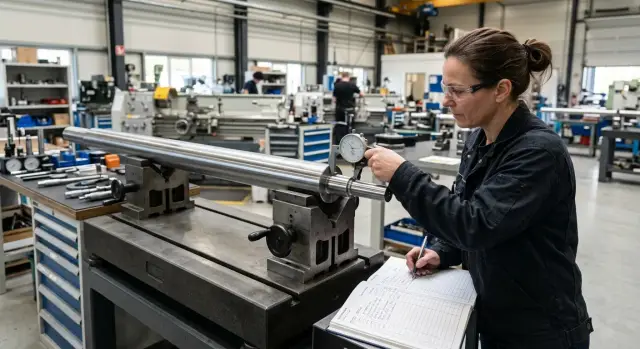
Why different shifts get different numbers
When measuring long shafts between centers, the spread often comes not from the instrument, but from different habits on the shop floor. A long shaft bends easily under its own weight, so even a small detail changes the result. If one shift uses two supports and another works with one support or none at all, the part is already sitting differently.
The difference shows up in several places at once:
- the shaft is supported differently
- the part is measured at a different temperature
- operators choose different contact points
- the log does not show the conditions under which the measurement was taken
Temperature creates a very noticeable shift. One operator takes the shaft almost right after machining, while the metal is still warm. Another measures the same part later, after it has cooled. On a long part, that is enough to get a different reading and then argue about who was wrong.
Different measurement points cause just as much confusion. One person places the tip at the start of the journal, another a little farther along, after the chamfer or radius. Formally both are “measuring the length,” but in practice they are not measuring the same thing. If the tolerance is tight, even that small difference quickly turns into a mismatch between shifts.
The problem gets worse when the log is empty. If the record does not include the time, the part temperature, the support layout, and the measurement points, the next shift only sees a number. Nobody knows where it came from anymore. Then the discussion is not about the part, but about guesses.
A typical metalworking situation looks like this: the day shift measured the shaft right after the turning operation and recorded one value. The night shift took the same shaft later, set it on two supports, and got a different one. Both measurements could have been honest. The conditions were just different.
When the shop does not agree on one set of rules, the numbers start depending on the person instead of the part itself.
What to include in one standard
If every shift follows its own routine, the same shaft can easily produce two different results. Usually the problem is not the instrument, but the small details: the shaft sits differently, the time after machining varies, no one checks the measurement points, and everyone records things their own way.
For measuring long shafts between centers, the standard should be short and very specific. One sheet for the shop works better than a long instruction that nobody opens.
This standard should define four things.
- The support layout for each length range. People need to see where to place the supports, how many are needed, and how to position the shaft between centers. Without this, one operator will place a support closer to the chuck, another will move it farther away, and the shaft will bend differently.
- The waiting time after machining. If one shift measures the part right away and another measures it half an hour later, long shaft inspection will no longer be consistent. The document should clearly state how long the part must sit before measurement and where that should happen.
- The measurement points and sequence. You need more than general wording, but a clear scheme: which end to start from, which sections to measure, and in what order to repeat the measurements. Then people will not skip a section or compare different spots on the same shaft.
- One unified recording form. It usually only needs the date, part number, shift, temperature during measurement, support layout, measurement points, and final value. If the form is the same for everyone, later arguments become much harder.
A good standard removes unnecessary decisions from the job. The operator does not have to think about how to place the shaft or what to write down. They just follow one routine.
If you want to check whether the document works, give it to two shifts and have them measure the same shaft. If both shifts use the same shaft supports, wait the same amount of time, and record the result in the same form, the spread usually drops quickly.
How to choose supports and set the shaft
When measuring a long shaft, the error often starts not with the instrument, but with how the shaft sits between centers. If one shift places the supports closer to the chuck and another shifts them toward the middle, the shaft bends differently. On the indicator, it looks like “different parts,” even though it is the same part.
The supports should be placed symmetrically, at equal distances from both centers. That gives the shaft the same support arrangement every shift. If the part is long and thin, even moving a support by 30-50 mm can change the result.
The lower support must not push the shaft upward. It should support it, not change its position. If a roller or prism lifts the shaft even slightly too much, the part axis shifts, and long shaft inspection turns into an argument between people instead of a repeatable measurement.
Before setup, always clean the center holes, the centers themselves, and all contact surfaces. A small chip, an oil film mixed with dirt, or a nick on the center is enough to seat the shaft differently. On a long part, that tiny issue can easily create a noticeable spread.
A good rule is simple: clean first, seat second, then check free rotation by hand. If the shaft turns with a jerk or binds, look for the problem right away, not after recording the result.
It helps to lock in one short setup standard:
- place the supports at the same distance from the centers
- do not push the shaft up from below, only support it
- clean the centers, center holes, and rollers before every measurement
- check that the shaft rotates smoothly without sticking
- record the position of the steady rest or roller supports
Many people skip the last point for no good reason. If the steady rest was 180 mm from the left center, that needs to be written in the inspection sheet or route card. Otherwise the next shift will place it “about there,” and that is already a different condition.
In a metalworking shop, this kind of standard works better than any verbal agreement. The same shaft, the same support layout, the same note about the steady rest, and the numbers between shifts usually line up much faster.
How to keep the temperature the same
Even good long shaft inspection gives different results if the part, supports, and tool have heated up differently. For a long shaft, that is a common reason for disputes between shifts. In the morning one number is recorded, after lunch another, while the part itself has not changed.
You need one clear routine. Do not measure the shaft right after transport, grinding, or long storage by the shop door. Set a waiting time for everyone, for example 30 minutes or 1 hour in the same area of the shop. What matters is not the exact number itself, but one rule for everyone.
Keep the shaft, indicator, micrometer, and supports in the same area. If the tool is stored in a cabinet by a cold wall and the shaft lies near a running machine, the difference will appear before the first contact. When measuring long shafts between centers, that quickly creates inconsistency, especially on thin and long parts.
There are four simple rules:
- keep the part and the tool in the same area of the shop
- give the part the same waiting time before measurement
- do not touch the measurement area with your hand
- record the air temperature and the part temperature
Hands can easily ruin a stable measurement. Holding a shaft journal with your palm for half a minute is enough to warm the metal at that spot. Then the operator sets the instrument and sees extra microns. It is better to hold the shaft by areas that are not part of the measurement and wear gloves if that does not affect accuracy.
Record the temperature in the same way every time as well. Do not just write “shop” or “normal.” A much more useful note is short and specific: air 22 C, shaft 22 C, waiting time 40 minutes. If the number is disputed, that line immediately explains why one shift got one value and another got a different one.
If the temperature in the shop changes during the day, do not guess. Stop the measurement, let the part and tool equalize, and only then continue. It is a boring discipline, but it removes most of the inconsistency without new equipment or long debates.
Step-by-step measurement sequence
If one operator sets the shaft right after the process and another waits half an hour, the numbers will almost certainly differ. That is why measuring long shafts between centers is best done with one short, fixed sequence, without “creativity” on the floor.
The simplest routine below is easy to build into a shift standard.
-
First prepare the part and the measurement area. Wipe the center holes, journals, and the areas where the shaft will sit on the supports. Remove chips, thick oil, and small burrs. Even a thin film of dirt can add extra hundredths.
-
Then set the shaft using one approved layout. Use the same centers and the same support points listed in the inspection sheet. If the shaft is placed differently each time, long shaft inspection quickly turns into a dispute between shifts.
-
Next, let the part and the tool sit for the required time. If the shaft has just come off the machine or was brought from a cold warehouse, do not start immediately. The temperature during measurement must be the same for the part, the supports, and the instrument, otherwise the size will drift without any real reason.
-
Take the measurement only at the specified points and always in the same order. The easiest option is to move from left to right without skipping any points. If the standard requires a repeat measurement, do it right away at the same point, rather than returning to it ten minutes later.
-
As soon as you get the number, enter it into the form right away. Do not keep the result in memory and do not write it on random scrap paper. The record should include the size, time, part or batch number, temperature, and who measured it.
In practice, that is already enough to remove most of the inconsistency. For example, if both shifts wait the same 20 minutes after placing the shaft on supports, measure using the same layout, and immediately enter the measurement results, the difference usually drops sharply.
If the number still differs from the previous measurement, do not argue about scrap right away. First check three things: whether the same supports were used, whether the shaft had time to equalize in temperature, and whether the operator recorded the result without rounding “for convenience.”
How to record the result without arguments
Disputes start not because of the number itself, but because of empty spaces in the record. One operator measured in the morning, another in the evening, but the log only shows the size. A day later nobody remembers what supports the shaft sat on, which instrument was used, or whether the part was still warm after machining.
For a long shaft, the record should answer a simple question: can another person repeat the same measurement and get a similar number? If the answer is “no,” the record is weak, even if the number looks neat.
One short form for each measurement works well. It does not need many fields, but each field should remove one possible reason for a dispute. Usually five blocks are enough:
- part or order number
- shift, operator name, and measurement time
- part and shop temperature
- support layout and inspection points
- instrument, its number, and space for a repeat check
It is better to always record the shift and operator, even if the shop is small and everyone knows each other. A week later, memory fails. Measurement time is also not just a formality. If the first shift measured the shaft right after machining and the second shift did it two hours later, the difference may be due not to part quality, but to temperature.
The support layout should be marked not with words like “as usual,” but with a simple sketch or code based on the approved template. The same goes for the inspection points: if one person measures closer to the shoulder and another shifts by 20 mm, the comparison loses meaning. When measuring long shafts between centers, such small differences quickly create inconsistency.
The instrument should also be recorded in full. Not “indicator,” but the specific instrument with its number. If it later turns out that one indicator went for repair, you will still have a clear trace instead of a verbal argument.
Leave a line in the form for a repeat measurement. For example: “first result,” “repeat result,” “checked by.” This keeps the shift disciplined and makes long shaft inspection easier. If two numbers differ, the supervisor can immediately see where to look for the cause.
In practice, the record might look like this: shaft 04-178, shift 2, operator Ibrayev, 16:40, part 22 C, shop 21 C, supports per scheme B2, inspection at points T1 and T2, instrument ICh-10 No. 17, repeat check after 15 minutes. With a line like that, it is already hard to argue. You can recheck the measurement instead of debating who “remembered better.”
Example with a shaft from two shifts
On a shop floor after a CNC turning machine, a long shaft 1200 mm long was being checked. The first shift took it almost right after machining and placed it between centers without a common support layout. The indicator showed a size 0.04 mm above nominal. The operator recorded the result and decided the machine had drifted.
A few hours later, the second shift took the same shaft. Instead of arguing with the machine, they measured it their own way: they used two supports, straightened the shaft, and rechecked the same area. The number was different again. On paper, it looked like inconsistency between shifts, even though it was the same part.
Then the supervisor stopped the argument and removed the chance factor. The shaft was left to equalize under a common waiting time so the metal and the shop could reach a similar temperature. After that, both shifts repeated the measurement using one layout:
- the same measuring tool
- the same support points
- the same setup sequence between centers
- the same recording of the result with measurement time
The numbers almost matched. The difference fell within normal measurement error instead of tens of microns. It turned out the first shift had measured a warm part straight after the machine, while the second shift had changed the support scheme. Both causes shifted the result.
This kind of case shows why measuring long shafts between centers requires more than a good instrument. You need a repeatable routine. If one operator sets the shaft without supports and another supports it in two places, they are not comparing the same measurement. If one measures a hot part and another a cooled one, the numbers will not match either.
After that, the shop adopted a simple standard. First the waiting time after machining. Then one support layout. Then recording not only the number, but also the measurement conditions. The disputes dropped already in the first week. When people repeat the same routine, long shaft inspection stops depending on the shift and starts depending on the part itself.
Where mistakes happen most often
Most disputes do not come from the shaft itself, but from small differences in shift habits. When measuring long shafts between centers, even a slight shift in the contact point or support position quickly creates a difference that is later treated as scrap.
A common mistake is simple: the operator remembers where they measured yesterday and places the indicator or micrometer “about the same place.” That sometimes works for a short part. Not for a long shaft. If the morning shift measured closer to the journal and the evening shift a couple of millimeters off, the numbers can no longer be compared honestly.
The same goes for supports. People move them so the shaft runs more smoothly, but nobody records the new position. A few hours later, another operator gets a different bending pattern and thinks the part has warped. In reality, the measurement setup changed, not the shaft.
Confusion grows quickly when the shop uses different instruments and does not cross-check them. One station works with one indicator, another uses the neighboring one, and a third checks with an old micrometer. If the instruments were not verified before the shift, long shaft inspection turns into an argument about whose tool is “more correct” instead of the part condition.
Another problem appears after correction. The shaft is measured again, a new number is recorded, but the correction itself and the time of the repeat measurement are not noted. Then the log contains two results, and nobody understands whether this is method spread or a different part after intervention.
The biggest issue comes from a dual record system. The official log is kept for reporting, while the real numbers are written in a notebook, on a sticky note, or in a phone note. Then one number goes into the log and another stays “for reference,” and the dispute can no longer be resolved. If there is more than one record, there is no common basis for comparison.
Usually the inconsistency starts with small things like these:
- the shift does not record the exact measurement location;
- the operator moves the supports and does not mark it;
- the shop compares readings from different instruments without a quick check;
- a repeat measurement after correction is entered into the same records without a note.
A good sign of trouble is this: one shift is sure the shaft is within tolerance, while another sees a deviation, but nobody can show the same measurement conditions within two minutes. If the conditions cannot be repeated from the record, the error is almost always in the process, not in the part.
Quick checklist before measurement
Five short checks before measurement often prevent more disputes than an expensive instrument. If the shift spends two minutes on them, it will not later spend time looking for the cause of a 0.02-0.05 mm difference or arguing about who measured “correctly.”
Before starting work, it is useful to keep one sheet near the inspection point. It is not there for formalities, but so every operator sees the same thing and does not have to guess the sequence from memory.
- The shaft should sit until it reaches the temperature range used at the shop. If the part is still warm after machining or transport, the numbers will drift.
- The center holes and support surfaces must be cleaned. The supports should be placed strictly according to the approved layout, not “roughly like yesterday.”
- The instrument should be checked on a standard or master before the shift starts. There should be a clear mark that the check has already been done.
- Measurement points should be defined on a scheme, in a card, or directly on the part sketch. The operator should not have to ask the previous shift where exactly to measure.
- The recording form or electronic template should be nearby. It is better to see the fields for date, shift, part temperature, instrument number, and result right away.
Usually, the biggest problems come not from the measurements themselves, but from the details around them. One operator takes the shaft 15 minutes after machining, another after an hour. One places the supports closer to the center, another shifts them slightly. In the end, both are sure they are right.
A good checklist makes the measurement repeatable. If all five items are checked before work starts, the difference between shifts drops sharply. If even one item is missed, the result should already be treated as questionable and the part should be rechecked right away, not at the end of the batch.
It is useful to leave a short note field on paper or in the form. Sometimes a single phrase like “part arrived warm” or “left support was moved to layout 2” is enough to quickly understand the cause of the deviation later.
What to do next on the shop floor
Do not stretch this over a month. One simple standard can be introduced in a single day if you do not argue about the small things and test it on a real part. To start, you only need one recording template, one shaft, and two shifts.
The recording template should be the same for everyone. It usually only needs a few fields: part number, date and time, part and shop temperature, which supports were used, who measured it, and what number was obtained. If one shift writes “warm” and “normal” while another enters exact values, the disputes will come back.
This approach works well:
- approve one paper form or one electronic form for all shifts
- choose one real long shaft and review the process right at the measurement station
- give both shifts the same setup and measurement routine
- after a week, collect the records and compare the spread for one group of parts
- fix only the points where the deviation repeats
It is better to do the review not in an office, but at the machine or inspection station. Take one shaft, place it on the same supports the shop uses, and ask two operators to perform the measurement using one layout. That way you will immediately see where the actions differ: someone sets the shaft between centers differently, someone measures right after moving it from a cold zone, someone does not record the temperature at all.
After a week, do not look for someone to blame. Look at the numbers. If the shifts differ on the same shaft, the cause is usually in three places: supports, temperature, or how the result is recorded. Fix one item at a time and check again. That is the fastest way to understand what is really causing the inconsistency.
If your shop is just starting to process long shafts or wants to reduce variation already at the equipment selection stage, you can discuss the task with EAST CNC specialists. The company works with CNC lathes for metalworking and can help you choose a machine and configuration for long shafts so the inspection process is more stable from the very start of the shop.